
Having a criminal record expunged in Georgia is what is officially called "record restriction." It's a process that seals past charges or convictions from public view, providing a powerful tool for a fresh start. It can mean a second chance at opportunities that might have felt out of reach.
Understanding What Record Restriction Really Accomplishes

Many people think expungement means the record is totally erased, like it never happened. That's a common misconception. In Georgia, record restriction doesn't destroy the history, but it does lock it away from the public.
What does that mean in practical terms? It means when a potential employer, landlord, or school runs a typical background check, that restricted record won't show up. It effectively takes down a massive barrier that could be holding someone back.
The True Impact on Your Future
The benefits of getting a record restricted are real, and they can change a life almost immediately. Once it’s done, a person can confidently chase opportunities that a public criminal history might have blocked.
The main advantages are:
- Better Employment Prospects: Many employers automatically disqualify candidates with certain records. Restriction opens up a whole new world of better-paying jobs.
- Improved Housing Options: Landlords almost always run background checks. A restricted record dramatically improves the chances of getting approved for a lease.
- Educational Opportunities: Getting into a college or vocational program becomes much less of a headache without a visible criminal history to explain.
This whole process is built on the idea that past mistakes shouldn't follow a person forever. There's a growing movement for "Clean Slate" policies that aim to clear records automatically because the research is clear: it works. It creates real pathways to better jobs, stable housing, and stronger families for the nearly one-third of Americans with a criminal record.
A restricted record provides a chance to present yourself based on who you are today, not who you were in the past. It allows a person to answer "no" on most applications asking about prior convictions for that specific charge.
Ultimately, getting a criminal record restricted is about taking back control of one's own story. It’s the system's way of saying that a past event shouldn't define an entire future.
Determining Your Eligibility in Georgia
Before filling out a single form, the very first step is to figure out if you actually qualify to have a criminal record expunged in Georgia. The state’s rules, which are officially called record restriction, are very specific about who is eligible based on how a case ended and what the charge was for.
Getting a handle on these rules from the start helps set realistic expectations. The most straightforward path is for charges that never resulted in a conviction.
For example, the chances are good if a case was resolved in one of these ways:
- Dismissal: The prosecutor looked at the case and decided to drop the charges.
- Nolle Prossed: This is a more formal way of saying the prosecutor is no longer pursuing the case.
- Not Guilty Verdict: The case went all the way to trial and ended with a not guilty verdict by a judge or jury.
When a person wasn't found guilty of the offense, the road to getting the record restricted is usually much clearer.
Georgia's Second Chance Law
But what if there was a conviction? For a long time, most convictions in Georgia were permanent, public stains on a person’s record. That all changed with the state’s “Second Chance” law (SB 288), which finally created a way for certain misdemeanor and felony convictions to be restricted.
Under this law, a person can now petition to restrict and seal up to two misdemeanor convictions once four years have passed without any new convictions. For a minor shoplifting charge from six years ago—if the person has had no new charges since then, they are likely eligible to get that record restricted.
The big takeaway here is that Georgia law now officially recognizes that good people can move past their mistakes. The Second Chance law gives individuals a structured opportunity to go before the court and show they've been rehabilitated.
For felonies, the process is a bit tougher and usually requires getting a pardon first. It’s crucial to understand the details of the specific case, as not every offense is eligible. To dig deeper into the complexities of felony charges, you can find more information in our article on being charged with a felony.
To get a better sense of where you might stand, here’s a quick breakdown of common scenarios.
Georgia Record Restriction Eligibility at a Glance
This table compares a few common situations to help you get a preliminary idea of whether a record might be eligible for restriction here in Georgia.
| Scenario / Charge Type | Generally Eligible for Restriction? | Key Considerations |
|---|---|---|
| Case Dismissed / Nolle Prossed | Yes | This is the most common and direct path to restriction. |
| Not Guilty Verdict (Acquittal) | Yes | If you were found not guilty at trial, you are typically eligible. |
| First Offender / Conditional Discharge | Yes | Upon successful completion of your sentence, restriction is automatic for most. |
| Misdemeanor Conviction | Yes (with limitations) | Up to two misdemeanors after 4 conviction-free years under the "Second Chance" law. |
| Felony Conviction | No (generally) | Most felony convictions require a pardon from the State Board of Pardons and Paroles before you can apply for restriction. |
Remember, this is just a general guide. Every case has its own unique details, so it's important to look into information tailored to your specific situation.
Broader Trends in Record Clearing
Georgia's shift toward offering people a second chance is part of a larger, nationwide movement. Many states are passing laws to make it easier for people to clear their records, sometimes even automatically.
For instance, Minnesota's Clean Slate Act, which kicks in on January 1, 2025, will automatically clear certain criminal records after a waiting period of two to five years. Virginia has also updated its laws to automatically seal some misdemeanor convictions and dismissed charges after seven years.
These reforms are all about reducing the barriers that a criminal record creates, giving people a fair shot at finding a job, securing housing, and fully rejoining their communities. You can read more about these efforts across the country in this overview of Clean Slate laws.
Navigating the Georgia Record Restriction Process
Knowing you’re eligible for what most people call expungement is a huge relief, but the real work starts with the process itself. Georgia’s system for record restriction isn't a single action but a series of steps involving multiple agencies. It can feel a little bureaucratic, but it's a path that can be navigated with the right information.
The very first thing needed is an official criminal history. A complete, certified copy must be obtained from a local police department, sheriff's office, or the Georgia Crime Information Center (GCIC). This document is the roadmap—it contains all the critical details like arrest dates, specific charge descriptions, and the final dispositions needed for the paperwork.
With the criminal history in hand, the next job is to map out every agency that touched the original case. This almost always includes:
- The arresting agency (e.g., city police, county sheriff)
- The prosecutor's office (Solicitor-General for misdemeanors, District Attorney for felonies)
- The clerk of the court where the case was resolved
This chart gives you a simplified look at how the request moves through the system once you've submitted the forms.
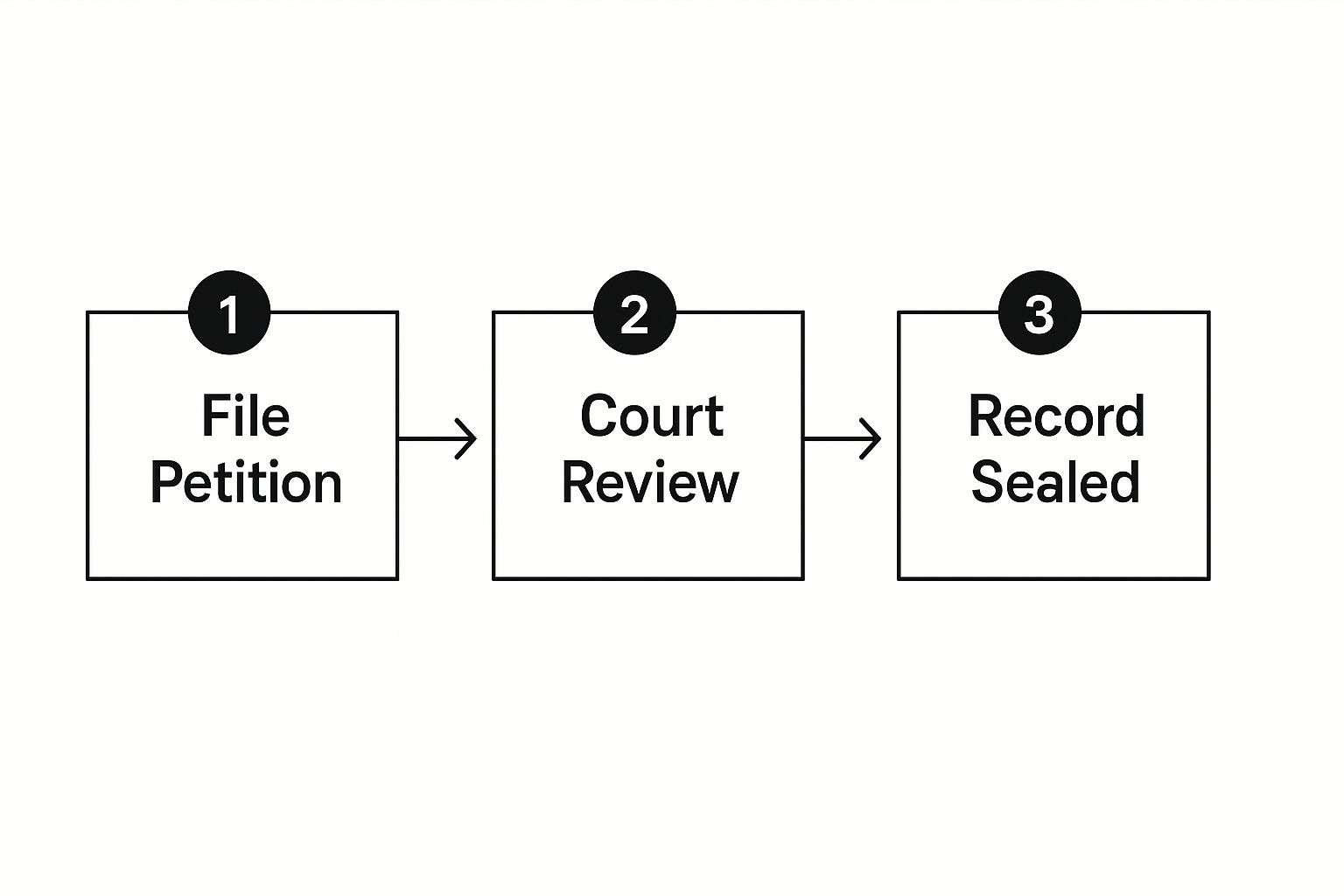
As you can see, once the paperwork is filed, it goes through a formal review by a few different offices before the record is finally sealed from public view.
Filling Out the Necessary Forms
The "Request to Restrict Arrest Record" form is the centerpiece of this whole process. Accuracy here is everything. Each section has to be filled out with the exact information from the official criminal history.
A separate form needs to be completed for each arrest date that needs to be restricted. So, if a single arrest involved several charges, they all go on one form for that specific date.
Be ready to provide some key information:
- Personal details: full name, date of birth, and Social Security number.
- The arrest specifics: the date, the name of the arresting agency, and every single charge.
- The final outcome for each charge: whether it was dismissed, nolle prossed, or a not guilty finding.
It's critical to double-check every single detail. A simple typo on a date or case number can cause major delays or even get the request rejected, forcing a person to start all over again.
The Roles of Each Agency
Once the form is filled out, it starts its journey. Each agency has a specific job to do, and knowing who does what helps in understanding where the request is in the pipeline.
First, the form is submitted to the arresting law enforcement agency. They pull their own records, fill out their section of the form to confirm the arrest details, and then pass it along to the prosecutor.
From there, the prosecutor’s office takes over. Their role is to review the case file and confirm how the charges were resolved. Critically, they have to agree that the case qualifies for restriction under Georgia law. If they approve it, they sign off and send it to the clerk of court.
The prosecutor's approval is a critical checkpoint. If they object, the process can become much more complicated, often requiring a court hearing to resolve the disagreement.
Finally, the clerk of court gets the approved form. They will file it with the court, and a judge will then sign an order that officially grants the restriction. The clerk sends this court order to the GCIC, which updates the state’s central criminal history database. Once GCIC processes that order, the record is officially restricted.
You can learn more about the specifics of these procedures by exploring information on Georgia record restrictions.
Understanding the Costs and Timelines

When people decide they want to get their criminal record expunged, two questions always come up first: how much will it cost, and how long will it take? Getting a handle on both the financial and time commitments from the start is crucial. It helps in setting realistic expectations and prevents any unwelcome surprises down the road.
The total cost for record restriction isn't a single flat fee; it's a collection of smaller costs that add up. These can vary quite a bit based on the specific case and the county where the arrest happened.
You should be ready for a few different expenses:
- Application Fees: Most law enforcement agencies and court clerks charge a fee just to process a restriction request. These are usually pretty modest, but they can add up if multiple arrests are being restricted.
- Record Retrieval Costs: An official copy of the criminal history is needed, and the agency that provides it will typically charge a small fee.
- Court Filing Costs: When the petition and the final order are filed with the clerk of court, there will be a filing fee. This is often the biggest single cost, ranging from $50 to over $200, depending on the county.
It’s good to know that Georgia law allows for fee waivers in some situations. If a person can show they’re facing a genuine financial hardship, some of these costs might be reduced or eliminated.
Breaking Down the Timeline
When it comes to the record restriction process, patience is absolutely essential. While there may be an eagerness to get this done, the legal system moves at its own deliberate pace. Knowing what to expect at each stage can make the wait a lot less frustrating.
The timeline is really a sequence of reviews and processing steps that kicks off the moment a completed application is submitted to the arresting agency.
From the day of filing to the moment the record is officially updated, the entire process can take anywhere from 90 days to over six months. Delays are common, especially if there are errors in the paperwork or if a prosecutor objects to the restriction.
From the arresting agency, the request moves through several checkpoints, and each one has its own timeframe.
What to Expect at Each Stage
To get a clearer picture of the process, it helps to see a breakdown of the costs and timelines involved.
Estimated Costs and Timelines for Georgia Record Restriction
This table provides a quick summary of what you can generally expect in terms of expenses and waiting periods as the request moves through the system.
| Process Stage | Estimated Cost Range | Estimated Timeframe |
|---|---|---|
| Prosecutor Review | N/A (Included in other fees) | 30 to 90 days |
| Court Filing & Processing | $50 – $200+ | 30 to 60 days |
| GCIC Record Update | N/A (Included in other fees) | 30+ days |
| Total Estimated Timeline | N/A | 90 days to 6+ months |
Here's how those stages play out in practice:
-
Prosecutor Review: Once the arresting agency sends the paperwork over, the prosecutor's office has to review the case. They'll decide whether to approve or deny the request, and this part of the process usually takes 30 to 90 days.
-
Court Processing: After the prosecutor gives the green light, the petition gets filed with the court. A judge then has to review and sign the final restriction order, which can take another 30 to 60 days.
-
GCIC Update: Once the judge signs the order, the clerk sends it to the Georgia Crime Information Center (GCIC). The GCIC is responsible for the official state database, and it can take them another 30 days or more to get the record updated in their system.
A criminal record is only officially restricted from public view after the GCIC completes its update. Until then, it can still show up on background checks.
Life After Your Record Is Restricted
Getting a record restricted is a huge victory, but it's not quite the finish line. It's really important to understand what happens next to make sure the full benefit of the fresh start is realized. While a lot of people hope for a completely erased record, the reality in Georgia is a bit different.
When a criminal record is expunged through restriction, it’s sealed from public view. This means most private employers, landlords, and schools won't see it pop up during a standard background check. For many people, this single change can open doors that were slammed shut before.
But the record isn't totally gone. It stays accessible to law enforcement and certain government agencies for specific reasons. For example, if a person applies for a job in criminal justice or a role that needs a high-level security clearance, they'll almost certainly still see the restricted charge.
Verifying Your Restricted Record
After the judge signs the order, don't just assume the change is instant. The last piece of the puzzle is the Georgia Crime Information Center (GCIC) updating its official database. This update is what truly seals your record from the public.
It’s a smart move to confirm this actually happened. A few months after receiving the final court order, a person can run a new background check on themselves. Getting that clean report provides the peace of mind to move forward confidently.
Once the GCIC update is complete, a person can generally and truthfully answer "no" on most job or housing applications that ask if they've been convicted of that specific crime.
Taking this extra step helps ensure there is no accidental sharing of something that no longer has to be disclosed and makes sure the system did what it was supposed to do.
The Impact on Your Future and Community
The benefits of record restriction go way beyond just getting a job or a place to live. Research has shown that when people get a clean slate, they are far less likely to reoffend. This doesn't just improve their own lives—it makes our communities safer.
A 2020 study found that people with expunged misdemeanors had a very low recidivism rate. Only 6.4% were arrested and just 3.8% were convicted of a new crime within five years. The numbers were still low even for those with expunged felonies—8.1% arrested and 4.6% convicted. You can read more about these findings on the power of a second chance from the Cato Institute.
So what does this mean for someone, practically? It means being able to apply for professional licenses, seek better financial loans, and volunteer in the community without a past mistake holding them back. It’s about getting the chance to rebuild life on your own terms.
Common Questions About Record Restriction

When trying to get a criminal record expunged, a lot of questions come up. That is totally normal. Even with a clear guide, the small details can be confusing, so this section covers some of the most common questions.
One of the biggest points of confusion is what "restriction" actually accomplishes. Many people assume it means the record is physically destroyed.
Does Record Restriction Erase My Criminal Record?
No, restriction doesn't destroy the record itself. Think of it more like putting a digital lock on it, sealing it from the public. This means when a private employer, a potential landlord, or just a curious member of the public runs a typical background check, they won't see it.
However, law enforcement and certain government agencies can still get access to these records for specific reasons, like for an application to a criminal justice job or if they're conducting a new investigation.
Can a DUI Conviction Be Restricted in Georgia?
This question comes up a lot, and the answer is almost always no. Georgia law is very specific about this—most DUI convictions are not eligible for record restriction. The state keeps these records accessible for public safety and to track driving histories.
The inability to restrict a DUI really highlights how Georgia law treats serious traffic offenses. They're in a different category than other charges, even some misdemeanors that are eligible under the Second Chance law.
How Many Records Can Be Restricted?
Georgia’s Second Chance law is a big deal for people looking to move on from past mistakes. It allows for the restriction and sealing of up to two misdemeanor convictions, but there's a condition: the person must remain conviction-free for at least four years first.
Certain felonies can sometimes be restricted, too, but that's a much tougher road. It usually requires getting a pardon first and meeting other very strict criteria. And of course, not all offenses qualify under the law.
Finally, a major concern is what to say on an application after a record has been restricted.
Do I Disclose a Restricted Record on Job Applications?
This is the goal for many people. Once a record is officially restricted, a person can generally—and legally—say that they have not been convicted of that crime on most job applications.
The main exception is when applying for sensitive positions. Think law enforcement jobs or any role that requires a high-level security clearance. Those background checks are far more thorough, and disclosure is often required.
Understanding the nuances of record restriction can make a huge difference in one's future. For those navigating this complex process, experienced guidance can be helpful. You can learn more at https://challengemycharge.com.
