
When you hear "criminal trespass," you might picture someone breaking into a building or hopping a fence. But Georgia law recognizes different levels of severity, and the least serious among them is 3rd-degree criminal trespass.
While it's a formal charge, it's a world away from offenses involving structures or fenced-off land. Understanding this distinction is the first step in grasping how property rights are categorized under the law.
What Criminal Trespassing 3rd Degree Means
Think of trespass laws like a ladder. Each rung represents a more serious violation. At the very bottom rung, you'll find criminal trespassing in the 3rd degree. It's the foundational charge, and getting a handle on it makes the rest of the law much clearer.
Let’s put it in simple terms. Imagine your neighbor's front yard is open, without a fence. If someone cuts across it once on their way to the store, it's probably just an honest mistake.
But what if the neighbor comes out and says, "Please don't use my lawn as a shortcut"? If that person turns around and does it again the next day, their action has crossed a line. They were given a clear warning and chose to ignore it. That’s the very heart of third-degree trespass: knowingly being somewhere you’re not supposed to be after you’ve been told to leave.
The Core Concept of Unauthorized Presence
The key element in a third-degree charge is simple: remaining on property without permission after receiving notice. This charge almost always applies to areas that aren't secured or enclosed, such as:
- An open field or a patch of private woods.
- The parking lot of a retail store long after it has closed for the night.
- An unfenced front yard or a private driveway.
The law draws a bright line between accidentally wandering onto a property and deliberately staying after knowing one shouldn't. An experienced attorney knows how to navigate these nuances, and you can learn more about their approach from our blog spotlight on Brian A. Hansford.
How It’s Classified Across States
While the core idea is similar everywhere, the exact classification can vary. In many states, third-degree criminal trespass is considered a violation or a low-level misdemeanor.
For example, our neighboring state of Kentucky classifies it as a simple violation. However, if the trespass happens during a declared state of emergency, the charge gets bumped up to a Class B misdemeanor. This shows how context and circumstances can dramatically change the severity of a trespass charge.
Please note: This information is for educational purposes only. It is not a substitute for professional legal consultation tailored to a specific situation.
Breaking Down the Key Elements of the Charge
For a situation to escalate into a formal charge of criminal trespassing 3rd degree, it takes more than just being on someone else's property. The law sets a clear standard, and specific conditions have to be met. Think of them as building blocks—each one must be in place and proven by the prosecution for the charge to stick.
At its heart, the charge rests on three key pieces: what the person knew, whether they had permission, and the type of property involved. Let's walk through each one to see how they fit together in the real world.
Knowingly Entering or Remaining
The first crucial element is intent—specifically, the idea of acting "knowingly." This means the person had to be aware they weren't supposed to be on the property. An honest mistake, like accidentally wandering onto an unmarked property line while hiking, usually doesn't meet this standard.
The "knowingly" part is typically proven in one of two ways:
- Prior Notice: The property owner, or someone acting for them like a security guard, gave a clear warning. This could be a store manager telling a disruptive person they are no longer welcome and not to come back.
- Posted Signage: A visible "No Trespassing" sign or similar notice acts as a constant warning. Ignoring a sign like that makes it hard to argue that the person didn't know they were trespassing.
Imagine a group of teenagers hanging out in a private parking lot after a business closes. At first, they might not realize they're trespassing. But as soon as a security guard tells them to leave, staying put becomes a knowing act.
Acting Without Authority
The second building block is being on the property "without authority." This is a simple but critical part of the charge. It just means the person did not have permission or any legal right to be there.
This can cover a lot of ground. It could be a former employee using an old key to get into their old office, or someone deciding to fish on a private pond that's clearly marked against public use. In both scenarios, the person is acting without the owner's consent.
Many states use a tiered system to classify trespass, reflecting the severity of the act. In Delaware, for instance, third-degree trespass applies generally to real property, while more serious degrees are reserved for fenced-in land or dwellings. You can explore more about these legal distinctions on the official state code website.
The Type of Premises or Land
Finally, the location itself plays a big role in defining criminal trespassing 3rd degree. This charge usually applies to land or premises that aren't fenced in or secured in a way that would physically block someone from entering.
Common examples include:
- Unfenced private woods or fields.
- The grounds of a school or business after hours.
- A private beach or an empty lot.
The open nature of these properties is often what separates a third-degree charge from more serious ones. Entering a locked building or hopping a fence usually bumps the charge up to second or first-degree trespass because it means bypassing a physical barrier.
To successfully build a case, a prosecutor must prove all three of these components. Let's break them down into a simple table.
Elements of Criminal Trespass 3rd Degree
| Element | What It Means | Common Example |
|---|---|---|
| Knowingly Entering or Remaining | The person was aware they were not supposed to be there. | Ignoring a "No Trespassing" sign or being told to leave by an owner. |
| Without Authority | The person did not have permission or a legal right to be on the property. | A non-customer using a business's private parking lot. |
| Specific Type of Premises | The property is typically open or unfenced land, not a secured building or dwelling. | Walking across a private, unfenced field after being warned not to. |
Understanding these three elements—knowledge, lack of authority, and property type—is fundamental to grasping how Georgia law defines and prosecutes this specific charge.
How Trespass Degrees Differ from Each Other
To really get a handle on what a 3rd-degree criminal trespass charge means, it helps to see how it stacks up against the other degrees. Think of Georgia's trespass laws as a tiered system. Each level gets more serious based on the location and exactly how a person entered the property. These distinctions aren't random—they're based on how much privacy and security a property owner should expect.
Putting third-degree trespass into context with first and second-degree charges makes it clear why the law treats them differently. The main things that separate these offenses are the type of property, whether there are barriers like fences, and the potential risk to anyone inside.
A Hierarchy of Trespass Offenses
The law views a trespass charge as more serious depending on what a person has to overcome to get onto a property. A first-degree charge, for instance, is the most severe because it almost always involves entering someone's private home or a locked building. This is a huge violation of personal security.
Second-degree trespass usually involves properties that are enclosed or fenced in. Hopping a fence into a backyard or slipping into a gated construction site after hours are classic examples. The physical barrier makes it obvious that people are meant to stay out.
That leaves us with 3rd-degree criminal trespass, which typically applies to open, unenclosed areas. We're talking about an unfenced field, a private parking lot, or the grounds of a business. Since there's no fence or gate, the charge often comes down to whether the individual was clearly told to leave and refused.
The image below breaks down the three essential pieces of a third-degree trespass charge.
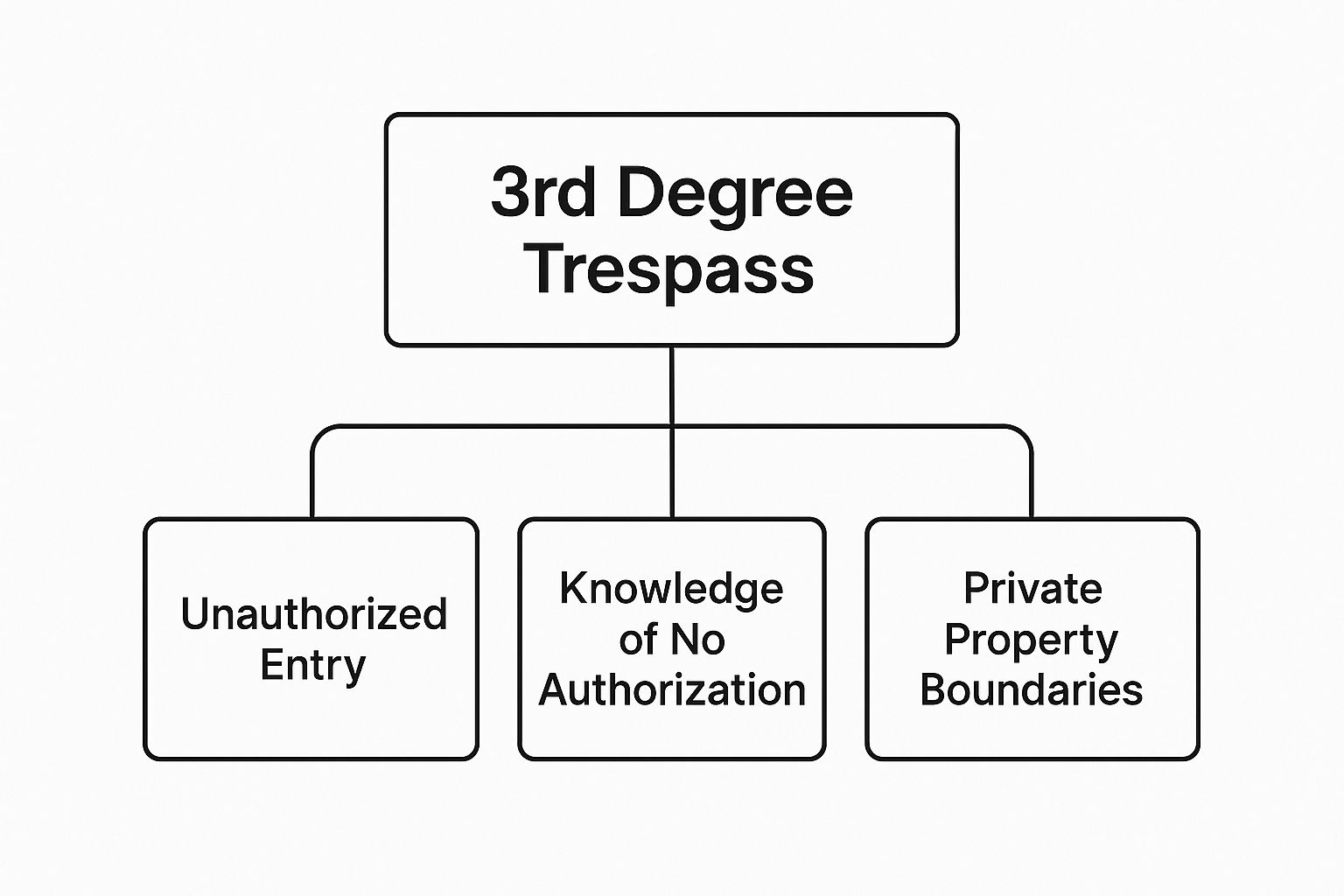
As you can see, it's a three-legged stool: a person has to be on private property without permission, and they have to know they're not supposed to be there.
Criminal Trespass Degrees at a Glance
Sometimes, seeing things side-by-side makes all the difference. The table below lays out the key characteristics that define each degree of criminal trespass in Georgia.
| Degree | Typical Location | Key Differentiating Factor |
|---|---|---|
| First Degree | A private residence, apartment, or occupied building. | The act involves entering a dwelling or shelter, which has the highest expectation of privacy. |
| Second Degree | Fenced-in yards, enclosed commercial lots, or gated areas. | The individual must bypass a physical barrier like a fence, gate, or locked door. |
| Third Degree | Open land, unfenced yards, or public-access areas after hours. | The violation usually occurs after a verbal or written notice to leave on property without barriers. |
Understanding this hierarchy is crucial. It shows that the law considers entering someone's home a far more serious act than walking across an open field, even though both are technically trespassing. The potential penalties reflect that difference.
Real-World Scenarios of Third Degree Trespass

It’s one thing to read the legal definition, but it's another to see how it plays out in the real world. A charge for criminal trespassing 3rd degree often starts with something that feels minor but gets serious once a clear warning is ignored. These everyday examples show just how easily a simple misunderstanding can escalate into a formal criminal charge.
The situations below are purely for educational purposes. They’re designed to connect the legal ideas we've covered—like "knowingly remaining without authority"—to circumstances that could happen in various situations.
The Overstayed Welcome at the Shopping Mall
Picture a group of teenagers using a big shopping mall parking lot as their late-night hangout spot, long after the last store has locked its doors. The lot is open and unfenced, but it's clearly private property. A security guard rolls up and politely tells them, "Folks, the mall is closed. You need to leave the property now."
Most of the group hops in their cars and drives off. One person, however, decides to stay behind, arguing that they aren't causing any harm.
- Analysis: This is the turning point. The guard gave a clear, direct notice to leave. By choosing to stay, that individual is now "knowingly" on the property "without authority." That's all it takes to meet the core requirements for a third-degree criminal trespass charge.
The Photographer on Private Farmland
Think about a photographer driving through the countryside who spots a beautiful, rustic barn on what looks like open farmland. Seeing a perfect photo opportunity, they pull over, walk onto the field, and start snapping pictures. The property isn’t fenced, but there is a small "Private Property" sign near the driveway.
The landowner comes out and tells the photographer they're on private land and need to get off. The photographer says sorry but keeps taking a few more shots while slowly walking back to their car.
- Analysis: Even if the photographer honestly missed the sign at first, the landowner's verbal warning was an unmistakable notice. By lingering to take more pictures instead of leaving right away, their presence is no longer an innocent mistake. It has become a deliberate act of remaining on the property without permission.
Trespassing laws can be surprisingly complex, and they change quite a bit not just from state to state, but all over the world. To try and standardize things, the United Nations Office on Drugs and Crime created the International Classification of Crime for Statistical Purposes. The goal is to create consistent definitions for offenses like trespassing to help compare data between countries, though local laws still vary significantly. You can dive into the full report and learn more about this international crime classification effort.
The Shortcut Through the Restaurant Patio
Here’s another common one: someone repeatedly uses a restaurant's outdoor patio as a shortcut to the next street. The first few times, nobody says anything. But it becomes a daily habit, so the manager finally steps in and tells the person the patio is for paying customers only and they can't cut through anymore.
The very next day, the person ignores the warning and walks right through the patio again. This time, the manager doesn't hesitate to call the police.
- Analysis: The manager's direct warning drew a clear line. By coming back and doing the exact same thing again, the person showed they were knowingly and intentionally ignoring that notice. This behavior fits the classic pattern of criminal trespassing 3rd degree.
Understanding Potential Penalties and Consequences

While a criminal trespassing 3rd degree charge is a misdemeanor in Georgia, it's a mistake to treat it as a minor issue. Any criminal charge, no matter the level, can result in a range of outcomes that can have a serious, lasting impact on a person's life.
The consequences aren't one-size-fits-all. A judge will look at the specific details of the case, such as a person's criminal history and the exact circumstances of the alleged trespass. Everything is determined within Georgia's misdemeanor sentencing framework.
Direct Judicial Penalties
When someone is convicted of a misdemeanor like third-degree criminal trespass, a judge has a few tools at their disposal. These penalties are often meant to serve as a deterrent and a path to rehabilitation.
The direct penalties could include:
- Fines: A monetary penalty is almost always on the table, with the final amount set by the court up to the legal maximum.
- Community Service: The judge can order a set number of hours of unpaid work for a local nonprofit or government agency.
- Probation: This is a period of supervision where a person has to follow a strict set of rules. These conditions often include checking in with a probation officer, staying away from the property in question, and not committing further offenses.
It’s common for a judge to combine these penalties. For instance, an order might be issued to pay a fine and also serve a year on probation. To get a better handle on what that supervision looks like, you can learn more about the differences between felony and misdemeanor probation in Georgia.
From the court's point of view, the goal of these penalties is to ensure accountability and discourage anyone from committing the same offense again. The unique facts of each case are what really shape the final sentence.
The Long-Term Impact of a Criminal Record
Beyond the immediate penalties from the court, perhaps the most significant consequence is the creation of a permanent criminal record. This record can follow a person for years, appearing at inopportune moments.
A conviction for trespassing will show up on routine background checks, which can create huge obstacles when someone is trying to:
- Get a Job: Most employers run background checks, and a recent misdemeanor could be a factor in hiring decisions.
- Rent a Home: Landlords almost always screen potential tenants. A criminal record might be a reason for a rental application to be denied.
- Pursue Education: Some college programs, professional licenses, or even scholarship applications may require a clean background check.
Even a charge that seems as minor as criminal trespassing 3rd degree can cast a very long shadow. That is why it is critical to take it seriously from the start.
Common Questions About Criminal Trespass
When digging into property laws, a lot of questions pop up. Even a seemingly straightforward misdemeanor charge like 3rd-degree criminal trespass has nuances that can be confusing. Let's clear up some of the most common questions people have.
Keep in mind, this is for educational purposes. It is not a substitute for sitting down with an attorney to discuss the specifics of a particular case.
Is a "No Trespassing" Sign Required for a Charge?
This is a big one. Many people think a "No Trespassing" sign has to be posted for a charge to stick, but that’s not always true. A sign is definitely the clearest form of notice, but it's not the only way the law sees it.
A verbal warning carries real weight. If a property owner, an employee, or a security guard tells a person to leave, that counts as notice. From that moment on, if they stay, they are there "knowingly." The key element is whether it was clearly communicated that they weren't welcome.
What Is the Difference Between Civil and Criminal Trespass?
The line between civil and criminal trespass really comes down to who is taking action and what they're trying to accomplish. A single incident can lead to both.
-
Civil Trespass: This is a private matter. The property owner files a lawsuit against the person who trespassed. The goal here is usually money—getting compensated for damage to the property or for its unauthorized use. The outcome is about financial recovery, not a criminal record.
-
Criminal Trespass: This is a public offense. The state, not the individual, prosecutes the case. The goal is to punish the act itself with fines, probation, or even jail time. A conviction means a person has a criminal record, which follows them for a long time.
It's crucial to understand this distinction. You can learn more about the formal process by reading our guide on what happens when someone is arrested and enters the justice system.
Can Someone Be Charged for Trespassing on Public Property?
Absolutely. Just because a property is "public"—like a park, library, or government building—doesn't mean access is unlimited. These places all have rules and operating hours.
For instance, being in a city park after it officially closes for the night is a classic reason for a trespass charge. Ducking into an "Employees Only" area in a courthouse is another clear example. Public access has its limits, and those limits are defined by specific times and designated areas.
At its core, a trespass charge is about crossing a line that one was told not to cross. That applies just as much to public property as it does to private land—the "authority" to be there is limited by the rules of that space.
Does Intent Matter in a Criminal Trespass Case?
Intent is everything in a 3rd-degree criminal trespass case. To get a conviction, the prosecutor has to prove a person knowingly entered or stayed on the property without permission.
A simple accident might not be enough. Let's say a hiker unintentionally wanders off the trail onto private land that isn't fenced or marked. An argument could be made that the law wasn't knowingly violated. But if the owner finds the hiker, tells them to get off their property, and they refuse? That's when the intent changes, and the grounds for a charge have likely just been created. The specific facts of the situation are always what matter most.
Facing a criminal charge is a heavy burden. At Brian Hansford Law, we use over 25 years of experience—including time spent as a prosecutor—to defend clients' rights. If you are looking for a dedicated legal advocate in Georgia, visit us at https://challengemycharge.com to see how we can fight for you.
Article created using Outrank
