
When you hear the term "criminal trespassing," it’s easy to picture someone sneaking onto a property late at night. While that’s one version of it, the reality in Georgia can be far more straightforward—often stemming from a simple misunderstanding over property lines or whether you had permission to be somewhere.
A criminal trespassing charge in Georgia means you've been accused of knowingly going onto or staying on someone else's property when you weren't supposed to. The key word there is accused. A charge is just the starting point of a process; it is not a guilty verdict.
What Does Criminal Trespassing Mean in Georgia

At its heart, a criminal trespassing charge is all about boundaries. Think of a 'No Trespassing' sign like a password prompt for a piece of land. If you go past it without the right "credentials"—in this case, permission—it can trigger an alert that leads to a criminal charge.
This doesn't mean a person is automatically guilty. It just means the state is formally alleging that a line was crossed.
The Core Components of a Trespassing Accusation
For any trespassing situation to become a formal criminal charge in Georgia, the prosecutor's case has to be built on one of three specific actions. They need to show that someone knowingly and without any authority did one of the following.
To make this crystal clear, here’s a breakdown of the three main ways a person can end up with this charge.
Key Components of a Criminal Trespassing Charge
| Action | What It Means | Common Example |
|---|---|---|
| Entering for an Unlawful Purpose | Going onto the property with the intent to commit a separate crime. | Hopping a fence into a backyard specifically to look into someone's windows. |
| Entering After Receiving Notice | Going onto the property even after being clearly told it was forbidden. | Ignoring a "Private Property" sign and walking down a driveway anyway. |
| Remaining After Being Told to Leave | Being initially allowed on the property, but that permission was revoked and the person refused to go. | A store manager asks someone to leave due to disruptive behavior, but they stay and continue arguing. |
As you can see, each scenario is slightly different, but they all boil down to knowingly being somewhere without permission. Without at least one of these elements, the state's case can fall apart quickly.
If you're looking for more detail on this, you can learn more about when trespassing is considered a crime in our detailed guide.
A key takeaway here is that a person's state of mind matters. Accidentally wandering onto someone's land while on a hike is a world away from intentionally climbing a locked gate after being told to stay out.
Understanding Notice and Permission
The idea of "notice" is critical in most criminal trespassing cases. It's how a property owner communicates that their land, store, or building is off-limits. But a sign nailed to a tree isn't the only way to give notice.
The law recognizes several valid forms of notice:
- Verbal Warning: A property owner, security guard, or employee directly telling a person to get off the premises. It's clear, direct, and legally binding.
- Written Notice: This could be a formal letter, an email, or even a text message that explicitly forbids someone from entering the property.
- Physical Barriers: Fences, locked gates, and other obvious enclosures are a universal sign that a property is not open for just anyone to enter.
Getting a handle on these basic concepts is the first step. A criminal trespassing charge is an accusation that a boundary—physical or verbal—was crossed on purpose. From this point on, the specific details of what happened and the evidence involved become everything.
Not all criminal trespassing charges are built the same. Georgia law, found under O.C.G.A. § 16-7-21, provides the basic framework, but the specifics of where an alleged trespass happened can completely change the situation. It’s a lot like a speeding ticket—going 15 mph over the limit is one thing on the highway, but it’s a much more serious problem in a school zone.
The type of property involved is a huge factor in how these charges are treated. An accusation involving a local retail store is going to be handled very differently than one concerning critical infrastructure, like a railroad yard or a protected farm.
Distinctions in Georgia Trespassing Law
Understanding these differences is important because they directly impact the potential consequences a person could be facing. The law creates separate categories to give extra protection to properties that are either more easily damaged or more essential to public safety and commerce.
This tiered system helps ensure the response fits the situation. Let's break down the common types of criminal trespassing charges seen in Georgia.
- General Criminal Trespass: This is the one seen most often. It covers entering someone’s land, vehicle, or building after being told not to, or staying after being asked to leave.
- Trespass on Agricultural Land: Georgia has specific laws to protect farms and related sites from uninvited entry, which could lead to crop damage or biosecurity risks.
- Trespass on Railroad Property: Entering or being around railroad tracks or rail yards is its own specific offense because of the obvious and immense safety dangers involved.
Criminal trespassing is still one of the most common property crimes reported across the country. Recent data from the Bloomington Police Department (BPD) shows just how persistent it is. Between January and August 2025, the BPD handled 2,171 calls related to trespassing, making it the top property crime in that area for that time frame. You can explore more about these crime statistics to get a sense of just how prevalent these charges are.
A Closer Look at Potential Penalties
Here in Georgia, almost every criminal trespassing charge is classified as a misdemeanor. While that might not sound as scary as a felony, a misdemeanor conviction is a big deal. It creates a permanent mark on a person's criminal record that can follow them for life.
The penalties aren't set in stone. They often depend on the specific facts of the case and the discretion of the judge handling it. Still, there’s a general outline of what someone can expect if convicted.
A misdemeanor conviction in Georgia can lead to serious consequences, including up to 12 months in jail and fines reaching as high as $1,000. And remember, those penalties can be applied for each individual count.
On top of potential jail time and fines, a judge can also add other conditions to a sentence. These are meant to be both a punishment and a way to prevent future issues.
- Probation: A person could be placed under court supervision for a period of time, requiring them to follow strict rules like checking in with a probation officer.
- Community Service: The court might order a certain number of hours of unpaid work for a local nonprofit or government agency.
- Restitution: If any property was damaged, the judge will likely order the person to pay the owner back for the cost of repairs.
- "Stay Away" Orders: It's very common for a judge to issue a formal order that prohibits someone from returning to the property in question, sometimes for several years.
The final mix of these penalties can vary widely. A case where someone accidentally wandered onto a vacant lot and caused no damage will be viewed very differently from a situation where a person repeatedly entered a business after being formally warned to stay away. The details and context of the accusation matter more than anything else.
How a Trespassing Case Moves Through North Georgia Courts
If someone is facing a criminal trespassing charge in North Georgia, the path the case takes through the local court system can feel confusing and intimidating. While the specifics can vary, the general process in places like Alpharetta, Roswell, Marietta, and Cumming follows a predictable series of steps. Knowing what to expect is part of preparing.
For many trespassing cases, the process doesn't even start with an arrest. It often begins with a citation—basically a ticket—handed to the individual by a police officer. That citation will list an arraignment date, which is the first required appearance in court. This is where the formal charges are read and a plea is entered.
The First Court Appearance and What It Means
Whether someone was arrested and bonded out or just received a citation, that arraignment date is absolutely critical. It doesn't matter if it's in a Forsyth County or Cobb County court; this hearing kicks off the entire process.
It cannot be missed. If the person doesn't show up, the judge will almost certainly issue a bench warrant for their arrest, and they could be hit with an additional charge for Failure to Appear. Suddenly, a simple trespassing citation has become a much bigger problem.
This infographic breaks down how penalties can differ depending on where the alleged trespassing took place.
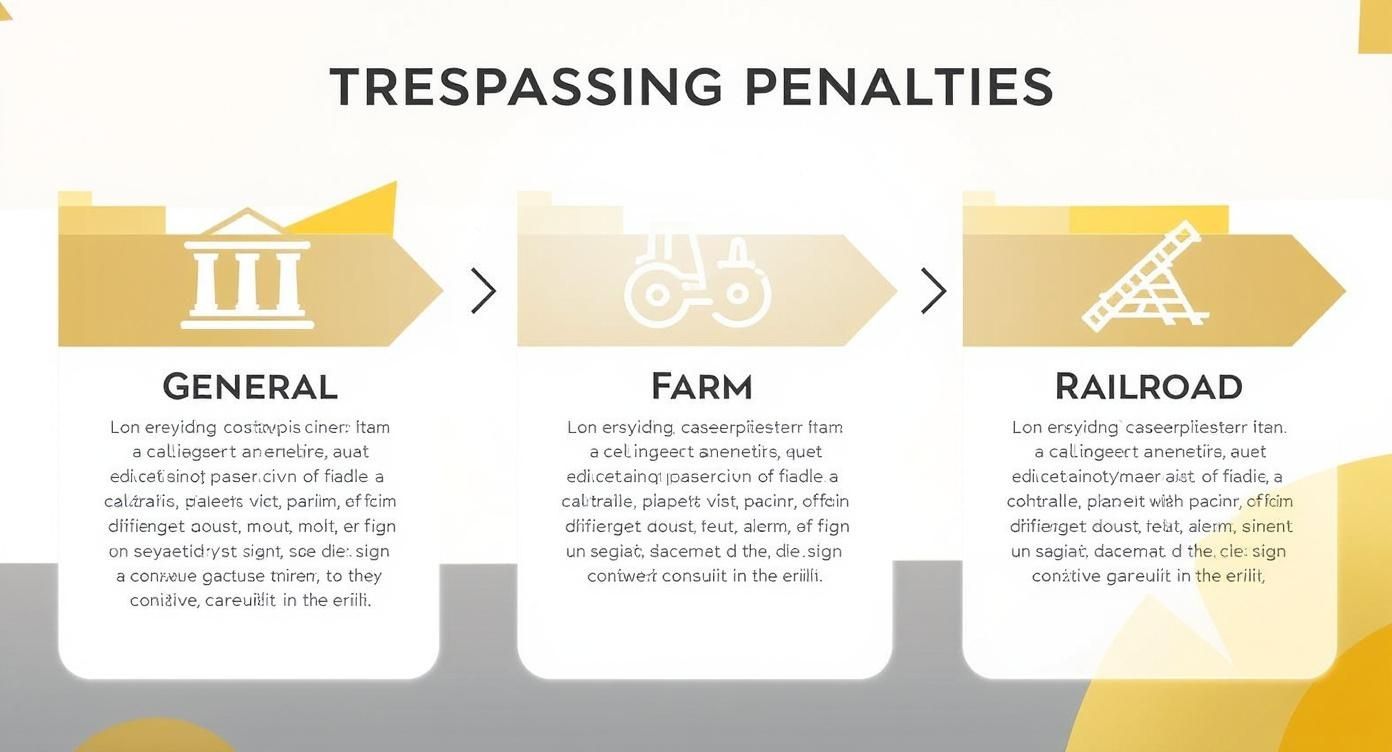
As you can see, being on certain protected properties, like a farm or railroad, changes the game compared to a standard trespassing allegation.
From Arraignment to a Potential Resolution
Once the arraignment is over, the case moves into a pre-trial phase. This is when the real work begins. It’s a period of back-and-forth between the defense attorney and the prosecutor, filled with pre-trial conferences and other hearings.
This is where the state’s evidence is examined, motions are filed, and negotiations with the prosecutor take place. A lot of cases get resolved right here, long before a trial is even on the horizon.
The specific court a case is in really matters. Procedures in the City of Milton Municipal Court can be quite different from the State Court of Cobb County. These local quirks affect everything from court scheduling to what kinds of plea deals or diversion programs are on the table.
Understanding these local differences is key. A prosecutor in one jurisdiction might be open to a pre-trial diversion program for a first-time offender, while a prosecutor one town over might have a much stricter policy. One can get a general sense of the timeline by reviewing the steps in the criminal justice process, but every courthouse has its own rhythm.
What Happens When No Agreement Is Reached?
If negotiations don't lead to a plea agreement, the case gets scheduled for trial. At this stage, there are two options for how to proceed:
- Bench Trial: The judge alone hears the evidence from both sides and decides the verdict. No jury is involved.
- Jury Trial: A jury of peers is selected. They listen to the evidence and must unanimously decide if the state has proven its case beyond a reasonable doubt.
Going to trial is a major decision. It can be a long, stressful process, but it's a fundamental right to have the facts of a case heard. Thankfully, most trespassing charges are resolved well before this point through skilled negotiation, getting into a diversion program, or filing a motion that leads to a complete dismissal.
Exploring Common Criminal Defense Concepts
When up against a criminal trespassing charge, the first step is to understand the core concepts that shape a defense. Every case is built on a specific set of facts and evidence. The prosecutor has their story, and a good defense involves looking at those same elements from a different—and more complete—perspective. This isn't about finding loopholes; it's about making sure the full story is told and that the court gets it right.
The entire process boils down to one simple fact: the State of Georgia has to prove every single element of the charge beyond a reasonable doubt. A defense strategy is really just a series of questions that test how strong their evidence is. For example, did the person genuinely know they were on private property? Was permission ever given, even indirectly? The answers can completely change the context of the case.
The Critical Element of Intent
One of the most foundational concepts in a criminal trespassing case is a person's state of mind, or intent. To convict, the prosecution generally has to prove that the individual knowingly entered or stayed on the property without permission. If their presence was accidental or based on a reasonable misunderstanding, it knocks out a key pillar of the case.
Think of a hiker following a poorly marked trail who accidentally wanders onto a massive, unfenced private estate. If there was no reason to believe they were leaving public land, their actions lack the deliberate intent required for a criminal charge. This is a world away from someone who hops a clearly marked fence to get onto that same property.
A key takeaway is that an honest mistake is not the same as a criminal act. Demonstrating a lack of intent—showing you were unaware you were trespassing—is a common and logical defense angle that focuses on clarifying your state of mind at the time.
Questioning the Validity of Notice
Another crucial area to examine is whether proper notice was given that a person couldn't be there. The law requires a property owner to communicate that entry is forbidden. If that communication was unclear, inconsistent, or never happened at all, it can form the basis of a powerful defense.
Common ways to challenge the "notice" element include:
- Inadequate Signage: Were the "No Trespassing" signs actually visible and readable? A sign that's faded to white, knocked over, or hidden behind an overgrown bush might not be legally sufficient notice.
- Ambiguous Boundaries: On a large, open property with no fences or markers, how was anyone supposed to know where public land ended and private property began? It’s entirely reasonable to be confused.
- Conflicting Communication: What if a store employee said it was okay to be there, but a manager later asked the person to leave? Mixed messages like that can invalidate the idea that a clear and final notice to vacate was received.
On a national scale, criminal trespassing charges are a significant part of property crime statistics. According to the FBI’s Uniform Crime Reporting (UCR) Program, property crime in the United States has been on a long-term decline, with the overall rate dropping 30% between 2013 and 2023. However, since there isn't a standardized national system just for trespassing, local data is what really matters for understanding its impact here in Georgia. You can discover more insights about these national crime trends from the CSG Justice Center.
Establishing Consent or Implied Permission
Sometimes, the defense is straightforward: there was permission. If the owner or someone with authority allowed someone on the property, a trespassing charge simply can't stick. Permission doesn't always come in the form of a written invitation, either. It can be verbal or even implied by the owner’s past actions or the situation itself.
For example, if a homeowner has let neighborhood kids cut across their lawn for years without saying a word, an argument can be made for implied consent. If that owner suddenly calls the police one day without first telling the kids the old rule has changed, it creates a strong argument that they had a reasonable belief they were allowed to be there.
Evidence like text messages, emails, or testimony from neighbors who also had permission can be vital in building this defense. Ultimately, successfully using these concepts depends on gathering and organizing the evidence that backs up that side of the story.
The Role of an Experienced Criminal Defense Attorney

Facing criminal trespassing charges without assistance can be difficult. The court system is its own world, complete with a unique language and a maze of procedural rules that can trip up anyone unfamiliar with them. An experienced criminal defense attorney can be a guide through this intimidating process—an advocate whose job is to protect an individual's rights from day one.
The first thing a good lawyer does is take a deep dive into the specifics of a case. They scrutinize every single piece of evidence the prosecutor has, from the initial police report and witness statements to any photos or videos of the scene. The entire goal is to examine the state's case, looking for weaknesses, inconsistencies, or any sign that rights were violated.
Navigating Local Court Systems
One of the biggest advantages of hiring a seasoned attorney is their firsthand knowledge of the local courts. The way things are handled in Forsyth County isn't exactly the same as in Cobb County. Likewise, the municipal courts in Alpharetta, Roswell, or Johns Creek all have their own quirks and unwritten rules.
An attorney who is in these courthouses regularly knows the key players, from the prosecutors handling the cases to the judges who will hear them. That kind of familiarity is invaluable. It helps them anticipate how a case might play out and allows them to communicate more effectively with the prosecution when it’s time to negotiate. This local insight can make all the difference when trying to get charges reduced or exploring alternative resolutions.
Having a professional who understands both the black-letter law and the unwritten rules of the local courthouse is a powerful asset. Their experience helps level the playing field when an individual is up against the resources of the state.
Knowing what to expect and what to ask is a critical first step. You can find valuable guidance on this subject by reviewing our list of questions to ask a criminal defense attorney before hiring one.
Building a Strategy to Protect Your Future
A defense attorney’s job goes way beyond just reviewing evidence. It's about crafting a compelling narrative that tells a complete side of the story. They will identify the strongest defenses available—like a lack of intent or improper notice—and then gather the facts needed to build that argument. This process often involves:
- Interviewing witnesses who can provide crucial context or directly contradict the prosecution's claims.
- Filing motions to get improperly obtained evidence thrown out so it can't be used.
- Negotiating with the prosecutor to push for a dismissal, a reduction in charges, or entry into a diversion program that could keep a record clean.
At Brian Hansford Law, our entire approach is built on this kind of detailed preparation and deep local experience. As a former prosecutor, Brian Hansford knows exactly how the other side thinks and builds its cases. That perspective is invaluable in protecting rights and fighting for the best possible outcome when someone is facing criminal trespassing charges. Our ultimate goal is always to safeguard a person's future and minimize the impact of this accusation on their life.
Common Questions About Criminal Trespassing Charges
When someone is suddenly facing a criminal trespassing charge, a million questions probably run through their mind. It’s a confusing and stressful situation. Here are some straightforward answers to the questions we hear most often.
Can I Be Charged with Trespassing if There Were No Signs?
Yes, it is possible. While a “No Trespassing” sign is the clearest warning, it isn’t the only legally valid one in Georgia.
The law hinges on whether notice was given that a person wasn't welcome. That notice can come directly from the property owner, an employee, or a security guard telling someone to leave. A verbal warning is just as powerful as a sign. If a person stays after being told to go, they can be charged. The lack of a sign is not a free pass, especially if someone with authority has asked a person to get off their property.
What Is the Difference Between Criminal and Civil Trespassing?
This is a critical distinction because the consequences are completely different. Think of it as the government versus a private individual.
-
Criminal Trespassing is a crime against the state. The prosecutor’s office files charges because a law was broken. A conviction means a criminal record, plus potential penalties like fines, probation, or even jail time.
-
Civil Trespassing is a private matter. The property owner sues in civil court, not to punish with a criminal record, but to get money—called damages—for any harm they believe was caused.
One crucial point: these two actions are not mutually exclusive. A property owner can sue civilly at the same time the state is prosecuting criminally. A person could find themselves fighting battles on two fronts over the same incident.
Is Criminal Trespassing a Felony or Misdemeanor in Georgia?
For almost all standard cases under O.C.G.A. § 16-7-21, criminal trespassing is a misdemeanor. But don't let that label lead you to think it isn't serious.
A misdemeanor conviction in Georgia can land someone in jail for up to 12 months and cost up to $1,000 in fines. Just as damaging, it leaves a permanent criminal record. That record will pop up on background checks for jobs, housing applications, and professional licenses for years to come, creating obstacles that were never anticipated.
What Should I Do Immediately After Being Charged?
Getting a citation or being arrested is jarring. The first job is to stay calm and not make the situation worse. It is often suggested to be polite with law enforcement, but exercise the right to remain silent.
A common recommendation is to avoid explaining or discussing the details with the police until a lawyer is present. As soon as possible, it can be helpful to sit down and write out every single thing remembered.
Note these key details:
- The exact time and location.
- Who else was there (names or descriptions).
- What was said by everyone involved, as close to word-for-word as can be recalled.
- Were there any signs, fences, or gates? What condition were they in?
This information could be invaluable. The next step is often to contact an experienced criminal defense attorney. Getting a professional to review the facts and explain the options is one of the best things a person can do to protect themselves.
If you are facing criminal trespassing charges in Alpharetta, Cumming, Marietta, or anywhere in North Georgia, the stakes are too high to face alone. At Brian Hansford Law, we bring over two decades of experience, including valuable insight as a former prosecutor, to fight for your rights. Contact us today for a consultation to discuss your case by visiting https://challengemycharge.com.
