
A lot of people first hear the phrase deceptive trade practices act when they think they're dealing with a customer dispute, a refund demand, or a nasty letter from another lawyer. Then the tone changes. A state investigator asks for records. A bank wants answers. A detective calls. What looked civil starts looking criminal.
That shift catches business owners off guard in Alpharetta, Roswell, Johns Creek, Cumming, Milton, Marietta, and across North Atlanta. A misleading ad, a disputed guarantee, an online sales complaint, or a financing representation can move from consumer law into allegations of fraud, theft by deception, or other white collar offenses. At that point, you don't need a marketing fix. You need a defense strategy.
What is the Deceptive Trade Practices Act
A typical version of this problem begins subtly. A contractor in Forsyth County gets a demand letter claiming his sales materials overstated what a service package included. A shop owner in Roswell receives notice that a consumer complaint was filed over advertising and refund practices. Someone tells them it's “just consumer law.”
That advice is dangerous.
The deceptive trade practices act is a broad label people use for laws aimed at stopping unfair or misleading business conduct. These laws target false advertising, misrepresentations about goods or services, misleading claims, and practices that can trick consumers into spending money or giving up property. On paper, that sounds civil. In practice, the same facts can become evidence in a criminal investigation.
At the federal level, the legal foundation goes back a long way. The Federal Trade Commission Act, enacted on September 26, 1914, made Section 5 a core part of U.S. consumer protection by prohibiting “unfair or deceptive acts or practices in or affecting commerce” according to the Federal Reserve's FTC Act reference material. That history matters because state consumer protection laws grew out of the same basic concern. Government agencies watch how businesses sell, describe, promise, and collect.
Why business owners underestimate the risk
Most owners think in civil terms. They ask whether they can settle, revise the website, or refund the customer. Those steps may help in the right case, but they don't solve the biggest problem if investigators think the conduct was intentional.
Practical rule: Once a complaint suggests deception, act like every email, invoice, ad, text message, and refund policy may later be read by a prosecutor.
If you work in a regulated or complaint-prone space, it also helps to understand related consumer protection frameworks. For example, companies dealing with credit-related services can learn a lot from the Superior Credit Repair CROA guide, which shows how consumer-facing promises can create serious legal exposure when sales practices and disclosures don't line up.
What actually matters
The label matters less than the conduct. Authorities focus on what was said, what the customer was led to believe, what money changed hands, and whether the business knew the representation was false or misleading. In Fulton County, Cobb County, and Forsyth County, that can become the starting point for a much more serious case than most owners expect.
Georgia's Fair Business Practices Act Explained
In Georgia, the law that usually matters most is the Fair Business Practices Act, often called the FBPA. It's Georgia's consumer protection framework for unfair or deceptive conduct in consumer transactions. If you run a business in Alpharetta, Johns Creek, Cumming, or Marietta, this is the state law that often drives complaints, investigations, and civil enforcement.
The FBPA is part of the same family of laws people loosely refer to when they talk about the deceptive trade practices act. The idea is simple. Businesses can't market or sell with material misrepresentations, misleading omissions, or unfair tactics that distort a consumer's decision.
How Georgia law fits into the bigger picture
Georgia didn't create this framework in isolation. The Uniform Deceptive Trade Practices Act influenced state consumer laws across the country, including Georgia's approach. State attorneys general play a major enforcement role, and Georgia's Consumer Protection Division handled 15,000 deceptive practice probes in 2022 and secured $40 million in redress according to the OJP consumer fraud reference.
That matters for a local business because it means enforcement isn't theoretical. Complaints can get reviewed. Records can get requested. Negotiations can happen under pressure.
What the FBPA usually targets
The conduct at issue often falls into a few familiar categories:
- Advertising claims that overpromise. A service package says one thing, the contract says another, and the customer claims they were induced by the ad.
- Omissions that change the deal. Key limits, fees, exclusions, or conditions are left out until late in the transaction.
- Representations about quality or source. A seller describes goods as new, premium, certified, or backed by a guarantee when the support for that claim is weak or nonexistent.
- Sales practices that create a false impression. The issue may be less about a direct lie and more about the overall message a consumer received.
What business owners need to understand early
A lot of owners make the same mistake. They treat an FBPA complaint as a public relations issue. They call a marketing consultant, revise the website, and hope the problem cools off.
That can help with future compliance. It doesn't protect your statements about the past.
A consumer protection inquiry is often a document case before it becomes anything else. Your ads, intake forms, text messages, and payment records usually matter more than your explanation after the fact.
The FBPA also creates civil exposure even where a customer's damages are disputed. That's why speed matters. If investigators or opposing counsel are already involved, every response should be built with an eye toward both civil liability and criminal risk.
Common Examples of Deceptive Business Practices
The fastest way to understand the deceptive trade practices act is to look at conduct that gets people into trouble. Most cases don't begin with dramatic fraud language. They begin with ordinary business habits that drift into misrepresentation.

Bait and switch advertising
A Roswell business advertises a low-price package to get customers in the door. When customers call or arrive, the advertised option is suddenly “unavailable,” and staff steer them to a much higher-priced version. That's the classic setup for a deceptive practices complaint.
The legal problem isn't aggressive selling by itself. It's using one offer to attract the customer while planning to sell a different deal.
False quality or origin claims
An online seller in Milton describes products as premium, authentic, or factory-backed without solid support. If those statements influence the sale, the claim may trigger consumer law issues and, in the right facts, criminal scrutiny if the seller knew the claims were false.
This comes up often in vehicle and product sales. If you're dealing with that kind of dispute, the auto fraud law overview is a useful starting point for seeing how sales representations can become legal claims.
Manufactured reviews and testimonials
A business in East Cobb loads a website with glowing testimonials that weren't written by real customers, or that omit a material relationship. Customers later claim they relied on those endorsements when deciding to buy.
That's not just sloppy branding. It can be framed as a deliberate effort to create trust through a false impression.
Guarantees that vanish after payment
A home services company tells buyers there's a “full satisfaction guarantee” or “money-back promise,” but the written process makes refunds practically impossible. Investigators often look hard at these cases because the marketing message and actual business practice don't match.
If a jury sees a promise on the website and a different rule in the back office, the business loses credibility fast.
What usually does not help
Owners often defend themselves by saying the customer should have read the fine print or asked more questions. Sometimes that argument matters. Often it doesn't. If the larger message was misleading, hiding the truth in a disclaimer may not fix the problem.
That's why these cases need legal review early, before anyone gives a recorded statement or turns over a selective set of records that creates a worse story than the full file would show.
How Civil Complaints Can Become Criminal Charges
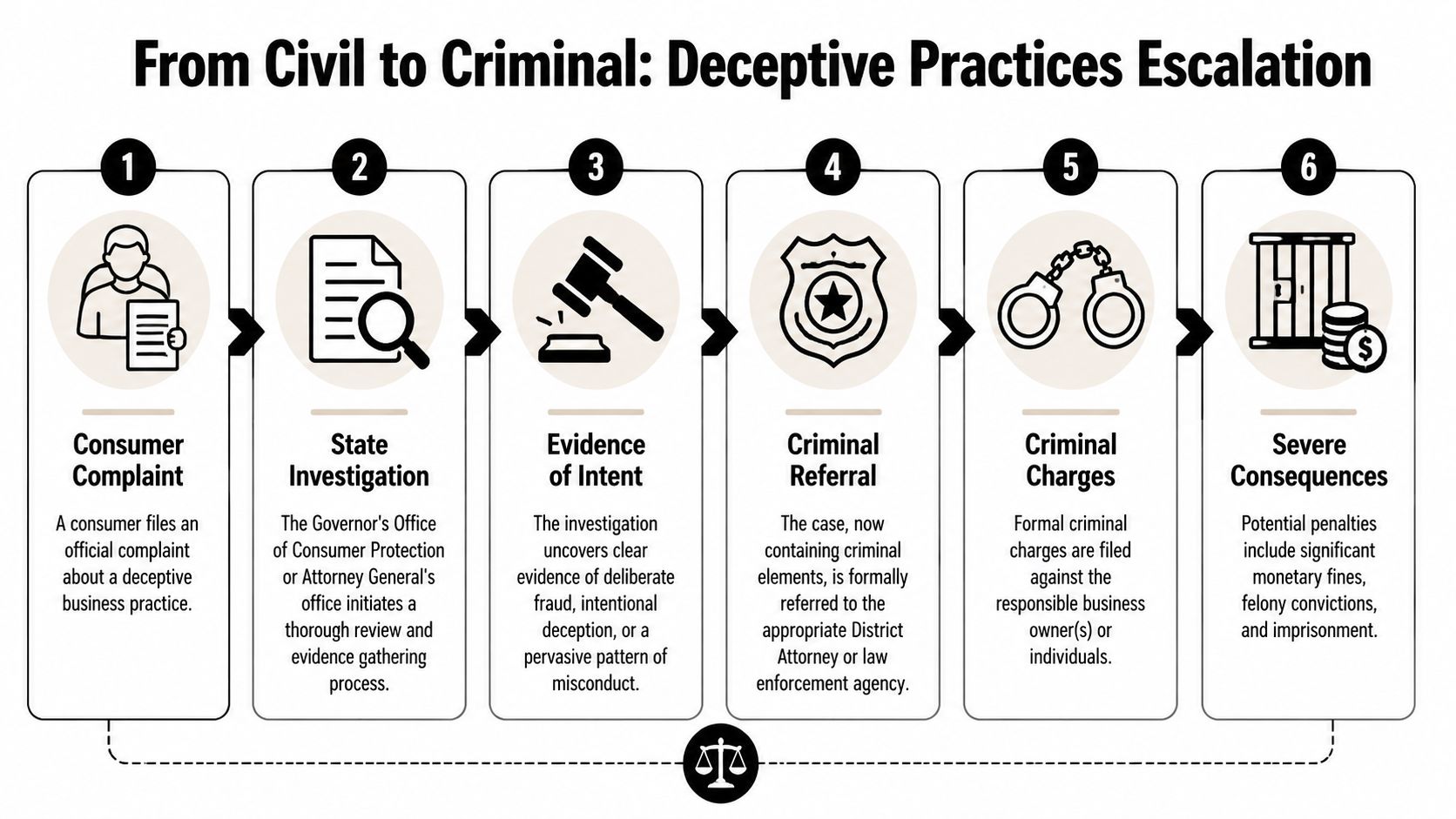
A civil complaint becomes dangerous when investigators stop asking only whether a customer was misled and start asking whether the business used false representations to obtain money or property. In Georgia, that's where criminal exposure enters the picture.
The path from complaint to prosecution
The process often looks like this:
- A customer files a complaint with a state agency, law enforcement, a bank, or a lawyer.
- Records get reviewed. Ads, contracts, payment histories, emails, texts, call notes, and refund policies become evidence.
- Intent becomes the focal point. Investigators look for repeated complaints, internal messages, changed scripts, or proof that the seller knew the statements were false.
- The file may be referred to criminal investigators or a district attorney if the facts suggest fraud rather than mere sloppiness.
- Charges can follow, even if civil negotiations were already underway.
The criminal statute that often matters most is O.C.G.A. § 16-8-3, Georgia's theft by deception law. The issue becomes whether someone intentionally used deception to obtain another person's property. According to the verified data provided, making false representations to obtain property can become a felony if the amount is over $500.
Why prosecutors care about patterns
One unhappy customer can produce a business dispute. Multiple customers describing the same script, same guarantee, same missing product, or same hidden term can look like a scheme.
That's why a business owner should never assume a civil response will stay in the civil lane. A refund sent to one customer doesn't erase what earlier ads, invoices, call recordings, or merchant records may show about the broader conduct.
The concern is especially real because the verified data states that over 1,200 theft by deception cases are prosecuted annually in Georgia, many tied to conduct that overlaps with consumer protection violations, as described in the TexasLawHelp reference cited in the provided data.
What makes the case turn criminal
Several facts tend to move a case in that direction:
- Repeated misrepresentations across multiple transactions
- Proof of knowledge, such as internal messages showing the seller knew the promise was false
- Collection of money first, followed by excuses, substitutions, or nonperformance
- Fake support materials, including false testimonials, altered paperwork, or misleading refund terms
- Efforts to conceal, destroy, or rewrite records after complaints arrive
For readers dealing with this kind of investigation, the white collar crime explanation gives broader context on how financial and business-related allegations are charged.
Once intent is on the table, your case isn't about customer service anymore. It's about whether the state can prove a crime.
The practical mistake that causes damage
The biggest error is talking too much. Owners call investigators to “clear things up.” Employees text each other trying to align stories. Someone edits the website and deletes old files. Those actions can become some of the strongest evidence in the case.
Silence, preservation, and a controlled legal response are usually far more effective than an emotional explanation.
Comparing Civil Remedies and Criminal Penalties
Civil and criminal cases may grow out of the same transaction, but they are not the same fight. One is about liability, money, orders, and business practices. The other is about conviction, punishment, and a record that follows you long after the case ends.
Civil vs. Criminal Consequences for Deceptive Practices
| Consequence Type | Civil Remedies (FBPA Lawsuit) | Criminal Penalties (Theft Conviction) |
|---|---|---|
| Primary goal | Stop the practice and compensate the harmed consumer | Punish the accused and protect the public |
| Who brings it | Consumer, state agency, or attorney general | State prosecutor |
| Typical focus | Misleading ads, omissions, unfair sales conduct | Intentional deception used to obtain money or property |
| Possible outcome | Injunctions, restitution, attorney fee exposure, business restrictions | Jail or prison exposure, probation, fines, conviction record |
| Proof concerns | What the customer saw, heard, and relied on | What the accused knew, intended, and did |
| Long-term effect | Financial pressure and operational changes | Employment, licensing, reputation, immigration, and record consequences |
Why this distinction matters in real life
A business owner sometimes thinks a civil settlement solves everything. It may resolve one piece of the problem, but it doesn't automatically block a criminal case. Statements made in settlement talks, documents produced in a rush, and refund records can all shape the prosecution's theory.
That's one reason experienced defense lawyers look at these matters the way they would examine any fraud-adjacent file, including issues that arise in related financial allegations such as those discussed in this Georgia fraudulent checks penalty overview.
Compliance programs do not replace a defense
Businesses often ask whether they can take a class, update procedures, or complete some form of remediation. Those steps can be useful. They are not a substitute for defending the allegation itself.
In traffic and DUI contexts, people sometimes encounter court-ordered education tools like the A-1 Driving School panel explanation. Consumer and fraud-related cases can have their own corrective components, but no educational program changes the central question in a criminal file. Did the state collect enough evidence to prove intent?
Civil exposure threatens your bank account. Criminal exposure threatens your freedom, your license in some professions, and your future options.
That's why the first strategic decision is so important. Treating a hybrid civil-criminal problem like a customer relations issue usually makes the criminal side worse.
Strategies for Defending Against These Allegations
These cases are won or lost early. The first calls, the first emails, and the first document decisions often shape the entire file. If you've been contacted by a consumer investigator, served with a lawsuit, or arrested on a related charge, start with control.
What to do immediately
- Stop speaking informally. Don't call the investigator to “explain.” Don't send a long apology email. Don't post online about the dispute.
- Preserve records. Save contracts, invoices, ads, text messages, direct messages, call logs, refund requests, website versions, and employee communications.
- Identify every representation made. What did the customer see first. What did the sales staff say. What does the paperwork show.
- Separate fact from cleanup. You can improve current business practices, but don't rewrite history or alter records.
- Get counsel before interviews. That includes “voluntary” meetings that are framed as routine.
Defenses that can work
A strong defense depends on facts, but several themes appear often.
Puffery versus factual misrepresentation
Some statements are sales talk, not provable facts. “Best in town” is different from “factory certified” or “includes a full refund guarantee.” The law usually hits factual claims harder than broad opinion language.
Lack of intent
Criminal cases need more than a bad outcome. If the evidence shows confusion, vendor failure, staff miscommunication, poor recordkeeping, or an honest dispute over performance, that may undercut the state's claim that the conduct was intentional.
Good-faith compliance efforts
A business that used contracts, disclosures, customer acknowledgments, refund procedures, and correction efforts may be in a better position than one that ran entirely on oral promises. Good faith doesn't erase a problem, but it can matter a great deal.
Special considerations for first-time offenders
In some cases, damage control includes sentencing strategy as well as trial defense. The verified data provided states that for first-time offenders in Cumming or Johns Creek, Georgia's First Offender Act can allow record restriction after a conviction for a non-violent offense like misdemeanor deception, and that the GA Judicial Council reported a 68% success rate in Forsyth and Cobb Counties in the cited material at this provided reference.
That does not mean everyone qualifies. It does mean early lawyering matters.
Defense insight: The best time to think about record protection is before the plea, not after the sentence.
What usually fails
These moves often backfire:
- Selective production of only “helpful” documents while hiding damaging files
- Coaching employees on what to say before interviews
- Destroying or editing records after notice of a complaint
- Assuming repayment ends the case
- Using one lawyer for civil optics and no criminal strategy
A practical defense has to address both the paper trail and the intent narrative. If the state can't prove a knowing misrepresentation, a lot changes. If the state can show a pattern, the case gets harder quickly.
How Brian Hansford Law Defends Clients in North Atlanta
When a consumer complaint starts pointing toward theft by deception, fraud, or another white collar charge, local court knowledge matters. So does knowing how prosecutors build these files. That combination is especially important in North Atlanta, where business owners and professionals often have a lot at stake beyond the case itself.
Brian Hansford Law is built for that kind of problem. Brian Hansford brings over 25 years of experience and a background as a former prosecutor, which matters when the state is trying to turn a civil-sounding dispute into a criminal prosecution. That experience helps in evaluating weak intent evidence, anticipating charging decisions, and controlling client contact with investigators before the record gets worse.
The firm serves clients in Alpharetta, Roswell, Johns Creek, Milton, Cumming, Marietta, Sandy Springs, and Duluth, and throughout Fulton County, Forsyth County, Cobb County, Cherokee County, and Gwinnett County. That local reach matters for more than convenience. Courts have different rhythms. Prosecutors have different habits. Judges have different expectations about preparation, credibility, and negotiated resolutions.
This also fits the broader needs of people searching for urgent criminal defense help in North Atlanta. Many clients first look for a DUI lawyer in Alpharetta, a reckless driving lawyer in Roswell, a traffic ticket attorney near me, a drug possession lawyer in Cumming, or a felony defense lawyer in Marietta. The common thread is urgency. When your freedom, license, record, or business reputation is at risk, you need fast court representation and a defense plan grounded in local practice.
The same is true here. A deceptive practices investigation can affect more than one part of your life at once. It can threaten your company, your personal finances, your record, and your ability to keep operating while the case unfolds. Quick, disciplined action gives you the best chance to protect all of it.
If you're facing allegations tied to deceptive business practices, theft by deception, fraud, DUI, reckless driving, license suspension, drug possession, or another criminal charge in North Atlanta, waiting usually makes the problem harder.
Brian Hansford Law provides confidential, strategic defense for people facing criminal charges in Alpharetta and throughout North Atlanta. If you need immediate help with a deceptive trade practices investigation, theft by deception allegation, DUI arrest, traffic offense, drug charge, or court deadline, contact Brian Hansford Law for a free consultation and get a defense plan in place now.
