
Think of the exclusionary rule as a referee's call in the justice system. When evidence is collected in a way that breaks the rules—specifically, by violating certain constitutional rights—this rule allows a judge to throw it out. That evidence is now off-limits and cannot be used against someone in court.
What Is the Exclusionary Rule Explained Simply
At its heart, the exclusionary rule is all about protecting Fourth Amendment rights against unreasonable searches and seizures. Its purpose is not to let someone off the hook; it's to discourage law enforcement from cutting constitutional corners during an investigation.
Let's say police raid a home without a proper warrant and discover evidence that seems to seal the case. The exclusionary rule is the tool that allows a defense attorney to challenge how that evidence was found. If the judge agrees the search was illegal, the evidence gets "suppressed." For the prosecutor, that means a key piece of their puzzle just vanished.
The Rule's Foundation and Purpose
The entire principle is built on a straightforward idea: rights are meaningless without consequences for violating them. By making illegally gathered evidence inadmissible, the rule gives police a powerful reason to do things by the book, like getting a warrant based on probable cause. It's a system of accountability designed to protect everyone's rights.
The impact of this rule can completely change the direction of a criminal case, and its success often hinges on the specific details of the police search. Navigating these complexities involves a deep understanding of state and federal law, which is especially critical for cases across Georgia.
This concept didn't just appear overnight. It was first established for federal cases back in 1914 with the Supreme Court's decision in Weeks v. United States. But the real game-changer was the 1961 landmark case Mapp v. Ohio, which made the rule apply to all state courts, too. This decision forced thousands of local police departments to align their procedures with the Fourth Amendment, creating a single, nationwide standard.
To give you a clearer picture of its role, here's a quick breakdown of the rule's core principles.
Key Aspects of the Exclusionary Rule at a Glance
| Core Principle | Primary Purpose | Constitutional Basis |
|---|---|---|
| Evidence obtained through an illegal search or seizure is inadmissible in court. | To deter unconstitutional conduct by law enforcement officers. | The Fourth Amendment's protection against unreasonable searches and seizures. |
This table shows how the rule connects police actions directly to constitutional protections, ensuring certain rights have real meaning in the real world.
Key Goals of the Exclusionary Rule
Ultimately, the rule is designed to achieve a few crucial goals:
- Deterring Misconduct: It takes away the incentive for police to conduct illegal searches by ensuring they can't use what they find.
- Upholding Judicial Integrity: The rule prevents the courts from being complicit in constitutional violations. In short, it keeps the justice system's hands clean.
- Protecting Constitutional Rights: It adds teeth to the Fourth Amendment, turning its protections from words on paper into an enforceable reality.
The exclusionary rule is not a technicality; it is a foundational safeguard that ensures the methods used to gather evidence are just as important as the evidence itself. It reinforces the idea that the ends do not justify the means in the pursuit of justice.
From Federal Courthouses to Main Street: The Rule's Journey
The exclusionary rule is a pillar of modern criminal defense, but it wasn't always the law of the land for every police officer in America. Its history is one of slow, deliberate expansion, starting in the federal system and eventually reaching every town and county, from Forsyth to Cobb. This journey marks a massive shift in how our justice system balances police power with individual rights.
The rule’s story begins with one key case: Weeks v. United States in 1914. Federal marshals had searched Fremont Weeks' home—twice—without a warrant. They grabbed personal papers and used them to convict him. The Supreme Court stepped in, calling the search a clear violation of the Fourth Amendment.
To give the amendment some actual teeth, the Court ruled that any evidence collected by federal agents in an illegal search had to be thrown out of court. But here was the catch: this powerful new rule only applied to federal law enforcement. State and local cops? They weren't bound by it at all, leaving a huge gap in constitutional protection.
A Tale of Two Systems: Federal vs. State Enforcement
For almost 50 years after the Weeks decision, a strange double standard existed. If a federal agent did a warrantless search, the evidence was toast. But a city police officer in Roswell or Alpharetta could potentially use illegally seized evidence to prosecute someone in a state court.
This meant Fourth Amendment rights really depended on which agency was knocking on the door. The Supreme Court at the time held that the Bill of Rights didn't automatically apply to the states, leaving it up to each one to decide if they wanted to adopt their own version of the exclusionary rule.
The initial limitation of the exclusionary rule to federal cases created a patchwork of justice across the nation. For decades, the very same act by an officer could lead to vastly different outcomes for a defendant, depending entirely on whether the case was in a state or federal court.
This setup created an unbalanced system. Federal authorities were held to a higher constitutional standard than the state and local officers on the beat. It would take another landmark case to finally bridge this gap and set one uniform standard for all.
Mapp v. Ohio: The Case That Changed Everything
The entire landscape of American law enforcement was redrawn in 1961 with the Supreme Court's ruling in Mapp v. Ohio. The case centered on Dollree Mapp. Cleveland police, looking for a bombing suspect, forced their way into her home. They didn't have a valid search warrant but found materials that led to her conviction on completely different charges.
The Supreme Court used Mapp’s case to fix the inconsistent application of the exclusionary rule once and for all. The justices declared that the Fourth Amendment's protections were simply too fundamental to be applied selectively. They argued that the right to privacy is a core liberty protected by the Fourteenth Amendment—which absolutely applies to the states.
Using a legal principle known as selective incorporation, the Court extended the exclusionary rule to every single state and local police department in the country. The message was unmistakable: evidence found during an unconstitutional search is inadmissible, period. It doesn't matter if a federal agent or a local officer from Marietta or Milton found it.
The Mapp decision brought the principles of Weeks out of federal courthouses and onto Main Street, forever changing police procedures and ensuring the Fourth Amendment's shield protects every citizen, everywhere.
Understanding the Fruit of the Poisonous Tree
The exclusionary rule’s reach doesn't just stop at the first piece of evidence illegally seized by police. It actually creates a ripple effect, disqualifying other evidence that was only discovered because of that initial mistake. This critical legal principle is known as the “Fruit of the Poisonous Tree” doctrine.
The name itself gives you the best way to think about it. If an officer conducts an illegal search (the “poisonous tree”), then any evidence that “grows” from that search (the “fruit”) is also tainted. It doesn't matter if that secondary evidence seems perfectly legal on its own; its direct link to the original unconstitutional act makes it inadmissible in court.
In short, this doctrine prevents law enforcement from using an illegal shortcut to get to other evidence. It poisons the whole investigative chain, not just the first link.
How the Doctrine Works in Practice
Let’s look at a real-world scenario to see how this plays out. Imagine an officer illegally enters a home in Cobb County without a warrant. Inside, he finds a handwritten note with a key and an address for a storage unit over in Milton.
-
The Poisonous Tree: The illegal entry into the home is the first constitutional violation—the "poisonous tree." The note itself would be thrown out under the standard exclusionary rule.
-
Discovering the Fruit: The officer then uses that illegally obtained note to go to the storage unit. He uses the key, opens the door, and finds a stash of stolen goods.
-
Suppressing the Fruit: While the stolen goods weren't found during the initial home search, police only knew about them because of that illegal entry. The note was the direct connection. Therefore, the stolen goods are the "fruit of the poisonous tree," and a sharp defense attorney will argue to have them suppressed, too.
This shows that the evidence doesn’t have to be found at the exact same time as the violation. As long as there's a clear causal link between the illegal act and the later discovery, the new evidence is likely to get tossed out.
The Logic Behind the Metaphor
This powerful concept isn't new; it first showed up in the 1920 Supreme Court case Silverthorne Lumber Co. v. United States. The Court understood that without this rule, the Fourth Amendment's protections would be pretty flimsy. Officers could just use illegally obtained tips to find what they needed through other channels, making the original rule almost useless.
The essence of the "Fruit of the Poisonous Tree" doctrine is that the government should not be put in a better position than it would have been if no illegality had transpired. It ensures that constitutional shortcuts do not lead to convictions.
This principle is one of the most important tools for holding police to a high standard. It forces everyone to look at the entire chain of events leading to a discovery, not just the final piece of evidence. It’s all about making sure an investigation is clean from start to finish.
Key Exceptions That Limit the Rule
While the exclusionary rule is a powerful safeguard for certain constitutional rights, it’s not an iron-clad, absolute command. Over the years, the courts have realized that applying it rigidly in every single instance could sometimes do more harm than good. Because of this, several major exceptions have been carved out, creating specific situations where illegally obtained evidence might just make it into court.
These exceptions aren't random loopholes; they're built on common-sense reasoning. Their goal is to strike a balance between the rule's main purpose—stopping police misconduct—and the real-world needs of the justice system. For anyone facing a criminal charge, understanding these limits is just as critical as knowing the rule itself, because they often become the make-or-break issue in court.
The Good Faith Exception
One of the most significant exceptions is known as the good faith exception. This comes into play when police officers believe they are acting legally, typically because they are relying on a search warrant that looks valid on its face but is later found to be defective.
Let's say police in Johns Creek get a warrant from a judge to search a home. They execute the search, find incriminating evidence, and make an arrest. Later on, a defense lawyer discovers a technical error in the warrant that makes it invalid.
Under the good faith exception, the court may still allow the evidence to be used. The logic is that the officers acted in "good faith," trusting a warrant issued by a neutral judge. Since the whole point of the exclusionary rule is to deter police from breaking the rules—not to punish errors made by the judiciary—throwing out the evidence here wouldn't serve that primary goal.
The Inevitable Discovery Doctrine
Another key exception is the inevitable discovery doctrine. This rule allows evidence to be admitted if the prosecution can prove that it would have been found through legal means anyway, no matter what illegal action took place first.
Imagine an officer performs an unconstitutional search of a car in Marietta and finds a firearm hidden under a seat. Normally, that illegal search would mean the gun gets suppressed.
But, if the police department has a standard, routine policy to tow and inventory every vehicle after an arrest, that inventory search would have turned up the gun legally. If the prosecution can prove that this separate, lawful process was already in motion, a judge might allow the gun as evidence. They have to show with a high degree of certainty that the evidence was going to surface one way or another.
The core idea behind inevitable discovery is that the prosecution shouldn't be penalized for a police mistake if the evidence would have been legally found regardless.
Other Important Exceptions to Consider
Beyond those two major exceptions, courts have identified a few other scenarios where the rule won't apply. Each one tackles a unique situation where suppressing the evidence just doesn't line up with the rule's intended purpose.
- The Independent Source Doctrine: This applies when evidence is found through two different channels—one illegal and one that's completely legal and separate. As long as the legal source wasn't tainted by the illegal one, the evidence can come in.
- The Attenuation Doctrine: This exception is used when the connection between the illegal police action and the discovery of evidence is so weak or has been interrupted by another event that the "taint" of the original violation has faded away.
This next infographic helps visualize how an illegal act (the "poisonous tree") can contaminate any evidence that grows from it (the "fruit").
As the image shows, there's often a direct line from an illegal act to the evidence found. The exceptions we've discussed are designed to address situations where that line gets broken. They argue that other factors—like an officer's good faith or an independent investigation—make the evidence admissible despite the initial misstep. It’s also important to place these rules in the broader context of police encounters; for a deeper look, you can learn more about whether police can stop you for no reason in our related guide.
The table below breaks down these common exceptions to make them easier to understand.
Common Exceptions to the Exclusionary Rule
| Exception | Core Concept | Example Scenario |
|---|---|---|
| Good Faith | Evidence is allowed if officers acted on a warrant they reasonably believed was valid, but was later found defective. | Police search a house using a warrant that a judge signed, but the warrant is later invalidated due to a technical error the officers could not have known about. |
| Inevitable Discovery | Illegally obtained evidence is admissible if it would have been discovered through lawful means anyway. | An illegal car search reveals a weapon, but the police were already in the process of lawfully impounding the car, which would have led to its discovery. |
| Independent Source | Evidence is allowed if it was discovered through a source completely separate from the illegal police conduct. | Police illegally enter a warehouse and see drugs. At the same time, another officer gets a valid warrant to search the same warehouse based on a separate tip. |
| Attenuation Doctrine | The link between the illegal police act and the evidence is so weak or remote that the "taint" has dissipated. | An officer makes an illegal stop. The person runs, and a week later, they are arrested on a valid, unrelated warrant. Evidence found during that arrest is likely admissible. |
Understanding these nuances is essential, as a skilled defense attorney can challenge the prosecution's attempt to use one of these exceptions to get questionable evidence admitted in court.
How the Rule Is Challenged in Court
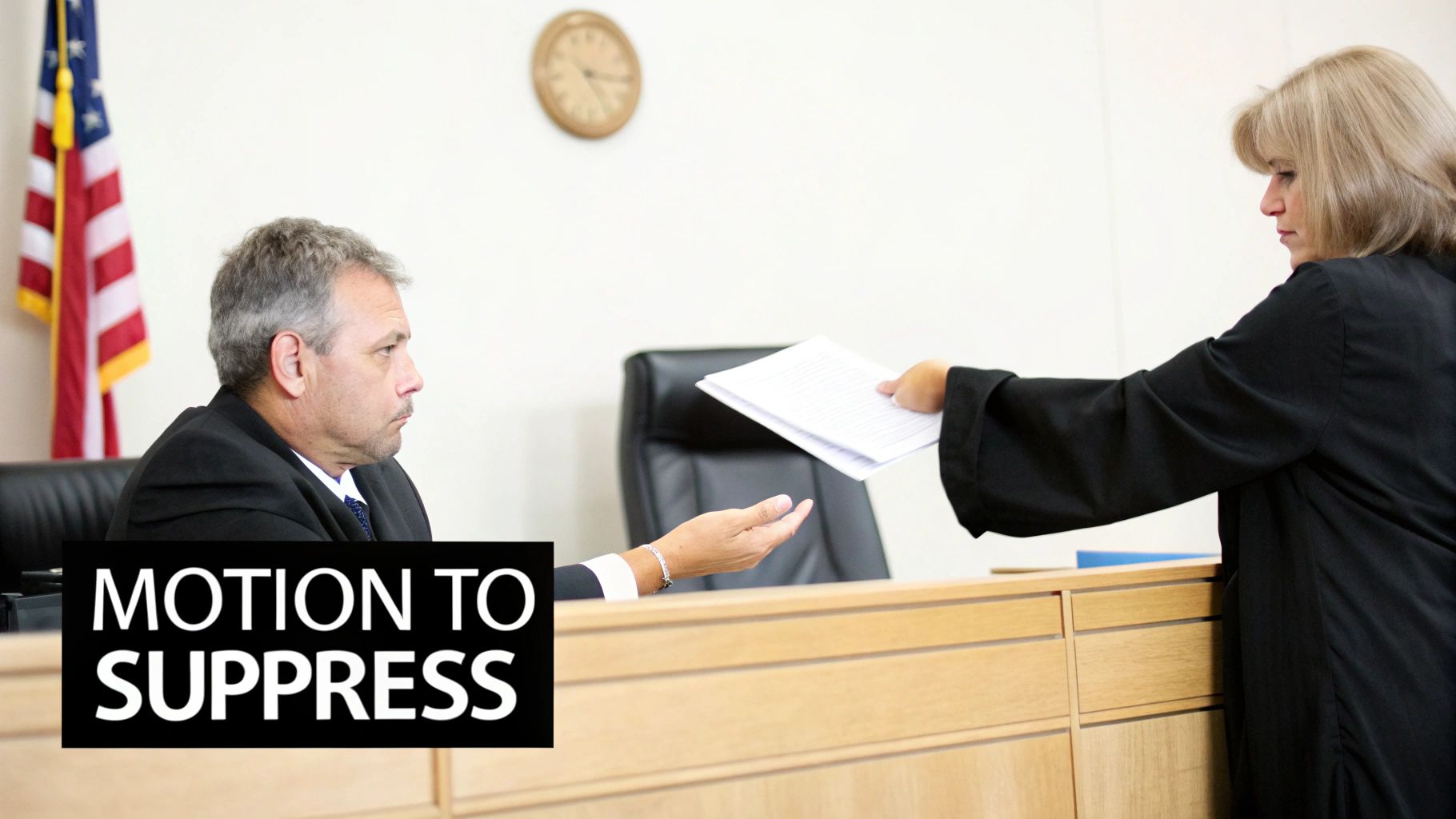
Understanding the exclusionary rule in theory is one thing, but seeing it work in a real courtroom shows its true power. The entire fight happens in court, starting with a written legal argument and moving to a live hearing where a judge makes the final call. This is where a defense attorney formally challenges the government's evidence, aiming to get it thrown out before a jury ever sees it.
The process kicks off with a specific tool: the motion to suppress. This is a formal, written request filed by the defense asking the judge to exclude specific evidence from the trial. The motion lays out exactly what evidence is being challenged and, more importantly, why it was obtained in violation of the defendant’s constitutional rights.
Filing this motion essentially hits pause on the main criminal case. It triggers a separate, smaller hearing focused only on how the evidence was collected. This is called a suppression hearing, and it's where both sides argue their case about the search or seizure in question.
The Suppression Hearing
During a suppression hearing, there’s no jury. The judge alone acts as the fact-finder, listening to testimony and reviewing the evidence to decide if a constitutional violation actually happened. It’s a critical stage where every detail of the police encounter gets put under a microscope.
Typically, the police officers involved in the arrest or search will testify. The prosecutor questions them to build a case that their actions were completely lawful. Then, the defense attorney gets to cross-examine the officers, probing for inconsistencies and highlighting any action that may have stepped over a constitutional line.
A suppression hearing isn't about whether someone is guilty or innocent. It's a focused examination of police procedure. The only question the judge is trying to answer is: did the government follow the rules when it gathered its evidence?
For example, the hearing might dig into whether officers truly had probable cause for a search, if a warrant was executed correctly, or if a person's consent to a search was genuinely voluntary. Winning at this stage often comes down to the specific facts and the defense attorney's ability to build a compelling argument. This is exactly why having strong representation can be important. You can learn more about how to find a good criminal lawyer to help navigate this process.
A Real-World Example From Encounter to Ruling
To see how this plays out from start to finish, let's walk through a common scenario.
Imagine someone is pulled over for a minor traffic issue, like a broken taillight, in Alpharetta. The officer approaches the car and, after a brief chat, claims to smell something suspicious. Based on that claim alone, the officer orders the driver out of the car and conducts a full vehicle search without a warrant.
Inside the glove compartment, the officer discovers evidence of a more serious crime. The driver is arrested and charged. Here’s how the exclusionary rule challenge would unfold in court:
-
Filing the Motion: The driver's lawyer files a motion to suppress the evidence found in the car. The motion argues the officer didn't have the probable cause needed to escalate a simple traffic stop into a full-blown search, making it unconstitutional.
-
The Hearing: At the suppression hearing, the officer takes the stand to testify about the stop and what prompted the search. The defense attorney cross-examines the officer, questioning the credibility of the "suspicious smell" and whether any other real justification for the search existed.
-
The Judge's Decision: After hearing all the testimony, the judge has to make a ruling. If the judge agrees that the officer lacked sufficient probable cause, the search is declared illegal.
-
The Impact: The motion to suppress is granted. This means the evidence found in the glove compartment is excluded from the case. Without that key piece of evidence, the prosecution's case might fall apart, potentially leading to the charges being reduced or dismissed entirely. This entire process shows the real-world impact of the exclusionary rule—it turns a constitutional principle into a powerful, practical defense.
The Debate Over the Rule's Purpose and Impact
Is the exclusionary rule a critical shield for certain constitutional rights, or is it just a loophole that lets guilty people walk free? For decades, this question has been at the heart of one of the most heated debates in the American justice system.
The rule exists at the crossroads of two powerful, and often competing, interests: the need for effective law enforcement and the fundamental protection of every citizen's Fourth Amendment rights.
A Necessary Shield for Freedom
Supporters will tell you that without the exclusionary rule, the Fourth Amendment would be just a bunch of empty words on paper. They see it as the only real tool to discourage police misconduct. By making sure illegally obtained evidence is useless in court, the rule takes away the incentive for officers to cut constitutional corners during an investigation.
From this perspective, the rule isn't just about protecting one defendant; it’s about upholding the integrity of the entire justice system. It keeps the courts from becoming accomplices to unconstitutional police actions. Proponents argue that it forces law enforcement accountability and reinforces a simple but powerful idea: how evidence is gathered is just as important as the evidence itself.
This viewpoint is built on a core belief:
The cost of losing an occasional case is a small price to pay for a system that respects the constitutional limits of government power. It protects every one of us from potential overreach, making sure our rights are real and can be enforced.
Concerns About Public Safety
On the other side of the aisle, critics have serious concerns about the rule's impact on public safety. They argue that it often acts as a technicality, letting clearly guilty individuals get off because of a procedural mistake. This, they claim, erodes public trust in the justice system and ties the hands of police trying to solve serious crimes.
This argument zeroes in on the practical consequences. It suggests that valuable, reliable evidence often gets thrown out, making it much harder for prosecutors to win convictions, especially in violent crime cases. Opponents believe there are better ways to handle police misconduct—like internal discipline or civil lawsuits—that don't risk letting dangerous criminals go free.
The Balancing Act
Ultimately, the debate over how to define exclusionary rule—as a guardian of liberty or an obstacle to justice—shines a light on a central tension in any free society. It forces us to constantly weigh the balance between empowering police to keep our communities safe and ensuring that the government's power stays within its constitutional boundaries.
The rule’s very existence, along with its many exceptions, reflects this ongoing struggle to find that middle ground. It remains a powerful, if controversial, part of criminal law, symbolizing our nation’s commitment to making sure that the pursuit of justice never comes at the expense of our fundamental rights.
Common Questions About the Exclusionary Rule
It's natural to have questions when trying to get your head around a complex legal doctrine like the exclusionary rule. Here are a few of the most common ones that come up.
Does the Exclusionary Rule Apply in Civil Cases?
Generally, no. The exclusionary rule was designed as a check on police power in criminal investigations. It's meant to discourage law enforcement from violating constitutional rights when they're gathering evidence to put someone behind bars.
That's why evidence thrown out of a criminal trial can often still be used in a related civil case, like a personal injury lawsuit or an administrative hearing. Its power is almost entirely confined to the criminal justice system.
How Is It Different from Miranda Rights?
This is a very common point of confusion. While both are powerful protections for the accused, they spring from different parts of the Constitution and protect against different kinds of government overreach.
Think of it this way:
- The Exclusionary Rule is a Fourth Amendment issue. It deals with physical things—evidence illegally seized during a bad search.
- Miranda Rights are a Fifth Amendment issue. They protect against self-incrimination and deal with words—confessions or statements a suspect makes without being properly informed of their rights.
So, a Fourth Amendment violation might get a piece of evidence tossed out, while a Fifth Amendment violation gets an illegally obtained confession suppressed.
Can Suppressed Evidence Ever Be Used?
Surprisingly, the answer is yes, but in very specific and limited ways. Once a judge suppresses a piece of evidence, the prosecution is barred from using it in their main case to prove someone is guilty.
However, "suppressed" doesn't always mean "vanished." That same piece of evidence could potentially be used to attack credibility if someone decides to take the stand and tell a story that contradicts it. In some courts, a judge might even be allowed to consider it during sentencing after a conviction has already been reached.
These exceptions are narrow, but they show that even excluded evidence can sometimes linger in the shadows of a case.
If you are facing criminal charges in Cumming, Alpharetta, or anywhere in the surrounding Georgia area, understanding your rights is the first and most critical step. At Brian Hansford Law, we have over 25 years of courtroom experience, including critical time spent as a prosecutor. That unique perspective allows us to anticipate the other side’s moves and build a powerful defense.
Contact us today to make sure your rights are fully protected. Learn more at challengemycharge.com.
