
Meta Title: Define Home Invasion in Alpharetta, GA
Meta Description: Define home invasion in Alpharetta, GA. Learn how Georgia treats these charges in Fulton County and what to do after an arrest.
Suggested URL Slug: /define-home-invasion-alpharetta-ga
Internal Link Suggestions:
- /burglary-vs-robbery/
- /charged-with-a-felony/
- /can-police-search-your-house-without-a-warrant/
- /dui-defense-attorney-alpharetta-ga/
- /drug-charge-defense-alpharetta-ga/
Schema Recommendations:
- Attorney
- LegalService
- FAQPage
A late-night arrest in Alpharetta, GA for what police call a “home invasion” can feel like your life split in two. One minute you are dealing with Alpharetta Police Department officers, Fulton County deputies, or investigators asking questions. The next, your family is trying to figure out bond, court dates, and whether you are facing a felony in the Fulton County court system.
The first thing to understand is simple. In Georgia, the phrase define home invasion does not lead to a standalone criminal charge the way it does in some other states. That distinction matters. It shapes what the prosecutor has to prove, what defenses are available, and how a case may be challenged in Fulton County Superior Court or during earlier North Fulton proceedings.
If you were arrested in Alpharetta, Johns Creek, Milton, Roswell, Sandy Springs, Dunwoody, Cumming, Marietta, or East Cobb, do not try to explain your way out of this with law enforcement. Do not guess. Do not fill in gaps for investigators. Speak with an attorney today. Your first court date matters, bond conditions matter, and what you say now can affect everything later.
Arrested for Home Invasion in Alpharetta GA What Happens Now
People often do not get much warning. Police show up at a house or apartment. Someone says there was forced entry, a fight, a stolen item, or a weapon. Officers separate everyone, start asking for statements, and the words “home invasion” appear before anyone has slowed down enough to ask what that means under Georgia law.
In Alpharetta, that confusion is common. A person may be arrested by Alpharetta Police Department, booked into the Fulton County system, and told they are facing a serious felony without ever hearing the statutory charge. Family members start searching “define home invasion” or “criminal defense attorney near me” because they need an answer right away.
The immediate priorities are practical.
- Stop talking: You do not help yourself by trying to sound cooperative after arrest.
- Secure counsel early: A lawyer can intervene before a rushed statement hardens into the center of the prosecution’s case.
- Focus on release conditions: Bond terms in Fulton County can shape work, travel, family contact, and where you are allowed to live.
Important: If police want “your side of the story,” assume they are building evidence, not clearing things up.
A North Fulton arrest often moves quickly. A person picked up in Alpharetta may have early appearances tied to local procedure, but a felony-level case can move into the larger Fulton County system fast. That means early mistakes carry real consequences.
If you are trying to understand how serious this is, start with a grounded explanation of what it means to be charged with a felony. Then get specific legal advice based on the accusation, not the label officers used at the scene.
Families in Roswell, Johns Creek, and Milton often ask the same question in those first hours: “Can this still be fought?” Yes. But the best opportunities usually come early, when the facts are still being tested and before the state locks your words into its timeline.
Call now for a consultation. Protect your record. Do not speak to police without representation.
What Home Invasion Means Under Georgia Law
In Georgia, home invasion is not codified as a standalone felony. That is the first point that generic national articles often miss. A case that sounds like “home invasion” in ordinary speech is usually prosecuted under another statute, most often burglary, and sometimes alongside assault, robbery, weapons, or trespass allegations.
That matters in Alpharetta, North Fulton, and Fulton County because defense strategy starts with the exact charge on paper, not the phrase used in conversation.
Georgia treats the conduct as burglary or related offenses
Georgia prosecutes these cases under burglary statutes, including O.C.G.A. § 16-7-1, rather than through a separate home invasion law. States such as Connecticut and Illinois have specific home invasion statutes, but Georgia does not. The same source also notes that in Forsyth County Superior Court, a high percentage of residential burglaries with an occupant present resulted in felony enhancements due to the presence of a dangerous weapon, which shows how quickly allegations can escalate in real Georgia cases (US Legal Forms overview of home invasion law).
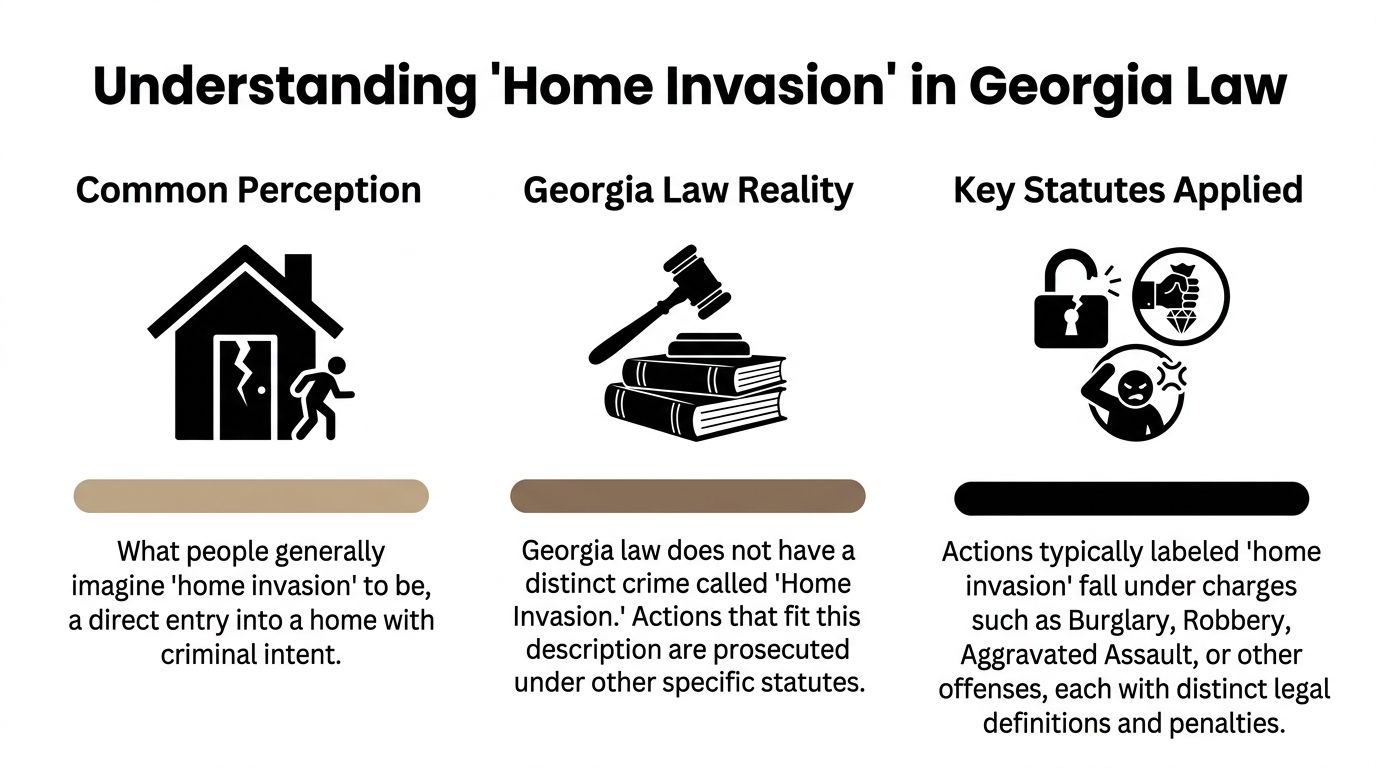
When people search define home invasion, they usually mean one of three things:
- Someone entered a residence without authority.
- The prosecutor claims there was intent to commit theft or another felony inside.
- Occupants were allegedly present, threatened, injured, or aware of the entry.
Those facts can produce very different legal charges.
What the prosecutor usually has to prove
A Fulton County prosecutor typically needs to prove core burglary-related elements such as:
- Entry or remaining: The state must show the accused entered or stayed in a dwelling.
- Without authority: Consent, permission, or a believable claim of right can change the case.
- Intent: The state must prove intent to commit a theft or felony inside the dwelling.
That third issue, intent, is often where cases get more complicated than police reports suggest. Suspicion is not proof. A chaotic argument, a relationship dispute, a property disagreement, or a drunken bad decision may still support criminal exposure, but not always the specific theory the state prefers.
Burglary is not the same as robbery or trespass
Clients often use several legal terms interchangeably when they are not interchangeable at all. That confusion can lead people to misunderstand the risk they face.
Here is a simple comparison:
| Charge type | Core allegation | Key issue |
|---|---|---|
| Burglary | Unlawful entry into a dwelling with intent to commit theft or a felony | What was the intent at entry or while remaining |
| Robbery | Taking property from a person by force, intimidation, or sudden snatching | Focus is on taking property from someone |
| Aggravated assault | Assault involving a deadly weapon or likely serious injury | Focus is threat or injury |
| Criminal trespass | Unauthorized presence or interference without the burglary-level intent | Often turns on consent and property rights |
If you need a clearer side-by-side explanation, this breakdown of burglary vs. robbery is useful because many police narratives blend the two.
Why this distinction creates real defense opportunities in Alpharetta
In practice, a “home invasion” arrest in Alpharetta may involve a former partner, a family member, a roommate dispute, a guest who overstayed, or a person accused of entering through an unlocked door. Those facts do not excuse conduct. But they can affect whether the state can prove unauthorized entry, criminal intent, or a more serious enhancement.
Key takeaway: In Georgia, the fight is rarely over the phrase “home invasion.” The fight is over whether the state can prove burglary or another felony under the actual statute charged.
That is why a careful defense in Fulton County starts with the warrant, the accusation, the body-camera footage, the witness statements, and the timeline of entry. Not with headlines. Not with assumptions.
Penalties and Long-Term Consequences in Fulton County
A person accused of what people call home invasion in Alpharetta is usually dealing with felony exposure. In Georgia, first-degree burglary is treated seriously, and the consequences go far beyond the courtroom.
The immediate penalty risk is prison. The Georgia framework described in the verified material states that first-degree burglary can carry 1 to 20 years imprisonment under O.C.G.A. § 16-7-1. If the allegations also involve violence, a weapon, or related felony charges, the legal danger grows fast.
What a conviction can affect
A felony conviction in Fulton County Superior Court can follow you into almost every part of daily life.
- Employment: Background checks can affect hiring, promotions, and internal discipline.
- Professional licensing: Nurses, teachers, commercial drivers, financial workers, and other licensed professionals face extra scrutiny.
- Housing: Landlords often screen for violent or property-related felony history.
- Firearm rights: A felony record can restrict lawful possession.
- Family and reputation: Parenting issues, immigration concerns, and public trust can all be affected.
For professionals living in Sandy Springs, Dunwoody, Roswell, or Milton, the practical damage often starts before the case is over. Employers may place someone on leave. Licensing boards may ask questions. Security-clearance or credentialing concerns can appear early.
Why Fulton County cases feel especially high stakes
Felony prosecutions in Fulton County are formal, document-heavy, and unforgiving of delay. If the state alleges entry into a dwelling plus a theft or assault theory, the prosecutor may build the case around fear, danger, and risk to occupants. That can influence bond, plea posture, and charging decisions.
A charge that began with one version of events can also expand. Allegations involving a weapon, confrontation, or injury can lead to multiple counts. That changes the ability to negotiate a plea and sentencing exposure.
Practical point: The long-term problem is not just incarceration. It is the permanent record that can remain after one bad night unless the case is handled carefully from the start.
What does not work
People under stress often make the same mistakes:
- Trying to “clear it up” alone
- Assuming no injury means no serious felony
- Waiting until arraignment to hire counsel
- Believing a shared relationship with the resident ends the case automatically
Those assumptions can be costly. A burglary-based prosecution turns on legal elements, not just common-sense explanations. Early defense work is often the difference between reacting to the state’s story and testing whether that story holds up at all.
Strategic Defenses for Home Invasion Charges in Alpharetta
Strong defense work in a so-called home invasion case is rarely dramatic. It is detailed. It focuses on what the state can prove in Alpharetta, Fulton County, and nearby courts, not what the arrest report makes sound obvious.
A good defense starts by stripping the case down to elements, witnesses, and procedures. Then it looks for pressure points.
Entry is often less clear than police reports suggest
The state may claim unlawful entry. But the facts can be messier.
Maybe the accused had been to the residence before. Maybe there was a shared key, a garage code, text-message permission, or a domestic relationship that made authority less clear. In some cases, a person entered through an unlocked door, and the legal dispute becomes not just whether they went in, but whether they were allowed in and what they intended once inside.
This is one reason entry method matters so much. According to FBI data analyzed by ConsumerAffairs, forcible entry accounts for 55.7% of all home invasion incidents, while unlawful entry accounts for 37.8% (ConsumerAffairs home invasion statistics). In a criminal case, that distinction is not academic. It can shape how aggressively the state argues intent, danger, and credibility.
Intent is often the battlefield
A lot of burglary cases rise or fall on intent. Prosecutors do not just need a person inside a residence. They need a theory for what crime the person meant to commit there.
Intent can be challenged in several ways:
- Misunderstood purpose: The accused went to retrieve property, continue an argument, or confront someone, not commit theft or another felony.
- Conflicting statements: Witnesses describe the event differently, which weakens the state’s theory of planned criminal purpose.
- Conduct after entry: What happened inside may not match the prosecution’s claim about what was intended from the start.
In domestic and family-linked cases in North Fulton, this is often where negotiation and litigation both become possible.
Search and seizure problems can change a case
Police sometimes move fast in emotionally charged residence-based cases. That speed creates legal issues.
If officers searched a house, phone, vehicle, or personal property without proper legal authority, the defense may file motions to suppress. If a statement followed an unlawful detention or a Miranda problem, that can also shift the case. Search issues do not automatically win a case, but they can remove key evidence and reshape plea discussions.
This overview of when police can search your house without a warrant highlights the kinds of Fourth Amendment questions that often matter in home-entry prosecutions.
Defense reality: What works is not broad outrage about unfair treatment. What works is identifying a specific constitutional violation and tying it to specific evidence the state wants to use.
Mistaken identity is still common in residence cases
People assume a home-related allegation always produces strong identification. Not necessarily.
Lighting can be poor. Stress distorts memory. Witnesses may know the accused only partially, or may identify based on voice, clothing, or assumption. In fast-moving incidents, especially those involving multiple people, certainty can sound stronger on paper than it does under cross-examination.
That is why the defense reviews:
- body-camera footage
- surveillance video
- call logs
- text messages
- location evidence
- prior relationship evidence between witnesses and the accused
Lesser-charge framing can be powerful
Not every accusation that sounds like home invasion legally supports burglary. Sometimes the better defense is not an all-or-nothing trial posture. Sometimes it is forcing the legal frame back toward trespass, disorderly conduct, or another less serious view of what happened.
An emerging example is cuckooing, a non-violent home takeover in which vulnerable individuals are pressured into allowing illegal activity in their homes. Verified data notes many such incidents in metro Atlanta, including Forsyth and Cobb counties, and says local police in Marietta and Roswell have seen an increase in related reports (Cambridge-linked verified data reference). In Georgia, that kind of allegation may support a very different legal analysis than the classic armed-break-in narrative.
That matters because the defense may be able to reframe the conduct around issues of consent, coercion, trespass, or drug-related allegations rather than accept a burglary label at face value.
First Offender and diversion questions
People often ask whether the Georgia First Offender Act or a pretrial diversion option can help. Sometimes yes. Sometimes no.
Eligibility depends on the charge, the client’s background, the county, and the facts the prosecutor believes can be proved. In Fulton County, serious felony allegations receive close review, but that does not mean alternatives are off the table in every case. A strategic lawyer looks at whether rehabilitation-focused resolution, negotiated reductions, or a structured non-conviction path can be argued.
That can matter considerably for:
- first-time offenders
- college students
- young adults
- professionals worried about licenses
- parents trying to protect future employability
What usually helps and what usually hurts
The best defense choices are often the least emotional.
What helps
- preserving texts, call records, and location data
- identifying consent or relationship evidence early
- avoiding witness contact that can be misread
- preparing for Fulton County bond hearings and conditions
- reviewing every statement for inconsistencies
What hurts
- apologizing in texts “just to calm things down”
- trying to talk the complainant into recanting
- deleting messages
- posting online
- assuming local prosecutors will treat this like a misunderstanding
In Alpharetta and across North Fulton, the right defense is built case by case. There is no script. But there is a pattern. The strongest results usually come from narrowing the accusation to what can be proved, then attacking the weak point with discipline.
Navigating the Fulton County Court Process from Arrest to Trial
After an arrest in Alpharetta, the court process can feel mechanical and confusing. It helps to know the order of events and what each stage is really about.
Booking and the first appearance
After arrest, the person is booked. Then comes the initial appearance and bond process.
In Fulton County, bond hearings matter. Conditions of release can restrict travel, contact with alleged victims, and access to a home or neighborhood. For people living or working in North Fulton, those restrictions can affect childcare, employment, and even where they sleep that night.
This is also where early legal representation can make a practical difference. Counsel can address release conditions, begin gathering favorable facts, and position the case before the prosecution’s first version hardens.
Local court path in Alpharetta and beyond
A felony residence-related charge may begin with local handling, but it does not stay local for long. Depending on the charge and posture, early appearances may intersect with local procedures or Alpharetta Municipal Court matters, while the felony prosecution itself moves into Fulton County Superior Court.
That transfer matters because the case becomes more formal at each stage. The District Attorney’s office, not just the arresting officer, now shapes the path forward.
Arraignment, discovery, and motions
Once formal charges are in place, the defense reviews the accusation and enters pleas at arraignment. Then the important work begins.
Discovery is the state’s evidence package. It may include:
- incident reports
- witness statements
- body-camera footage
- surveillance
- forensic material
- 911 calls
- phone extractions
At that point, the defense is testing specifics. Did the state overcharge the entry? Is the timeline shaky? Is there proof of force?
That last question matters because, as noted in verified data, forcible entry accounts for a significant portion of home invasion incidents, while unlawful entry accounts for a smaller but still substantial portion. When force is weakly supported, the defense may have room to challenge the most serious theory or push for lesser treatment.
Practical tip: The police report is a starting claim, not the final version of the facts. Discovery often reveals gaps, contradictions, or overstated conclusions.
Plea negotiations are not automatic surrender
A lot of clients hear “plea negotiation” and think the case is over. It is not.
Good plea discussions happen after the defense has done enough work to expose problems in the state’s case. Sometimes that means arguing over entry. Sometimes over intent. Sometimes over the reliability of an identification or whether a statement should be suppressed.
In Fulton County Superior Court, serious cases often require patience. Quick offers are not always good offers. North Fulton prosecutors respond differently when they know the defense has reviewed the file carefully and is prepared for motion practice or trial.
Trial preparation if the case does not resolve
If the case does not settle, trial preparation becomes the focus. That means witness interviews, cross-examination planning, evidentiary motions, jury strategy, and a clear theory of defense.
A trial can center on one question or several:
| Trial issue | Why it matters |
|---|---|
| Authority to enter | If entry was permitted or arguably permitted, burglary becomes harder to prove |
| Intent at the time of entry | The state must prove more than presence inside the home |
| Identity | Weak identification can create reasonable doubt |
| Use of force or weapon evidence | Affects severity, credibility, and related counts |
The process is stressful, but it becomes more manageable when you know what stage you are in and why it matters. In Alpharetta, Roswell, Johns Creek, Milton, Sandy Springs, Dunwoody, Cumming, Marietta, and East Cobb, people often come in overwhelmed by the phrase “home invasion.” The court process forces the case into legal components. That is where defense work becomes effective.
Why Choose Brian Hansford for Your Defense in Alpharetta
When you are facing a serious felony allegation in Alpharetta, you need more than a lawyer who can recite statutes. You need someone who understands how prosecutors build these cases, how North Fulton courts move, and where early defense decisions can change the outcome.
Brian Hansford brings that perspective as a former prosecutor with more than 25 years of legal experience. That matters in residence-related felony cases because the state often tries to frame the story quickly around fear, danger, and intent. A defense lawyer who has worked from the prosecution side knows how those files are evaluated, where weak points tend to hide, and which issues deserve immediate pressure.
His practice is rooted in the communities where these cases are being prosecuted. That includes Alpharetta, Fulton County, North Fulton, and surrounding areas such as Johns Creek, Milton, Roswell, Sandy Springs, Dunwoody, Cumming, Marietta, and East Cobb. That local familiarity matters when dealing with local law enforcement agencies, bond conditions, prosecution patterns, and the practical realities of Fulton County State Court, Fulton County Superior Court, and Alpharetta Municipal Court.
This is also a high-stakes practice for people with a lot to lose. Professionals worried about their licenses. Parents trying to protect their families. College students trying not to derail their future. First-time offenders who have never been inside a courtroom before.
If you are under investigation or already charged, do not wait for the next court date to get serious about your defense.
Speak with an attorney today. Call now for a consultation. Protect your record before the state defines your case for you.
Frequently Asked Questions About Home Invasion Charges in Georgia
Q: Is home invasion a real criminal charge in Alpharetta, GA
A: In Georgia, “home invasion” is usually not a standalone charge. In Alpharetta and across Fulton County, prosecutors typically use burglary and related felony statutes instead. That distinction matters because the defense focuses on the actual elements charged in court, not the label used by police at the scene.
Q: What court handles a home invasion type felony case in Alpharetta
A: A felony case tied to Alpharetta can begin with local procedures, but prosecution usually moves into Fulton County Superior Court. Early appearances, bond issues, and related local matters may still connect to the Alpharetta area, so it is important to have counsel who knows both local practice and the larger Fulton County court system.
Q: Should I talk to Alpharetta Police Department if I did nothing wrong
A: No. Even innocent explanations can be used against you if they are incomplete, inconsistent, or taken out of context. If Alpharetta Police Department or another agency wants a statement, ask for a lawyer immediately and stop answering questions until you have legal advice.
Q: Can a case be reduced if there was no forced entry
A: Sometimes. In Georgia, the way the prosecutor proves entry can affect the strength of the case. If the evidence points to consent, an unlocked door, or disputed authority to enter, the defense may have room to challenge burglary allegations or push for a lesser charge in Fulton County.
Q: What happens after bond in Fulton County
A: After bond, the case continues. You may face conditions about contact, travel, or returning to a residence. Then the case moves through charging, arraignment, discovery, motions, negotiation, and possibly trial. Missing a court date or violating release conditions can make an already serious case much worse.
Q: Can first offenders avoid a conviction in Georgia
A: Sometimes, but it depends on the facts, the charge, and your record. In some cases, the Georgia First Offender Act or a diversion-based resolution may be worth pursuing. In serious felony cases in Fulton County, those options require a careful strategy and should never be assumed.
Q: What if the allegation involves a family member or former partner
A: Those cases are common and often more complex than they first appear. Prior permission to enter, shared property, ongoing contact, and emotional disputes can all affect the defense. But they can also produce added allegations, including assault or protective-order issues, so early legal guidance is critical.
Q: How fast should I hire a lawyer after an arrest in North Fulton
A: Immediately. The early stage affects bond, evidence preservation, witness issues, and how the case is framed before prosecutors. Waiting until your first major court date in Fulton County often means losing opportunities that were available right after arrest.
If you need clear advice after a serious arrest in Alpharetta or anywhere in North Fulton, contact Brian Hansford Law. Brian Hansford is a former prosecutor who defends clients facing felony and misdemeanor charges throughout Alpharetta, Fulton County, Johns Creek, Milton, Roswell, Sandy Springs, Dunwoody, Cumming, Marietta, and East Cobb. Call now for a consultation, protect your record, and speak with an attorney today.
