
When you are facing a criminal charge in Alpharetta, GA, the prosecutor's case is only one side of the story. The other side—the context, the circumstances, and your personal history—is where mitigating factors come into play. These are not just excuses; they are powerful, legally recognized reasons for a prosecutor or judge in Fulton County to show leniency, reduce a charge, or agree to a more favorable sentence.
If you have been arrested in Alpharetta, Milton, or anywhere in North Fulton, understanding these factors is your first step toward building a strong defense. Do not speak to the police without representation. Call our office for a confidential consultation to protect your record and your future.
What Are Mitigating Factors In A Criminal Case?

Why This Matters in Alpharetta
When you're arrested in Alpharetta or anywhere in North Fulton, the prosecutor's job is to prove guilt. They often do this by stacking up aggravating factors—details designed to make the offense look worse and justify a harsh penalty.
A strategic defense attorney’s job is to push back against that narrative. We don’t just challenge the state's evidence; we build a proactive case for you. This is where a strong mitigation strategy becomes our most powerful tool. Deadlines in Fulton County move quickly, and building this case must begin immediately.
In the courtrooms of Fulton County, from the Alpharetta Municipal Court to the Superior Court, a well-presented mitigation package can be the single most critical element in securing a good outcome. It moves you beyond the black-and-white of a police report and shows the court you are more than one alleged mistake.
Charge Breakdown: Mitigating vs. Aggravating Factors In Fulton County Courts
It’s crucial to understand what helps your case versus what hurts it. Fulton County prosecutors will zero in on every negative detail they can find. Your attorney’s job is to be ready with a compelling counter-narrative built on positive, verifiable information.
Here’s a look at how these opposing forces play out in a Georgia courtroom.
| Factor Type | Definition And Goal | Examples In a Fulton County Case |
|---|---|---|
| Aggravating Factors | Information the prosecutor uses to argue for a harsher sentence. The goal is to portray the offense and the defendant in the worst possible light. | A prior criminal record, especially for similar offenses. Using a weapon during the incident. Causing significant harm or loss to a victim. Taking a lead role in planning the offense. |
| Mitigating Factors | Evidence your attorney presents to argue for leniency. The goal is to provide context and humanize you, justifying a reduced charge or lighter sentence. | No prior criminal history—often the strongest factor for a first-time offender in Alpharetta. Showing genuine remorse. Playing a very minor role in the offense. Personal struggles like addiction, mental health issues, or acting under duress. |
This contrast is why presenting a complete picture of who you are—a good employee, a dedicated family person, a respected member of your community in Roswell or Milton—is so essential.
Defense Strategy: The Role Of Mitigation In Plea Negotiations
The vast majority of criminal cases, whether in Alpharetta Municipal Court or Fulton County State Court, are resolved through plea negotiations, not a jury trial. This is where your attorney sits down with the prosecutor and presents the "mitigation package."
This is a critical moment. Understanding how prosecutorial discretion works is key, because a powerful set of mitigating factors can give a prosecutor the justification they need to offer a better deal. It might mean reducing a felony to a misdemeanor, dropping some charges altogether, or agreeing to a sentence that keeps you out of jail.
For our clients from Sandy Springs to Cumming, this evidence—from character reference letters to proof of proactive enrollment in counseling—is often the key to protecting their permanent record, their job, and their future.
How A Lack Of Criminal History Helps Your Alpharetta Case
When you're facing an arrest in Alpharetta, Roswell, or Johns Creek, your strongest asset might not be a legal argument from a book. Often, it’s your own life story. Having no prior criminal history completely changes the conversation with prosecutors and judges.
A clean record is one of the most persuasive mitigating factors you can have. From the Alpharetta Municipal Court to the Fulton County courts, judges and prosecutors are far more willing to view a first-time offense as a one-time, uncharacteristic mistake. It allows us to frame the situation for what it is: a good person who had a bad day, not a danger to the community.
This isn't just a feeling; it’s a principle backed by data. National sentencing research shows that a lack of criminal history has a real impact on case outcomes. Defendants with no prior record consistently receive significantly shorter sentences than those with criminal histories. This confirms what we see in courtrooms from Cumming to Dunwoody every day: a clean past is a powerful tool for securing a better future. You can find additional details on how courts weigh these factors.
Your Clean Record In The Alpharetta Court System
For first-time offenders in the North Fulton legal system, a clean record opens up doors to resolutions that are simply off the table for someone with a criminal past. We use your good name to argue for outcomes designed to protect your future, not to punish you for a single mistake.
This is especially critical for people living in communities like Milton and Sandy Springs, where keeping a professional license or passing a background check is non-negotiable.
Your clean slate makes you an ideal candidate for strategic resolutions such as:
- Pre-Trial Diversion Programs: These are special agreements with the Fulton County prosecutor’s office. You complete certain tasks—like classes or community service—and in return, your charges get dismissed entirely.
- Conditional Discharge: This resolution is often available for first-time drug offenses in Georgia. After you successfully complete a period of probation, the case is dismissed, and no conviction ever goes on your record.
- Georgia First Offender Act: The Georgia First Offender Act is a powerful tool. It allows a judge to let you complete your sentence without formally entering a conviction. Once you’re done, the charge is sealed from your public criminal history, giving you a true second chance.
An arrest does not have to define the rest of your life. When I walk into court, I’m not just defending against a charge; I'm introducing a valued member of our North Fulton community who deserves the chance to move on without this one incident holding them back.
Humanizing Your Case For Fulton County Prosecutors
When I sit down with a prosecutor in Alpharetta or Fulton County, my first job is to get them to see beyond the police report and see the actual person involved. Your lack of a criminal history is what makes that possible.
Are you a valued employee in East Cobb? A parent who volunteers at your child's school in Dunwoody? A college student trying to build a future? These aren't just minor details—they are crucial pieces of the story. I work with clients to gather character reference letters, proof of employment, and any evidence of community ties to build a comprehensive "mitigation package."
By presenting this information, we show that the incident was completely out of character, not part of a larger pattern. This gives the prosecutor the reason they need to use their discretion in your favor. Instead of seeking harsh penalties, they become open to discussing dismissals, reducing the charges, or agreeing to a diversion program. Your clean record is what starts that conversation. Speak with an attorney today to begin this process.
The Strategic Power Of Showing Remorse And Accountability

When you're facing criminal charges in Fulton County, it's natural to think that saying "I'm sorry" is the same as pleading guilty. That's a common mistake, and it can be a costly one.
While you should never admit guilt to the police without an attorney by your side, taking proactive steps to show genuine accountability can be one of the most powerful moves you make. This is about more than just words; it’s about demonstrating real remorse through your actions.
Prosecutors and judges in courts across Alpharetta, Roswell, and Johns Creek are people. They are far more receptive to a person who takes responsibility than to one who doesn't. When you take meaningful steps before your court date—like voluntarily starting a treatment program or paying a victim back—it completely changes the dynamic of your case.
Proactive Steps That Show Real Accountability
Saying you're sorry is one thing. Proving it is another. In courts from Sandy Springs to Cumming, your actions will always speak louder than your words. We guide our clients to take specific, meaningful actions that show the court this incident was out of character, not a pattern of behavior.
A few powerful proactive steps include:
- Voluntary Treatment or Counseling: Immediately enrolling in a DUI risk reduction class, an anger management program, or substance abuse counseling shows a judge you're serious about addressing the root of the problem.
- Paying Restitution Early: If someone lost money or had property damaged, working to pay them back before the court even orders it is a powerful sign of personal accountability.
- Writing a Sincere Apology Letter: Under our guidance, a well-crafted letter of remorse can be a compelling tool, especially in places like Alpharetta Municipal Court where community impact is a significant factor.
Taking these steps isn't a sign of weakness—it's a demonstration of character and a smart legal strategy. It hands your attorney the tools needed to argue for a better outcome, transforming you from just another case file into a person who is taking control of their future.
How Remorse Impacts Plea Deals And Sentencing
Another critical mitigating factor is showing sincere remorse through an early acknowledgment of responsibility. This strategy has changed outcomes in courtrooms across North Fulton. The data backs this up. Federal sentencing guidelines consistently show that defendants who accept responsibility early often receive significantly lighter sentences. You can learn more about how mitigating factors influence sentencing outcomes.
As a former North Fulton prosecutor, Brian Hansford knows the impact these actions have on the other side of the aisle. He understands exactly how to frame this evidence for a prosecutor or judge. It’s a delicate balance—accepting responsibility for your actions while fiercely protecting your legal rights.
This approach is often the key to getting charges reduced, securing a favorable plea offer, or convincing a judge to order a sentence focused on rehabilitation, not just punishment.
Using Mental Health Or Addiction As Mitigating Factors
When facing a criminal charge in the Alpharetta or Fulton County courts, we have to look past the single event and understand the whole story. For many people, that story includes a documented history of mental health challenges or a struggle with substance addiction. This isn't an excuse—it's critical context that can fundamentally change the outcome of a case.
This isn't about dodging responsibility. It's about showing a prosecutor or a judge how conditions like depression, PTSD, anxiety, or a substance use disorder directly influenced your state of mind and actions. When presented correctly, your personal battles become a powerful reason for a sentence that favors treatment and rehabilitation over simple punishment.
Turning Personal Struggles Into a Legal Strategy in Alpharetta
Courtrooms from Alpharetta to Roswell are more open to the connection between untreated mental health or addiction and criminal behavior. But just saying you were struggling isn't enough. Building a real defense requires a methodical, documented approach.
We help our clients formally prove these challenges are real. This means gathering concrete evidence, such as:
- Psychological or Psychiatric Evaluations: An assessment by a qualified professional provides a formal diagnosis and explains how that condition likely impacted your judgment at the time of the incident.
- Treatment Records: Showing a history of therapy, counseling, or rehab proves you've been trying to address the root problem. It shows the court you are taking this seriously.
- Expert Testimony: Sometimes, the most powerful tool is having a mental health expert testify in court, giving the judge and prosecutor a clear, persuasive explanation.
This process takes a private struggle and turns it into a compelling legal argument for a more humane and effective outcome.
The infographic below shows how we structure a defense around these factors, moving from initial evaluation to courtroom argument.
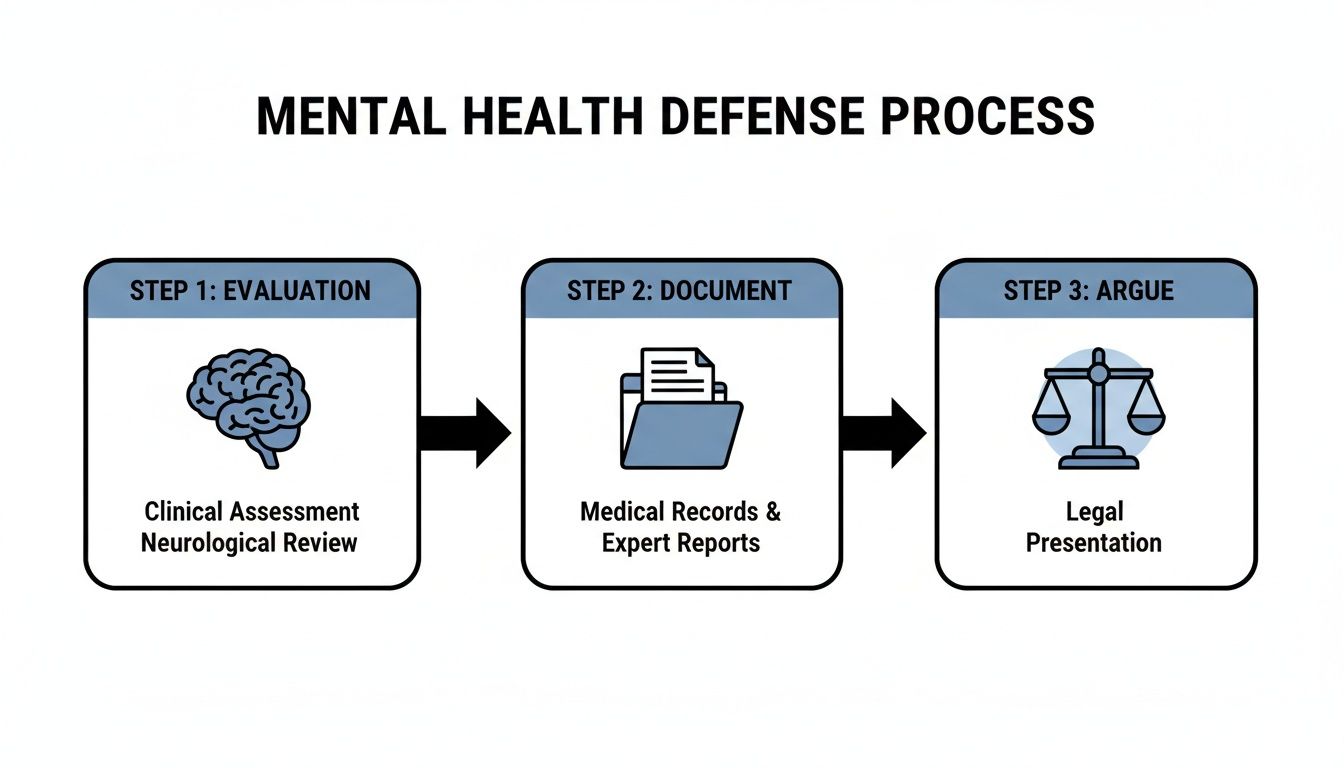
As you can see, a successful strategy is built on a structured approach to documenting and arguing how these factors played a role.
The Court Process in Fulton County: Impact on Sentencing
Mental health and addiction are powerful mitigating factors that can absolutely alter a sentence. This is especially true for those facing DUI or drug charges in Alpharetta, as these issues demonstrate diminished culpability. According to U.S. Sentencing Commission data, documented mental illness and addiction issues regularly lead to significant sentence reductions when properly presented.
When we present this evidence, we aren’t asking for a free pass. We are asking the court to choose the most effective path forward—one that prioritizes treatment, reduces the likelihood of another offense, and gives a member of our community in Milton, Johns Creek, or Sandy Springs a real chance to heal.
For many of our clients, their mental state is the core of their story. It’s also crucial to understand the legal standards for a defendant's ability to even participate in their own defense. For more on this, you can read also about the legal concept of competency to stand trial. Building a case around these deeply personal issues requires both legal skill and a genuine understanding of what you're going through.
How An Alpharetta Attorney Builds Your Mitigation Case

A solid criminal defense in Alpharetta isn't just about fighting the prosecutor’s case against you. A truly effective strategy involves building our own case—a case for you. It’s about proactively telling your story, not with excuses, but with real proof of your character and who you are beyond this one charge.
We start this process on day one, long before we ever see a courtroom. Our first move is to assemble what we call a mitigation package. Think of it as a carefully organized portfolio of your life, designed to show the prosecutor and the judge the whole person, not just the defendant on a file.
The most effective legal arguments are often built long before we step into a courtroom. A well-prepared mitigation package demonstrates a commitment to accountability and gives us the leverage needed to negotiate for a better outcome.
Gathering The Building Blocks Of Your Case
The first step is a deep dive into your personal story to find every single mitigating factor we can use. This is a team effort between you, your family, and our firm. We work together to collect powerful evidence that speaks to your character, your responsibilities, and your place in the community.
This isn’t just about collecting random papers. We are meticulous. We don't just ask an employer for a letter; we guide them on how to write one that will actually make a difference to a prosecutor in Fulton County. We want to paint a full picture of a responsible person.
Key pieces of evidence often include:
- Powerful Character Reference Letters: We need letters from people who know you best—employers, pastors, coaches, and mentors from Dunwoody to Milton—who can vouch for your work ethic and integrity.
- Proof of Responsibility: This is concrete evidence of your stability. Think employment records, school transcripts, military service papers, or proof of consistent volunteer work.
- Documentation of Proactive Steps: Nothing speaks louder than action. Showing proof that you’ve already enrolled in counseling, addiction treatment, or relevant community classes demonstrates genuine remorse and a commitment to change.
This collection of documents is the raw material we use to build a compelling narrative about you. Each piece helps us show the court there's more to you than this single incident.
Crafting Your Story Into A Formal Argument
Once we have all the evidence, we don't just dump a messy file on the prosecutor's desk. An experienced Alpharetta defense attorney knows how to organize these materials into a formal, persuasive document called a sentencing memorandum or mitigation package.
This is a formal legal document we submit directly to the prosecutor and judge before your court date. It lays out your story in a structured and compelling way, framing all the mitigating evidence we gathered within a legal context. It’s our chance to explain why a lenient outcome is not only fair but is the most just resolution.
This memorandum is your official introduction to the court, and it allows us to make a strong first impression. We get to control the narrative, define the terms of the conversation, and argue for a result that focuses on your future, not just your past.
Knowing how to get probation instead of jail time often starts right here. A powerful, well-crafted memorandum can be the single most important tool for securing an outcome that protects your record and lets you move forward with your life.
Why Choose Brian Hansford in Alpharetta
It’s one thing to know what a mitigating factor is. It's another thing entirely to use them effectively in an Alpharetta courtroom to protect your future. This is where real-world experience and local relationships make all the difference. When everything is on the line, you need a criminal defense attorney near me who doesn't just know the law—you need someone who knows the people and the system in North Fulton.
A Former North Fulton Prosecutor On Your Side
Brian Hansford served for years as a prosecutor right here in the North Fulton court system. That’s a perspective you can’t get from a textbook. He saw firsthand how prosecutors in Fulton County build their cases and, more importantly, what kind of mitigating evidence actually persuades them to offer a better deal.
This gives our clients a serious edge. We aren't guessing what arguments might work. We build a mitigation strategy from an insider’s point of view, anticipating the prosecutor's next move and telling your story in a way that directly addresses their concerns.
Strategic And Protective Representation In Alpharetta
A criminal charge is stressful and personal. You aren't just a case number, and your attorney should treat you with the respect you deserve. Brian Hansford provides a calm, direct, and strategic presence to guide you through the confusing court proceedings in Alpharetta, Roswell, and Milton.
Our goal is simple: to make the judge and prosecutor see you as a person. We work hard to present your full story—whether you’re a professional from Sandy Springs worried about your license, a parent in Johns Creek, or a young adult from Cumming who made a mistake and deserves a second chance.
We have a proven history of using well-prepared mitigation strategies to secure better outcomes for our clients. Whether we're arguing for a pre-trial diversion program or presenting evidence for a reduced sentence under the Georgia First Offender Act, our focus is always on protecting your future.
If you are facing charges in North Fulton, you need to act now. Call Brian Hansford for an immediate and confidential case review. Your story needs to be told, and we know exactly how to tell it.
FAQ: Mitigating Factors in Alpharetta, GA
Here are answers to some of the most common questions we hear about mitigating factors in the Alpharetta, Cumming, and greater Fulton County legal systems.
Q: Can mitigating factors get my case dismissed in Alpharetta?
A: While mitigating factors rarely lead to a direct dismissal, they are critical for achieving that outcome. A strong mitigation package can persuade a prosecutor in Alpharetta Municipal Court or Fulton County State Court to offer a pre-trial diversion program. Completing this program successfully results in the charges being dismissed, protecting your record.
Q: How much do mitigating factors really matter to Fulton County judges?
A: They matter a great deal. Judges in Fulton County Superior and State Courts see hundreds of cases. A well-presented set of mitigating factors humanizes you, providing context for the alleged offense. This allows a judge to justify a more favorable sentence, such as probation over jail time or sentencing under the Georgia First Offender Act.
Q: What is the most powerful mitigating factor for a DUI in Alpharetta, GA?
A: For a first-time DUI charge in Alpharetta or Johns Creek, proactively enrolling in a DUI Risk Reduction program (DUI school) or getting a substance abuse assessment before a court orders it is incredibly powerful. This action demonstrates genuine remorse and accountability, which can significantly influence the outcome and sentence proposed by the prosecutor.
Q: Can I still use mitigating factors if I have a prior record?
A: Yes, absolutely. While a clean record is a strong factor, it’s not the only one. We can still build a powerful mitigation case by emphasizing the time since your last offense, your stable employment in Sandy Springs or Cumming, your family responsibilities, and any proactive steps you've taken, like counseling, to address past issues.
Q: What is a "mitigation package" and how is it used in Alpharetta courts?
A: A mitigation package is a formal collection of documents—character letters, employment records, proof of counseling—that we assemble for you. We present this to the Fulton County prosecutor before your court date. It tells your side of the story and gives the prosecutor the justification they need to offer a more lenient plea deal.
Q: How does being a student or professional affect my case in North Fulton?
A: Your status as a student or a licensed professional is a significant mitigating factor. For professionals in Roswell or Milton, we can argue that a conviction would disproportionately harm your livelihood. For students, we can focus on protecting your educational future. This context helps us argue for resolutions that won't derail your career or academic path.
Q: What should I do right after an arrest in Alpharetta to start building my case?
A: First, do not speak to law enforcement without an attorney. Second, call a local criminal defense attorney immediately. Third, start gathering names of potential character references (employers, mentors). Preserving evidence and starting your defense strategy on day one is critical, as deadlines in the Fulton County court system approach quickly.
Don't let the prosecution be the only one telling your story. A strong defense requires immediate, strategic action to present your case in the most favorable light. At Brian Hansford Law, we have the local experience to build a powerful mitigation argument on your behalf. Call us today for a confidential consultation to protect your future.
