
People often use the terms "expunged" and "sealed" as if they mean the same thing, but in Georgia, they represent two very different outcomes for a criminal history. The core difference really boils down to this: expungement aims to completely destroy a record, while sealing (which is called record restriction in Georgia) simply hides it from public view.
Understanding Expunged vs. Sealed Records
When a criminal record is restricted, it doesn't vanish. Instead, access is severely limited, making it invisible to the general public. This means most potential employers, landlords, and nosy neighbors won't ever see it.
Expungement, however, is a much more permanent solution. It's the process of physically destroying or obliterating the record. The goal is to treat the incident as if it never happened in the first place.
This distinction is fundamental to how the justice system approaches second chances. With a restricted record, courts and probation departments will typically report that 'no record exists' to most inquiries. However, certain entities, like law enforcement or government agencies requiring high-level security clearance, can still get access. You can read more about the legal differences between sealing and expunging records to see how various states handle this issue.
Key Differences At a Glance
Getting a handle on these differences is the first step toward figuring out your options. While both restriction and expungement offer a path to a cleaner slate, the level of clearance you get is what really matters. A restricted record still exists, but an expunged one shouldn't show up on any background check.
This infographic gives a great visual breakdown of what we're talking about.
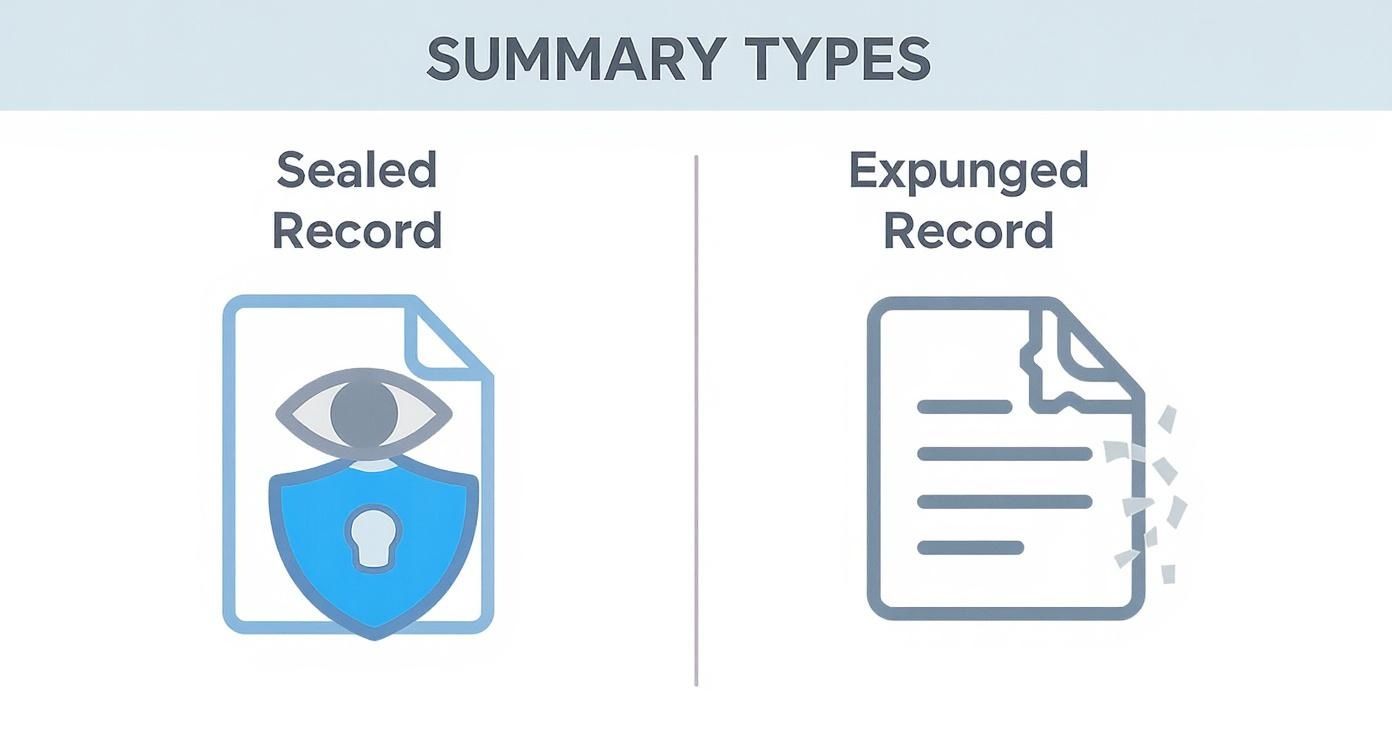
Seeing the difference between hiding a record and destroying it makes the purpose of each process crystal clear.
The most important takeaway is that sealing limits visibility, while expungement seeks complete removal. This distinction is crucial for individuals in areas like Alpharetta and Forsyth County who need to pass background checks for employment or housing.
To give you a clearer picture, let's break down the two options side-by-side.
Key Differences At a Glance Expunged vs Sealed Records
This table provides a quick reference to compare the core features of a sealed (restricted) record versus a truly expunged one.
| Feature | Sealed Record (Restriction) | Expunged Record (Erasure) |
|---|---|---|
| Public Accessibility | Hidden from public view (employers, landlords) | Completely removed and inaccessible to the public |
| Law Enforcement Access | Generally accessible to law enforcement & government | Typically not accessible, even to law enforcement |
| Impact on Employment | Most employers will not see the record | Cannot be seen by any employer |
| Permanence | Record still exists but is hidden from view | Record is permanently destroyed or erased |
Thinking about which path is right for you depends entirely on your specific case and what you're eligible for under Georgia law.
Eligibility for Record Restriction in Georgia

So, do you qualify to have your record restricted in Georgia? That’s the first real question to answer. Georgia law has very specific rules about who gets this second chance, and it almost always comes down to how the original case ended. This isn't a free pass for every charge or conviction.
The clearest path to eligibility is for cases that didn't result in a conviction. If your charges were dismissed, dropped by the prosecutor (nolle prosequi), or if you went to trial and were found not guilty, you’re likely in a strong position to restrict the arrest record. This is the most common way people clear a criminal history that’s visible to the public.
The whole point of the law is to help people who got tangled up in the justice system but were never actually found guilty of a crime. Still, the process isn’t always automatic, and the specific details of a dismissal or acquittal matter.
Cases Without a Conviction
For many individuals in Forsyth and Cobb Counties, an arrest that never turned into a conviction is the most direct route to getting a record restricted. Georgia law recognizes that an arrest alone, even when you're innocent, can leave a stain on your reputation.
Here are the most common non-conviction situations that typically qualify for restriction:
- Charges were dismissed: The prosecutor decided not to move forward with the case before it ever got to trial.
- Acquittal: You were found "not guilty" by a judge or jury after fighting the charges.
- No charges filed: You were arrested, but the prosecutor looked at the evidence and chose not to formally file any charges.
In these scenarios, Georgia law allows you to petition the court to restrict that arrest from public view. This helps make sure a case that went nowhere doesn't interfere with your future job or housing prospects.
A key point to remember is that eligibility is determined by the final disposition of your case. An arrest alone doesn't disqualify you; what matters is how the case officially concluded.
Special Programs and Misdemeanors
Georgia also opens the door for people who successfully completed certain diversion or pre-trial programs. There are even options for some misdemeanor convictions, recognizing that a past mistake shouldn't follow you forever.
The First Offender Act is a big deal here. This program allows many first-time offenders to avoid a conviction entirely if they successfully finish their sentence. Once all terms have been met, the record gets sealed from public view. Conditional discharge programs, often used for certain drug offenses, work in a similar way, leading to restriction after completion of the program.
The law has also changed over the years to allow for the restriction of some misdemeanor convictions. This, however, comes with a waiting period. After all fines are paid and every part of a sentence (including probation) is finished, you generally must wait four years with a clean record before you can petition the court. You can find more details in our guide on how to expunge a misdemeanor charge.
Waiting Periods and Other Considerations
Waiting periods are pretty standard, but how long you have to wait varies a lot. Some jurisdictions might make you wait 5 to 10 years after your sentence is complete before you can even ask for relief. It can be confusing, and national studies show that only 45-50% of people who are eligible ever actually go through with clearing their records, often because the rules are so unclear.
It’s also crucial to know that not every offense can be restricted. Serious violent felonies, sex offenses, and a list of other crimes are flat-out excluded in Georgia. The specific charge, the final outcome, and your entire criminal history are all pieces of the puzzle that determine if you can move forward.
How These Records Affect Background Checks

Let's be honest, one of the biggest reasons to clear a criminal record is to pass a background check. Whether you're applying for a new job, trying to rent an apartment, or seeking a professional license, the results of that check can be life-altering. This is where the difference between expunged and sealed records really comes into focus.
In Georgia, a sealed record—which is officially called a restricted record—is hidden from the public's view. What this means in practice is that for most commercial background checks run by employers and landlords, the restricted incident simply won't show up. It’s as if a curtain has been pulled over that part of your history, making it invisible to most people looking.
But "sealed" doesn't mean "gone." That information still exists; access to it is just severely limited. It remains visible to law enforcement agencies and certain government bodies, especially if you're applying for a job that requires a high level of security clearance.
Visibility on Employment and Housing Checks
For anyone living in communities like Roswell or Marietta, getting a record restricted can bring immense relief. When a potential employer runs a standard background check, a restricted arrest or charge shouldn't appear, finally letting you compete for jobs on a more level playing field. The same goes for apartment applications in places like East Cobb or Johns Creek, where landlords won't see the sealed information.
This distinction is a big deal because it directly impacts your opportunities. For instance, if you successfully finished a First Offender program for a past mistake, that sealed record won't be a roadblock for most private-sector jobs.
The real power of record restriction in Georgia is its ability to shield your past from private employers and landlords. This is often the biggest hurdle people face. While it’s not a complete erasure, it effectively removes the record from the most common types of background checks.
Expungement, on the other hand, is a whole other level of clearance. Because an expunged record is treated as if it never existed, it shouldn't show up on any background check—including those done by law enforcement or for government security clearances.
The Impact on Your Future Opportunities
The practical benefits of clearing your record are not just theoretical. Research shows that roughly 70-80% of individuals with sealed criminal records can find a job without ever having to disclose their past, since those records are hidden from standard employer checks. Those with expunged records see even better results. Studies indicate that 75-85% of people with expunged records can legitimately state they have 'no criminal record' on applications for jobs, housing, and licenses.
Knowing these details is a crucial first step. If you want to dive deeper, take a look at our guide on how to clear your criminal background, which gives a broader overview of the entire process.
To make it even clearer, here’s a breakdown of who can see what when it comes to these two different record-clearing methods.
Record Visibility on Different Background Checks
This table illustrates how sealed (restricted) and expunged records typically appear on various types of background checks in Georgia.
| Type of Background Check | Sealed Record Visibility | Expunged Record Visibility |
|---|---|---|
| Standard Employer Check | Not Visible | Not Visible |
| Landlord/Housing Check | Not Visible | Not Visible |
| Law Enforcement Check | Visible | Not Visible |
| Government Security Clearance | Visible | Not Visible |
As you can see, both options are powerful tools for getting past the routine checks that hold most people back, but expungement offers a more complete removal from all databases.
A Note on Private Databases
There's one common snag to be aware of: private data brokers. These are third-party companies that scrape public records and sell that information. Even after a record is officially restricted by the court, it might still exist in some old, outdated private database.
This can lead to a frustrating situation where a background check from a less reputable company pulls up old information. While there are steps you can take to challenge and fix these inaccuracies, it's a good reminder that the digital footprint of a record can sometimes take a little longer to fade away than the official court file.
The Process for Sealing a Record in Georgia
Knowing your record might be eligible for restriction is a huge relief, but it’s just the first step. The actual process to seal a record in Georgia follows a strict, step-by-step path. While it might seem intimidating, breaking it down can make the journey feel much more manageable for people in areas like Alpharetta, Cumming, and Johns Creek.
The whole system is methodical for a reason—it ensures every procedural box is checked. It all starts with confirming eligibility and gathering the right documents, and it ends when a judge signs a court order officially hiding your record from public view. Every single step demands careful attention to detail to avoid a frustrating delay or an outright rejection.
Starting with the Right Paperwork
Before you do anything else, you have to get your hands on your official criminal history and the specific court paperwork for the case you want to restrict. This is the foundation of your entire effort, because the petition you eventually file must be 100% accurate.
First, you’ll need a copy of your Georgia Criminal History Report from the Georgia Crime Information Center (GCIC). This document lists all of your arrests and, critically, the final disposition of each case. Next, you have to get certified copies of the case disposition from the clerk of court in the county where the charge was handled, whether that's in Forsyth County, Cobb County, or somewhere else.
These documents aren't just for your files; they are essential evidence you must submit. Any mistakes or missing information here can bring the whole process to a grinding halt. For a more detailed breakdown of these initial requirements, you can learn more about how to seal criminal records in our guide.
Filing the Petition and Notifying the Prosecutor
With all the necessary documents in hand, you’re ready to prepare and file the actual petition for record restriction. This is a formal request submitted to the court that originally heard your case. The petition clearly lays out who you are, the details of the charge you want restricted, and the reason you’re entitled to it.
Once the petition is filed with the clerk, your work isn't done. You are required to formally "serve" a copy of that petition to the prosecuting attorney's office. This is a critical step because it gives the prosecutor their chance to review your request and decide whether to fight it.
The prosecutor's review is a key checkpoint in the process. They will examine the facts of the case and your criminal history to determine if they believe restricting the record is appropriate under Georgia law. An objection from the prosecutor doesn't automatically mean a denial, but it does mean a hearing will be necessary.
The Possibility of a Court Hearing
If the prosecutor doesn't object to your petition within the required timeframe, the judge may grant your request without ever holding a hearing. This is the smoothest, fastest path to getting your record restricted. The judge will simply review the paperwork and, if everything is in order, sign the order.
But if the prosecutor files an objection, the court will schedule a formal hearing. At the hearing, both you and the prosecutor get to present arguments to the judge. You'll need to explain why your record should be restricted, and the prosecutor will state their reasons for opposing it. The judge then makes a final call based on the law and the arguments presented. This final decision determines whether your past will finally be shielded from public view, giving you a true fresh start.
Common Pitfalls in the Record Clearing Process
Trying to get a criminal record restricted is a huge step forward, but the path is full of procedural traps. A simple mistake can cause frustrating delays or even get your petition denied outright, forcing you to start the whole process over. Knowing these common hurdles is the first step to avoiding them.
One of the most frequent errors is a basic misunderstanding of who is actually eligible. People often believe a record can be restricted when it cannot, or they file before a mandatory waiting period is over. This happens all the time when someone miscalculates when their waiting period begins, which is only after the entire sentence—including probation and all fines—is completely finished.
Another big mistake is filing in the wrong courthouse. Your petition for record restriction has to be filed in the court of the county where the original charge was handled. If your case was in Forsyth County, you can't file the paperwork in Cobb County, even if that's where you live now. This jurisdictional rule is strict and there's no way around it.
Incomplete Paperwork and Notification Failures
When it comes to the petition itself, accuracy and completeness aren't just suggestions; they are absolute requirements. Submitting a petition with missing information, incorrect case numbers, or without the necessary certified court dispositions will bring the process to a dead stop. The court clerk might reject the filing on the spot, or a judge could deny it later for being incomplete.
Just as critical is the failure to properly notify all the required parties. After you file your petition, you are required to serve a copy to the prosecuting attorney’s office that handled your original case. This step is not optional.
Failing to provide formal notice to the prosecutor is a fatal flaw in the process. Without it, the prosecutor has no chance to review or object to your request, and a judge cannot grant the restriction.
Proper notification gives the state its opportunity to respond. Skipping this step or doing it incorrectly violates established procedure and will almost certainly get your petition dismissed.
Overlooking the State vs. Federal Distinction
A crucial point many people miss is the difference between state and federal records. Successfully restricting a record at the state level here in Georgia has no effect on records held by federal agencies. If you have a federal charge, you must go through the entirely separate and much more limited federal process to get any relief.
This distinction is vital for understanding what your record-clearing efforts can truly accomplish. The difference between expunged and sealed records gets even more complex when you cross from state to federal jurisdictions. A state-level restriction will clear your name on most commercial background checks, but federal agencies like the FBI will still have access to the original information for their own purposes. Recognizing these potential challenges from the start just underscores how important careful preparation and meticulous attention to detail really are.
Understanding What Comes Next
Figuring out the difference between a sealed and an expunged record is the first real step toward moving past a mistake. People throw these terms around like they're the same thing, but in Georgia law, they are worlds apart. Sealing a record, what we call restriction, just hides it from public view. Expungement, which is incredibly rare, aims to destroy the record completely.
When you get this basic difference, it's empowering. It tells you what's actually possible and sets real expectations for what lies ahead. Whether you're in Alpharetta, Roswell, or anywhere in Forsyth or Cobb County, knowing your true options lets you move forward with a plan.
Taking That First Step Forward
The path to a cleaner record always starts with a hard look at your specific situation. Every single case is different, and whether you're eligible for record restriction hinges on how your charge was resolved, what the offense was, and what your criminal history looks like. Hope isn't a strategy; taking informed action is what gets results.
The most critical thing you can do right now is find out if your specific case actually qualifies for restriction. Getting that one question answered can open doors to jobs, housing, and other opportunities you thought were long gone.
If you know an old arrest is holding you back, it's time to figure out exactly where you stand. The process is full of complexities—from tracking down the right paperwork to hitting non-negotiable deadlines—so you absolutely have to know if you're eligible before you even start.
How to Get a Clear Answer on Your Case
For people in communities like Marietta, Johns Creek, and Cumming, the way forward starts with a detailed case review. A professional look at your criminal history and the court documents can show whether you meet Georgia's tough criteria for restriction. This is no time for guesswork.
It's all about connecting what you've learned here to your own life. If you're ready to see what's possible for clearing a criminal record in North Georgia, our team at Brian Hansford Law is here to give you the clear, straightforward answers you need to finally move forward.
Frequently Asked Questions
When you're dealing with the fallout of a criminal charge, a lot of questions pop up. Even after you get the basic difference between expunged and sealed records, you still have to figure out what it means for your actual, day-to-day life. Here are some of the most common things people ask when they're thinking about record restriction in Georgia.
We've put together these answers to give you some clarity on the situations you're likely to run into. From filling out a job application to just wondering how long this all takes, getting the details right is what matters.
If My Record Is Restricted, Can I Say I Was Never Arrested?
For the most part, yes. When it comes to things like job or housing applications, once a Georgia court restricts your record, you can generally state that the incident never happened. You can say this without worrying about perjury, which is one of the biggest reasons to go through this process in the first place.
But—and this is a big but—there are a few critical exceptions. You will likely still have to disclose the arrest when you're applying for very specific roles, including:
- Jobs in law enforcement or with any criminal justice agency.
- Any position that requires a government security clearance.
- Certain professional licenses, especially in fields like healthcare or education.
The best approach is to always read an application's question very carefully. The specific wording will tell you exactly what you need to disclose.
How Long Does the Record Restriction Process Take?
There's no single, set-in-stone answer for how long it takes to get a record restricted in Georgia. The timeline can vary quite a bit depending on a few key factors: the county where your case was handled, how complex the case was, and frankly, how backed up the local courts and prosecutor's office are at the moment.
On average, you should probably expect the process to take somewhere between three to six months. That's from the day the petition is filed to the day a judge signs the final order. If a snag occurs, like the prosecutor objects and a hearing needs to be scheduled, it could take longer. This is one of those times where patience is a virtue, and making sure every piece of paper is filed perfectly the first time is crucial to avoid any self-inflicted delays.
Can a Felony Conviction Be Restricted in Georgia?
This is a tough one. Restricting a felony conviction in Georgia is extremely difficult, and most are simply not eligible. The law is very particular about which offenses can be shielded, and that list is quite short.
While most felony convictions are permanent, Georgia law provides a few specific pathways for restriction. Understanding these exceptions is crucial for determining if you have a viable option.
That said, there are a few important exceptions where a felony record might be eligible for restriction. These situations are very specific:
- First Offender Act Cases: If your sentence was handled under the First Offender Act and you successfully completed every requirement, the record is typically sealed.
- Dismissed or Acquitted Felonies: If you were arrested for a felony but the charges were ultimately dismissed or you were found not guilty at trial, you are almost always eligible to have the arrest record restricted.
- Pardoned Felonies: A recent change in the law created a path to restrict a small number of non-violent felony convictions, but there's a big hurdle: you must first get a pardon from the State Board of Pardons and Paroles and meet other strict requirements.
Figuring out if your felony case falls into one of these categories requires a really close look at the specific facts and history of your case.
If you believe an old criminal record is holding you back in Alpharetta, Cumming, Johns Creek, or anywhere else in the surrounding North Georgia area, the first step is to get a clear, honest answer on your eligibility. Contact Brian Hansford Law to understand your options for moving forward. Learn more about how we can help at challengemycharge.com.
