
If you're facing a criminal charge in Georgia, one of the first things to understand is whether it's a felony or a misdemeanor. The answer comes down to the potential punishment. Put simply, a felony is a serious crime that can result in imprisonment in state prison for more than a year, while a misdemeanor is a less severe offense, generally punishable by up to a year in the county jail, fines, or probation.
Understanding the Core Distinctions in Georgia

This single distinction sets the entire tone for a case. It doesn't just determine the immediate penalties; it shapes the long-term impact on a person's life, affecting everything from their civil rights to their job prospects in communities like Alpharetta, Roswell, or Forsyth County. Understanding this fundamental divide is the first step in grasping the seriousness of the charge.
From the moment of arrest and the first bond hearing, all the way to sentencing and beyond, the path a case takes is dictated by this classification. Think of it as a roadmap for the legal system, signaling the complexity of the process ahead and the potential for lifelong consequences that can follow a conviction.
For residents in Cobb County, Milton, or Johns Creek, knowing these differences is critical for understanding the situation. The label attached to a criminal charge is far more than just a word—it defines the entire legal journey.
Georgia Felony vs Misdemeanor at a Glance
To quickly see how these charges stack up, it helps to compare them side-by-side. The table below gives a high-level summary of the fundamental distinctions found in Georgia's criminal justice system.
| Characteristic | Misdemeanor | Felony |
|---|---|---|
| Potential Incarceration | Up to 12 months in a county or local jail | Over one year, served in a state prison |
| Place of Confinement | County Jail | State Prison |
| Typical Offense Examples | Simple battery, shoplifting (under a certain value), disorderly conduct | Aggravated assault, burglary, drug trafficking, murder |
| Impact on Civil Rights | Generally does not affect rights like voting or firearm ownership | Can result in the permanent loss of the right to vote, own firearms, and hold public office |
| Long-Term Consequences | Can impact employment and housing, but less severe than a felony | Severe and lasting impacts on employment, professional licensing, housing, and federal aid eligibility |
| Court Jurisdiction | Typically handled in State, Magistrate, or Municipal Courts | Handled exclusively in Superior Court |
The bottom line is pretty clear. A felony conviction is designed for serious, prolonged punishment and carries permanent consequences that will follow a person for life. A misdemeanor sentence, on the other hand, typically involves local confinement and lesser—though still significant—penalties.
This comparison sets the stage for a deeper look into Georgia's legal landscape. From sentencing rules to the specifics of the court process, each type of charge follows a very different path with vastly different stakes.
The Official Georgia Definitions for Criminal Offenses
To really understand the difference between a felony and a misdemeanor charge, it's helpful to go straight to the source: Georgia law. The state’s rulebook, the Official Code of Georgia Annotated (O.C.G.A.), lays out the specific definitions that classify a criminal act. This classification is the bedrock for everything that comes next in a criminal case.
At its most basic level, Georgia draws a bright line based on the potential punishment. Under O.C.G.A. § 16-1-3, a felony is any crime that can be punished by death, life in prison, or imprisonment for more than 12 months. On the other hand, a misdemeanor is any crime where the punishment is a year or less in jail. This simple distinction controls the entire legal journey, from which courthouse will hear the case to the lifelong consequences of a conviction.
For anyone researching charges in Alpharetta, Roswell, or anywhere in between, knowing this divide is critical. A felony conviction can result in being sent to state prison and losing fundamental rights like owning a firearm. A misdemeanor, while still serious, is capped at time in a local jail and comes with less severe collateral damage.
Not All Misdemeanors Are Created Equal
Under Georgia law, there's another layer to misdemeanors. The state separates them into standard misdemeanors and those of a "high and aggravated nature," which allows the courts to impose tougher penalties for what are considered more serious offenses.
A standard misdemeanor in Georgia carries a penalty of up to 12 months in jail and a fine of up to $1,000. These are the types of cases frequently seen in Forsyth and Cobb County courts, including:
- Simple Battery (O.C.G.A. § 16-5-23): Unwanted physical contact.
- Shoplifting (O.C.G.A. § 16-8-14): Taking goods valued at $500 or less.
- Disorderly Conduct (O.C.G.A. § 16-11-39): Public behavior that is disruptive or alarming.
However, certain facts can elevate a charge. A misdemeanor of a high and aggravated nature comes with a much steeper fine of up to $5,000, though the potential jail time is still capped at 12 months. This classification is often used when the victim belongs to a protected group, like someone over 65 or a pregnant woman.
For instance, a simple battery that occurs on a MARTA bus or is committed against a family member can be upgraded to an "aggravated" misdemeanor. That one small detail in the case significantly raises the stakes, at least financially.
Breaking Down Georgia's Felony Classifications
Just like with misdemeanors, felonies in Georgia are also tiered by seriousness. But you won't find a simple "Class A" or "Class B" system here. Instead, the specific statute for each crime defines its unique sentencing range, creating a complex system based on the severity of the offense.
Felonies can range from property crimes with relatively low minimum sentences all the way up to violent acts that carry a sentence of life in prison or even the death penalty. Take Burglary in the First Degree (O.C.G.A. § 16-7-1), for example. Illegally entering someone's home is a serious felony that carries a sentence of one to twenty years.
But that's treated far less severely than a violent felony like Armed Robbery (O.C.G.A. § 16-8-41), which has a ten-year mandatory minimum prison sentence. The details are what matter—the value of stolen property, whether a weapon was used, or if there is a prior record. These are the factors Georgia law uses to draw the line between a few years of probation and decades behind bars.
Comparing the Stakes: Penalties and Sentencing
The real difference between a felony and a misdemeanor hits home when you look at the potential penalties. In Georgia, the sentencing for each is worlds apart, showing exactly how the justice system views the seriousness of a crime. One path might lead to local jail time and fines, while the other can mean being removed from society for years.
Misdemeanor sentences are generally meant to be corrective, not just punitive. The focus is on local confinement and supervision, trying to address the behavior without locking someone away long-term in a state prison. This approach keeps people in their communities, even if it comes with heavy restrictions.
Felony sentencing, on the other hand, is built for serious, extended punishment. The penalties are intentionally harsh to match the crime's gravity, almost always involving mandatory time in a state prison—far from home for residents of Forsyth or Cobb County. For anyone facing a criminal charge, understanding these two very different paths is critical.
This summary shows the basic classification differences, from less severe misdemeanors like simple battery to the most serious felonies.
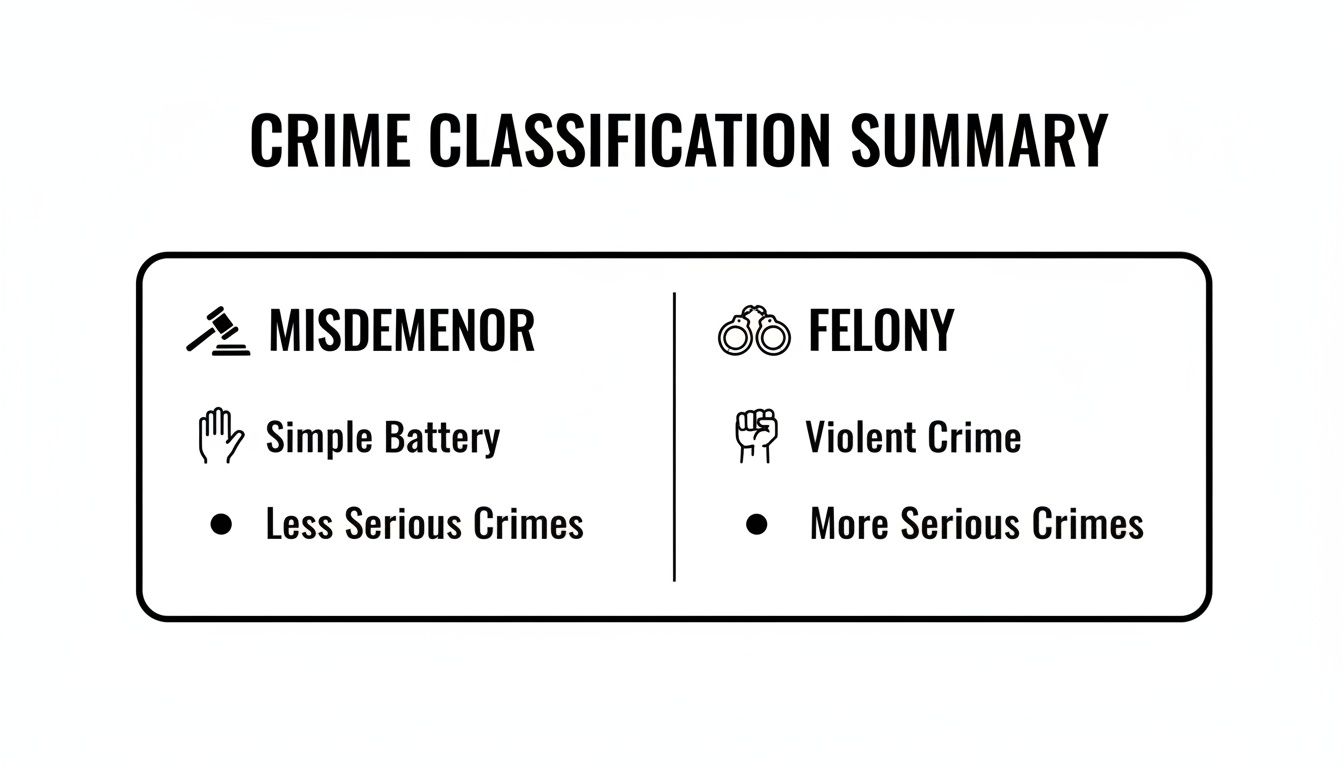
As you can see, while any charge is serious, the system treats felonies as a far greater threat, demanding a much more severe response.
Misdemeanor Penalties in Georgia
When someone is convicted of a misdemeanor in Georgia, the court has several options, but none of them involve state prison. The penalties can still be very disruptive, but they are designed for a shorter duration.
In places like Johns Creek or Milton, common penalties for a standard misdemeanor include:
- Jail Time: Up to 12 months in a county or local jail.
- Fines: Up to $1,000, plus court costs and various surcharges.
- Probation: A period of supervision where specific rules must be followed, like checking in with a probation officer.
- Community Service: A set number of hours working for an approved non-profit.
- Counseling or Classes: Mandatory programs for things like anger management, substance abuse, or theft awareness.
For a "high and aggravated" misdemeanor, the potential fine jumps to $5,000, though the maximum jail time stays at 12 months.
The Heavy Consequences of a Felony Sentence
A felony sentence in Georgia is a completely different ballgame, with outcomes that can be life-altering. The penalties aren't just about punishment; they're also about removing someone from the community for a long time. These consequences are designed to be permanent and far-reaching.
To put it into perspective, here’s a high-level look at how the penalties stack up side-by-side.
Sentencing Comparison Felony vs Misdemeanor
| Penalty Type | Typical Misdemeanor Penalties | Typical Felony Penalties |
|---|---|---|
| Incarceration | Up to 12 months in a county or local jail. | A mandatory minimum of 1 year in a state prison. |
| Fines | Up to $1,000 (or $5,000 for high/aggravated). | Can reach tens or even hundreds of thousands of dollars. |
| Probation | Typically a shorter term (e.g., 12 months), often with less intense supervision. | Can last for many years, with very strict and difficult conditions. |
| Long-Term Impact | Record may be eligible for restriction/expungement. | Loss of civil rights (voting, gun ownership), permanent criminal record. |
This table makes the distinction incredibly clear. A misdemeanor disrupts your life; a felony fundamentally alters it.
The most critical difference is where the time is served. A felony sentence is served in a state prison, not the local county jail, and the sentence is always for more than one year.
Key parts of a felony sentence often include:
- State Prison: A mandatory minimum of over one year, with some crimes carrying sentences of decades or even life.
- Mandatory Minimums: For serious offenses like armed robbery or drug trafficking, Georgia law forces a judge to impose a specific minimum sentence, taking away their discretion.
- Substantial Fines: Fines can run into the tens of thousands or even hundreds of thousands of dollars.
- Lengthy Probation: If probation is part of the sentence, it can go on for years with strict conditions that are easy to violate.
The weight of these penalties shows exactly why it's so important to understand what happens after being charged with a felony. The system is designed to impose a heavy price, and the stakes are infinitely higher than they are for a misdemeanor.
Navigating Different Legal Processes
The path a criminal charge takes through the justice system is completely different depending on whether it’s a felony or a misdemeanor. This isn't just about the final penalty; it dictates the entire journey, from arrest all the way to a resolution in court. Understanding these procedural roadmaps is critical if you're trying to learn about charges in Alpharetta, Marietta, or anywhere in between.

Misdemeanor cases are generally quicker and more direct. Felony cases, on the other hand, involve a much more complex and drawn-out series of steps, simply because the stakes are so much higher. This divide shows why getting a strong defense in place early on is so important, especially when a felony is on the table.
The Misdemeanor Court Process
When someone is charged with a misdemeanor in Georgia, the case usually lands in a Municipal, State, or Magistrate Court. These are the courts you'll find in Forsyth and Cobb Counties handling a high volume of cases, so the process is built for efficiency. The journey tends to follow a straightforward, predictable path.
After an arrest, the key stages for a misdemeanor typically include:
- Arraignment: This is the first formal court appearance. The charges are read, and a plea is entered—guilty, not guilty, or no contest.
- Motions and Pre-Trial Conferences: If a not guilty plea is entered, a defense attorney may file motions to challenge evidence. Pre-trial conferences are held to discuss the case with the prosecutor, which often leads to negotiations.
- Resolution: Many misdemeanors are resolved through a plea agreement. If no deal is reached, the case moves to a trial, which is usually decided by a judge (a bench trial) or a small jury.
The Complexities of a Felony Case
Felony cases are a different world entirely. They are far more involved and are handled exclusively in Georgia’s Superior Courts. The process includes several additional, critical steps that you won't see in a misdemeanor case, reflecting just how serious the charges are.
One of the biggest hurdles in a felony case is the indictment requirement. A prosecutor can't just move forward to trial; they must first secure a formal accusation from a grand jury.
This crucial step, known as an indictment, means a group of citizens has reviewed the evidence and decided there is enough probable cause to proceed. While a prosecutor can sometimes file an "accusation" instead, the grand jury is a fundamental protection in the felony process.
From there, the journey only gets more intricate. A key stage is the preliminary hearing, where a judge determines if there's enough evidence to keep the charges going. This is followed by a lengthy discovery phase, where the defense and prosecution must exchange all their evidence, witness lists, and expert reports. This phase is much more extensive in felony cases because the evidence is often more complex and the potential consequences are so severe.
It's also important to understand the differences between felony and misdemeanor probation in Georgia, as that’s a common part of the outcome. The procedural differences alone underscore why felony cases demand more time, more resources, and a more sophisticated defense right from the start.
Understanding the Lifelong Consequences
A criminal conviction is more than just the sentence handed down in a courtroom. The real difference between a felony and a misdemeanor often lies in the “collateral consequences” that can shadow a person for the rest of their life, profoundly shaping their future. For anyone living in Alpharetta, Cumming, or Johns Creek, these hidden penalties are just as real as any jail time or fine.
While any mark on a criminal record can throw up roadblocks, a felony conviction builds permanent barriers that a misdemeanor simply doesn't. It’s a distinction that fundamentally changes a person's standing in society, affecting everything from basic civil liberties to everyday opportunities. These aren't temporary setbacks; many are designed to be permanent.
The Loss of Fundamental Civil Rights
Perhaps the most jarring consequence of a felony conviction is the loss of rights that many people take for granted. This is where the line between the two charge types becomes incredibly stark.
A felony conviction in Georgia can mean:
- Losing The Right to Vote: While serving any part of a felony sentence, a person is disenfranchised.
- Losing Firearm Rights: Under both Georgia and federal law, a felony conviction means a lifetime ban on owning or even possessing a firearm.
- Ineligibility for Public Service: A felony conviction prevents someone from holding public office or serving on a jury in Georgia.
Misdemeanors, even serious ones, do not typically come with these severe, rights-stripping penalties. This makes the difference between a felony and a misdemeanor absolutely critical when it comes to maintaining full participation in civic life.
Impact on Employment and Professional Licensing
Beyond civil rights, the professional fallout from a felony is massive and immediate. In competitive job markets like East Cobb and Roswell, most employers run background checks, and a felony is often an automatic disqualifier.
The reality is that a felony record closes doors. It can make it nearly impossible to obtain professional licenses for careers in healthcare, education, real estate, or law, effectively ending a career path before it begins.
A misdemeanor can certainly complicate a job search, but it’s viewed with far less gravity. Many employers are willing to look past a minor offense, but a felony is a much higher mountain to climb. The conviction can also block a person from getting federal student loans for education or obtaining certain government benefits, creating a tough cycle of limited opportunities.
Housing and Everyday Life
The consequences seep into almost every corner of daily life. Landlords in communities like Marietta and Milton routinely run background checks on prospective tenants. A felony conviction can lead to an instant denial of a rental application, making it incredibly difficult to find a safe, stable place to live.
Think about facing a criminal charge in Forsyth County or Cobb County—the difference between a felony and a misdemeanor could be the difference between years in state prison or just a fine and probation. Historically, felonies carry sentences of more than one year, while misdemeanors cap jail time at under a year. Data from the U.S. Sentencing Commission in fiscal year 2016 showed that of 67,742 federal offenders sentenced, 72.8% had prior convictions. This highlights how felonies build a heavier criminal history, dramatically escalating future sentences in a way misdemeanors don’t. You can review the details in this report on criminal history from the U.S. Sentencing Commission.
Even after the sentence is complete, the "felon" label sticks, creating a permanent social and economic handicap. While clearing a record is sometimes possible, you can learn more about how to expunge a misdemeanor charge to see how different the processes are. The path for felonies is far more restrictive, underscoring again the life-altering stakes involved.
Why an Experienced Lawyer Is So Important
Once you understand the massive difference between a felony and a misdemeanor, one thing becomes crystal clear: navigating the criminal justice system is a huge challenge. Georgia’s laws are complex, prosecutors are aggressive, and a strategic, knowledgeable defense is needed to protect a person's rights and their future.
From the very first day, a skilled defense attorney starts dissecting every detail of the case. The process involves challenging the state's evidence, questioning if a search or arrest was legal, and hunting for procedural mistakes made by law enforcement. These early steps are absolutely vital for building a strong defense, whether an arrest took place in Forsyth County, Cobb County, or right here in Alpharetta.
Building a Defense Strategy
Every criminal case is different. A cookie-cutter defense is a recipe for disaster. What's needed is an attorney who can craft a strategy tailored to the specific facts of a case. This is where a deep understanding of legal nuances creates opportunities where it felt like none existed.
A solid defense strategy often involves:
- Negotiating with the Prosecutor: An experienced lawyer can often get a charge reduced. For example, it might be possible to get a felony theft charge knocked down to a misdemeanor if the evidence is shaky or if there are mitigating factors.
- Challenging the Evidence: If the police obtained evidence illegally, a motion can be filed to have it suppressed. That means the prosecution can't use it in court, which can completely gut their case.
- Presenting the Full Story: Highlighting aspects of a person's history or the circumstances of the alleged offense can persuade prosecutors or a judge to consider a much better outcome.
This proactive, hands-on approach is essential for anyone facing charges in communities like Roswell, Marietta, or Johns Creek.
An invaluable asset in any criminal defense is experience from the other side. A background as a former prosecutor provides a unique window into how the state builds its cases, revealing weaknesses that can be used to an advantage. It’s crucial for anticipating what the prosecutor will do next and countering it effectively.
At Brian Hansford Law, that exact experience is the cornerstone of our defense philosophy. Because I’ve been a prosecutor, I understand how they think and operate. It means I know their playbook, can anticipate their next move, and I’m always prepared to challenge their arguments at every turn.
This level of preparation can make all the difference in a case. Whether fighting to get a felony reduced, pushing for a complete dismissal, or gearing up for trial, having someone who has seen it all before provides a significant advantage. It ensures rights are fiercely protected and that every single option is put on the table.
Common Questions About Georgia Criminal Charges
When caught up in the Georgia criminal justice system, questions come fast and furious. The line between a felony and a misdemeanor is just the starting point. Most people researching charges in places like Alpharetta, Cumming, or Johns Creek have very specific, urgent concerns about what comes next. Here are some straightforward answers to the questions we hear most often.
Can a Felony Charge Be Reduced to a Misdemeanor in Georgia?
Yes, it's definitely possible for a felony charge to be knocked down to a misdemeanor. This doesn't happen by accident, though. It's the result of tough, strategic negotiations between a defense attorney and the prosecutor.
Whether this can happen depends on a lot of things: the specific facts of the case, how strong the state's evidence really is, and a person's criminal history. A skilled lawyer knows how to find the weak spots in the prosecution's case and use them as leverage to argue for a lesser charge. This one change can make a massive difference in the final outcome.
What Is a Wobbler Offense in Georgia?
Georgia law has certain offenses that can go either way—prosecuted as a felony or a misdemeanor. These are often called "wobbler" offenses because they can "wobble" between the two.
The prosecutor or judge gets to decide which way to go, and they base that call on the unique circumstances of the alleged crime and the defendant's background. We see this often with certain theft or drug possession charges. This is exactly why a strong legal advocate from day one can be so important—to persuade the court that the misdemeanor charge is the only appropriate path.
A "wobbler" offense highlights the gray areas in criminal law. The same set of facts could lead to vastly different consequences, making the initial stages of a case critically important for setting a favorable direction.
How a Misdemeanor Affects a Background Check Compared to a Felony
Make no mistake, both a felony and a misdemeanor will show up on a record. But employers, landlords, and professional licensing boards see them in two completely different lights. A felony conviction is a giant red flag that often leads to automatic disqualification from jobs, housing, and other opportunities.
A misdemeanor is still serious, but it's generally viewed as less severe. More importantly, Georgia's laws on record restriction (what many people call expungement) are complicated. It is far more difficult to get a felony conviction restricted than it is for most misdemeanors. That means the consequences of a felony are not just harsher—they're also much harder to ever escape.
What Should Someone Do If Arrested?
If arrested, the two most critical things to do are to remain silent and to clearly state a request to speak with an attorney. Answering police questions without a lawyer present is not advisable. Anything said can be used later on. The first and best move is to contact a qualified criminal defense attorney in the area as soon as possible.
If you are facing criminal charges in Alpharetta, Roswell, Marietta, Forsyth County, or Cobb County, the stakes are too high to go it alone. Contact Brian Hansford Law today for a consultation to discuss your case and learn how an experienced defense can protect your future.
