
When you boil it down, the biggest difference between a theft charge and a burglary charge in Georgia comes down to a single act: unlawful entry.
Burglary is all about illegally entering a building or structure with the intent to commit a crime inside. Theft, on the other hand, focuses only on the act of taking someone else's property without their permission. A simple way to think about it is that burglary is about the entry, while theft is about the taking.
Understanding Georgia's Property Crime Distinctions

While people use these terms interchangeably in everyday conversation, Georgia law sees them as completely separate offenses. Each has its own legal elements and, more importantly, its own set of consequences. Getting a handle on these differences is the first critical step for anyone facing charges in places like Alpharetta, Cumming, or anywhere in Forsyth County.
The confusion usually pops up because a theft can certainly happen during a burglary, but the charges for both actions are distinct.
Essentially, theft (what the law often calls larceny) is the unlawful taking of someone else’s property with the intent to permanently deprive them of it. Burglary, in contrast, is the act of illegally entering a building—a home, a business, even a boat or vehicle—with the intent to commit a crime once inside. That intended crime is often theft, but it doesn't have to be. For more on national trends, recent data from the Pew Research Center offers some context on property crime.
Core Distinctions At A Glance
To make it clearer, here’s a straightforward table that breaks down the main elements separating theft from burglary under Georgia's legal framework.
| Core Element | Theft (Larceny) | Burglary |
|---|---|---|
| Primary Action | Unlawfully taking property. | Unlawfully entering a structure. |
| Location | Can happen anywhere. | Must involve a building or structure. |
| Intent Required | Intent to permanently deprive the owner of property. | Intent to commit a felony or theft inside the structure. |
| Entry | Does not require an unlawful entry. | Requires an unlawful entry or remaining without authority. |
These are just the starting points, of course. How these laws are applied can shift dramatically based on the unique details of a situation. For instance, a person can be charged with burglary even if they didn't actually steal anything. As long as the prosecutor can prove the intent to commit a crime was there at the moment of entry, that’s all that matters for the burglary charge.
The most critical takeaway is that burglary is an offense against a place, focused on the violation of a person's secure space. Theft, on the other hand, is an offense against property, centered on the act of taking.
This key difference also helps explain how these charges relate to other crimes. A lot of people, for example, also get burglary and robbery mixed up. You can check out our guide on the differences between burglary and robbery to see how that distinction works. In the sections ahead, we'll dig deeper into the specific statutes, look at real-world scenarios, and outline the potential penalties for each of these charges in Georgia.
Breaking Down the Legal Elements of Each Charge
To really get a handle on the difference between theft and burglary in Georgia, it helps to look at what a prosecutor has to prove to get a conviction. These charges aren't just based on general ideas; they're built on specific legal components called "elements." For a charge to stick, the State has to prove every single one of those elements beyond a reasonable doubt.
At its core, any theft charge is about two key things: unlawful appropriation and the intent to deprive. It's not enough for a person to simply have someone else's stuff. The prosecution must show it was taken by someone who knew they had no right to it and, crucially, that they intended to keep it from the rightful owner for good.
Understanding Georgia's Theft Statutes
Georgia law actually breaks theft down into several distinct types, each with its own unique elements. The one seen most often is theft by taking. This is what happens when someone unlawfully takes the property of another person with the intention of depriving them of it. This covers everything from shoplifting at a store in Roswell to grabbing a wallet someone left on a restaurant table.
But theft goes beyond just taking something. Other common forms include:
- Theft by Deception: This occurs when a person gets property by using lies or creating a false impression. A classic example is convincing someone to "invest" in a business that doesn't actually exist.
- Theft of Services: This involves knowingly getting services—like a meal at a restaurant or a taxi ride—through deception with the intent to avoid paying the bill.
- Receiving Stolen Property: Even if someone wasn't the one who physically stole an item, they can still face a theft charge for knowingly receiving, getting rid of, or holding onto stolen property. The key element here is proving they knew the property was stolen.
The common thread in all these situations is intent. A prosecutor’s entire case often comes down to proving what was going on in the defendant's mind at that exact moment, which is a complex and highly fact-specific battle.
Dissecting the Elements of Burglary
Burglary, on the other hand, isn't really about the property itself. The focus is on the act of entering a space. Under Georgia law, a person commits burglary when they enter or remain inside a building or dwelling without authority and with the intent to commit a felony or theft therein.
Let's unpack that.
Unlawful Entry or Remaining Without Authority
This is the absolute foundation of a burglary charge. It doesn't have to be the dramatic "breaking and entering" seen in movies; just walking through an unlocked door without permission is enough. The phrase "without authority" is critical. It's what separates burglary from a lesser offense like criminal trespassing charges, which deals only with being on a property without permission and doesn't require the added element of intending to commit another crime.
Intent to Commit a Felony or Theft Therein
This is the other half of the equation. The prosecutor has to prove that at the very moment of entry, the person had the specific plan to commit another crime once inside. Most often that crime is theft, but it could be any felony, like assault. This means a person can be charged with burglary even if they get caught before they actually take anything. What matters is what their intent was when they crossed that threshold.
This table breaks down the essential legal components for each charge:
| Legal Element | Theft in Georgia | Burglary in Georgia |
|---|---|---|
| Primary Focus | The unlawful taking of property. | The unlawful entry into a structure. |
| Core Intent | Intent to permanently deprive the owner. | Intent to commit a felony or theft inside. |
| Action Required | Must involve taking or appropriating property. | Requires an unauthorized entry or remaining. |
| Location | Can happen anywhere. | Must involve a building, dwelling, or structure. |
Understanding these specific legal building blocks is the first step. It makes it clear why two situations that seem almost identical—like taking a bike from a public park versus entering a garage to take that same bike—can lead to dramatically different charges and penalties here in places like Cobb County and Marietta.
Practical Scenarios That Illustrate the Difference
Legal definitions can be dense and hard to connect to the real world. To really get a handle on the practical difference between theft and burglary charges in Georgia, it helps to walk through a few realistic situations. How a case unfolds—where it happens, what the person was thinking, and when they formed that intent—is what ultimately determines the charge.
These examples show how a few different facts can lead to completely different legal outcomes, highlighting why the specific details of every case are so critical.
Scenario 1: The Shoplifting Case in Alpharetta
Imagine someone walks into a high-end store at North Point Mall in Alpharetta. While looking around, they slip a designer watch under their jacket and head for the exit without paying. A security guard stops them in the parking lot, and the police are called.
In this situation, the charge would almost certainly be theft by taking—specifically, shoplifting. The person entered the store lawfully; it was open to the public, and they were welcome as a customer. The crime only happened when they unlawfully took the watch, intending to keep it for good. Since there was no unlawful entry, burglary isn't even on the table.
Scenario 2: The Garage Break-In in Forsyth County
Now, let's change the facts. A homeowner in a Forsyth County neighborhood is out of town for the weekend. Someone spots the empty driveway, heads to the detached garage, pries open a locked side door, and goes inside to steal a set of expensive power tools.
This is a textbook burglary. The key element here is the unlawful entry—forcing open a locked door to get inside without permission. The person entered with the clear intent to commit a theft. Even if a neighbor's dog started barking and scared them off before they could actually grab anything, the burglary charge would stick. The crime was complete the moment they entered illegally with criminal intent.
This decision tree helps visualize how that one element—unlawful entry—separates these two property crimes.
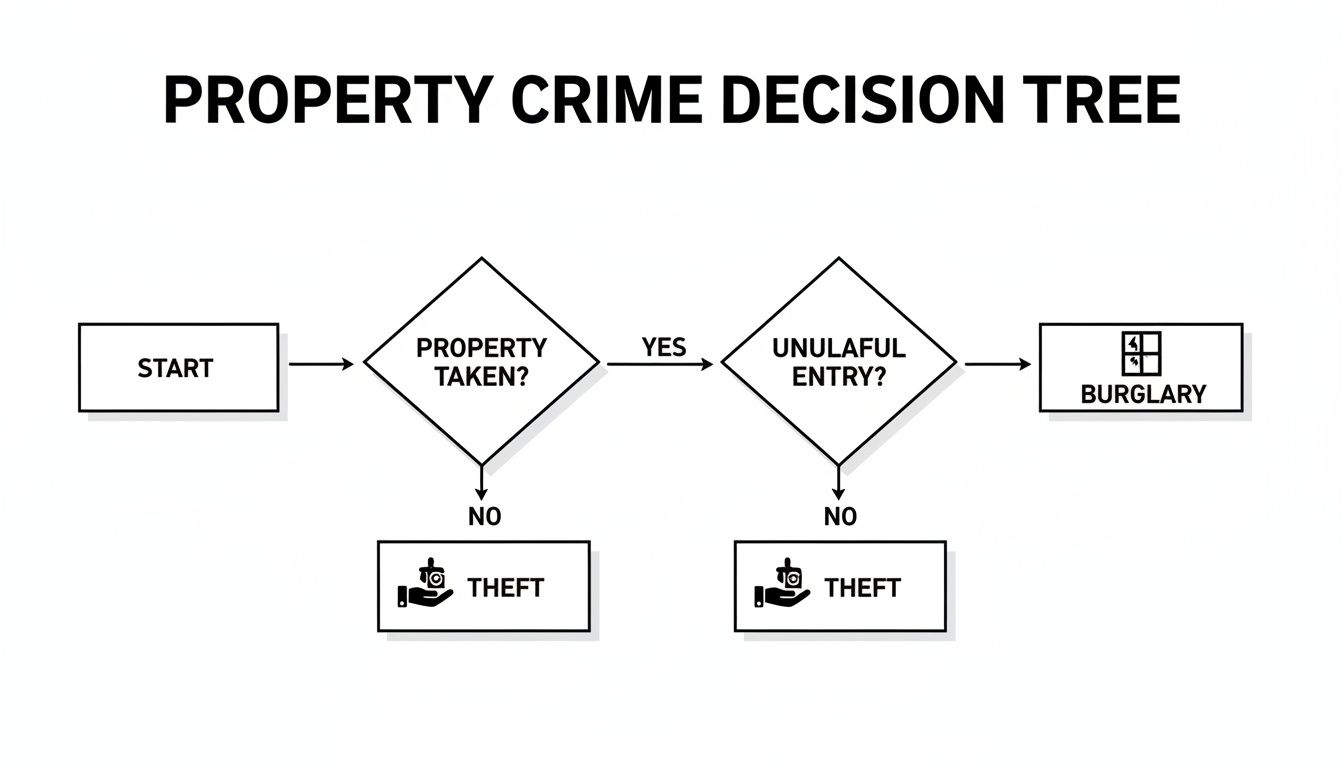
As the flowchart shows, the critical question that separates theft from burglary is whether an unlawful entry was part of the act.
Scenario 3: The Complex Case of Changing Intent
Let's dig into a more complicated scenario that often creates confusion. A person is invited to a friend's house party in Marietta. As a guest, they enter the home with full permission. While using the upstairs bathroom, they spot a valuable piece of jewelry on a dresser and, on impulse, pocket it.
This situation really brings the importance of timing and intent into focus. The initial entry was lawful, so at first glance, it doesn't meet the definition of burglary. The crime here would likely be theft.
But Georgia law also covers situations where someone "remains without authority" in a building with the intent to commit a crime. If that same guest decided to hide in a closet until everyone left, with a new plan to steal more items, their status as a lawful guest would be over. At that point, remaining in the home becomes unlawful, and a burglary charge could be on the table.
This nuance shows that the difference between theft and burglary often boils down to a detailed analysis of when the criminal intent was formed in relation to the person's authority to be on the property.
- Lawful Entry, Later Theft: Someone enters with permission and only later decides to steal. This is typically charged as theft.
- Unlawful Entry, Planned Theft: Someone breaks in without permission, intending to steal from the get-go. This is a clear-cut burglary.
- Lawful Entry, Unlawful Remaining: Someone enters with permission but then hides or stays past their welcome with the intent to commit a crime. This can turn into burglary.
These scenarios prove that the line between these offenses can be razor-thin. The specific facts of what happened in places like Roswell or East Cobb—from the moment of entry to the alleged act of taking—will dictate the nature and severity of the charges someone might face.
How Evidence Shapes Theft and Burglary Cases

When prosecutors build a case, the type of evidence they rely on tells a story. The evidence needed to prove a theft charge is fundamentally different from what’s required for a burglary conviction, and understanding that difference is where a strong defense strategy often begins.
In a straightforward theft case, the prosecution's focus is on proving the unlawful taking. This can be as simple as surveillance footage from a Roswell retailer, a witness statement from a neighbor, or the stolen items being found in a suspect’s car.
For a burglary charge, however, the entire case hinges on proving unlawful entry. This is a much higher bar to clear, and it requires a different kind of proof.
The Evidence Prosecutors Use in Theft Cases
In theft prosecutions, the District Attorney is trying to establish an intent to permanently deprive the owner of their property. It’s all about the act of taking.
Common evidence includes:
- Surveillance Video: Clear footage capturing the moment property was taken.
- Witness Testimony: Statements from employees, loss prevention officers, or bystanders.
- Proof of Possession: The stolen items being discovered on a person, in their car, or at their home.
In a busy area like Alpharetta, the quality and timing of a video clip can make or break the state's case.
The Proof Required for a Burglary Conviction
Burglary is all about the illegal entry. Without proving someone entered a building or dwelling without permission, the state’s case falls apart.
This is where forensic evidence becomes absolutely critical. Prosecutors will lean heavily on things like fingerprints on a door frame or DNA left behind at the point of entry. Physical signs of forced entry—like pry marks on a window or a broken lock—are golden for the prosecution.
Evidence in a burglary case isn't just about what was taken; it's about building the story of how the entry happened in the first place.
A witness placing someone near a home in Johns Creek or Milton around the time of a break-in can be powerful, but it’s the physical evidence that often seals the deal.
| Evidence Type | Emphasis in Theft Cases | Emphasis in Burglary Cases |
|---|---|---|
| Video Surveillance | Critical to show the act of taking | Can be used to establish time of entry |
| Possession of Stolen Goods | Core evidence of the crime | Often secondary to proof of entry |
| Fingerprints / DNA | Less common, but can be used | Key evidence to prove unlawful entry |
| Witness Statements | Focuses on intent and the taking | Establishes presence at the scene |
| Forced Entry Marks | Not applicable | Crucial (pry marks, broken glass, etc.) |
How Defense Strategies Are Built Around the Evidence
Defense attorneys put the prosecution's evidence under a microscope. Every piece is scrutinized, from forensic reports to the chain of custody for a key piece of video.
They look for weaknesses. Was the forensic testing done correctly? Are there inconsistencies in the police reports? Can the authenticity of that surveillance footage be verified? This detailed approach often opens doors to getting charges reduced or dismissed in courts across Forsyth County, East Cobb, and Cobb County.
When building a defense, common actions include:
- Demanding and analyzing all forensic lab reports for procedural errors.
- Challenging the authenticity, timestamps, and clarity of surveillance videos.
- Interviewing all of the state's witnesses to uncover contradictions.
- Aggressively arguing that a lack of entry evidence makes a burglary charge unsustainable.
Why Local Expertise Matters
An attorney who knows the courts in Cumming and Marietta also knows the prosecutors and judges—and how they tend to view certain types of evidence. For instance, they understand how a specific judge in Forsyth County might interpret a vague witness statement versus hard forensic proof.
This local insight allows for strategies tailored to a specific courtroom, whether that means highlighting gaps in a DNA report in a Cobb County burglary case or using CCTV timelines to dismantle a shoplifting charge in Alpharetta.
In property crime cases, knowing the local players and their standards can be just as important as knowing the law.
Why Evidence is Everything
The distinction between theft and burglary evidence is not just a legal technicality—it’s the entire foundation of the prosecution's case. A detailed, aggressive review of every piece of proof is essential for building a defense that holds up in court.
If you are facing charges in Johns Creek, Milton, Roswell, or anywhere in the surrounding counties, seeking experienced representation to review the evidence is a critical step.
Comparing Potential Penalties and Consequences in Georgia
While people often use the words "theft" and "burglary" interchangeably, the Georgia justice system sees them as two very different animals. The potential penalties don't just differ slightly; they operate on completely separate scales, and understanding this is critical for anyone facing charges anywhere from Forsyth County to East Cobb.
Simply put, burglary is almost always treated more severely than theft. The reason is straightforward: the law views burglary as more than just a property crime. It’s an invasion of a person's private, secure space—a home, a business, a place where people should feel safe. That unlawful entry creates an inherent risk of a dangerous confrontation, which is why the law comes down so much harder on it.
How Georgia Penalizes Theft
When it comes to theft in Georgia, the consequences are all about the money. The penalties are tiered based on the value of whatever was taken. This system means a theft charge could be a relatively minor misdemeanor or a serious felony with a long prison sentence hanging in the balance.
- Misdemeanor Theft: If the value of the stolen property is $1,500 or less, the charge is typically a misdemeanor.
- Felony Theft: Once the value crosses that $1,500 line, a person is looking at a felony. The higher the value, the more severe the potential sentence.
Think about it this way: shoplifting a $100 jacket from a store in Roswell is likely a misdemeanor charge. But if someone steals $5,000 worth of copper wire from a Marietta construction site, that's a felony, and the stakes get much, much higher. The punishment is tied directly to the financial loss.
The Consequences of a Burglary Conviction
Burglary penalties in Georgia work completely differently. The value of what was stolen doesn't matter—in fact, a conviction for burglary can occur even if nothing was taken. What matters is the type of building that was entered without permission.
The most serious charge is burglary in the first degree. This applies when someone unlawfully enters a person's home or "dwelling house." Because it violates the sanctity of where a family lives, it's a major felony that comes with a mandatory minimum prison sentence.
On the other hand, entering a commercial building—like an office in Alpharetta or a warehouse in Cumming—is usually charged as burglary in the second degree. It's still a felony, but the potential penalties are less severe than for a home invasion.
This distinction gets to the heart of the law's priorities. Protecting the safety and security of a person's home is valued more highly than the monetary value of property alone.
These crimes are a persistent problem not just here, but globally. The European Union, for example, recorded 1,229,429 police-reported burglaries in 2023, an 11.9% jump from 2021. You can review more international crime statistics to see how these trends compare around the world.
Georgia Sentencing Framework: Theft vs. Burglary
To make these differences crystal clear, the table below provides a side-by-side look at the potential penalties for different levels of theft and burglary in Georgia.
| Offense Category | Classification | Potential Penalties (Informational Only) |
|---|---|---|
| Theft of Property (Value under $1,500) | Misdemeanor | Up to 12 months in jail, fines. |
| Theft of Property (Value over $1,500) | Felony | 1 to 10 years in prison, fines. |
| Burglary (Second Degree) (Non-Dwelling) | Felony | 1 to 5 years in prison. |
| Burglary (First Degree) (Dwelling/Home) | Felony | 1 to 20 years in prison (mandatory minimum). |
These aren't just minor legal details. The gap between a theft charge and a burglary charge can be the difference between getting probation and spending years behind bars. It all comes down to what the prosecution can prove, making the specific elements of a case absolutely essential.
The Role of an Experienced Criminal Defense Attorney
Trying to navigate a theft or burglary charge can be very risky. These cases are complicated, and a deep understanding of Georgia's laws and criminal procedures is critical when a person's future is on the line. Having a knowledgeable defense attorney isn't just helpful—it's essential. A seasoned lawyer does more than just show up for court; they take the prosecutor's case and dissect it, piece by piece.
This process always starts with a meticulous review of every scrap of evidence. An experienced attorney will scrutinize all the details, from the initial police reports and witness statements to any forensic evidence and surveillance footage. The goal here is to find procedural mistakes or constitutional violations that can poke holes in the state's argument.
Building a Strategic Defense
Drawing on years of experience, including time spent as a former prosecutor, gives an attorney the unique ability to anticipate the prosecution's next move. This kind of insight allows for the creation of a defense strategy built specifically for the facts of a case. It's this proactive approach that can truly make all the difference.
A strong defense involves several key actions:
- Challenging the Evidence: This could mean questioning the legality of a search, the reliability of a key witness, or the accuracy of forensic testing.
- Negotiating with Prosecutors: Attorneys work to get charges reduced or explore alternative resolutions that minimize any long-term consequences.
- Preparing for Trial: If a favorable agreement can't be reached, they prepare a powerful and persuasive case to present to a judge and jury.
The core of a strong defense is challenging whether the prosecution has proven every single legal element of the charged offense beyond a reasonable doubt. For a burglary charge, this often means attacking the proof of unlawful entry or intent.
Understanding the nuances is crucial. For instance, many people facing these kinds of property crime accusations can benefit from learning more about the specifics of Georgia's theft and shoplifting laws and how they are actually applied in court. An attorney’s primary role is to ensure a person's rights are protected at every single stage.
Why Experience in Local Courts Matters
Familiarity with the courts in Alpharetta, Cumming, Forsyth County, and Cobb County is a major advantage. An attorney who is in these courthouses regularly understands the local procedures, knows the prosecutors, and is familiar with the judges. This local knowledge is invaluable when building a defense designed to be effective in that specific courtroom. Whether it's negotiating a plea in Marietta or arguing a motion in Johns Creek, that direct experience can be put to work for a client.
Common Questions About Theft and Burglary Charges
When you're dealing with property crimes in Georgia, the specific details can get confusing fast. Let's clear up some of the most common questions that come up when trying to figure out the difference between theft and burglary.
Is Shoplifting in a Store Considered Burglary?
No, shoplifting is almost always handled as a theft charge, not burglary. The reason comes down to one of the most important elements of burglary: unlawful entry.
When a person walks into a store in Alpharetta or Cumming during its normal business hours, they are entering with the public's permission. The entry is lawful. Because of that, a burglary charge just doesn't fit, even if they decide later to pocket an item without paying. The crime is the act of taking, which is theft.
Can It Still Be Burglary If Nothing Was Actually Stolen?
Yes, absolutely. A burglary charge can be filed even if not a single thing was taken. The crime of burglary is actually complete the moment someone enters a building without permission with the intent to commit a theft or another felony inside.
The prosecutor's main job is to prove what was going through the person's mind at the moment they entered. If they can build a case showing the plan was to steal something, the charge holds up—it doesn't matter if the person got spooked and ran or couldn't find anything valuable to take.
A key takeaway here is that burglary is a crime that punishes the illegal entry and the criminal intent, not whether the intended crime was successfully pulled off. This is a critical point in understanding the difference between theft and burglary.
What Happens If Someone Had Permission to Enter but Then Decided to Steal?
In most cases, this is going to be a theft charge. If someone was invited into a friend's home in Johns Creek or a business in Marietta, their entry was perfectly legal. Making the decision to steal something while already inside doesn't retroactively make the initial entry unlawful.
However, these situations can get murky. Let's say a person's permission to be there runs out (for example, they hide in a closet until a party is over and everyone leaves). If they then remain with the intent to steal, their presence could be considered "without authority," which might be enough for prosecutors to argue it's a burglary.
Does Breaking a Window Automatically Mean It’s Burglary?
Not automatically, but it makes the prosecutor's job a lot easier. A broken window or a forced lock is powerful evidence that the entry was both unlawful and forced, which ticks a major box for a burglary charge.
Still, the prosecutor has to prove the second part of the equation: the intent to commit a felony or theft once inside. While smashing a window strongly suggests that's what was planned, it still has to be proven in court to get a burglary conviction. Without that proven intent, the act might be charged as a lesser crime, like criminal damage to property.
If you're facing accusations of a property crime in Alpharetta, Cumming, Roswell, or anywhere across Forsyth and Cobb County, you know the details are everything. At Brian Hansford Law, we bring over 25 years of courtroom experience, including critical insights gained as a former prosecutor, to dissect the evidence and defend your rights. Contact us today to get started on your case by visiting https://challengemycharge.com.
