
Here’s a frustrating truth: a background check can absolutely show an arrest, even if the case was dismissed or you were never convicted. This catches so many people in Alpharetta, Cumming, and across North Georgia off guard. It's a common, and completely understandable, mistake to think that a dropped charge just disappears.
But an arrest record isn't like that. It's more like a digital footprint that stays put unless specific steps are taken to clear it.
The Critical Difference Between an Arrest and a Conviction
To start taking control of your record, it's important to first understand the huge gap between an arrest and a conviction. We often use these words like they mean the same thing, but when it comes to a background check, they are worlds apart. Not knowing the difference can impact a job offer or a housing application.
An arrest simply means you were taken into custody because an officer suspected a crime was committed. It’s the very beginning of the process—it is not a finding of guilt.
A conviction, on the other hand, is the end of the process. It's the official judgment from a court declaring that someone is guilty of the crime. A person can be arrested without ever being convicted, but a person can’t be convicted without first being arrested or formally charged.
Arrest vs. Conviction At a Glance
Here’s a quick table to break down the key differences, which is crucial for anyone in places like Johns Creek and Marietta to understand.
| Concept | What It Means | What Appears on a Record |
|---|---|---|
| Arrest | You are taken into custody based on suspicion of a crime. This is not a finding of guilt. | The date of arrest, the initial charges, and the arresting agency. |
| Conviction | A court of law has formally found you guilty of a crime, either through a plea or a trial. | The final judgment of guilt, the specific crime you were convicted of, and the sentence. |
Seeing it laid out like this makes it clear: an arrest is just an accusation, while a conviction is a conclusion reached in a court of law.
Why This Distinction Matters for You
The real problem pops up because many background checks don't just pull clean, simple conviction data. They pull everything, including arrest records. A potential employer in Roswell might see that you were arrested years ago and jump to conclusions, even if the charges were dropped or you were found not guilty.
And this isn’t a small issue. The use of criminal records for everyday things like hiring is exploding. A report from the Urban Institute really put a spotlight on the mess this creates:
Between 2010 and 2014, the FBI provided a staggering 30 million records to employers and others, a 22% increase in just a few years. However, a critical finding was that only about 68% of arrests in the FBI database had information on the final court outcome, leaving nearly a third of them in limbo without disposition details. You can review the full Urban Institute report for more on these findings.
That data gap is huge. It means your old arrest might show up with no context—no note saying the case was dismissed or resolved in your favor. To the person reviewing your background check, an open-ended arrest looks like a big red flag, no matter what really happened.
You can learn more about the initial process by reading our guide on what happens when you get arrested. The first step in protecting your reputation and future is to understand exactly what people can see and then learn how to deal with it head-on.
Different Types of Background Checks and What They Reveal
Not all background checks are created equal. Knowing the difference is absolutely critical to understanding what a potential employer, landlord, or licensing board might actually see. Think of it as a search for information—some are just a quick skim of local headlines, while others are a deep dive into national archives.
The type of check they run usually depends on the job or application in question. A local business here in Cumming might just use a simple commercial background check that pulls from public databases. But a state licensing board for a healthcare or education job? They’re going to require a much more thorough, fingerprint-based screening. The level of scrutiny directly impacts whether an old arrest—even one that never led to a conviction—will show up.
Common Screening Methods Explained
To get a better handle on what might appear on your record, let’s break down the most common types of checks. Each one pulls information from different places, which means they can produce wildly different results.
- Level 1 Background Checks: These are typically name-based searches run at the state level. In Georgia, this usually means a query of the Georgia Crime Information Center (GCIC) database. While they're mainly designed to find in-state convictions, they can sometimes show Georgia-based arrests, too.
- Level 2 Background Checks: This is a much more serious screening. It’s fingerprint-based and submits your prints to both the GCIC and the national FBI database. This is the kind of check required for positions of trust—think working with children, the elderly, or in any state-licensed profession. It is far more likely to reveal your entire criminal history, including arrests from any state.
- Private Commercial Background Checks: This is what most private employers use. These third-party services scrape information from a huge range of sources, like commercial databases, court records, and credit reports. The quality and accuracy of these checks can be all over the map, and it's not uncommon for them to contain outdated or incomplete details about old arrests.
This diagram helps visualize the relationship between a general record, an arrest, and a conviction.
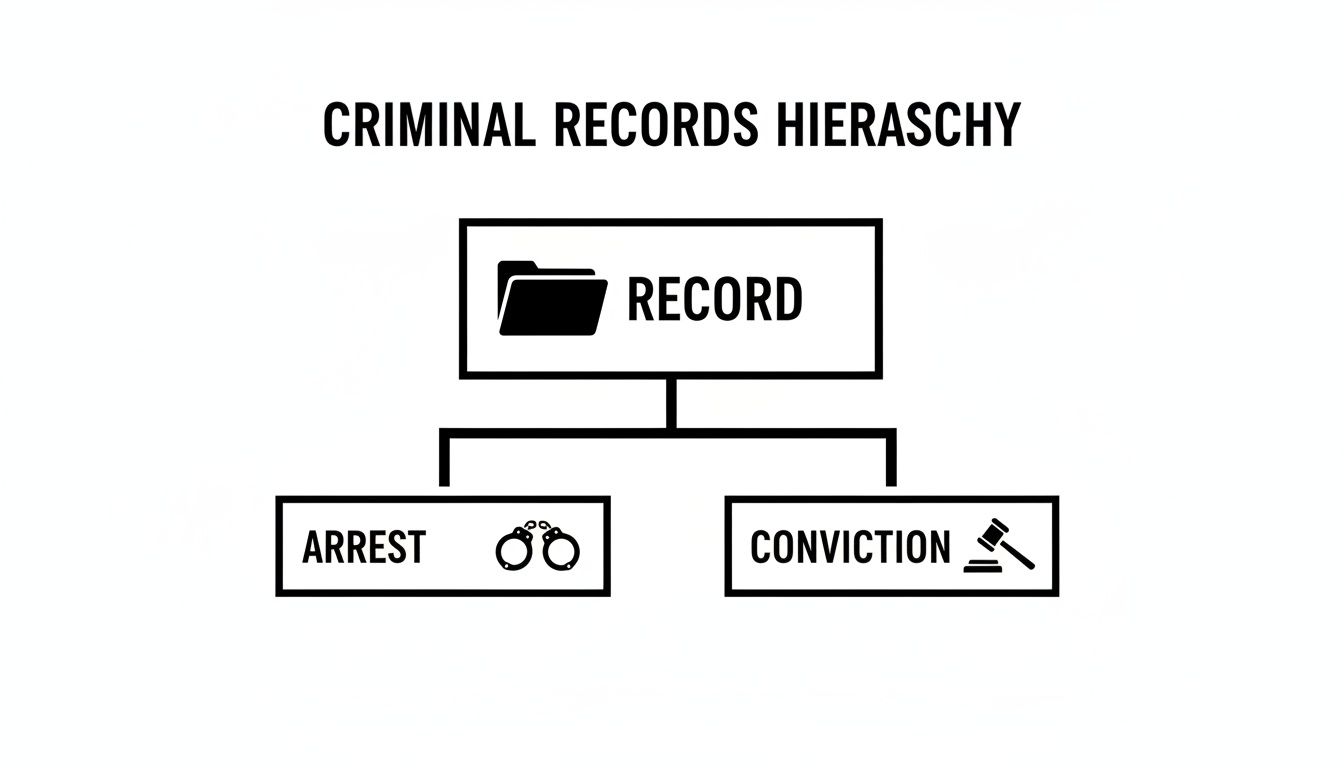
As you can see, an arrest is a specific event, separate from a conviction, but both fall under the umbrella of a person's overall record.
The Problem with Inaccurate Databases
While a Level 2 FBI check is often called the "gold standard," it's far from perfect. Arrests are a big part of what shows up, but the records themselves are notoriously flawed. It’s pretty shocking, but studies have found that a huge percentage of these records are inaccurate or incomplete, often missing the final court dispositions.
A report highlighted that 50% to 80% of FBI background check records are inaccurate or incomplete, disproportionately affecting Black applicants in areas like Marietta and Roswell. The National Employment Law Project estimates 1.8 million workers annually face issues with flawed FBI checks. You can learn more about the real-world impact by reading the full report on criminal background checks and employment.
What does this mean for you? It means an old arrest from years ago could pop up on a background check without ever mentioning that the charges were dropped or dismissed. To the person reviewing that report, it just looks like an unresolved issue, creating an instant bias that can get you disqualified. This is a massive hurdle because the information they’re seeing is misleading, painting an incomplete and damaging picture of your history.
Understanding which type of background check you're facing is the first step in preparing for what might be on it.
How Georgia Law Governs Your Criminal Record
It’s completely understandable to feel frustrated when you find out an old arrest is still popping up on your record. The good news is, Georgia law provides a powerful tool to deal with this exact problem. A person is not necessarily stuck with that arrest record forever, especially if the case never led to a conviction.
The key is a process called Record Restriction, which used to be known as expungement. While the goal is the same—cleaning up a public record—the name change is important. The whole point of record restriction is to limit who can see certain arrests on a person's criminal history, effectively sealing it from the view of most employers, landlords, and the general public.
This process isn't automatic. An old arrest record in Forsyth County or Cobb County won't just fade away on its own after a few years. Action must be taken, first by figuring out if a person is eligible and then by formally requesting to have the record restricted.
Who Is Eligible for Record Restriction in Georgia?
Whether a person can restrict their record in Georgia is tied directly to how the case ended. The law recognizes that being arrested isn't the same as being found guilty. It provides a path to seal the arrest record if things went a certain way in court. This is a critical protection because, as we’ve discussed, just the mention of an arrest can create a negative impression, no matter the facts.
Generally, a person might be eligible for record restriction if their arrest concluded in one of these ways:
- The case was dismissed by the prosecutor. For instance, maybe someone was arrested for shoplifting at an Alpharetta retail store, but the prosecutor later dropped the charges because there wasn't enough evidence.
- The person was found not guilty at trial. If the case went all the way to a judge or jury and the person was acquitted, the arrest record is almost always eligible for restriction.
- A pre-trial diversion or intervention program was successfully completed. Many Georgia counties offer these programs for certain first-time offenses. Once the requirements are met, the charges are dismissed, and the arrest becomes eligible for restriction.
It's a common myth that a dismissed case just disappears. The reality is, the arrest record remains public until the proper steps are taken to have it officially restricted under Georgia law.
How Record Restriction Works in Practice
Think of record restriction like putting a sensitive file into a locked cabinet. The file is still there, but only a handful of people with a special key can ever see it. Once an arrest is restricted, it is removed from the official Georgia criminal history report that the public can access.
What does this mean for an individual? When a potential employer in Roswell or a landlord in Johns Creek runs a typical commercial background check, that restricted arrest will not show up. This is a complete game-changer for job applications, housing searches, and even getting a professional license.
Imagine a college student who was arrested for misdemeanor marijuana possession but completed a drug court program. The charges were dismissed, but the arrest still shows up. By successfully petitioning for record restriction, they can stop that one incident from unfairly derailing their career after graduation.
The law is designed to prevent a single mistake—one that didn't even result in a conviction—from creating a lifelong barrier to opportunity. Understanding these specific Georgia rules is the first step toward taking control of one's future.
The Real-World Impact of an Arrest on Your Record

It’s one thing to understand the technical side of how an arrest can pop up on a background check. It's a whole different reality when that report lands on a hiring manager's desk. An unresolved arrest isn't just a line of text in a database; it’s a roadblock that appears at the worst possible moments, hitting your career, your housing, and your peace of mind.
Picture this: you've just nailed the final interview for your dream job in Alpharetta. You’ve got the skills, the experience, and you really clicked with the team. Then, a week later, you get an awkward call asking you to "explain" an arrest from five years ago—for a case that never even led to a conviction.
Suddenly, a person is forced to defend themself, trying to explain away a past event that has nothing to do with their ability to do the job. This is the practical, day-to-day headache for countless people. An old arrest, even for a charge that was dismissed, creates instant doubt and raises questions that can overshadow all qualifications.
How an Arrest Record Creates Unexpected Obstacles
The fallout from a publicly visible arrest record touches nearly every part of modern life. It's more than just a hassle; it can actively stop you from moving forward. The simple fact that do background checks show arrests means you could face hurdles you never saw coming.
Consider these all-too-common situations:
- Employment Opportunities: Many employers have policies against hiring people with certain records. Even if the rule is about convictions, the HR person reviewing a file might not know the difference, leading to an automatic rejection.
- Housing Applications: Landlords and property managers, especially in competitive areas like Roswell and Johns Creek, run background checks on everyone. An arrest record can look like a liability, making them choose another applicant with a "cleaner" history.
- Professional Licensing: Careers in nursing, teaching, real estate, and finance require state licenses. A background check is always part of that process, and an unresolved arrest could delay or even deny your ability to practice in your chosen field.
The core problem is that a background check report has zero context. It doesn't explain that the evidence was weak, that it was a case of mistaken identity, or that a diversion program was completed and the charges were dropped. All the reviewer sees is the arrest, and that’s often enough to slam the door.
The Financial and Emotional Weight of a Public Record
Beyond getting turned down for a job or an apartment, there's a deeper, more personal toll. The constant worry that a past mistake might surface is incredibly stressful. It’s a heavy psychological weight, making people feel judged for a situation that never even resulted in a guilty finding. This can kill confidence and make someone hesitant to chase new opportunities.
The financial consequences are just as real. With the explosion in criminal background checks, which are often riddled with errors, we have a system that unfairly punishes millions of people. It's common for an arrest to appear without its corresponding dismissal or acquittal, creating a completely misleading picture.
Research has shown that the widespread use of criminal background checks can slash job chances by nearly 50% for individuals with a record. With approximately 70 million Americans having some form of criminal record, the economic toll is staggering, with some facing potential lifetime earnings losses of over 50%. You can explore more about these extensive impacts in the full analysis of criminal records and economic inequality.
This data confirms a critical truth: failing to address an arrest on a record isn't just a privacy issue—it has direct and lasting financial consequences for you and your family. The system isn't set up to clear a name on its own. Taking proactive control of a record isn't just an option; it's a necessary step to secure one's future and get peace of mind back.
Your Action Plan for an Arrest on Your Background Check

Finding out an old arrest showed up on a background check can feel like a punch to the gut. It’s jarring, and it’s easy to feel like you’ve lost control. But this isn’t a dead end.
Instead of letting that sinking feeling take over, a person can tackle the situation head-on with a clear, structured plan. These are actionable steps to understand exactly what’s on a record and what can be done about it. The first step, always, is to get the facts straight. Don't rely on memory—it's best to see precisely what a potential employer or landlord sees.
Obtain Your Official Criminal History
Before a problem can be fixed, a person has to know its exact size and shape. That means getting an official copy of their criminal history report. In Georgia, this can typically be obtained from a local law enforcement agency, like the sheriff's office or police department in the county where the arrest happened.
This report is the blueprint. It will show the arrest date, the specific charges, and—most importantly—the final outcome, or disposition, of the case. Seeing it all in black and white eliminates the guesswork and provides the accurate information needed to move forward.
Having the official report in hand is non-negotiable. It is the single source of truth that confirms whether an arrest record includes the dismissal, acquittal, or other non-conviction outcome that is crucial for seeking record restriction.
Once this document is in hand, it's possible to move on to the next phase: gathering the proof to back up the case for clearing a public record.
Gather All Related Court Documents
A criminal history report gives you the summary, but the court documents are the proof. The next critical step is to track down all the paperwork connected to the arrest. This is especially vital if the case never resulted in a conviction.
A person will want to find copies of key documents like:
- Dismissal Orders: If the prosecutor dropped the charges, there’s an official court document stating that.
- Acquittal Verdicts: If a judge or jury found you not guilty at trial, the court record will show it.
- Diversion Program Completion Certificates: If a pre-trial intervention or diversion program was successfully finished, there should be paperwork to prove it.
These documents are the evidence. They prove the arrest did not lead to a guilty verdict and are essential for the record restriction process. Copies can usually be obtained from the clerk of court in the county where the case was handled, whether that was in Forsyth County, Cobb County, or elsewhere in Georgia. Having this complete file is a vital step before a person can learn more about how to get your arrest record expunged.
Understand the Record Restriction Process
With an official history and court documents in hand, a person is now ready to tackle the final step: pursuing record restriction. As discussed, this is Georgia’s process for sealing an eligible arrest from public view. It involves filing a formal request with the right agencies.
To help stay organized, here’s a simple checklist to follow.
An Action Plan for Addressing an Arrest Record
| Step | Action Item | Why It's Important |
|---|---|---|
| 1. Get Your Official Record | Request a copy of your Georgia criminal history from a local law enforcement agency. | This is the starting point. It shows exactly what employers see and confirms the case's final outcome. |
| 2. Collect Court Documents | Contact the Clerk of Court where the arrest occurred and get copies of dismissals, acquittals, or program completion certificates. | This is the proof. These documents are the hard evidence needed to show the arrest did not lead to a conviction. |
| 3. Review for Eligibility | Compare your documents with Georgia's record restriction criteria to see if the arrest qualifies. | Not all records can be restricted. This step confirms there is a valid path forward before filing any paperwork. |
| 4. Consult with a Professional | Speak with an experienced professional to review the case and get guidance through the restriction process. | The process can be complex. An expert can ensure a request is filed correctly and helps avoid costly mistakes. |
Each step in this plan builds on the last, giving a solid foundation to address the issue head-on. By getting the record, gathering the proof, and understanding the path forward, a person goes from being a passive recipient of a background check to an active participant in clearing their name and securing their future.
How an Experienced Professional Can Guide You
Trying to navigate the aftermath of an arrest on your own feels overwhelming for a reason. The system is a maze of confusing rules, from challenging inaccurate FBI records to understanding Georgia's specific record restriction laws. It may be helpful to get guidance—the right professional brings the clarity and direction needed to protect a person's future.
Think of it like trying to fix a complex engine with no training. A person might be able to figure out a few things, but one wrong move could cause even more damage. A seasoned professional acts as a guide, bringing deep, practical knowledge of the local court systems in places like Forsyth County and Cobb County to make sure every step is handled correctly.
The Value of Deep Knowledge and a Meticulous Approach
An experienced firm knows the unwritten rules and nuances that define each courthouse. They understand the specific procedures, know the right people to call, and meticulously prepare a case to sidestep the common pitfalls that can delay or completely derail the effort. When a reputation and career are on the line, that level of detail is everything.
Attempting to manage a record restriction on one's own often leads to missed deadlines or incomplete paperwork, forcing a person to start the whole frustrating process over again. A dedicated advocate can ensure a case is presented correctly the first time, giving the best possible shot at a successful outcome.
This is about more than just filling out forms; it’s about building a solid case to clear a name.
A Dedicated Advocate for Your Future
Ultimately, the goal is to move forward without a public arrest record casting a long shadow over one's life. When working with a dedicated professional, a person gets an advocate who is truly committed to protecting their opportunities. They handle the intricate paperwork so the individual can focus on their career, their family, and their peace of mind.
Whether you're just trying to figure out do background checks show arrests or need to take immediate action, the right guidance can be essential. If you want to learn more about what to look for, check out our guide on how to find a good criminal lawyer. An experienced guide can make all the difference in turning a difficult situation into a fresh start.
Frequently Asked Questions
When a job or housing is on the line, navigating the details of a background check can be confusing. After getting the basics down, people probably still have some very specific questions about how an old arrest might affect them here in Georgia. Let’s get some direct answers to the most common ones we hear.
Can an Employer in Georgia Ask About Dismissed Arrests?
This is where things get tricky. While laws like the Fair Credit Reporting Act (FCRA) put some guardrails on how employers can use information, the question on an application isn't the same as what a deep-dive background check might turn up.
The key here is whether the arrest has been formally restricted under Georgia law. If it has, it’s sealed from public view and shouldn't pop up for most employers. This is exactly why so many people get professional help—to make sure their rights are protected and the record is properly sealed.
How Long Does an Arrest Stay on Your Record in Georgia?
Forever, unless something is done about it. That’s the hard truth. An arrest record, even for a misdemeanor that was thrown out, creates a permanent file in both state and federal systems. It doesn't just fade away with time.
This is why the record restriction process is so critical. It’s not an automatic process and won't happen on its own. The record doesn’t simply “fall off” after seven or ten years.
Simply waiting for an old arrest to disappear isn’t a real strategy. Action must be taken.
If My Case Was Dismissed, Does That Mean My Record Is Clean?
This is probably the biggest misconception out there. A dismissal is great news—it means there was no conviction. But the record of the arrest itself still exists and can be seen by the public.
Think about it: when a potential employer runs a background check, they can see the original charge, when you were arrested, and the final outcome (dismissal). Even though a dismissal is a good thing, just seeing the arrest can create doubt or bias in an employer’s mind. That’s the number one reason to pursue record restriction: it removes the public-facing arrest record and gives a person a truly clean slate.
An old arrest record shouldn't get to decide your future. If you're worried about what might show up on a background check, the experienced team at Brian Hansford Law can walk you through your options for record restriction in Georgia. Take the first step toward real peace of mind and visit https://challengemycharge.com to schedule a consultation.
