
Yes. Bench warrants can show up on background checks, especially in Georgia when an employer or screening company pulls state and county records instead of relying only on a basic national database. They do not appear in every screening, though. Whether a warrant shows up usually depends on the type of search, how the court record is entered, and whether the screening company checks local records in places like Fulton, Forsyth, or Cobb.
A job offer in Alpharetta, Cumming, or Marietta can feel secure right up until the background authorization lands in your inbox. Then an old missed court date, unpaid fine, or probation review you forgot about starts to matter fast.
For North Atlanta residents, this problem carries more risk than many people expect. Georgia courts and law enforcement agencies share information through connected systems, and local employers often order searches that go deeper than a standard national check. That means a bench warrant that stays invisible in one screening can still surface in another, or lead to an arrest during a traffic stop before your start date.
What matters now is simple. Do not assume the warrant will stay hidden, and do not wait for HR or police to force the issue. Bench warrants can often be cleared proactively, and handling them early can protect your job, your license, and your ability to keep building your future.
The Job Offer Is In But an Old Warrant Looms Large
A lot of people don't learn they may have a bench warrant when they're standing in court. They learn when life is finally going well.
Maybe you just accepted a role with a tech company in Alpharetta. Maybe you're moving your family closer to good schools in Milton. Maybe you're changing jobs after a rough stretch and trying to put a reckless driving charge, misdemeanor case, or old DUI behind you. Then HR sends the background check authorization, and an old memory comes back fast.

Why this fear hits so hard
A bench warrant usually doesn't come with the drama people expect from criminal law. It often starts with something ordinary:
- A missed court date: You thought your traffic ticket attorney handled it, but the court still expected you there.
- An unpaid fine: You planned to pay it later and forgot.
- A probation issue: A reporting condition, class requirement, or review hearing slipped past you.
- A mailing problem: Notice went to an old address, and you never saw it.
The result feels wildly out of proportion. One procedural mistake can suddenly threaten a job, your license, or your freedom.
What clients usually need to hear first: Panic doesn't help, but speed does. If you deal with a possible bench warrant before the employer finishes screening, you give yourself far better options.
The real question isn't only whether it shows up
People often ask this as if there is one master database that every employer sees. That's not how it works. Some screenings are shallow. Some are thorough. Some employers in North Atlanta rely on broader state-level searches or direct court record pulls because they want a cleaner picture before hiring.
That means two people with the same warrant can have very different outcomes.
One gets hired because the warrant never appears on a basic screening. Another loses the offer because the employer used a more detailed search tied to county or state records. That's why this issue matters so much in places like Cumming, Roswell, Johns Creek, and Marietta, where many employers move quickly and don't wait around while an applicant sorts out old court problems.
If you're worried about an old missed appearance for DUI, speeding, drug possession, or another misdemeanor, the immediate priority isn't guessing. It's finding out what exists, where it sits, and whether it can be recalled before it causes damage.
Understanding Bench Warrants Versus Arrest Warrants
A bench warrant and an arrest warrant can both end with handcuffs. They start in different places, and that difference matters if you are trying to protect a job offer in Alpharetta, Cumming, or Marietta.
A bench warrant comes from the court. A judge issues it because you did not do something the court ordered. The missed step might be a court appearance, a fine payment, a probation check-in, a class, or another condition tied to a pending or closed case.
An arrest warrant usually starts with a criminal investigation. Law enforcement asks a judge for authority to arrest someone based on probable cause that a crime was committed.
The short version is simple. An arrest warrant is tied to the alleged offense itself. A bench warrant is tied to failing to follow a court directive after the case is already in the system.
If you want broader background on how these orders are issued and handled, this guide on arrest warrants in Georgia is a useful starting point.
Why the difference matters in real life
From a defense lawyer's standpoint, bench warrants often catch good people off guard. I see them in cases that began with a speeding ticket, a DUI court date, a misdemeanor shoplifting charge, or a probation review that someone thought had already been handled.
That procedural origin can make people underestimate the risk. The court does not.
A bench warrant still authorizes law enforcement to take you into custody and bring you before the judge. In North Atlanta, that can happen during a traffic stop, a visit to the courthouse, or any police contact where your status is checked through Georgia's connected law enforcement and court systems.
Why people confuse bench warrants with background check problems
Many applicants assume a warrant either appears everywhere or nowhere. Real hiring screens do not work that way, and the legal label matters.
A bench warrant may exist because of a missed hearing or another court compliance issue, even if the underlying case was minor. An arrest warrant usually reflects a new accusation supported by probable cause. Employers, recruiters, and screening companies may treat those situations differently if the record they pull gives enough detail to show what happened.
That is one reason I tell clients not to guess based on internet folklore. A warrant can be active, enforceable, and serious long before a generic screening company displays it in a neat report.
Common cases that lead to bench warrants
In Georgia courts, bench warrants often grow out of matters people treated as manageable until they missed one deadline too many:
- Traffic cases: speeding, reckless driving, no insurance, registration issues
- DUI cases: missed arraignments, missed review dates, incomplete conditions
- Misdemeanor cases: simple battery, shoplifting, possession, disorderly conduct
- Probation matters: missed reporting, unpaid fines, unfinished classes, community service problems
The original charge does not control the danger once the warrant is active. A low-level case can still create a very real custody risk and a very real employment problem.
The practical mistake to avoid
Waiting rarely improves this situation.
People call the clerk hoping for reassurance, assume the warrant is old enough to have faded away, or decide to deal with it after the background check clears. In Fulton, Forsyth, and Cobb, that is a bad bet. If the court has not recalled the warrant, it usually remains active until you are brought in or your lawyer gets the matter in front of the judge the right way.
That is the practical divide. An arrest warrant points to a new accusation. A bench warrant tells the court you did not respond as ordered. For your freedom and your employment, both deserve immediate attention.
When and How Warrants Appear on Different Background Checks
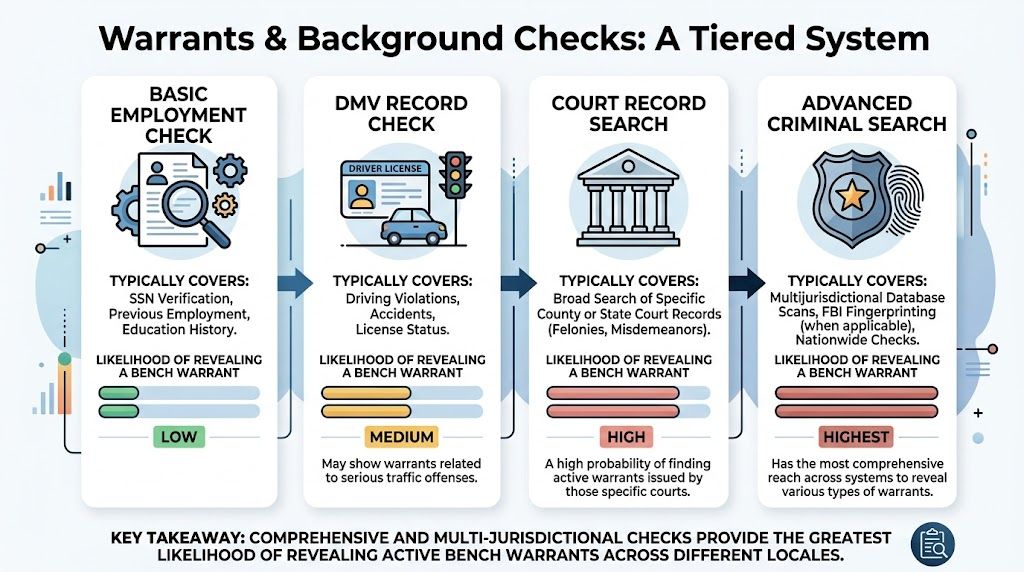
The phrase background check sounds singular. In reality, it covers several very different searches.
Some are little more than broad commercial database sweeps. Others are county-specific record pulls. Others involve state-level criminal history access. That difference is the whole game when you're asking whether a Georgia bench warrant will be found.
Not every search looks in the same places
A national commercial screening may miss a warrant that a county court search would catch. A state-level criminal search may reveal a problem a low-cost employment screen never touches. That's why one employer says nothing while another pulls the offer.
Here is the practical breakdown.
| Type of Background Check | What It Typically Shows | Likelihood of Showing a GA Bench Warrant |
|---|---|---|
| County court search | Local court case activity, filings, missed appearances, and related case records in the county searched | Higher if the warrant is tied to that county's court file |
| State-level criminal history search | Broader Georgia criminal history information, often more useful for in-state screening than a generic national database | Medium to high depending on access and reporting method |
| National commercial database search | Aggregated data from many jurisdictions and vendors, often uneven and incomplete | Lower than county or strong state-level searches |
| Specialized or fingerprint-based screening | More intensive record access for certain regulated roles or sensitive positions | Higher in the right context |
The seven-year rule creates confusion
One of the most misunderstood parts of this issue is time.
The underlying criminal charge associated with a bench warrant is not reportable if the warrant is older than seven years. The legal status of the warrant and the reporting status of the underlying charge operate on different timelines, which means a bench warrant can remain legally enforceable even when standard background check reporting rules limit what gets shown, as explained in Checkr's guide to warrants on background checks.
That matters because people hear "seven years" and assume the problem disappears. It doesn't. The court can still treat the warrant as active. Law enforcement can still act on it. The reporting rules alter what a standard screening company may include.
Practical rule: A warrant can become harder to report on a routine screening before it becomes any less dangerous to ignore.
What employers and screening companies actually do
Employers don't all buy the same product. Some order a quick national screen because it's cheap and fast. Others want county-level criminal research where the applicant lived or worked. Others use screening vendors that combine state and county data.
If you're applying for a role that involves trust, driving, money handling, healthcare, education, government access, or a company with a strong risk department, you should assume they may use more than the bare minimum.
If you want to understand how arrest records and related events can show up differently depending on the screening method, this article on whether background checks show arrests is worth reading.
What tends to increase risk
Certain facts make discovery more likely:
- The warrant is recent: fresher records are easier for screening systems to capture.
- The case sits in a county with accessible court records: local data can be easier to pull than older, fragmented records.
- The employer orders county and state searches: often reveals many surprises.
- The job is sensitive: some positions trigger more thorough review.
On the other hand, a person can still have an active warrant that doesn't show up on a basic employment screen. That false sense of relief creates another problem. The job may be safe for the moment, but the next landlord, lender, licensing board, police stop, or upgraded screening process can surface the issue.
Why Georgia Is Different Your North Atlanta Warrant Risk
Generic internet advice often misses what matters most in this region. Georgia isn't just another state where you can assume a bench warrant will stay buried in some local file.
In North Atlanta, local practice matters. So does the way courts, law enforcement, and screening processes interact.

County lines do not protect you
People sometimes think a warrant from one county is only a problem in that county. That is not how bench warrants feel in real life.
If a warrant was issued in Forsyth County after a missed court date in Cumming, you don't become safe because you're now driving through Roswell, working in Alpharetta, or living in East Cobb. Once the warrant sits in the system, routine contact with law enforcement can expose it well outside the courthouse where it began.
That is especially important for people who commute across county lines every day for work, school, family obligations, or treatment programs.
North Atlanta employers often screen more deeply
In Georgia counties like Forsyth, Cobb, and Fulton, misdemeanor bench warrants tied to probation violations or missed court dates frequently appear on thorough background checks conducted through the Georgia Crime Information Center, even if standard national checks miss them. The same source states that over 70% of mid-sized employers in metro Atlanta reportedly include state-level warrant pulls in their screening process, according to Checkr's discussion of how warrants show up on background checks.
That single point changes the practical answer for people living in Alpharetta, Roswell, Cumming, Marietta, and nearby communities.
A national article may tell you not to worry because many standard screenings miss open warrants. That may be true in the abstract. It is not enough comfort if the employer in front of you uses state-level checks or county searches because they hire locally and want a clearer picture.
Why this affects competitive hiring markets
North Atlanta employers often move fast. When a company likes a candidate, it wants the onboarding done, the laptop issued, and the start date confirmed. If a warrant issue appears late in the process, most employers won't stop everything and coach the applicant through court cleanup.
They usually do one of three things:
- Pause the offer while they ask for clarification
- Move to another candidate who has no unresolved flags
- Withdraw the offer if the role requires a clean screening result
This is especially tough in markets where applicants compete closely on credentials and timing.
In Georgia, the legal question and the employment question are connected but not identical. A warrant that looks invisible on a generic search can still become very visible when a local employer uses state or county tools.
The local lesson
If you live or work in Fulton County, Forsyth County, Cobb County, Cherokee County, or Gwinnett County, don't rely on advice written for a generic national audience. The answer to "do bench warrants show up on background checks" is more dangerous here because Georgia employers often look closer than people expect.
More Than Just a Job Offer What Is at Stake
Employment is usually what pushes people to act, but it's rarely the only thing on the line.
A bench warrant can keep sitting in the background while life gets more complicated around it. Then one ordinary event turns into a crisis.
Housing problems arrive fast
A person finds an apartment in Sandy Springs or Johns Creek, pays the application fee, and starts planning the move. The property manager runs tenant screening. Suddenly the leasing office asks questions the applicant didn't expect.
Even when a bench warrant doesn't appear on every screening, the broader trend is moving toward better visibility. Improvements in digital record-keeping by law enforcement agencies are projected to enhance warrant visibility in 2026, and one example cited in the same discussion is Ferguson, Missouri, where 16,000 people had outstanding warrants in a population of 21,000, according to iProspectCheck's article on whether warrants show up on background checks.
You don't need to live in Ferguson for the lesson to matter. Better records mean old assumptions about staying under the radar are weaker than they used to be.
A traffic stop can become an arrest scene
This is the part people often discount. They focus on the application process and forget the roadside risk.
You get stopped in Duluth for speeding on the way to work. The officer checks your information. What started as a traffic ticket turns into handcuffs, a tow truck, missed work, embarrassment, and a court appearance you didn't choose.
That can happen even where the original warrant came from a missed misdemeanor court date, unpaid fine, or old traffic matter.
Professional fallout doesn't wait for a conviction
A bench warrant can also create trouble for people whose livelihoods depend on reliability and court compliance.
Examples include:
- Commercial drivers: missed work, CDL concerns, and employer confidence issues
- Healthcare workers: hiring complications when facilities screen closely
- Sales and finance roles: trust concerns if the employer sees unresolved court noncompliance
- Anyone with regular driving obligations: every stop becomes a risk event
Families feel it too
A bench warrant doesn't only affect the named person. It changes how families plan everything.
Childcare gets disrupted. A spouse worries about travel routes and police contact. Parents who were helping with a minor ticket or DUI case realize the issue became much bigger than expected. Even a simple weekend trip can feel risky when someone knows an unresolved warrant may still be active.
The real cost of an old bench warrant is uncertainty. You can't reliably plan work, housing, travel, or even a routine commute when one database hit can interrupt the day.
How to Proactively Resolve a Georgia Bench Warrant
The right move is usually not to wait, not to guess, and not to walk into court cold hoping for mercy.
A bench warrant can often be addressed in a controlled way, but the first steps matter. Done properly, you may be able to reduce the chance of surprise arrest, get the warrant recalled, and put the underlying case back on track.
Step one is verification, not assumption
People are often operating on partial information. They think they missed a court date. They heard from a family member that a warrant might exist. They saw something odd during an online case search. None of that is enough.
Start by confirming:
- Which court issued the warrant
- Why it was issued
- Whether the underlying case is traffic, DUI, misdemeanor, probation, or felony related
- Whether the warrant is still active
That sounds simple, but local court records can be messy, especially when a case changed venues, involved multiple dates, or was handled years ago.
A lawyer can often approach the court strategically
In many Georgia cases, the practical goal is to seek recall of the warrant through the proper court process, often by asking the court to quash it or place the matter back on calendar. The exact procedure depends on the court, the judge, the underlying charge, and whether the case involves a municipal, state, probate, superior, or recorder's court setting.
What helps:
- A clear explanation for the missed appearance or noncompliance
- Proof of current stability: work, family obligations, treatment, classes, or address updates
- Immediate readiness to address the original case
- A local attorney who knows the court's preferences
What hurts:
- Showing up unannounced without knowing if the court may take you into custody
- Calling repeatedly and making statements that box you into a bad position
- Ignoring the underlying charge while focusing only on the warrant itself
Don't forget the original case
A bench warrant is usually a symptom. The underlying matter still has to be handled.
That may mean dealing with:
- A DUI charge that still needs court representation
- A reckless driving or speeding ticket that escalated after a missed date
- A misdemeanor case requiring negotiation, plea review, or trial planning
- A probation problem needing immediate compliance work
If you only remove the warrant but don't solve the original case, you risk ending up right back where you started.
The court wants compliance, not excuses. A strong resolution plan usually works better than a dramatic explanation.
What to say to an employer or landlord
Sometimes timing doesn't allow full cleanup before the screening process moves ahead. In that situation, overexplaining usually backfires.
A safer approach is often:
- Be honest if directly asked
- Keep it brief
- State that counsel is addressing the matter
- Avoid minimizing or blaming the court
For example, if an employer raises a record issue, a calm response that the matter is being actively resolved through counsel is usually better than a rambling story about notices, clerical errors, and old misunderstandings.
Why local knowledge matters
A person looking for a DUI lawyer in Alpharetta, a traffic ticket attorney in Marietta, a reckless driving lawyer in Roswell, or a misdemeanor defense attorney in Cumming often thinks in terms of the original charge. But when a bench warrant exists, local court knowledge becomes just as important as the defense itself.
Different courts respond differently to motions, calendars, compliance efforts, and voluntary resolution attempts. A lawyer who regularly handles North Atlanta criminal and traffic cases can usually see the pressure points faster and help you avoid the common mistakes that make a manageable problem worse.
Secure Your Future with a Forsyth County Defense Lawyer
If you're still asking do bench warrants show up on background checks, the practical answer in North Atlanta is yes, they can, and sometimes at the worst possible moment.
They may not appear on every basic screening. But in Georgia, especially in Fulton, Forsyth, and Cobb counties, relying on that possibility is risky. Local employers often screen more thoroughly. Law enforcement can still act on an active warrant even when a routine report doesn't show it. And a small underlying issue such as a missed traffic court date can grow into a much bigger problem.
The encouraging part is that bench warrant cases are often fixable. Fast action matters. Court-specific strategy matters. Local experience matters.
If your issue began with a DUI, speeding ticket, reckless driving citation, misdemeanor charge, probation problem, or failure to appear in Forsyth County, getting guidance from a lawyer who knows the local courts can make the process far more controlled. You can learn more about that kind of local representation through this page for a Forsyth County criminal defense attorney.
Don't let an old warrant control your next job, your license, or your freedom of movement. The sooner you deal with it, the more options you usually have.
Common Questions About Georgia Bench Warrants
Can a bench warrant from a traffic ticket really cause an arrest
Yes. A traffic-related bench warrant is still a bench warrant. If the court issued it because you missed a hearing or failed to comply with an order, an officer can act on it during a routine stop.
If my warrant is old, does that mean it is gone
Not necessarily. An older warrant may create different reporting issues on standard background checks, but age alone doesn't mean the court canceled it. Old warrants still need to be verified and formally addressed.
Will every employer in Alpharetta or Roswell see it
No. Some employers use basic screenings that may miss active bench warrants. Others use county or state-level searches that are much more likely to find them. That difference is why people get inconsistent results.
Should I call the court myself
Sometimes that works for very limited issues, but it can also create unnecessary risk if you don't know the warrant status, the judge's practices, or whether appearing without preparation could lead to immediate custody. A lawyer can usually assess that risk before you make contact.
Can an out-of-state issue matter in Georgia
It can. The exact impact depends on the type of warrant, the jurisdiction involved, and how the information is shared or enforced. The safest approach is not to assume distance solves the problem.
How long does it take to fix a bench warrant
There isn't one timeline. Some matters move quickly. Others depend on calendar availability, the underlying charge, the court involved, and whether additional compliance steps are needed. What matters most is starting now rather than letting the case age in the system.
If you're worried about a bench warrant affecting a job, housing application, DUI case, traffic ticket, or criminal charge in North Atlanta, contact Brian Hansford Law for a free, confidential consultation. Brian Hansford is a former prosecutor with over 25 years of legal experience, and the firm helps clients in Alpharetta, Cumming, Roswell, Marietta, Johns Creek, Milton, and surrounding counties take fast, strategic action to protect their future.
