
So you just saw the flashing blue lights in your rearview mirror. The big question bouncing around in your head now is, “Do I really need a lawyer for traffic court?”
While you’re not required to have an attorney for a minor ticket, it’s a strategic move that gets more and more important as the stakes get higher. It’s less about a hard-and-fast rule and more about weighing the risks to protect your driving record, your wallet, and even your freedom.
Evaluating Your Need for a Traffic Attorney
Figuring out whether to just pay the ticket or get professional help really comes down to the seriousness of the charge. A simple parking ticket is one thing. But a citation for reckless driving or getting hit with a Georgia “Super Speeder” violation? That’s a whole different ballgame.
The true cost isn’t just the fine printed on that piece of paper. It’s everything that comes after.
These consequences can pile up quickly:
- License Points: In Georgia, getting 15 points on your license in a 24-month window means an automatic suspension.
- Hefty Fines and Surcharges: Serious violations carry major financial penalties that go way beyond what you see on the ticket.
- Insurance Rate Hikes: A conviction can spike your insurance premiums for the next three to five years. That adds up.
- License Suspension or Revocation: Depending on the offense or how many points you have, you could lose your driving privileges completely.
Minor Infraction vs. Serious Charge
The heart of the decision is an honest look at the long-term impact. A minor ticket might just be an annoyance you can handle. A more serious charge, though, can seriously disrupt your life. Knowing where your ticket falls on that spectrum is the first step to making a well-informed choice.
This decision tree helps visualize the two main paths you can take after getting a ticket.
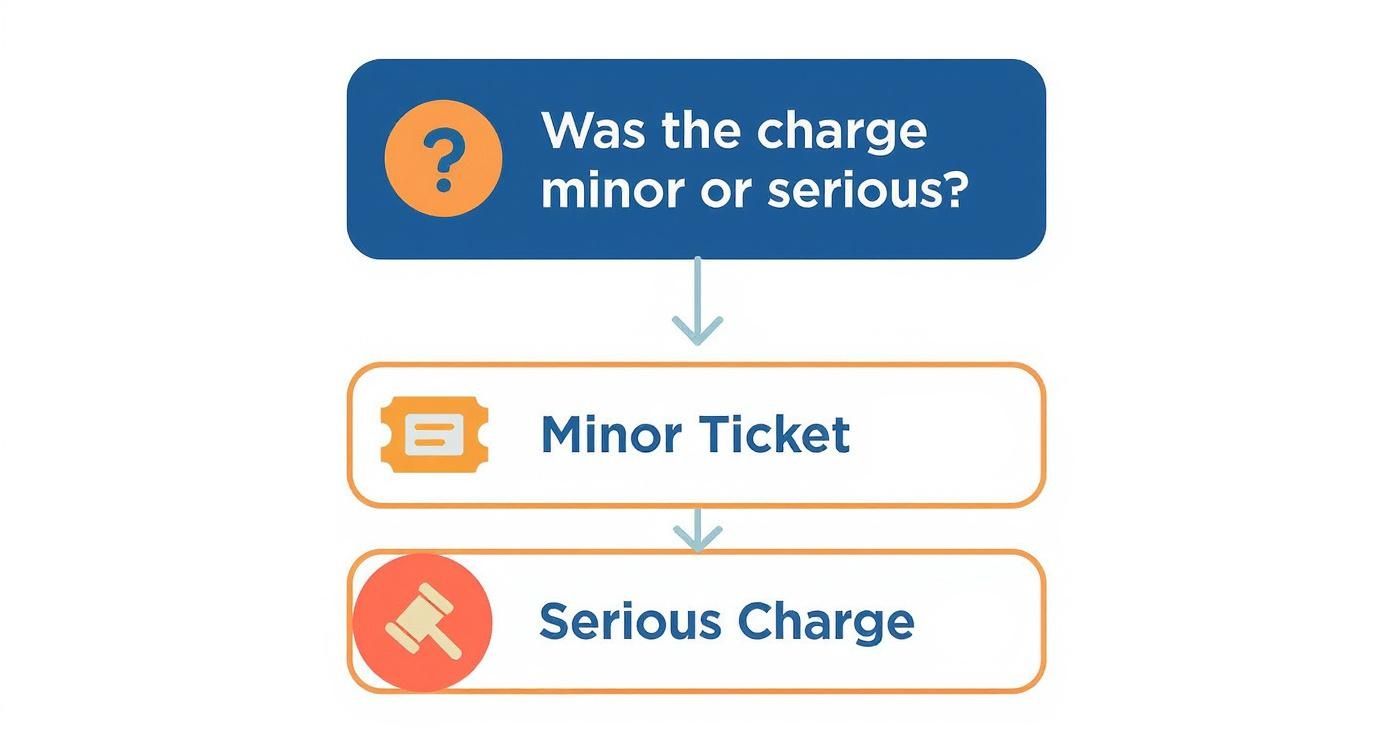
As the graphic shows, everything depends on how the charge is classified. The bigger the risk, the more sense it makes to get help. While you might be able to manage a simple ticket on your own, a serious charge brings in complexities and consequences that can be difficult to navigate without professional experience. It’s a choice you make to protect yourself from the full weight of the penalties.
To make it even clearer, here’s a quick guide to help you assess your situation.
When to Consider a Traffic Lawyer: A Quick Guide
| Traffic Violation | Potential Consequences in Georgia | General Information |
|---|---|---|
| Minor Speeding Ticket | Fines, 2-6 points on your license, potential insurance increase. | Often manageable on your own, unless you have prior points. |
| “Super Speeder” Violation | Additional $200 state fee, license suspension if not paid, significant insurance hike. | Highly Recommended. An attorney can often negotiate to avoid the “Super Speeder” status. |
| Reckless Driving | Fines up to $1,000, up to 12 months in jail, license suspension. | Essential. This is a serious misdemeanor with lasting consequences. |
| DUI (First Offense) | Jail time, fines, license suspension, mandatory DUI school. | Absolutely Essential. A DUI conviction impacts every part of your life. Never face this alone. |
| Driving with a Suspended License | Mandatory jail time, additional license suspension, hefty fines. | Essential. An attorney is critical to minimize jail time and further suspension. |
| CDL Holder Violation | Any moving violation can impact your livelihood and CDL status. | Highly Recommended. Protecting your commercial license is paramount. |
Remember, this table is just a starting point. Every case is different, and the best way to understand your options is to discuss the specifics with someone who handles these cases day in and day out.
Understanding the Stakes in Georgia Traffic Court
A traffic ticket might feel like a minor annoyance, but that fine printed on the paper is often just the opening act. Here in Georgia, a simple citation can kick off a chain reaction of consequences that hit your wallet, your driving record, and even your ability to get to work. Understanding what’s truly on the line is the first step in deciding if you need a lawyer for traffic court.
So many drivers make the mistake of thinking that paying the fine is the end of the story. But in the eyes of the law, paying that ticket is the same as pleading guilty. This admission triggers a whole host of penalties that go far beyond the initial cost, starting with the state’s points system.
The Georgia Points System Explained
Think of your driver’s license like it has a health bar in a video game, and every traffic ticket deals damage in the form of points. The Georgia Department of Driver Services (DDS) uses this system to track violations, and each moving violation conviction chips away at your good standing.
Here’s a quick look at how points get assigned for some common offenses:
- Aggressive Driving: 6 points
- Reckless Driving: 4 points
- Improper Passing: 4 points
- Speeding 24-33 MPH Over Limit: 4 points
- Speeding 19-23 MPH Over Limit: 3 points
- All Other Moving Violations: 3 points
The magic number you absolutely need to remember is 15. If you rack up 15 or more points in a 24-month period, the DDS will automatically suspend your driver’s license. That isn’t a maybe; it’s a guarantee. For drivers under 21, the rules are even stricter—a single ticket worth 4 or more points means an automatic suspension. This is why knowing how long traffic tickets stay on your record is so critical for managing these points over time.
A license suspension can throw your entire life into chaos, from commuting to your job in Alpharetta or Marietta to picking up the kids from school in Forsyth County. It’s a serious mess that can start with one seemingly minor ticket.
Uncovering the Hidden Financial Burdens
The financial sting of a traffic ticket goes well beyond what’s printed on the citation. The total cost is often layered with hidden fees that can add up fast, turning a hundred-dollar ticket into a thousand-dollar problem before you know it.
First, you have court costs and state surcharges. These are administrative fees tacked onto every fine, often bumping up the total amount you owe by a surprising percentage. They aren’t advertised, but they are always there.
Then there’s Georgia’s infamous “Super Speeder” law. This isn’t a separate ticket but an extra fine slapped on top of your conviction. If you’re found guilty of driving 75 MPH or more on any two-lane road, or 85 MPH or more on any road in Georgia, the state will mail you a separate bill for an extra $200. If you don’t pay it, your license gets suspended immediately.
The Long-Term Pain of Insurance Hikes
Maybe the biggest financial hit, though, is the one that sticks with you for years: skyrocketing insurance premiums. As soon as you’re convicted of a moving violation, your insurance company labels you as a higher-risk driver. And you know what that means—they raise your rates.
This isn’t a one-and-done increase, either. You’ll be paying those higher premiums for the next three to five years. Depending on the violation, your rates could easily jump by hundreds of dollars every year. Over that time, the extra cost can dwarf the original fine, often costing you far more than it would have to hire a lawyer to fight the ticket from the start.
When you add it all up—the fine, court costs, a potential Super Speeder fee, and years of inflated insurance rates—it’s clear the stakes are much higher than they seem. This is exactly why taking a strategic approach is so important.
When Hiring a Traffic Attorney Is a Smart Move
Sure, you can technically represent yourself for any traffic ticket. But some situations are more like trying to fix a complex engine problem than a simple oil change. You wouldn’t risk messing up your engine to save a few bucks, and the same logic applies when the stakes in traffic court get high.
Deciding to hire an attorney is a strategic move—one that protects your bank account, your driving record, and sometimes, your freedom. Let’s break down the specific scenarios where getting a professional on your side is not just a good idea, but a critical one.
When Facing Serious Violations
Some traffic citations aren’t just tickets; they’re criminal charges that can follow you for life. If you’re facing one of these, the question of whether you need a lawyer has a very clear and urgent answer: yes. Going it alone is a massive gamble.
Serious violations in Georgia that absolutely demand an attorney include:
- DUI (Driving Under the Influence): A conviction means potential jail time, huge fines, a suspended license, and a permanent criminal record. The consequences are life-altering, and the process is incredibly complex.
- Reckless Driving: This is a serious misdemeanor, not a simple speeding ticket. It carries penalties of up to 12 months in jail, a fine up to $1,000, and four points against your license.
- Leaving the Scene of an Accident: A hit and run can be charged as either a misdemeanor or a felony, depending on the amount of damage or if someone was injured.
- Aggressive Driving: Another serious misdemeanor in Georgia, this charge involves a pattern of dangerous driving behaviors and comes with stiff penalties.
For any of these charges, having an attorney is essential to building a solid defense. The right lawyer can make all the difference, which is why it’s also helpful to know how to choose a criminal lawyer who truly understands what’s at stake.
Protecting Your Commercial Driver’s License (CDL)
If you’re a commercial driver, even a basic traffic ticket can be a catastrophe. Your CDL is your livelihood, and the rules are far stricter than for a regular license. A single conviction for certain moving violations can trigger a suspension or even permanent disqualification.
A ticket that’s just an annoyance for a regular driver in Roswell or Milton could be a career-ending event for a professional truck driver.
An experienced attorney knows how to fight to protect your CDL, often by working to get the charges reduced to non-moving violations or dismissed entirely. The potential income lost from a CDL suspension easily outweighs the cost of a good lawyer.
When You’re at Risk of License Suspension
Even if the ticket itself seems minor, context is everything. Georgia uses a cumulative points system, and every ticket you get pushes you closer to a license suspension. If your current ticket will put you over the 15-point threshold within a 24-month period, you need to fight it.
An attorney will look at your complete driving history and the current charge to create a strategy focused on one thing: preventing the conviction that would get your license suspended. It’s about playing the long game to keep you on the road.
If You Believe You Are Not at Fault
Sometimes, it’s simple: you know the ticket was a mistake. Maybe the officer clocked the wrong car, the radar gun seemed off, or the reason for the stop just didn’t add up.
This is where a lawyer becomes your advocate. They know how to pick apart an officer’s report, gather evidence, and present a structured, compelling case in court. Proving your innocence requires more than just your side of the story—it requires a strong argument, and that’s exactly what an attorney provides.
How a Traffic Lawyer Can Help Your Case
An experienced traffic attorney does a lot more than just show up to court for you. They bring a very specific set of skills and strategies to the table, all aimed at getting you a better outcome. Think of them like a master mechanic for your traffic case—they know how to look under the hood of the citation, spot the problems, and make adjustments you wouldn’t even know were possible.
Their work starts the second they take your case, beginning with a detailed review of the ticket itself. Was the location listed correctly? Were there any procedural mistakes in how it was issued? You’d be surprised how often small technical errors are enough to get a case completely dismissed.
Negotiating for a Better Outcome
One of the most valuable things a traffic lawyer does is negotiate with the prosecutor. They understand the local court systems in places like Cobb County and Johns Creek and, just as importantly, they often have working relationships with the people on the other side of the aisle.
This relationship opens the door to resolutions that are almost never offered to someone trying to represent themselves. A classic example is getting a speeding violation knocked down to a non-reporting offense.
- Original Charge: A speeding ticket that puts points on your license and gets reported straight to your insurance company.
- Negotiated Outcome: A plea to a basic local ordinance violation, which is a non-moving violation. This usually means no points and no insurance rate hike, even though you still pay a fine.
That kind of result is a game-changer. The goal is to protect your driving record and save you from the long-term financial headache of skyrocketing insurance premiums.
Challenging the Evidence
Beyond just cutting a deal, a good attorney knows how to pick apart the evidence being used against you. Just because a police officer says you were speeding doesn’t make it an open-and-shut case. A lawyer knows exactly what questions to ask.
An experienced attorney can challenge the very methods used to issue the ticket. They can request the maintenance and calibration records for the radar or laser gun used to clock your speed. If those records are out of date or show problems, the evidence against you could be thrown out as unreliable.
This is a strategic move that shifts the burden of proof back to the prosecutor. It’s no longer just about what you did; it’s about whether the state can prove its case according to very strict standards. This is a level of accountability that’s tough for a non-lawyer to enforce.
An attorney’s specific experience really matters here. Data from Ticketvoid.com suggests that specialized traffic attorneys with 3-5 years of dedicated experience can achieve around an 85% success rate in getting tickets dismissed or reduced. Their focused knowledge of local court procedures gives them a serious advantage.
The Practical Convenience of Having a Lawyer
Finally, let’s talk about the practical side of things. For many common traffic cases in courts from Cumming to Roswell, your attorney can often appear on your behalf. That means you don’t have to take a day off work, find childcare, or waste hours sitting around a crowded courtroom.
Your lawyer handles the court dates, the talks with the prosecutor, and all the paperwork. You get to go on with your life with minimal disruption. This convenience alone saves you time and stress, making it a smart move for anyone facing a traffic charge.
Comparing the Cost of a Lawyer to a Conviction
It’s easy to get sticker shock when thinking about fees. When you’re staring at a ticket and wondering, “do I need a lawyer for traffic court,” the cost of hiring one can feel like the biggest hurdle. But that’s looking at it the wrong way. The real question is how that one-time fee stacks up against the long-term financial hit of a conviction.

Most experienced traffic attorneys in Georgia handle these cases for a flat fee. You’ll know the exact cost upfront. This single, predictable payment covers everything needed to handle your case, so you don’t have to worry about hourly bills adding up.
When you see the numbers, you realize that this one-time investment is often just a fraction of what you’d pay over the next few years if you just plead guilty.
The True Cost of a Conviction
A conviction costs a lot more than just the fine printed on your ticket. Think of it as a leaky pipe behind a wall—that initial ticket fine is the small drip you can see, but the real damage is the slow, steady, and expensive mess it creates for years to come.
Here’s a quick look at how the costs start piling up after you’ve been convicted:
- The Initial Ticket Fine: This is just the starting point.
- Court Fees and Surcharges: Every court tacks on administrative fees that can seriously inflate what you owe.
- Georgia “Super Speeder” Penalty: If your speed qualifies, the state sends you a separate bill for an extra $200.
- Multi-Year Insurance Premium Hikes: This is the big one. A conviction flags you as a higher risk, and your insurance company will raise your rates for the next three to five years.
Add it all up, and the total cost of a single conviction can easily climb into the thousands of dollars—far more than an attorney’s flat fee.
The real comparison isn’t the attorney’s fee versus the ticket fine. It’s the attorney’s fee versus the fine, the court costs, potential state penalties, and years of inflated insurance premiums combined.
A Practical Cost-Benefit Example
Let’s run the numbers on a common scenario. Say you get a speeding ticket that also makes you a “Super Speeder” in Georgia.
- Without a Lawyer: You decide to just pay the fine. You write a check for the $250 ticket and court costs. A month later, a $200 Super Speeder bill arrives. Then your insurance renewal comes in, and your premium is up $40 per month. Over the next three years, that’s an extra $1,440 in insurance payments.
- Total Cost Over 3 Years: $250 (fine) + $200 (Super Speeder) + $1,440 (insurance) = $1,890.
- With an Attorney’s Help: You hire an attorney for a flat fee of $750. They negotiate with the prosecutor and get your speed reduced to a non-reporting offense. You still pay a fine, maybe around $300, but there’s no Super Speeder penalty, no points on your license, and no insurance increase.
- Total Cost: $750 (attorney fee) + $300 (reduced fine) = $1,050.
In this very realistic example, hiring a lawyer saves you $840. The more serious the charge, the more you stand to save. For some, understanding the role of a public defender vs a private attorney is also a key part of the decision, but the goal is always the same: choosing the path that minimizes long-term financial damage.
What to Do Right After You Get a Georgia Traffic Ticket
Seeing those flashing blue lights in your rearview mirror is a feeling nobody enjoys. When the officer hands you that ticket, your first thought might be to just pay it online and forget the whole thing ever happened. It’s tempting, I get it.
But hold on a second. Paying that fine is the same as pleading guilty. It’s a guaranteed conviction, and that means points on your license and a hit to your driving record. Before you rush to that decision, take a breath. A few smart moves right now can make all the difference.
Your Immediate Plan of Action
The key is to not panic. Instead, get organized. This is about more than just a fine; it’s about protecting your driving record from long-term consequences, like skyrocketing insurance premiums.
Here’s exactly what you need to do:
- Read Your Ticket Carefully. Don’t just stuff it in the glove compartment. Look at the court date, the specific violation you’re being charged with, and any notes the officer wrote. Double-check that all your personal information and the location details are accurate. Mistakes happen.
- Find Your Deadline. Your citation will have a date by which you absolutely must respond to the court. Missing this deadline is a big deal and can trigger a Failure to Appear notice, which often leads to a suspended license.
- Write Everything Down. As soon as you can, jot down every detail you remember from the stop. What was the weather like? How was traffic? What were the road conditions? What exactly did you and the officer say to each other? If it’s safe, snap a few photos of the location where it happened.
- Look Into Your Options. Pleading guilty isn’t your only choice. Start researching attorneys who know the local courts inside and out—whether your ticket is in Forsyth County, Alpharetta, or another nearby jurisdiction. This is a critical step. A good lawyer familiar with the local prosecutors and judges often achieves a dismissal or a reduction in over 90% of their cases, keeping the violation off their client’s record entirely. As FoxBusiness.com has reported, having the right professional help can dramatically improve your odds.
Common Questions About Georgia Traffic Court
Getting a traffic ticket can leave you with a lot of questions. Below are some straightforward answers to the things people most often ask when they’re trying to figure out if they need a lawyer.
Can a Lawyer Guarantee My Ticket Will Be Dismissed?
No ethical attorney will ever promise a specific outcome. Think of it this way: a great surgeon can’t guarantee a perfect recovery, but their skill dramatically improves the chances of a successful operation. An experienced traffic attorney knows the local courts, prosecutors, and procedures inside and out, which significantly boosts the odds of a better result—whether that’s a dismissal, a reduced charge, or keeping points off your license.
If I Hire a Lawyer, Do I Still Have to Go to Court?
For many routine traffic offenses, one of the biggest benefits of hiring an attorney is that they can often appear in court for you. This is a huge practical advantage. It means you may not have to take time off work or rearrange your whole day just to sit in a courtroom for hours. You’ll want to confirm this with your attorney, of course, as it can depend on the specific court and the type of charge you’re facing.
Is It Really Worth It to Fight a Minor Speeding Ticket?
In many cases, yes. What seems like a “minor” ticket still puts points on your license. Just a single conviction can be enough for your insurance company to raise your rates, an increase that can stick around for years. When you do the math, the long-term cost of those higher premiums can easily add up to more than the original fine.
And if you already have a few points on your record, fighting that next ticket becomes even more critical to avoid a potential license suspension.
What Happens if I Just Ignore My Ticket?
Ignoring a traffic ticket is one of the worst things you can do. It absolutely will not just go away. What will happen is the court will issue a “Failure to Appear” notice. From there, things get serious fast. This typically leads to an automatic suspension of your driver’s license and can even result in a warrant for your arrest.
What started as a simple traffic violation can quickly snowball into a much bigger problem with far more severe consequences.
Making the right decision after getting a ticket can protect your driving record, your insurance rates, and your finances for years to come. If you have more questions about a ticket you received in Alpharetta, Cumming, or anywhere in the surrounding counties, Brian Hansford Law is here to help.
Visit https://challengemycharge.com to learn more about how experienced representation can make a difference in your case.
