
If you were just handed a citation by the Alpharetta Police Department or a Fulton County officer, the first question on your mind is urgent: do infractions go on your record? The answer is complex. In Georgia, it depends entirely on which record you are concerned about—your driving record or your permanent criminal record. An infraction can have serious consequences for both.
Most minor traffic tickets in Alpharetta, GA, will not appear on your official criminal history. However, they are absolutely added to your Georgia driving record, which can lead to higher insurance premiums, points against your license, and even suspension. The most critical step you can take right now is to understand the stakes and not simply pay the fine.
If you are facing a traffic infraction or a related criminal charge in Alpharetta, do not speak to law enforcement or prosecutors without legal counsel. Call Brian Hansford today for a confidential consultation to protect your record.
Your Guide to Infractions and Your Record in Alpharetta

When you receive a citation from the Alpharetta Police Department or another North Fulton agency, it’s critical to understand the two different records at play. Your driving history is tracked by the Georgia Department of Driver Services (DDS), while your criminal history is maintained by the Georgia Crime Information Center (GCIC). They are not the same, but one can easily lead to problems with the other.
Why This Matters in Alpharetta
Think of your DDS driving record as a report card for how you handle yourself behind the wheel. Insurance companies absolutely use it to calculate your premiums. Every single infraction that adds points—from a speeding ticket on GA-400 to a stop sign violation in a Milton neighborhood—can push your rates higher.
Rack up enough points, and the DDS has the power to suspend your license. For anyone who drives for work or commutes daily from places like Johns Creek, Roswell, or Cumming, a license suspension is more than an inconvenience—it's a direct threat to your livelihood and independence.
Your criminal record, on the other hand, is what populates most formal background checks for jobs, professional licenses, and housing applications. A simple speeding ticket won’t appear there. However, certain traffic violations are classified as criminal offenses in Georgia—like DUI, Reckless Driving, or Driving on a Suspended License. A conviction for these charges creates a permanent criminal record that follows you.
The most dangerous mistake you can make is ignoring the citation. A simple ticket can escalate quickly in the North Fulton court system, potentially leading to a warrant for your arrest. Deadlines in Fulton County move quickly.
Alpharetta Infraction vs. Criminal Charge: Know the Difference
To make it crystal clear, this table breaks down the fundamental differences between a common traffic infraction and a more serious criminal charge here in Alpharetta and Fulton County.
| Characteristic | Traffic Infraction (e.g., Speeding Ticket) | Criminal Charge (e.g., DUI, Reckless Driving) |
|---|---|---|
| Record Impact | Appears on your Georgia DDS driving record. | Appears on your GCIC criminal record AND your driving record. |
| Primary Penalty | Fines and DDS points. | Potential jail time, probation, and significant fines. |
| Court Venue | Typically handled in Alpharetta Municipal Court. | Handled in Fulton County State Court or Superior Court. |
| Long-Term Risk | Increased insurance rates, potential license suspension. | Lasting criminal record, impacting jobs, housing, and licenses. |
Understanding this distinction is the first step toward protecting your future. Whether you were cited in Alpharetta, Sandy Springs, or anywhere in North Fulton, what seems like a minor problem can have major consequences if not handled with a clear strategy. As an experienced defense attorney, I guide clients through the process in Alpharetta Municipal Court and Fulton County State Court to protect both their driving and criminal records.
Do not let a simple infraction compromise your future. Call Brian Hansford now for a case review to understand your options.
The Difference Between Your Driving Record and Criminal Record
If you've been pulled over in Alpharetta, one question probably floods your mind: is this going on my record? The answer isn't a simple yes or no. The key is understanding that in Georgia, you don't just have one "record." You actually have two, and they each serve a very different purpose.
Think of it like this: your driving record and your criminal record are two completely separate files. A simple mistake might only affect one, but a serious offense can impact both, creating major headaches for your personal and professional life. Knowing the difference is the first and most important step in protecting yourself.
Your Georgia DDS Driving Record
Your driving record is an ongoing account of your history behind the wheel. It's managed by the Georgia Department of Driver Services (DDS) and acts like a report card for your driving habits, tracking every ticket, accident, and point you accumulate.
Insurance companies in Roswell, Johns Creek, and Cumming look at this record very closely when setting your premiums. Even one speeding ticket on GA-400 can add points and lead to a significant jump in your insurance rates.
You can think of your driving record like a credit score, but for driving. A few negative marks will cost you, while too many can lead the DDS to suspend your license altogether.
This record is highly visible to insurers and the DDS. You can't just ignore it—the consequences, from higher premiums to a suspended license, are almost guaranteed. It's a system built to track and penalize risky driving.
Your GCIC Criminal Record
Your criminal record is a much more serious document. Maintained by the Georgia Crime Information Center (GCIC), this is your official legal history. It lists arrests and convictions for both misdemeanors and felonies across Fulton County and the entire state.
Unlike your driving record, your GCIC record is what employers, professional licensing boards, and landlords see during a background check. This is the permanent transcript that can open or close doors for your future. A basic speeding ticket won’t show up here, but serious traffic-related offenses like DUI, Reckless Driving, or Driving on a Suspended License absolutely will.
These types of criminal charges leave a lasting mark that can derail a career, block you from getting a professional license, or even impact your ability to rent an apartment in communities like Milton and Dunwoody.
Under Georgia law (O.C.G.A. § 35-3-34), official criminal background checks are supposed to exclude most minor traffic tickets. However, the details on your DDS driving record can stick around for years, potentially spiking your insurance rates by 20-30%. With a high percentage of employers running background checks, it’s clear how even a seemingly minor issue can have a major impact.
It’s crucial to know how long these tickets can follow you. For a deeper dive, you can learn more about how long traffic tickets stay on your record in our detailed guide. Protecting both your driving and criminal records is essential for anyone living or working in the North Fulton area, including in nearby East Cobb. A strong defense strategy is the best tool you have to keep a small mistake from turning into a lifelong problem.
How a Simple Alpharetta Infraction Can Escalate
That speeding ticket you got on Old Milton Parkway or another Alpharetta road probably feels like just a nuisance. You figure you’ll pay the fine and that’s the end of it. But here in North Fulton, that little piece of paper can quickly snowball into a serious criminal problem that leaves a permanent mark on your record.
For drivers in Alpharetta, Johns Creek, and the surrounding areas, the jump from a basic traffic infraction to a criminal charge is a very real possibility. It’s critical to understand what triggers this escalation so a small mistake doesn’t upend your life. Many people I speak with are stunned when they learn a simple ticket has led to a warrant for their arrest.
The Failure to Appear Trap in Fulton County
By far, the most common way an infraction gets worse is a Failure to Appear (FTA). When you’re issued a ticket, you’re also given a court date. If you blow off that date at the Alpharetta Municipal Court, you’re doing more than just ignoring a fine—you’re defying a direct court order.
What happens next is almost automatic. A judge will issue a bench warrant for your arrest. At the same time, the court reports the FTA to the Georgia Department of Driver Services (DDS), which will then suspend your driver’s license. Just like that, a $150 ticket has morphed into an active arrest warrant and the loss of your right to drive.
This chart shows how one incident can branch off and affect two completely different types of records.
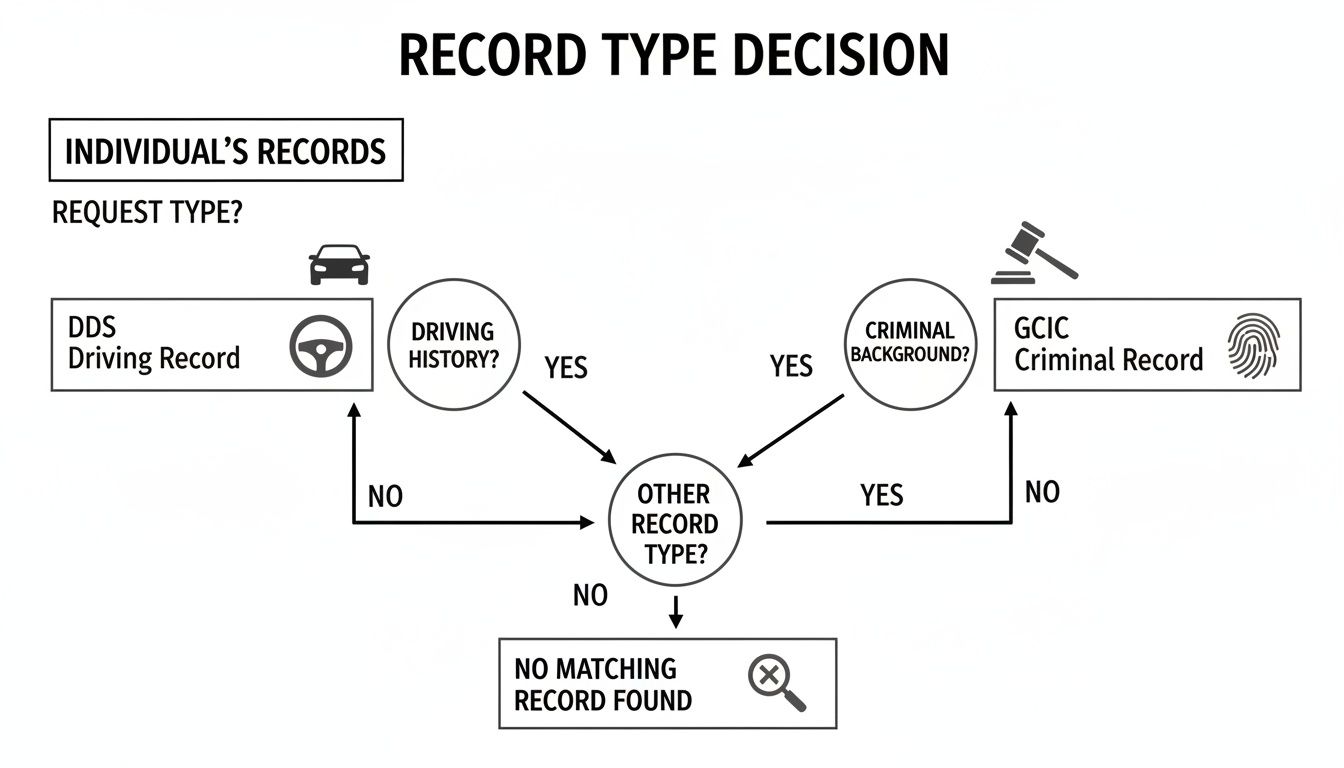
As you can see, the path an infraction follows—whether to your driving history or your criminal record—is all about the choices you make after getting the ticket.
Driving on a Suspended License
Once your license is suspended, either from an FTA or from racking up too many points, any future traffic stop becomes a much bigger deal. If an officer in Roswell, Sandy Springs, or Cumming pulls you over and runs your name, they’ll see the suspension. You will be arrested on the spot.
Driving on a suspended license isn't just another ticket. It’s a criminal misdemeanor in Georgia. This charge puts an entry on your GCIC criminal record, the one that shows up on virtually all employment background checks. Suddenly, what began as a routine speeding ticket has created a criminal history that follows you.
The penalties for driving on a suspended license in Georgia can include jail time, steep fines, and an even longer suspension period. It is a charge that North Fulton prosecutors take very seriously.
From Routine Stop to Criminal Investigation
A simple traffic stop can also escalate right there on the side of the road. An officer who stops you for a minor infraction is always looking for signs of other, more serious crimes. Here are a few common ways that happens:
- Suspicion of DUI: If the officer smells alcohol or sees signs that you’re impaired, the stop instantly turns into a DUI investigation. This can happen anywhere, from a main road in Dunwoody to a quiet neighborhood street in Milton.
- Discovery of Drugs or Paraphernalia: If illegal drugs are in plain sight inside your car, you’ll be facing drug charges under Georgia's strict drug schedules on top of the original traffic offense.
- Providing False Information: Giving a fake name or lying to a police officer is a misdemeanor that will get you arrested immediately.
These scenarios show just how fast a minor slip-up can put you in serious legal trouble. The only way to stop this is to be proactive. As an attorney who works in the Alpharetta Municipal Court and Fulton County State Court every day, I can get involved early to resolve FTAs, negotiate charges, and protect your record. Don’t wait for things to get worse—call my office today to keep your record clean.
What Employers See on Background Checks in Georgia
For professionals in Alpharetta, Milton, and Sandy Springs, one of the biggest questions after any run-in with the law is simple: how will this affect my career? It’s a completely valid fear, and it’s critical to know what a potential employer actually sees when they run a background check in Georgia. The process isn't a free-for-all; there are specific records they can and cannot pull.
A standard employment background check draws from your official criminal history at the Georgia Crime Information Center (GCIC). The good news is that a minor speeding ticket or a simple traffic infraction will not appear on this criminal report. But that’s not the end of the story, especially in the competitive North Fulton job market.
The Two-Record Problem for Job Seekers
Many employers, especially for jobs that involve driving, handling sensitive information, or using company vehicles, take an extra step. They’ll also ask for a copy of your Georgia DDS driving history. This is where a pattern of what seems like minor infractions can turn into a major roadblock.
While a single ticket probably won’t get you disqualified, a stack of points or several recent violations can send up serious red flags. To an employer in Roswell or Johns Creek, it might suggest a pattern of irresponsibility. For certain careers, the standards are even stricter:
- Professional Licensing: People like nurses, real estate agents, and accountants can face investigations or even have their licenses denied based on their driving record, particularly for things like reckless driving or DUI.
- Security Clearances: A poor driving record can be seen as a sign of unreliability or bad judgment, which could put your ability to get or keep a security clearance at risk.
- CDL Holders: For commercial drivers, the rules are incredibly tight. Many infractions that are no big deal for a regular driver can mean immediate disqualification.
From Civil Infraction to Criminal Record
It’s easy for a civil matter to suddenly become a criminal one, so you have to understand the line. Let’s say you get pulled over for speeding in Alpharetta or Cumming. Does that ticket stain your criminal record forever? Thankfully, no. In Georgia, most traffic infractions are handled as civil matters under Title 40 of the Official Code of Georgia Annotated. They are not criminal unless they cross a certain line. While our focus here is on Georgia law, you can find more detailed insights about these global legal distinctions in broader justice reports.
The line gets crossed with serious traffic offenses like a DUI, Reckless Driving, or Driving on a Suspended License. Those are not infractions; they are criminal misdemeanors. A conviction for any of those will absolutely show up on a GCIC background check.
A common question is whether a simple arrest shows up. The answer is yes, an arrest can appear on a background check even without a conviction, which is why fighting the charge from the beginning with a criminal defense attorney near me is so critical.
To protect the career you’ve worked so hard to build in the North Atlanta area, you have to be proactive about managing both your driving record and your criminal record. This means more than just paying a fine; it means understanding the long-term fallout. As an experienced attorney who practices in Alpharetta Municipal Court and Fulton County State Court, I can help you navigate this. If you want to understand more, check out our guide on whether background checks show arrests.
The Court Process in Fulton County: What to Expect

When an officer from the Alpharetta Police Department or another North Fulton agency hands you a citation, you’re standing at a fork in the road. Your next step will have a direct ripple effect on your driving record, your insurance premiums, and in some cases, even your freedom. This isn't just about paying a fine—it's about making a strategic choice that protects your future.
Most people think their only option is to pay the ticket online. But paying that fine is the same as pleading guilty. While it feels like the easy way out, it’s a guaranteed conviction that puts points on your DDS driving record and almost certainly makes your insurance rates climb. You have better options available.
Defense Strategy: The Three Paths You Can Take
Whether your case begins in the Alpharetta Municipal Court or is handled in the Fulton County State Court, you generally have three ways to proceed.
- Pay the Ticket (Guaranteed Conviction): This is the path of least resistance, but it comes with the worst outcome for your record. You're admitting guilt, accepting the points, and triggering a notification to your insurance company.
- Fight the Ticket in Court: You always have the right to take your case to trial and force the prosecutor to prove you committed the offense. If their evidence is weak, this could lead to a dismissal, but it's a significant gamble without an experienced attorney by your side.
- Negotiate a Resolution: This is where a skilled defense attorney provides immense value. I can often work with the prosecutor to reach an agreement that keeps the infraction off your permanent driving history.
My goal is always the same: prevent the offense from ever being reported to the Georgia Department of Driver Services (DDS). Once it's on your record, the financial damage has already begun.
Negotiation: The Key to Protecting Your Record
For drivers in places like Johns Creek, Roswell, and Milton, negotiation opens doors that simply paying the fine slams shut. As an attorney who knows the North Fulton prosecutors and court procedures, I can work toward several key outcomes:
- Plea to a Non-Reportable Offense: This is often the best-case scenario. We can frequently negotiate the charge down to a local ordinance violation. These typically carry a fine but, crucially, do not add points to your license or get reported to DDS.
- Plea of Nolo Contendere (No Contest): Georgia law allows you to use a "nolo" plea once every five years to avoid points for most minor traffic violations. A judge must approve this plea, but it’s a powerful tool in the right situation.
- Pretrial Diversion or Deferral: Some first-time offenders in Fulton County may qualify for a diversion program or options under the Georgia First Offender Act. If you complete the requirements—like a defensive driving course—the ticket can be completely dismissed and your record restricted.
These options can be a little confusing, but you can find additional information about deferring a ticket and how these programs work. The right strategy always depends on the specific facts of your case, your driving history, and the court you’re in. Don't just take the easy path and pay the fine—that’s a mistake that can cost you for years. Speak with an attorney today to protect your record.
Why Choose Brian Hansford in Alpharetta
When your record and future are on the line, you need more than just any lawyer. You need a calm, strategic advocate who knows the local courts inside and out. I have dedicated my career to defending individuals in Alpharetta, Roswell, and throughout North Fulton against traffic infractions and criminal charges. My approach is direct and protective—focused on one thing: achieving the best possible outcome for you.
I handle every case personally, providing the focused attention that larger, impersonal firms can't offer. I understand the stress and uncertainty you're facing. I am here to provide clear guidance and a strong defense, whether your case is in Alpharetta Municipal Court or Fulton County State Court.
FAQ: Your Questions About Alpharetta Infractions Answered
Getting a ticket or facing a charge in North Fulton leads to many questions. Here are direct answers to some of the most common concerns I hear from clients in Alpharetta and surrounding communities.
Q: Will a speeding ticket in Alpharetta go on my criminal record?
A: No, a standard speeding ticket from Alpharetta police is a traffic infraction, not a criminal offense. It is reported to the Georgia DDS for your driving record, which impacts insurance rates and license points. However, it will not appear on your official GCIC criminal record unless it escalates to a more serious charge like Reckless Driving.
Q: How can I get an infraction off my driving record in Fulton County?
A: Once a conviction is on your DDS record, it is very difficult to remove. The best strategy is to prevent it from getting there in the first place. An experienced attorney can often negotiate a resolution in Alpharetta Municipal Court or Fulton County State Court to a non-reportable offense, keeping your driving record clean.
Q: Do I need a lawyer for a traffic ticket in Johns Creek?
A: While not required, hiring an attorney for a ticket in Johns Creek or Milton is a strategic decision. An attorney familiar with North Fulton courts can negotiate to reduce the charge, saving you from license points, insurance hikes, and potential suspension. This is especially critical if you have a professional license or CDL.
Q: What happens if I miss my court date at Alpharetta Municipal Court?
A: Missing a court date at Alpharetta Municipal Court is a serious mistake. A judge will issue a Failure to Appear (FTA), which triggers a bench warrant for your arrest and an automatic suspension of your driver’s license by the Georgia DDS. Contact an attorney immediately to address the warrant and protect your license.
Q: What is the Georgia First Offender Act?
A: The Georgia First Offender Act is a program that allows some individuals without a prior felony conviction to have their charge dismissed and their record sealed after completing their sentence. This is a powerful tool to protect your future, but eligibility is complex. An attorney can determine if it's an option for your case in Fulton County.
If you are facing a traffic infraction or criminal charge in Alpharetta, Cumming, or anywhere in North Fulton, your next step is critical. Do not risk your record by just paying the fine. Contact Brian Hansford Law to protect your rights and your future. Request a confidential case review today by visiting https://challengemycharge.com.
