
A criminal charge has a way of collapsing your focus into one fear at a time. If you were arrested for DUI in Alpharetta, charged with drug possession in Roswell, or cited for reckless driving in Milton, you may be asking a question people rarely say out loud until they're in the middle of it.
Can the government keep coming after me until it gets the result it wants?
That concern sits at the heart of the double jeopardy legal definition. It isn't just a phrase from television. It's a constitutional limit on the government's power to prosecute. In practice, it can matter in DUI cases, misdemeanor cases, felony cases, and traffic-related prosecutions across North Atlanta courts.
It also gets misunderstood. Many people think any dismissal means the case can never come back. Others assume that once they're arrested, double jeopardy immediately protects them. Neither assumption is safe. The rule is more technical, and the timing matters.
If you're trying to protect your license, avoid jail, keep a conviction off your record, or stop a second prosecution from moving forward, you need the legal answer, not the popular version.
Facing a Charge and Fearing the Worst
The first days after an arrest are usually a blur. You post bond, call family, miss sleep, and start replaying the traffic stop, the search, the field sobriety tests, or the conversation with police.

Then a practical fear sets in. If the prosecutor loses once, can they just file it again and make you do the whole thing over?
That fear is common in DUI cases in Forsyth County, drug cases in Cobb County, and theft or white-collar investigations in Fulton County. It also comes up after a municipal court appearance, a dismissed traffic case, or a plea discussion that falls apart. If you want a basic overview of the arrest process itself, this guide on what happens when you get arrested is a useful place to start.
Why this fear is reasonable
People don't worry about double jeopardy because they love constitutional law. They worry about it because prosecution is expensive, public, and exhausting.
A second prosecution can mean:
- More court dates: You miss work again, arrange childcare again, and sit in another courtroom waiting for your name to be called.
- More advantage for the state: Prosecutors may try to improve a weak case or fix mistakes from the first round.
- More pressure to plead: Many defendants consider a plea not because they're guilty, but because they can't survive endless litigation.
Practical rule: Double jeopardy exists to stop the government from getting repeated chances against the same person for the same offense.
Where this gets personal in North Atlanta
A driver in Johns Creek may be charged after a stop that led to DUI and traffic offenses. A college student in Cumming may face a first drug charge and assume a dismissal ends everything. A professional in Marietta may worry that a not guilty verdict still won't bring finality.
Sometimes that concern is justified. Sometimes the law does block a second case. Sometimes it doesn't.
The difference usually turns on procedure, timing, and the legal definition of the offense itself.
Your Constitutional Shield The Fifth Amendment Protection
The starting point is the Fifth Amendment. Ratified on December 15, 1791, it states: "No person shall be subject for the same offence to be twice put in jeopardy of life or limb". That protection applies in federal court and, after Benton v. Maryland on March 24, 1969, also applies in state courts through the Fourteenth Amendment, as summarized by LawInfo's explanation of double jeopardy.
That sentence is the foundation of the double jeopardy legal definition. It means the government doesn't get unlimited attempts against the same defendant for the same criminal offense.
What the protection actually covers
In real practice, the rule protects against repeated criminal exposure after the state has already had its proper chance. It is aimed at finality.
That matters because criminal prosecution is not supposed to work like a test run. The state doesn't get to see what failed, regroup, and try again in the ordinary case.
If you've ever heard someone say, "They can't try me twice," the core idea comes from this clause. But the actual legal answer depends on when jeopardy begins.
When jeopardy attaches
Many people misunderstand this point. Jeopardy attaches at a specific procedural moment, not at arrest and not merely because charges were filed.
Use a timeline:
- Arrest or citation
- Charging decision
- Pretrial hearings
- Attachment of jeopardy
- Verdict or accepted plea
The key point is step four. Until then, the rules are different.
Under the constitutional rule summarized in the same LawInfo resource, jeopardy attaches:
- In a jury trial: when the jury is empaneled and sworn
- In a bench trial: when the first witness is sworn
The author brief also called for plea-related practical context, and in real defense work, accepted pleas can create finality concerns that must be handled carefully. If you're trying to understand your rights in a broader constitutional sense, this explanation of the meaning of pleading the Fifth helps separate two rights people often confuse.
A dismissal before jeopardy attaches may feel final to a defendant, but it often isn't final in the constitutional sense.
Why timing changes the outcome
If prosecutors dismiss a case early, they may still have room to refile. If they proceed into trial and jeopardy has attached, the law becomes much less forgiving of a second attempt.
For a DUI attorney in Alpharetta or a criminal defense lawyer in Roswell, this timing issue affects strategy from the beginning. It shapes whether to push a matter into hearing, whether to object to a mistrial, and whether a later filing can be stopped with a plea in bar.
Clients often want one broad answer. The honest answer is narrower and more useful.
Double jeopardy is powerful, but it isn't triggered by every arrest, every dismissal, or every court date. It turns on when the law says the prosecution has put you at risk in the constitutional sense.
What Does Same Offense Actually Mean in Georgia Courts
The phrase same offense sounds simple until two charges come from one stop, one search, or one incident. That's where double jeopardy disputes usually become technical.
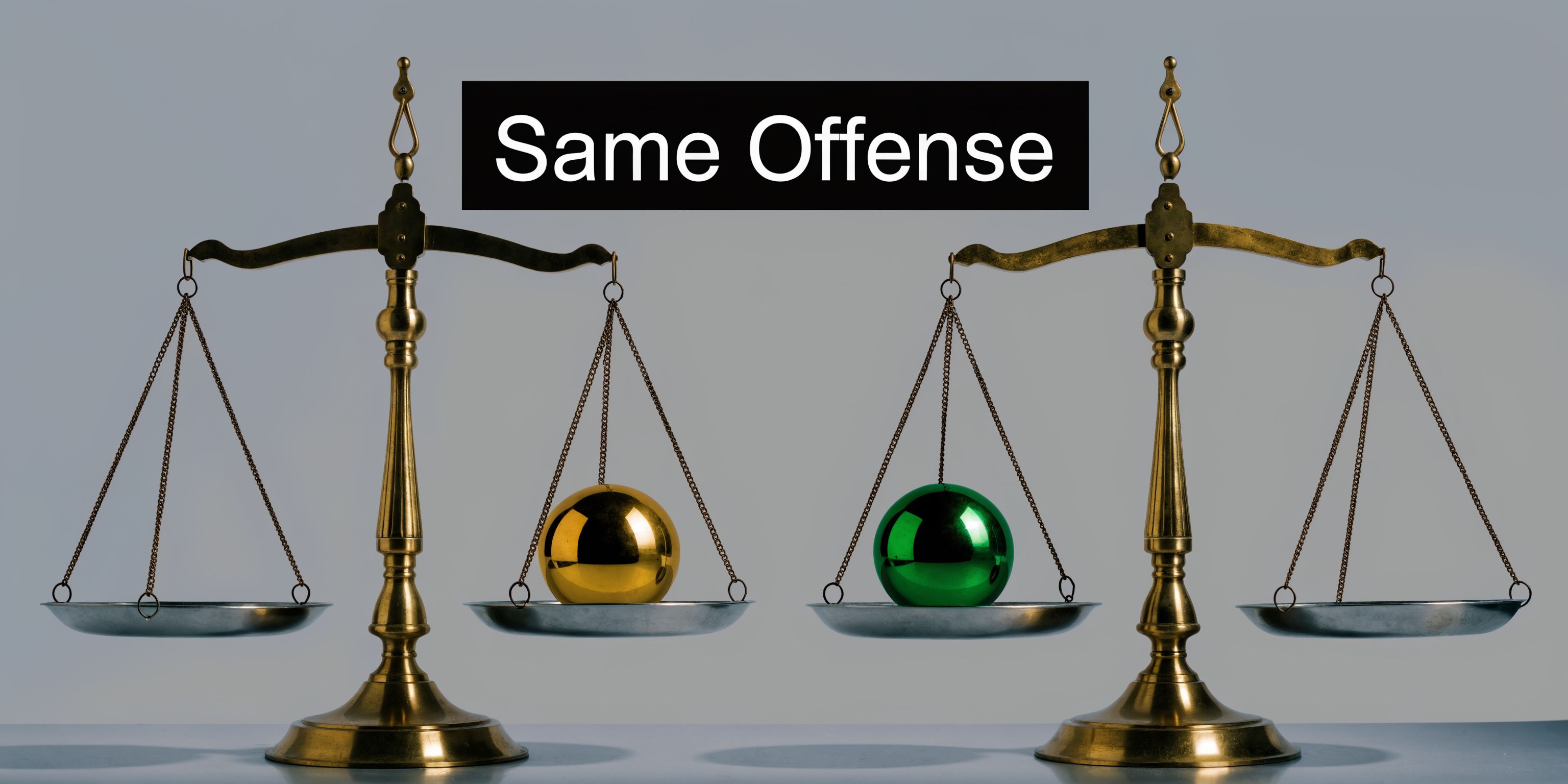
Courts use the Blockburger test from Blockburger v. United States, 284 U.S. 299 (1932) to decide whether two crimes are legally the same. The rule is this: each statute must require proof of a fact the other does not, as explained by Cornell Law's Wex entry on double jeopardy. That same source notes that jeopardy in a jury trial attaches when the jury is empaneled and sworn, citing Crist v. Bretz, 437 U.S. 28 (1978).
Think of it like a recipe
Take two recipes that use many of the same ingredients. If each recipe still requires at least one ingredient the other doesn't, they are different recipes.
Criminal charges work in a similar way.
If one offense requires proof of fact A and fact B, and another requires proof of fact A and fact C, the court may treat them as separate offenses because each one has an element the other lacks. But if one charge adds nothing legally distinct, the second prosecution or additional punishment may be barred.
Why this matters in traffic and DUI cases
North Atlanta cases often involve charge stacking. A stop in Milton or Johns Creek might lead to DUI, reckless driving, speeding, lane violation, or related accusations from the same event.
That doesn't automatically mean every charge violates double jeopardy. Some are distinct. Some are not. The answer depends on statutory elements, not just whether everything happened on the same night.
A defense lawyer looks past the police report headline and asks:
- What must the prosecutor prove for charge one
- What must the prosecutor prove for charge two
- Does each charge contain an element the other doesn't
- Is the state trying to relitigate under a new label
If you're wondering why prosecutors sometimes file overlapping counts, part of the answer lies in charging strategy and influence. This discussion of what prosecutorial discretion means gives useful context for why the state may pursue multiple theories from one event.
What works and what doesn't
Some defendants make the mistake of arguing, "It was all one incident, so it must be one offense." Courts don't use that shortcut.
A stronger argument focuses on legal elements. That's where the Blockburger analysis has real force.
| Comparison point | Weak defense argument | Stronger defense argument |
|---|---|---|
| Single event | "Everything happened at once." | "The second charge doesn't require proof of a fact the first charge lacks." |
| Multiple counts | "They overcharged me." | "These counts punish the same offense under the controlling elements test." |
| Refiling concern | "They changed the name of the charge." | "The new filing targets the same offense in substance, not a legally distinct one." |
The label on the accusation matters less than the elements the prosecutor must prove.
This is one reason experienced court representation matters. In felony defense, misdemeanor defense, and even serious traffic matters, the double jeopardy legal definition only helps if someone applies the right legal test to the actual charging language.
When Double Jeopardy Does Not Protect You Key Exceptions
Double jeopardy is a real constitutional shield, but it has limits. Some are narrow. Some surprise people.
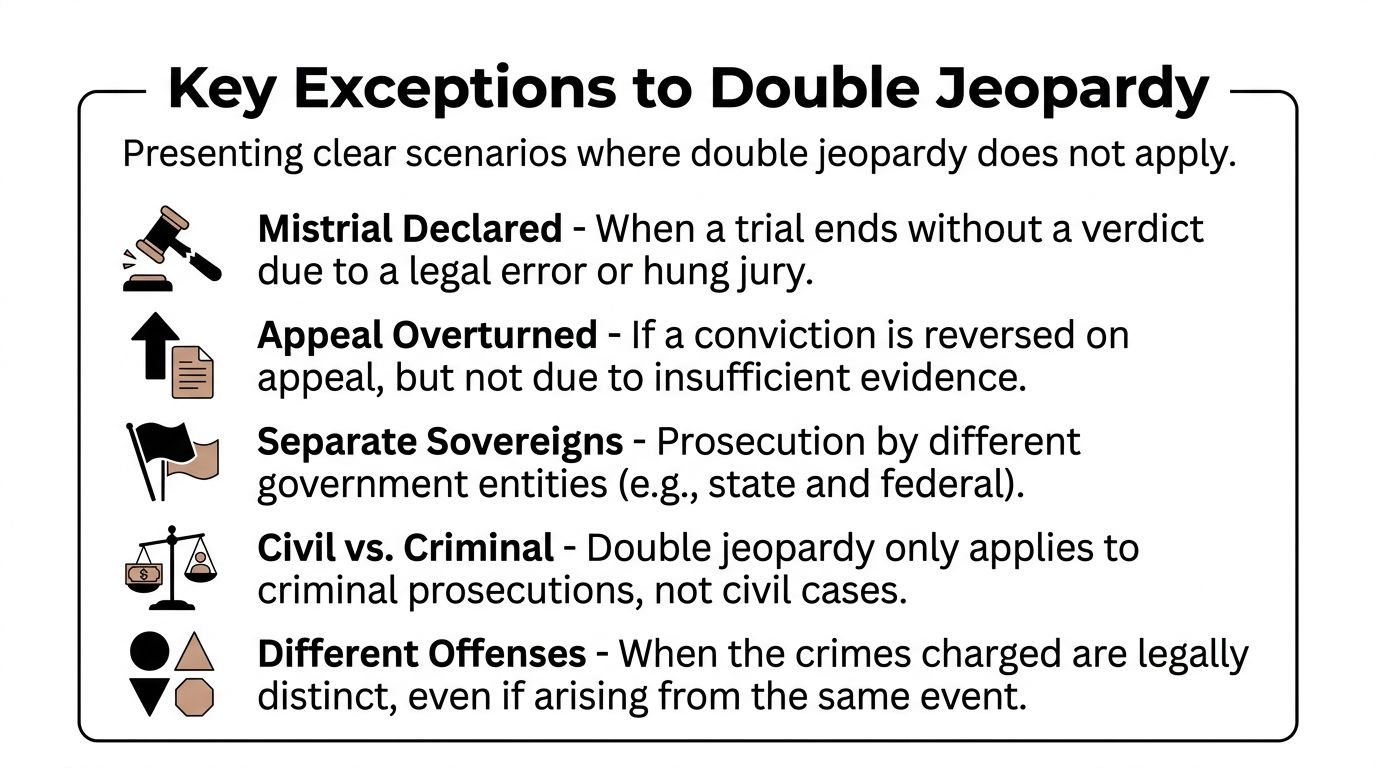
One major exception is the dual sovereignty doctrine, affirmed by the U.S. Supreme Court in Gamble v. United States on June 7, 2019. The Court allowed sequential prosecutions by separate sovereigns, meaning state and federal authorities can prosecute the same conduct without violating double jeopardy. Another exception allows retrial when a conviction is overturned on appeal. Double jeopardy also applies only to criminal proceedings, not later civil suits, as summarized in this discussion of key exceptions to double jeopardy.
The biggest exceptions defendants need to know
Some exceptions are procedural. Others are structural.
- Mistrial situations: If a trial ends without a valid final verdict, retrial may still be allowed in some circumstances.
- Successful appeal by the defendant: If you challenge your conviction and win a reversal, the state may get another chance unless the reversal rests on insufficiency grounds.
- Separate sovereigns: Georgia and the federal government are not the same sovereign for this doctrine.
- Civil follow-up: A civil claim can proceed even if the criminal case ended in your favor.
- Legally distinct offenses: If the charges are not the same offense under the governing test, double jeopardy may not bar additional prosecution or punishment.
Comparison table
| Scenario | Double Jeopardy Protection Applies? | Reason |
|---|---|---|
| Acquittal on the same offense by the same sovereign | Yes | A true acquittal is final and bars another prosecution for that offense. |
| Conviction later reversed on appeal | Not always | Retrial may be allowed after a successful appeal depending on why the conviction was reversed. |
| Georgia prosecution followed by federal prosecution for the same conduct | No, under the dual sovereignty doctrine | State and federal governments are treated as separate sovereigns. |
| Criminal acquittal followed by civil lawsuit | No | The rule applies to criminal proceedings, not civil liability claims. |
| Second case based on a legally different offense | Not necessarily | If each offense requires proof the other does not, the bar may not apply. |
| Certain mistrials | Not always | A mistrial can leave room for retrial if the first proceeding ended without a final adjudication. |
What this means in ordinary cases
A DUI defendant in Sandy Springs may assume a state result blocks every later risk. That's not always true if federal jurisdiction enters the picture through related conduct.
A defendant in Marietta may win an appeal and feel the case is over. Sometimes it is not. An appeal can erase a conviction without erasing the government's ability to retry.
A person found not liable criminally may still face a civil suit arising from the same event. Many people learn this distinction only after the criminal case ends.
Critical distinction: Double jeopardy protects against certain repeated criminal prosecutions. It does not create blanket immunity from every legal consequence connected to the same conduct.
What usually fails as a defense
Several arguments sound persuasive but don't carry the day.
- "The first case ended badly for the prosecutor." That's not enough by itself if the ending fits an exception.
- "Both cases are about the same facts." Facts overlap all the time. The legal question is narrower.
- "I already dealt with this in another forum." If the other forum was civil or administrative, that may not trigger the constitutional bar.
The real trade-off
Double jeopardy strongly protects final acquittals. But courts also preserve room for retrial in settings where the first case did not end with that kind of finality.
That balance matters. It protects defendants from harassment, but it also prevents technical interruptions from permanently ending prosecutions that the law still allows the state to pursue.
For anyone searching for a DUI lawyer near me, a drug possession lawyer in Alpharetta, or a felony defense lawyer in Cobb County, legal advice becomes case-specific very quickly. The rule sounds broad. The exceptions are where cases are won or lost.
Double Jeopardy in Action North Georgia Case Scenarios
Legal rules make more sense when you see how they play out in ordinary cases. In North Georgia, the issue usually doesn't arrive wrapped in constitutional language. It shows up as confusion after a dismissal, a refiling, or a second set of charges.

A DUI stop in Cumming
A driver is arrested after a late-night stop and charged with DUI and related traffic offenses. Before trial, the prosecutor dismisses the case because a witness problem surfaces.
The driver thinks the matter is dead forever. It may not be.
If jeopardy never attached, the dismissal may not carry the finality people assume. The defense question becomes procedural. Was this a true termination after attachment, or just a pretrial reset that leaves room for a new filing?
A reckless driving and speeding case in Milton
A driver gets cited after one incident and wants to know whether the court can punish both counts.
Sometimes yes. Sometimes no.
The answer doesn't come from the fact that both counts arose from the same stop. It comes from whether the offenses are legally distinct. In practice, that means a defense lawyer compares elements carefully and challenges any effort to impose multiple punishments for what is legally the same offense.
A drug possession prosecution in Roswell
A defendant goes to trial and wins an acquittal because the evidence doesn't persuade the court or jury. That kind of result has special force.
An acquittal is different from a dismissal that leaves procedural room to return. It reflects a final determination that the prosecution failed to prove the case as required.
When a case ends in a true acquittal, the government usually doesn't get another chance to fix weak proof and try again before the same sovereign.
A state charge and a federal charge tied to the same conduct
A person in North Atlanta may resolve a Georgia case and then hear from federal authorities about related conduct. That feels unfair because it is the same underlying event.
But fairness and constitutionality are not always the same argument. If separate sovereigns are involved, a second prosecution may still be permitted even though the defendant already faced one case.
A local court filing followed by a county court filing
Practical defense work matters here. A municipal or lower court matter can create assumptions that are wrong in both directions.
Some defendants assume any earlier filing blocks all later prosecution. Others assume the state can always start over. Neither shortcut is reliable. The answer depends on how the first case ended, whether jeopardy attached, and whether the later charge is legally the same offense.
What clients should take from these examples
If you're trying to fight a traffic ticket in Johns Creek, defend a DUI in Alpharetta, or challenge a drug case in Marietta, don't rely on common-sense phrases like "they already tried that" or "it was dismissed so it's over."
Use a lawyer's questions instead:
- What exactly happened in the first case
- At what procedural point did it end
- Was there an acquittal, conviction, mistrial, or dismissal
- Is the new case brought by the same sovereign
- Are these the same offense under the legal test
Those are the questions that turn a broad constitutional idea into an actual defense.
How a Roswell Criminal Defense Lawyer Defends Your Rights
Knowing the double jeopardy legal definition is useful. Using it in court is what protects people.
A defense lawyer doesn't wait for a prosecutor to announce a constitutional problem. The work starts by reading the charging documents, comparing statutory elements, checking prior court history, and identifying whether the state is trying to relitigate, repackage, or overpunish.
Early review can change the whole case
The first review should focus on sequence and posture. In practice, that means asking whether there was an earlier dismissal, a plea, a mistrial, a bench proceeding, a sworn jury, or a final verdict.
Those details decide whether a constitutional argument exists at all.
A careful defense lawyer also looks for practical pressure points:
- Stacked counts: Multiple charges from one event may create merger or multiple-punishment issues.
- Refiling patterns: A second filing may look new on paper while targeting the same offense in substance.
- Court-to-court movement: Cases that shift between courts can create confusion that benefits the prosecution if nobody challenges it fast.
The motion that often matters most
When a second prosecution appears improper, counsel may raise the issue through a plea in bar or similar pretrial challenge. The goal is simple. Stop the case before the client is forced through another prosecution that the law forbids.
That kind of motion has to be grounded in the record. Dates, rulings, transcripts, plea paperwork, and charging language matter.
A lawyer with former prosecutor experience often sees quickly how the state will frame the issue. That matters because the defense has to answer the prosecutor's strongest version of the argument, not the weakest one.
Defense reality: Constitutional rights don't enforce themselves. Someone has to raise them, brief them, and push them before the court in the right posture.
Double jeopardy also affects negotiation
Not every case turns into a full constitutional hearing. Sometimes the strongest use of the issue is strategic.
If the prosecution knows a second count is vulnerable, that can affect plea discussions. If the state knows a refiling theory is shaky, that can affect whether the case moves forward at all. If the government risks losing a plea in bar, prosecutors may become more realistic about dismissal, reduction, or resolution.
That doesn't mean every claim succeeds. Weak double jeopardy arguments can waste credibility. Good defense work means pressing the issue hard when it fits and not forcing it where it doesn't.
Why local judgment matters
A DUI attorney in Alpharetta, a reckless driving lawyer in Roswell, or a misdemeanor defense attorney in Cumming has to do more than cite general constitutional language. The lawyer needs to understand how local courts handle calendars, charging decisions, plea settings, and record preservation.
That practical reputation matters too. For clients evaluating counsel, online credibility is part of the modern decision process. This overview of Lawyer Reputation Management is useful if you're trying to understand how law firms build trust signals and why strong public feedback often reflects responsiveness, professionalism, and client communication.
When your license, job, record, or freedom is on the line, don't assume the court will spot a double jeopardy issue for you. Get a lawyer who knows how to identify it early, litigate it correctly, and use it as part of a broader defense strategy.
If you're facing a DUI, drug charge, traffic offense, misdemeanor, or felony in Alpharetta, Roswell, Johns Creek, Milton, Cumming, Marietta, East Cobb, or the surrounding North Atlanta area, Brian Hansford Law can help you act quickly. Attorney Brian Hansford brings more than 25 years of legal experience, including time as a former prosecutor, to cases where timing, court strategy, and constitutional protections can make a major difference. If you need same-day guidance, court representation, or a defense plan built to protect your license, record, and future, contact Brian Hansford Law for a free consultation.
