
A past traffic offense or arrest in Alpharetta should not define your future. If you're worried about an old mistake appearing on a background check and affecting your job, insurance, or professional license, you must understand Georgia's record restriction laws. Many call it 'expungement,' but whatever you call it, the legal process for sealing a record from public view has strict, unforgiving deadlines in both Alpharetta Municipal Court and the Fulton County State Court.
If you were arrested in Alpharetta, GA or a surrounding North Fulton community, a public record of that event exists—even if the charges were dropped. The first step toward protecting your future is understanding your options. Do not wait for a background check to cause a problem. Call Brian Hansford today for a confidential case review to determine if your record can be sealed.
Why This Matters in Alpharetta

For anyone living and working in Alpharetta—whether you are a professional, a college student, or raising a family—the thought of a past arrest appearing on a background check creates constant stress. A minor traffic incident from years ago could suddenly block you from securing a new job, renting an apartment in a competitive market, or even volunteering at your child’s school. This is why it’s so critical to understand driving record expungement, which is legally called record restriction in Georgia.
This guide provides the practical information you need to move forward with confidence. We’ll explain how the process actually works within the Fulton County court system and what it takes to secure a clean slate. The most important thing to know, however, is that you must be strategic from the very beginning.
The Real-World Cost of an Unrestricted Record in North Fulton
Here’s a hard truth: a criminal charge, even one that was dismissed, does not just disappear. It stays on your record, accessible to the public and plain as day on background checks. In a competitive area like North Fulton, that can have very real consequences.
- Professional Licensing: Many state licensing boards demand you disclose all arrests. An unrestricted record could put your professional license in jeopardy.
- Employment Opportunities: Employers in Alpharetta, Johns Creek, and Milton routinely run background checks. An old charge could get your application tossed out immediately.
- Insurance Rates: While restricting your criminal record may not directly impact your MVR-based premiums, it cleans up the history that many insurers also review.
- Personal Peace of Mind: There's immense relief in knowing your record is sealed, allowing you to finally move on from a past mistake.
One of the biggest mistakes people make is assuming a dismissed charge is automatically cleared. In Georgia, you must take proactive legal steps to restrict the record of the arrest. If you don't, it stays public forever.
The process for restricting a record involves very specific procedures with local agencies like the Alpharetta Police Department and the courts that serve our communities, from Roswell to Cumming. It demands perfect paperwork, hitting every deadline, and a strategic understanding of the law. Too many people try to handle this on their own, only to face frustrating delays or flat-out denials from Fulton County prosecutors because of a small mistake. Having a lawyer who knows the system is a major advantage.
Charge Breakdown: Understanding Record Restriction vs. Expungement
It's one of the first questions we get in our Alpharetta office: "Can you expunge my driving record?"
While "expungement" is the word everyone uses, the legal path in Georgia is actually called record restriction. It’s more than just a different name—it’s a completely different legal process that defines our entire strategy for clearing your record.
What Sealing Your Record in Georgia Actually Accomplishes
True expungement, where a criminal record is completely destroyed, is incredibly rare under Georgia law. Instead, our state uses record restriction, governed by O.C.G.A. § 35-3-37. This process seals the arrest record from public view, making it invisible to most employers, landlords, and anyone running a standard background check.
For people in North Fulton communities from Johns Creek to Milton, this is a game-changer. A past mistake, like a dismissed shoplifting charge in Alpharetta Municipal Court or a dropped misdemeanor from Fulton County prosecutors, doesn't have to follow you forever.
When we successfully restrict a record, here is what it means:
- Public Access: The general public, including most private employers, won't see the arrest during a standard background check.
- Law Enforcement Access: Police, prosecutors, and judges can still access the restricted record for criminal justice purposes.
- Answering "The Question": In most cases, you can legally answer "no" if a private employer asks if you've ever been arrested for that specific charge.
The objective is always to limit who can see your past so you can move forward without it holding you back. We can help you explore the differences between a sealed vs. expunged record in more detail.
Record Restriction vs. Expungement in Georgia
To give our clients in Roswell, Milton, and across North Fulton a clearer picture, it helps to see a direct comparison. Understanding these differences is crucial for setting the right expectations.
| Feature | Record Restriction (Georgia's Process) | Traditional Expungement (Limited in Georgia) |
|---|---|---|
| Record Status | The arrest record is sealed from public view. | The arrest record is physically destroyed. |
| Accessibility | Law enforcement and judicial agencies can still see it. | The record is gone and inaccessible to nearly everyone. |
| Availability | Available for many dismissed, dropped, or diverted charges. | Extremely rare, reserved for very specific circumstances. |
| Common Use | Used for non-convictions, First Offender Act, etc. | Primarily applies to certain juvenile cases or wrongful arrests. |
| Public Disclosure | You can generally deny the arrest to private employers. | The event legally never occurred for disclosure purposes. |
These nuances matter. Achieving a clean slate in Georgia means navigating the record restriction process, which requires precision and deep local knowledge of the courts in Fulton County and surrounding areas like Dunwoody and East Cobb.
Defense Strategy: Who is Eligible for Record Restriction in Alpharetta?
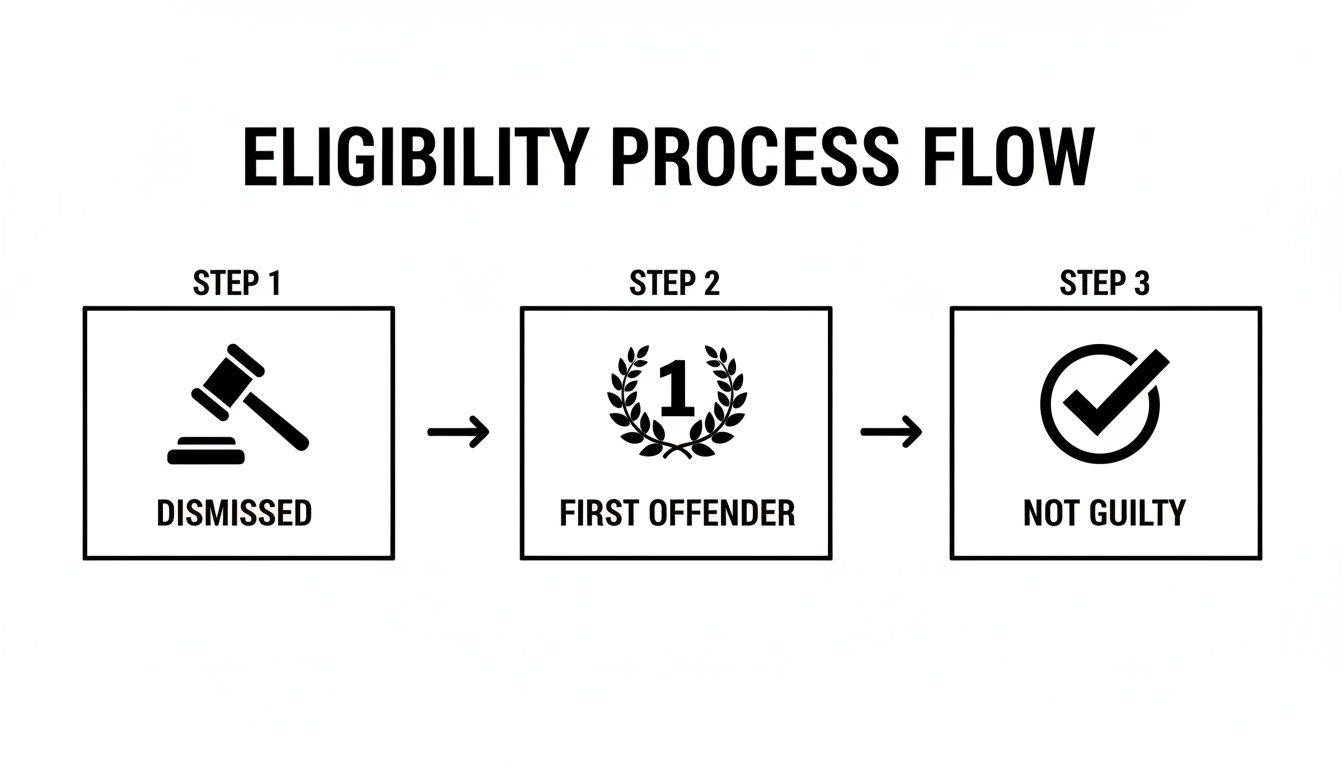
Whether you can restrict your record depends entirely on how your case was handled in the court system, from the Alpharetta Municipal Court to the Fulton County Superior Court. The good news is, many common outcomes open the door for a clean slate.
Favorable Outcomes That Can Be Sealed
For people in Alpharetta, Johns Creek, and Milton, the most common path to sealing a record starts when a case ends without a conviction. If you walked away from court with one of these results, you are likely in a strong position to petition for restriction.
These scenarios include:
- Dismissal by the Prosecutor: The Fulton County District Attorney's office reviewed the evidence and decided not to move forward.
- Nolle Prosequi: This is a formal declaration from the prosecutor, similar to a dismissal, stating they will no longer pursue the charges.
- "Not Guilty" Verdict: You fought the charges at trial in Fulton County State Court or a local municipal court, and a judge or jury found you not guilty.
Second Chances Through Special Programs
Georgia law provides specific pathways for first-time offenders, and courts throughout North Fulton use them to give people a second chance without the burden of a criminal conviction.
Two of the most powerful tools are:
- Pretrial Diversion Programs: Courts in places like Roswell and Sandy Springs often offer these programs for minor, non-violent offenses. You complete certain requirements, like classes or community service, and in return, the original charges are dismissed. That dismissal then makes the arrest eligible for restriction.
- Georgia's First Offender Act: This is a critical option for certain first-time felony and misdemeanor charges. By completing your sentence under the First Offender Act, you are not considered legally convicted. This allows you to have the entire record, from arrest to sentencing, restricted from public view.
It's important to understand these programs are not guaranteed. They must be negotiated by a defense attorney who knows the local prosecutors and their specific policies.
When Restriction Is Not an Option
Knowing which charges can't be restricted is just as important. Georgia law is very clear on this point.
The most critical thing to know is that most DUI convictions are statutorily barred from restriction. If you are convicted of DUI in Georgia, that conviction will be on your criminal record for the rest of your life.
This fact alone shows why an aggressive defense from day one is non-negotiable for a DUI charge. The primary goal is always to avoid a conviction by getting the case dismissed, reduced to a lesser charge like Reckless Driving, or winning at trial.
The sad reality is that many who are eligible never seek relief. Research from Georgia State University College of Law shows a significant expungement gap between those who are eligible and those who complete the process. This is a gap we are determined to close for our clients in Alpharetta and Fulton County.
The Court Process in Fulton County
Trying to get your criminal record restricted in Georgia can feel like navigating a maze blindfolded. For those of us living and working in North Fulton, from Alpharetta to Roswell, knowing the local court and police procedures is what makes the difference.
The whole process kicks off not in a courtroom, but by figuring out exactly which police agency arrested you. Was it the Alpharetta Police Department? The Fulton County Sheriff's Office? Maybe an officer from Johns Creek or Milton? This determines which agency you’ll be dealing with first.
The Paper Trail and Key Hurdles in the Alpharetta Area
Once you've identified the arresting agency, your next job is to get certified copies of your case disposition. This is the official court paper that proves how your case ended. You’ll need to get it from the Clerk of Court where your case was handled—that could be the Alpharetta Municipal Court for a city ordinance or the Fulton County State Court for a state-level misdemeanor.
With that certified disposition, you must tackle the state's record restriction application. This form is tedious and asks for very specific details. I've seen countless applications get kicked back immediately because of a simple mistake, forcing the person to start all over again.
Getting the Prosecutor's Signature in North Fulton
After you’ve filled out the application, your entire packet must be submitted to the right prosecutor's office for their signature. This is a huge checkpoint. The prosecutor has to review your petition and agree that it's eligible under the law.
This is where so many people trying to do this themselves hit a wall. A prosecutor might find a technicality to object to, or the paperwork might simply not be convincing. Having an attorney who works with the Fulton County Solicitor's and District Attorney's offices every week can be the difference between a signature and a denial.
An experienced lawyer can spot and fix potential problems before they ever become roadblocks. That local knowledge is priceless, whether your case was in Alpharetta, Sandy Springs, or Cumming.
The Final Step: Georgia Crime Information Center (GCIC)
Once the prosecutor signs off, the final move is sending the approved application to the Georgia Crime Information Center (GCIC). This is the state agency that manages Georgia’s official criminal history database. The GCIC takes that order and officially restricts your arrest record, sealing it from public view on most background checks.
This final stage also demands careful follow-up to ensure the GCIC processed the order correctly. From gathering documents in an Alpharetta court to getting that final confirmation, the whole process is full of potential traps. For more details, you can read our detailed guide on getting records expunged in Georgia.
Why Choose Brian Hansford for Record Restriction in Alpharetta

Many people think restricting a record is just about filling out the right forms. That mistake can cost you dearly. Successfully sealing a record in North Fulton isn’t about paperwork—it’s about precision, local knowledge, and a calm, strategic legal approach.
Prosecutors and judges in courts like the Alpharetta Municipal Court and Fulton County State Court have discretion. A persuasive argument from a respected local attorney who understands their expectations can make all the difference. This is your one shot to clean your record, and a simple mistake can derail the entire process.
The Advantage of a Former Prosecutor's Insight
To navigate the Fulton County court system, you need to know how the other side thinks. Attorney Brian Hansford brings that exact insight to the table from his time as a prosecutor. He knows precisely what prosecutors are trained to look for when they review a record restriction petition.
This background allows him to anticipate their arguments and build a case designed to counter objections before they are even made. He understands the unwritten rules and internal policies that guide these decisions in courtrooms from Roswell to Johns Creek, ensuring your petition is not just legally sound, but genuinely compelling.
Protecting Your Future in North Fulton
Your reasons for needing a clean record are personal and serious. Maybe you're a professional in Milton worried about a state license, a student in Alpharetta trying to protect future job prospects, or a commercial driver from Cumming whose livelihood is on the line.
The goal is to make it as easy as possible for the prosecutor and judge to say "yes." This is achieved through meticulous preparation and a professional relationship built on trust and respect within the local legal community.
Georgia's system requires you to be proactive. Inaction is not an option. An attorney ensures your petition is accurate, professionally presented, and advocated for every step of the way. Whether you're dealing with the fallout from a DUI in Sandy Springs or another charge in Dunwoody, the right legal counsel is a strategic necessity. You can learn more about how we defend against the underlying charges in our guide to DUI defense in Alpharetta.
FAQ: Local Answers for Alpharetta & Fulton County
When it comes to clearing your record, a lot of myths and confusion float around. Here are some of the most common questions we answer for people in Alpharetta and across North Fulton.
Q: Can any traffic offense be expunged in Georgia?
A: No. The process is legally called record restriction, and it’s primarily for charges that did not end in a conviction, like dismissals or cases resolved through the First Offender Act. Most traffic convictions, and especially any DUI conviction, are statutorily barred from being restricted from your criminal history in Georgia.
Q: What is the difference between record restriction and expungement in Alpharetta?
A: In Alpharetta, and all of Georgia, we have record restriction, which seals an arrest from public view. It is not true expungement, which would destroy the record. After restriction, law enforcement and Fulton County courts can still see the record, but most employers and landlords cannot.
Q: How long does a DUI conviction stay on my Georgia record?
A: Permanently. A DUI conviction in Georgia remains on your criminal history for life and can never be restricted or sealed. This is why it is critical to fight the charge from the very beginning in Alpharetta Municipal Court or Fulton County State Court to avoid the conviction altogether.
Q: Do I need a lawyer for record restriction in Fulton County?
A: While not legally required, it is highly recommended. The process is complex, and a small error can cause a denial by Fulton County prosecutors or the GCIC. An experienced Alpharetta attorney who regularly handles these petitions knows the local procedures and can ensure your case is presented correctly and professionally.
Q: My charge was dismissed. Does it come off my record automatically?
A: No, this is a common and dangerous myth. An arrest record remains public even if the charge was dismissed in Alpharetta Municipal Court or by Fulton County prosecutors. You must proactively file a petition for record restriction to have the arrest sealed from public background checks.
Q: How does record restriction affect my insurance rates?
A: It is an indirect benefit. While record restriction does not alter your official MVR, many insurance companies now run criminal background checks. Sealing an arrest record for a serious traffic violation prevents it from appearing on that check, which can protect you from rate increases or policy non-renewal.
Q: Can I restrict a record from Alpharetta Municipal Court?
A: Yes, absolutely. Cases handled in Alpharetta Municipal Court, such as city ordinance violations or misdemeanors that were dismissed or handled via conditional discharge, are often eligible for restriction. The process involves getting the case disposition from the Alpharetta court clerk and submitting the petition for review.
If you're ready to leave a past mistake in the past, now is the time to act. The process is detailed and doesn't forgive errors, but the peace of mind that comes with a clean slate is invaluable.
Contact Brian Hansford Law for a confidential consultation. We can help you figure out if you're eligible for record restriction and guide you through every step.
Call now to speak with an attorney who can protect your future: https://challengemycharge.com
Technical SEO Elements
Meta Title (59 characters): Driving Record Expungement Attorney in Alpharetta, GA | Brian Hansford
Meta Description (158 characters): Seal your record in Alpharetta, GA. Brian Hansford provides strategic record restriction (expungement) services for clients in Alpharetta and throughout Fulton County.
Suggested URL Slug: /driving-record-expungement-alpharetta-ga/
Internal Link Suggestions:
- Link "DUI defense" to
/dui-attorney-alpharetta-ga/ - Link "drug charges" to
/drug-charges-alpharetta-ga/ - Link "criminal defense attorney" to
/(homepage) or/about/ - Link "Fulton County" to a page about Fulton County court processes if one exists.
Schema Recommendations:
AttorneyLegalService(withareaServedfor Alpharetta, Fulton County, Roswell, Milton, Johns Creek, etc.)FAQPage(for the FAQ section)
