
Getting a ticket for driving without a license in Georgia can be more serious than most people think. It's not just a simple fine you can mail in—it’s classified as a misdemeanor offense. That means you're facing a criminal charge that goes on your record and can have lasting consequences.
What a Driving Without a License Charge Really Means
When a police officer in Georgia writes you a ticket for this under state law (O.C.G.A. § 40-5-20), they are formally accusing you of operating a vehicle on a public road without the authority to do so. This isn’t a simple administrative headache; it’s a charge that requires a court appearance.
Think of it this way: a driver's license is the state's official seal of approval, certifying a person has passed the tests for skill, knowledge, and vision needed to drive safely. Getting behind the wheel without that credential is treated as a potential risk to everyone else on the road, and the law reflects that.
Common Scenarios Leading to This Charge
This charge isn't a one-size-fits-all situation. It can happen for several different reasons, and understanding which one may apply is a key part of the process.
Most people get cited for one of these reasons:
- Never Been Licensed: This is for anyone who has never gone through the process of getting a driver's license in the first place.
- Expired License: You had a valid license, but you let it pass its expiration date without renewing it in time.
- New Resident Non-Compliance: If you've just moved to Georgia, the clock is ticking. You have only 30 days to get a Georgia driver’s license. A lot of people miss this deadline and end up with a ticket.
- Foreign License Issues: An international license might be valid for a short time, but if you're establishing residency here, it eventually has to be converted to a Georgia license.
This is a surprisingly common issue. In fact, some estimates suggest that about 10% of all traffic offenses nationwide involve unlicensed drivers. That statistic shows just how many of these cases courts in places from Forsyth County to Cobb County deal with every year. You can dig into more of these driving trends and statistics on focus2move.com.
A ticket for driving without a license is the beginning of a formal court process. It’s not a simple "pay-by-mail" situation. You will be given a mandatory court date, and you must appear before a judge to answer for the charge.
The charge is especially prevalent in the busy suburbs north of Atlanta, including Cumming, Johns Creek, Milton, Alpharetta, Roswell, and Marietta. With so many people moving into the area, it's easy to be unaware of the strict 30-day rule for new residents or just to let a renewal date slip by. But no matter the reason, the result is the same: a misdemeanor charge that needs to be handled correctly.
The Hidden Penalties Beyond Fines and Court Dates

The immediate stress of getting a ticket, facing a court date, and paying a fine is bad enough. But for a driving without a license charge in Georgia, the consequences don't stop when you leave the courtroom. This isn't just a simple traffic ticket—it's a misdemeanor, and a conviction creates a permanent criminal record that follows you for years.
This reality often comes as a shock. Most people assume it's a minor traffic issue, something that's just about points on a license or a small payment. The hard truth is that a misdemeanor conviction for driving without a license is a public record, accessible to anyone running a standard background check.
How a Criminal Record Impacts Your Future
A misdemeanor on your record can quietly close doors you never knew were locked. In today's world, background checks are routine for many of life's biggest steps, and a criminal conviction can be an automatic red flag for anyone making a decision about you. It's a shadow that follows you everywhere.
This single charge can create unexpected barriers in several key areas of your life:
- Employment Opportunities: Companies big and small, from corporate headquarters in Alpharetta to local businesses in Cumming, run background checks. A misdemeanor can disqualify you from jobs involving driving, handling money, or working with vulnerable people.
- Housing Applications: In competitive rental markets like Johns Creek and East Cobb, landlords and property managers screen every applicant. A criminal record might be all it takes for them to choose someone else.
- Educational Pursuits: Certain college programs, especially in fields like nursing, education, or criminal justice, require a clean background check for admission, internships, and clinical rotations.
- Professional Licenses: If your career requires a state license—think real estate, nursing, or cosmetology—a misdemeanor conviction could complicate your application or get in the way of your renewal.
The most damaging part of a conviction is its permanence. Unlike a speeding ticket that eventually fades from your record, a misdemeanor conviction stays with you, potentially impacting your life choices for years to come.
Real-World Scenarios in North Georgia
To really understand the weight of this charge, let’s look at how it plays out for people right here in our community. These abstract consequences become much more tangible when you see them in a real-world context.
Imagine a college student living in Johns Creek, studying finance. They land a dream internship interview with a major firm over in Roswell. The company runs a routine background check and discovers the misdemeanor conviction for driving without a license.
Faced with two equally qualified candidates, the hiring manager will almost always choose the one without a criminal record to avoid any perceived risk. Just like that, a simple traffic stop has derailed a promising career before it even got started.
Or think about a hardworking parent in Marietta who works a delivery job to support their family. A conviction not only hits them with fines but also gets them flagged by their employer's insurance provider. This could lead directly to termination, making it incredibly difficult to find another driving job anywhere in Cobb County.
These examples show that the penalties stretch far beyond the courthouse. A conviction for driving without a license creates a ripple effect, limiting your ability to earn a living, find a home, and chase your goals. It’s a steep price to pay for what many people mistakenly believe is a minor offense.
When you’re pulled over and the officer asks for your license, the specific charge you face depends entirely on the status of that license. People often lump "unlicensed," "suspended," and "expired" together, but from a court standpoint, they're worlds apart. Each one carries different penalties and requires a completely different defense strategy.
Think of it like having a gym membership. Your status determines how much trouble you're in. Are you a member in good standing who just forgot to pay this month? Or were you banned for bad behavior and snuck back in? The difference is huge.
Driving with an Expired License
This is the least serious of the three. It means you were once a fully licensed, qualified driver, but you missed your renewal deadline. It’s usually an honest mistake—a date that got lost in the shuffle of a busy life.
In our gym analogy, this is like forgetting to pay your monthly dues. Your membership has lapsed, but you haven't been kicked out. You just need to handle the paperwork and pay the fee to get back in good standing.
While it's still a violation that can get you a ticket, an expired license is typically seen as an administrative issue, not a deliberate refusal to follow the law. Resolving it is often as simple as renewing your license before your court date.
Driving with a Suspended or Revoked License
This is a much more serious offense. If your license is suspended or revoked, the state has actively taken away your driving privileges for a specific reason, like a DUI, racking up too many points, or other major violations.
Back at the gym, this is the equivalent of being banned. You didn't just forget to pay; you broke a major rule, and management told you not to come back. Showing up anyway isn't an oversight—it's trespassing. A suspended license means you are legally forbidden to be behind the wheel. For a deeper dive into this specific charge, you can check out our guide on driving with a suspended license in Georgia.
Driving Without Ever Being Licensed
This applies to anyone who has never gone through the process of getting a driver's license in Georgia or any other state. It means you’ve never passed the written, vision, and road tests required to prove you can drive safely.
In our gym example, this is someone who just walked in off the street and started using the equipment without ever signing up. They have no relationship with the gym and no permission to be there. A driving without a license charge is treated seriously because the state has no proof you possess even the most basic skills needed for road safety.
This distinction is becoming more common. An interesting trend shows that more than 26% of Gen Z do not drive, and of those, 42% say they don't even have a license. This cultural shift could lead to more people getting behind the wheel without ever having been licensed. You can read more about these Gen Z driving trends on Mediapost.com.
Knowing which of these categories you fall into is the first critical step. The potential penalties and the right defense for someone in Milton with an expired license are completely different from those for someone in East Cobb driving while suspended.
What to Expect After You Get a Ticket
Getting pulled over is stressful enough, but a ticket for driving without a license can leave you feeling completely lost. The process that follows—from the roadside stop to your day in court—is formal and can be intimidating. Knowing what’s coming can make a huge difference.
Once the officer confirms you don’t have a valid license on you, they'll write a citation. This isn't just a simple ticket; it's a summons. It officially charges you with a misdemeanor and lists critical information, including your mandatory court date. This isn't an invitation; it's an order to appear.
Your First Steps and the Court Date
Take a hard look at that citation. The most important details are the date, time, and location of your court appearance. It could be a local municipal court in places like Cumming, Alpharetta, or Marietta, or a county-level court in Forsyth or Cobb County. Whatever you do, don't miss that date. Ignoring it will only dig a deeper hole, almost always resulting in a warrant for your arrest.
The time between getting the ticket and your court date is crucial. This is your window to get organized, figure out your next move, and understand just how serious this charge is. Use this time to track down any documents that might help your case.
The biggest mistake you can make right now is ignoring that court date. A failure to appear automatically escalates everything, and the judge will likely issue a bench warrant for your arrest on the spot.
This first court date is called an arraignment. It's your initial appearance before the judge, where they will read the formal charge against you and ask how you plead: guilty, not guilty, or no contest. How you prepare for this moment sets the tone for your entire case.
Common Ways to Defend These Charges
Every situation is different, but a few common defense strategies often come into play. The goal is always to show the prosecutor and the judge the full context of what happened, which can lead to a much better outcome, like a reduced charge or even a dismissal.
Here are a few angles that may be explored:
- You Have a Valid License, Just Not on You: It happens. You left your wallet at home or in a different jacket. If you can prove you had a valid, unexpired driver's license at the time you were pulled over, this charge is often knocked down to a minor, non-criminal infraction or dismissed entirely.
- You Got a License After the Ticket: If you never had a license or let yours expire, getting one after the ticket is a positive step. Walking into court with a brand-new, valid Georgia driver's license shows the judge you took the situation seriously and fixed the problem. It’s a powerful sign of good faith.
- You Cleared Up the Real Problem: If your license was suspended, proving that you've handled the underlying issue and gotten your license reinstated is huge. Sometimes, people don't even know their license is suspended. If that's the case, it’s vital to figure out why and learn how to check for a suspended license so you can resolve the root cause.
Why Your Paperwork is So Important
No matter your story, documents are your best friend. Any piece of paper that backs up your situation is ammunition for your defense. This could be your recently expired license, proof you just moved to Georgia and missed the 30-day window to switch your license over, or the new license you got right after the ticket.
Think of it this way: the ticket is the prosecutor’s version of the story. Your documents are your chance to tell your side and add the context they left out. Having all this organized and ready before you step foot in the courthouse is one of the most important steps you can take.
Understanding North Georgia's Local Court Procedures
While state law is the same everywhere in Georgia, how a "driving without a license" ticket is handled really depends on where you are. The way things run in the municipal courts of Cumming, Johns Creek, and Alpharetta can feel very different from the procedures in the larger county-level courts serving Forsyth County and Cobb County. Knowing what to expect locally is half the battle.
Every court has its own rhythm. But whether you're in a smaller city court or a big county courthouse, you'll be dealing with two main players: the prosecutor (often called the solicitor) and the judge. The solicitor is there to represent the state's case against you, and the judge is the one who oversees the whole process and makes the final call.
Navigating the Court System from Arraignment to Resolution
Your journey through the court system usually follows a predictable path. It all kicks off with the first court date printed on your ticket, which is called the arraignment. This is your first official appearance, where the charge is read, and you're asked how you plead. From that point, your case moves toward its conclusion.
Getting a ticket for driving without a license isn't just about paying a fine; it sets a process in motion that starts with the traffic stop and ends with a mandatory court date.
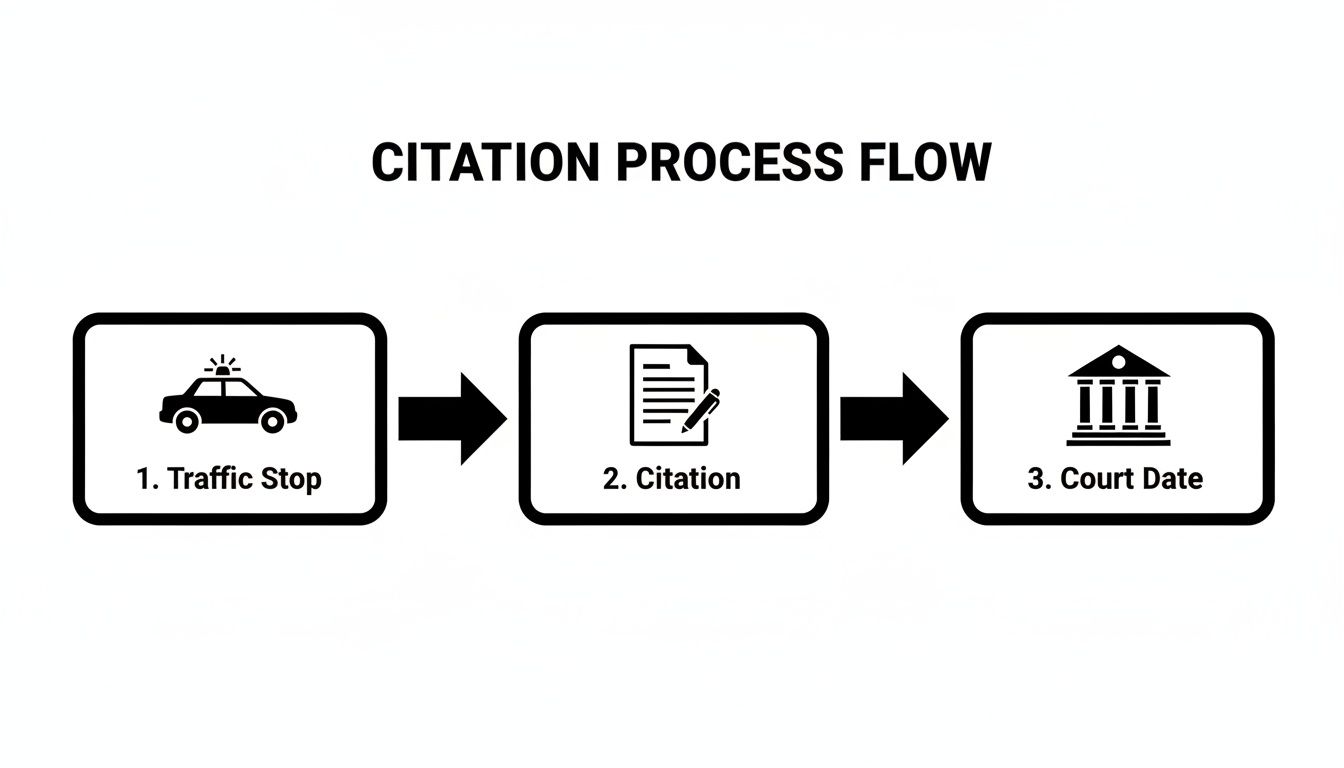
This process shows that the citation is more than a piece of paper—it's a summons that requires you to show up and deal with the charge.
Your experience might feel different from one courtroom to the next. For instance, a busy court like Marietta Municipal Court might move at a faster pace than a smaller one, just due to the sheer volume of cases. Still, the core roles of the solicitor and the judge are the same no matter where you are.
The most important thing to remember is that each local court, whether in Roswell or Milton, operates on a strict schedule. Missing a court date is not an option and almost always complicates matters significantly.
How your case unfolds will depend on the unique facts of your situation and the specific procedures of that court. It's all about understanding who does what and the steps you'll be guided through.
The Roles of the Prosecutor and the Judge
Think of the prosecutor, or solicitor, as the attorney for the state. Their job is to review the police report and the evidence related to your driving without a license charge. Any negotiations about a possible resolution, like a plea agreement, happen with the solicitor.
The judge, on the other hand, is the neutral referee in the courtroom. They make sure the rules are followed, listen to both sides, and apply the law to the facts. The judge has the final say—whether it's accepting a plea deal, ruling on motions, or determining a sentence after a conviction. The whole courtroom dynamic is shaped by how these two roles interact.
This issue has serious public safety implications, especially with the amount of commercial traffic in our area. In 2025, federal data showed at least 17 fatal crashes and 30 deaths were caused by commercial drivers operating without a proper U.S. license, which prompted a new federal rule. This is a big deal for Georgia’s major trucking corridors through Cobb County, East Cobb, Marietta, and Forsyth County, where an unqualified driver puts everyone else on the road at risk. You can read more about the federal response to this critical safety issue on fmcsa.dot.gov.
How an Experienced Defense Attorney Can Navigate Your Case

Staring down a charge for driving without a license can be an incredibly stressful experience, but you don’t have to go through it alone. A seasoned defense attorney can cut through the confusion, explaining the process and laying out your options in plain English. Their job is to dive into the specifics of your case and build a strategy designed to get the best possible outcome.
This isn’t just about showing up on your court date; it's about what happens long before you step into the courtroom. A good attorney scrutinizes every detail, from the reason for the initial traffic stop to the final citation. They are trained to spot the strengths and weaknesses in the State's case against you.
Leveraging Experience for a Better Outcome
There's a significant advantage in hiring an attorney who has a background as a former prosecutor. They've seen how the other side operates and know their playbook inside and out. This unique perspective is invaluable, allowing them to anticipate the prosecution’s strategy and build a proactive defense.
An effective defense strategy isn’t a one-size-fits-all template. It’s a personalized plan built from a deep understanding of Georgia law, the local court procedures in places like Forsyth and Cobb counties, and the specific facts of your situation.
This insider knowledge gives you an edge in several critical areas:
- Negotiating with Prosecutors: Knowing what solicitors are looking for opens the door to productive conversations about reducing or even dismissing charges.
- Identifying Procedural Errors: Former prosecutors know the rulebook by heart, which helps them catch mistakes that could be pivotal to your defense.
- Presenting a Compelling Case: They understand how to frame arguments that resonate with judges and prosecutors, making your side of the story more impactful.
Exploring Every Path to a Favorable Result
The number one goal is always to protect your rights and your future. A skilled attorney will explore every possible avenue to minimize the long-term consequences of a driving without a license charge. Depending on your case, this could involve a few different approaches. For a deeper look into what makes a good advocate, you can learn how to find a criminal lawyer in North Georgia and see what qualities truly matter.
An attorney works to secure outcomes such as:
- Charge Reduction: Negotiating to have the misdemeanor reduced to a less serious, non-criminal offense that won't haunt your record.
- Case Dismissal: Pushing for a complete dismissal if the evidence against you is weak or if proper procedures were ignored.
- Diversion Programs: Determining if you qualify for special programs that can keep a conviction off your permanent record entirely.
Ultimately, having a dedicated advocate in your corner ensures that your voice is heard and that your case is presented in the strongest possible light.
Frequently Asked Questions
When you're facing a charge for driving without a license in Georgia, it's natural to have a lot of questions. Things can get confusing fast. This section is here to clear up some of the most common concerns we hear about every day.
What if I Get My License After Receiving the Ticket?
This can be a very positive step for your case. If you go out and get a valid Georgia driver's license after being cited, it shows the court you've taken the initiative to fix the problem. This is an action that prosecutors and judges may look upon favorably.
Walking into your court date with a newly issued, valid license can be a game-changer during negotiations. While it's not a magic wand that makes the charge disappear, it often opens the door to a much better outcome, like getting the misdemeanor reduced to a simple, non-criminal ticket. It shows you're responsible and want to follow the law.
At the end of the day, the court's main concern is public safety—making sure everyone on the road is properly licensed. When you prove you've met that requirement, even after the fact, it can have a huge, positive impact on your case.
Taking this one step can completely reframe your situation. It changes the narrative from "someone breaking the law" to "someone who made a mistake and fixed it." That’s a powerful position to be in.
Is Jail Time a Possibility for a First Offense?
Technically, yes, but it's pretty unlikely. Georgia law classifies driving without a license as a misdemeanor, which carries a maximum penalty of up to 12 months in jail. However, for a first-time offender, jail time is rare, especially if there weren't any other issues involved.
Now, if there are what are known as "aggravating factors," that changes things. An aggravating factor could be another charge at the same time, like a DUI, or if you have a history of other serious traffic offenses. For a straightforward first offense where you were cooperative, the court usually focuses on fines and making sure you get licensed. Still, the possibility of jail time is there, which is why this charge should be taken seriously.
Can This Charge Be Removed From My Record?
A misdemeanor conviction creates a permanent criminal record, which is something to avoid if at all possible. This is why a primary goal is often to prevent a conviction in the first place. If a conviction does happen, it's sometimes possible to get the record restricted (what people used to call expungement), but whether you're eligible depends on a whole host of factors.
The smartest approach is to handle the charge correctly from the very beginning. Working to negotiate a plea to a non-criminal offense or even get the case dismissed entirely is a common strategy. A clean resolution means you won't have to worry about a criminal record following you around for years to come.
Navigating the complexities of a driving without a license charge requires careful attention to detail and a clear understanding of the local court system. At Brian Hansford Law, we are dedicated to helping you protect your future. Contact us for a consultation to discuss your case by visiting challengemycharge.com.
