
When you face drunk driving consequences in Georgia, penalties can escalate from fines and jail to long-term license loss and financial strain.
Missing just one breath test can set off a cascade of legal and personal setbacks.
Quick Overview Of Drunk Driving Consequences

Think of Georgia’s DUI penalties as a tightening spiral on your life’s highway.
- Fines And Jail Time: First-time or repeat offenders face up to 1 year behind bars and fines reaching $1,000.
- License Suspension: Under implied consent rules, missing a breath test can mean losing your driving privileges unless you request a hearing within 30 days.
- Ignition Interlock Devices: Courts often require these built-in breathalyzers to restart your vehicle after any offense.
- SR-22 Insurance: You’ll be labeled high-risk, driving premiums up for three years.
- Personal And Professional Impacts: Employers, schools, and immigration authorities may all take notice of a DUI on your record.
Understanding The Chain Reaction
Each penalty layer builds on the last, turning a single mistake into mounting hurdles. For example, if you skip that breath test and your license is pulled, you’ll need a ride everywhere—driving up expenses and complicating daily life.
Before we dive deeper, let’s look at how alcohol-impaired crashes affect road safety nationwide.
Alcohol Impaired Driving Fatalities Summary
Here’s a snapshot of the human toll from the most recent data:
| Metric | Value |
|---|---|
| Annual Alcohol-Impaired Driving Deaths | 12,429 |
| Daily Deaths Average | 34 |
| Traffic Fatalities Involving Alcohol | 30% |
These numbers underscore how a split-second decision can have lasting consequences.
At this rate, someone dies every 42 minutes in an alcohol-impaired crash. Young drivers aged 15–20 make up nearly a third of those fatalities, highlighting how a single lapse in judgment can turn tragic.
One violation can set off a series of penalties that echo through your life.
- Emotional trauma ripples through families and communities.
- Insurance hikes can linger long after your case is closed.
- Academic and career plans may derail under the weight of a criminal record.
Why Knowledge Matters
Breaking down each link in this penalty chain shows why responsible choices matter—and how easily one misstep snowballs into a full-blown crisis.
Brian Hansford Law provides resources for residents of Alpharetta, Cumming, Johns Creek, Milton, Roswell, Marietta, Forsyth County, East Cobb, and Cobb County. This guide explains the processes for hearings, requirements, and deadlines to help understand the procedures involved.
Understanding BAC Limits for DUI Charges
Think of your Blood Alcohol Concentration (BAC) like a fuel gauge for impairment—push past a certain mark and you risk triggering Georgia’s DUI laws. For most adults, that critical point sits at 0.08 g/dL.
If you’re under 21, the state enforces a zero-tolerance rule: just 0.02 g/dL can lead to a misdemeanor. Commercial drivers face an even stricter standard—0.04 g/dL—reflecting the heavier responsibility they shoulder behind the wheel.
- Adults: Charged at 0.08 g/dL and above
- Under-21 Drivers: Zero tolerance at 0.02 g/dL
- Commercial Operators: Penalties start at 0.04 g/dL
How Breath Tests And Field Sobriety Work
Breathalyzers capture alcohol in your deep-lung air, then translate that “steam reading” into a BAC estimate. It’s a bit like judging a kettle’s heat by its whistle—any calibration hiccup or delay in testing can throw off the result.
Field sobriety tests—think the walk-and-turn or one-leg stand—are essentially pop quizzes on your balance and coordination. Uneven pavement, nervousness or even an officer’s rushed instructions can skew the outcome.
“Waiting thirty minutes before administering a breath test can lower the reading by about 0.01 g/dL—enough to tip the scales in court.”
Here’s how Georgia compares worldwide:
| Region | Adult BAC Limit |
|---|---|
| Georgia | 0.08 g/dL |
| European Union | 0.05 g/dL |
| Australia | 0.05 g/dL |
| Japan | 0.03 g/dL |
Even small shifts in these thresholds can dramatically change enforcement and safety outcomes.
Common Defenses To BAC Readings
When you challenge a BAC result, you’re really challenging the testing process. Spotting flaws in device upkeep or sample timing can introduce reasonable doubt.
- Faulty Calibration: Devices require routine servicing—missed logs can signal bad data
- Residual Mouth Alcohol: A recent drink, mouthwash, or belch can inflate the number
- Medical Factors: Conditions like GERD or diabetes sometimes mimic alcohol on a breath test
Why One Drink Can Be Costly Globally
Globally, drunk driving is responsible for around 273,000 deaths each year—about 22% of all traffic fatalities. In the European Union alone, alcohol-related crashes make up 25% of road deaths, proving this is a universal challenge.
No matter where you drive, that one extra drink can turn your trip into a tragedy. For more on global drunk driving figures, read the full analysis on JMW.
For an in-depth look at Georgia’s implied consent law and what happens if you refuse a chemical test, check out our guide on Georgia’s Implied Consent Law for next steps.
Impact Of Testing Errors
Testing machines and officers follow strict protocols—but mistakes happen. Consider these actions when reviewing the process:
- Request maintenance and calibration logs
- Note the exact timestamp of every sample collection
- Record any officer comments or anomalies in device performance
Field Sobriety And Procedural Notes
Walk-and-turns and one-leg stands rely heavily on an officer’s subjective observation. Video footage or witness testimonies can reveal inconsistencies.
- File an open-records request for body-cam videos
- Gather statements from passengers or nearby pedestrians
- Highlight any conflicting descriptions in police reports
Exploring Scientific Motions
Timely action allows exploration of scientific or procedural motions to challenge evidence:
- Motions to suppress flawed test results
- Demonstrations of calibration lapses
- Requirement for prosecutors to prove strict adherence to every step
By understanding Georgia’s BAC thresholds and the nuances of testing, readers gain clarity on how to assess their situation.
Criminal Penalties For DUI Offense Levels
Georgia divides DUI charges by past convictions and blood-alcohol concentration. Each new offense stacks harsher consequences.
Think of it like driving down a road that gradually narrows. A first violation is a warning; the second forces a detour; by the third, you hit a full roadblock.
Here’s a quick snapshot of drunk driving consequences at each stage:
- First Offense: Up to $1,000 in fines, possible jail and probation.
- Second Offense: Steeper fines, mandatory community service and minimum jail time.
- Third Offense: Felony charges, prison sentences, up to $5,000 in fines, license revocation.
First Offense Penalties
A first DUI conviction is a misdemeanor carrying up to $1,000 in fines and as much as one year behind bars.
In reality, most first-timers receive probation, alcohol education and community service instead of the maximum jail term.
For a detailed breakdown of fines, alternatives and probation terms, check our guide on first-offense DUI penalties.
Second Offense Penalties
A second DUI within ten years raises the stakes considerably:
- Fines between $600 and $2,500
- Mandatory jail time of 5–12 months
- At least 30 days of community service
- Required alcohol evaluation and treatment
These added requirements can feel like an unexpected detour—but they’re part of the law.
Third Offense Penalties
A third DUI in a decade typically becomes a felony. That bump brings serious prison time and steeper fines:
| Offense Level | Classification | Fines | Jail Time | Additional Penalties |
|---|---|---|---|---|
| First DUI | Misdemeanor | Up to $1,000 | Up to 1 year | Probation, alcohol school |
| Second DUI | Misdemeanor | Up to $2,500 | 5–12 months | Community service, treatment |
| Third DUI | Felony | Up to $5,000 | 1 year minimum | License revocation, SR-22 filing |
Felony convictions also trigger a five-year license loss and at least three years of SR-22 insurance.
Analogy Of Penalty Escalation
Imagine cruising on a freeway:
- First Lane Closure: A small barrier—minor fine and caution.
- Second Lane Closure: A wider blockade—jail time and mandatory treatment.
- Full Roadblock: Heavy machinery—felony charges, license loss, SR-22 requirement.
Each barrier makes the road narrower. One misstep leaves you with fewer exits.
How Brian Hansford Law Provides Information
Brian Hansford Law offers resources on:
- Evidence Review: Auditing breath-test calibrations and procedures
- Defense Strategies: Outlining potential approaches based on unique situations
- Procedural Timelines: Tracking administrative filings and interlock requirements
This information is intended to clarify processes, not serve as advice.
Key Procedural Considerations
- Administrative Hearing: Request a DDS hearing within 30 days to challenge automatic suspensions
- Negotiation Options: Explore alternatives like house arrest or monitoring
- Timeline Management: Monitor ignition interlock installation and SR-22 deadlines
Early preparation and awareness can help identify opportunities to reduce fines or probation terms.
Navigating License Suspension And Post Arrest Steps
Once an arrest for DUI occurs, the clock starts ticking. A hearing request must be filed within 30 days to avoid an automatic 40-day suspension.
- Collect witness accounts, bar receipts or medical records to underscore mitigating factors.
- Prepare clear arguments for restricted or hardship permits if full reinstatement seems out of reach.
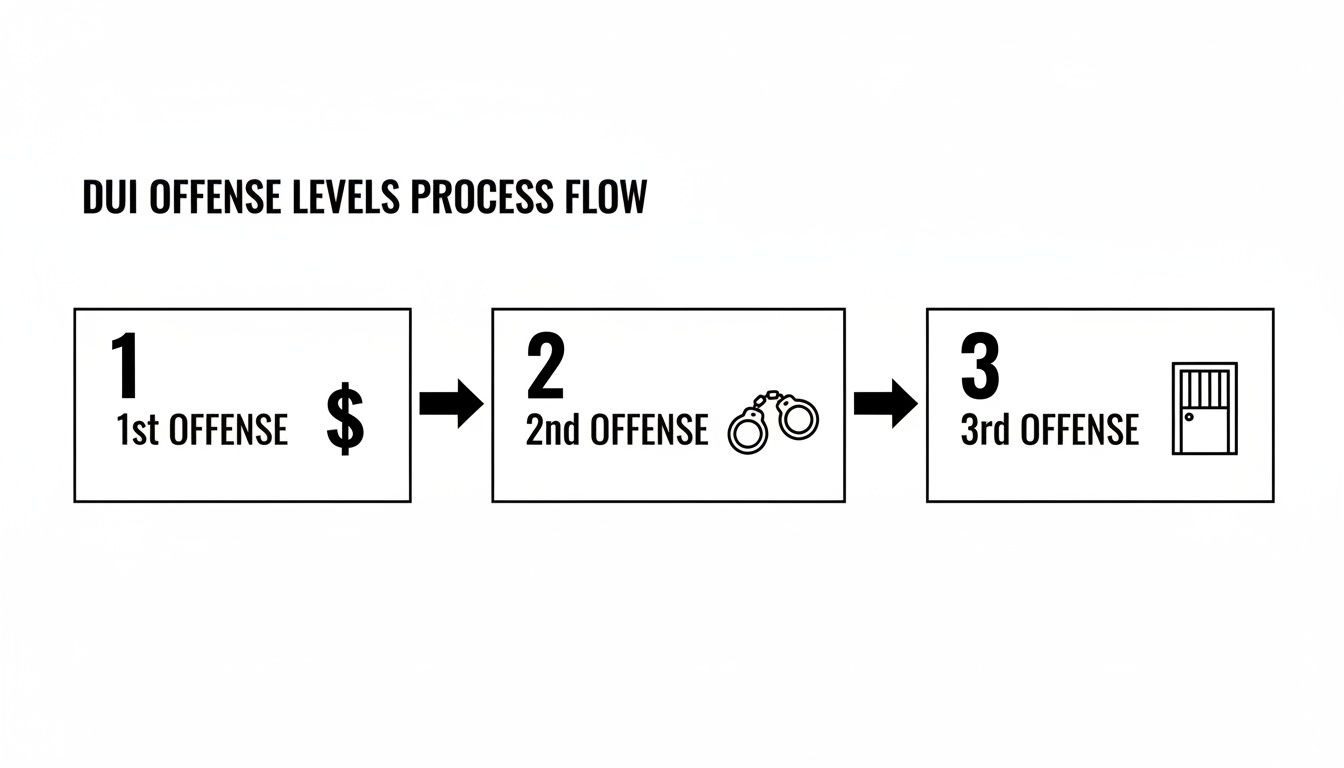
This breakdown shows how a first offense brings fines, a second adds community service and longer suspensions, and a third crosses into felony territory with even steeper consequences.
Preparing Your DDS Hearing
Organize evidence in a clear timeline to help hearing officers follow your narrative:
- Confirm hearing date and time with DDS well in advance.
- Submit evidence packets at least 7 days before the hearing.
- Draft a concise opening statement highlighting mitigating circumstances.
- Include maintenance logs proving breathalyzer accuracy.
Best Practices At The Scene
Actions after the stop can affect hearing outcomes:
- Note the officer’s badge number, unit identifier and timestamps.
- Keep answers brief and polite to maintain a professional record.
- Ask for copies of breath test results and field sobriety notes.
- Photograph road conditions, signage and weather for context.
“Recording every detail at the scene can boost defense credibility by 25%.”
Restricted And Hardship Permits
A granted restricted permit may include approved time windows and mileage limits. To manage this:
- Verify SR-22 insurance requirements early.
- Schedule ignition interlock device checks every 30 days.
- Maintain logs of permitted travel routes and purposes.
For more on post-arrest procedures, see What to Do After a DUI Arrest.
After The Hearing
Review the hearing decision and note any appeal deadlines. Confirm reinstatement dates and probation conditions.
- Arrange interlock installation before any court deadline.
- File SR-22 insurance immediately to prevent coverage gaps.
Staying proactive helps move toward full license restoration and minimizes unexpected delays.
Managing Ignition Interlock And SR-22 Insurance Requirements
Post-conviction, an ignition interlock device often becomes mandatory:
• Who Needs One: First offenders, repeat DUI convictions, and high BAC readings
• Installation Timeline: Typically within 30 days of conviction
• Monthly Costs: $70–$150, plus service fees
• Violation Protocols: Missed or failed tests can trigger service calls or additional hearings
Ignition Interlock Basics
A personal breathalyzer is wired into the car’s ignition. A reading under 0.02 g/dL permits startup.
| Phase | Timeframe | Fee Range |
|---|---|---|
| Installation | 1–2 weeks post-order | $150–$250 |
| Monthly Monitoring | Ongoing | $70–$150 |
| Removal | Court-defined | $100–$200 |
SR-22 Coverage Explained
An SR-22 notifies insurers that you’re high-risk, often raising premiums 200–400% for 3 years. Key points:
- Minimum Liability: $25,000 per person, $50,000 per accident
- Cancellation Warning: A missed payment can extend suspensions
Filing an SR-22 often marks you as high-risk for three years, driving up policy costs significantly.
Affordable Plan Tactics
To manage rising rates:
• Bundle auto and home policies for discounts
• Increase deductibles to lower premiums
• Consult local agents in Alpharetta, Cumming, or Johns Creek
• Ask about defensive driving credits or safe-driver reductions
Restoring Driving Privileges
Completing interlock and SR-22 requirements unlocks full reinstatement:
- Submit interlock removal certificate to DDS
- Verify SR-22 coverage period completion
- Pay the reinstatement fee (around $140) and update your license
Timely paperwork can reduce an additional 30-day suspension.
Understanding these processes and deadlines helps ensure smoother license restoration.
Collateral Consequences And Impacts On Young Drivers
A DUI extends beyond fines and court dates, affecting finances, records, and future plans.
For drivers under 21, an arrest can ripple into college applications, job screenings, and visa renewals:
- Higher Insurance Premiums: Coverage spikes by 200–400% for up to three years.
- Job Application Flags: Hiring managers may skip résumés with a DUI.
- Educational Impact: Mandatory classes can delay diplomas or college enrollment.
- Immigration Risks: DUI charges can stall visa approvals or renewals.
Financial And Professional Ripple Effects
Costs can exceed $15,000 in legal fees, fines, insurance hikes, and lost income. Physical injuries may require months of rehab, adding medical expenses and lost time from work or school.
The human toll of drunk driving extends far beyond immediate crashes, embedding deep emotional, physical, and financial scars. In the US, 12,429 alcohol-impaired fatalities occurred in 2023, marking a 7.6% drop—but Q1 2025 still saw 37 daily deaths, with young men aged 21–24 leading at 29%. Victims suffer over $1.5 million in lifetime economic losses per death. Learn more about this data on the National Safety Council
Zero Tolerance And Social Stigma
Georgia’s zero-tolerance policy means any detectable BAC can trigger charges for under-21 drivers:
- Immediate License Suspension: Even 0.02 g/dL can cost a permit.
- Mandatory DUI Classes: May delay graduation or college entry.
- Peer And Family Impact: Stigma can strain relationships and support networks.
Long-Term Financial Burden
Beyond fines and fees, a DUI conviction can increase loan rates, deplete savings, and harm credit scores for years.
Resources For Young Drivers
Guidance includes:
- Filing administrative hearing requests within 30 days
- Enrolling in state-approved alcohol programs
- Notifying insurers about SR-22 requirements
- Organizing interlock installations and maintenance
Early awareness of these steps helps flatten the ripple effects of a DUI.
FAQ On Drunk Driving Consequences
What Happens If I Refuse A Breath Test?
Under Georgia’s implied consent law, refusing a breath test triggers an automatic license suspension: 12 months for first refusal, 36 months for repeat refusals. A separate administrative charge also applies.
How Long Does A DUI Stay On My Record?
A DUI conviction remains on your driving record for at least 10 years. Insurers typically label you high‐risk for three to five years, increasing premiums by 200–400% during the SR-22 period.
Can I Get A Hardship Or Work Permit During Suspension?
To qualify for a restricted license:
- File a DDS hearing request within 30 days
- Provide proof of SR-22 insurance
- Complete a state-approved alcohol education program
Most drivers regain limited privileges in 6–8 weeks after meeting these requirements.
Key Process Timelines
- Request a hearing within 30 days of arrest to avoid automatic suspension
- Install an ignition interlock device and file SR-22 paperwork within 30–60 days post-conviction
- Track every deadline in a shared calendar to prevent oversights
What Are The Strongest Challenges To BAC Evidence?
Key areas to review:
- Calibration Logs: Missing or incomplete maintenance can undermine device accuracy
- Mouth Alcohol: Recent use of mouthwash or belching may skew results
- Timing Delays: Gaps between the stop and the test introduce reasonable doubt
A thorough audit of breath-test logs can reduce the prosecution’s admissible evidence by 25% if errors are uncovered.
By understanding each step and reviewing resources carefully, individuals can navigate Georgia’s DUI processes with greater clarity and preparedness.
Brian Hansford Law provides further information for Alpharetta, Cumming, Johns Creek, Milton, Roswell, Marietta, Forsyth County, East Cobb, and Cobb County. Learn more on the Brian Hansford Law website.
