
Most DUI charges start out as misdemeanors, but specific circumstances—what are sometimes called "aggravating factors"—can quickly escalate the charge into a much more serious felony. It's helpful to understand what those triggers are, because they completely change the stakes.
When a DUI Crosses the Felony Line

Think about the difference between a simple speeding ticket and a reckless driving charge that causes a major pile-up. Both involve driving too fast, but the outcomes and penalties are worlds apart. The same logic applies when a DUI becomes a felony. The charge isn't just about being impaired; it's about the specific, dangerous circumstances surrounding the incident.
Not all DUIs are treated the same. The legal system often responds much more harshly when there's an increased risk or actual harm done to the public. A felony conviction brings life-altering consequences that go far beyond fines and a temporary license suspension. These can include potential prison time and the loss of certain civil rights.
Key Factors That Escalate a DUI to a Felony
While the exact laws vary, there are several common factors that are often considered when a DUI is filed as a felony. The following table breaks down some of the most common triggers.
| Aggravating Factor | Brief Explanation |
|---|---|
| Multiple Prior Offenses | A history of DUI convictions is one of the most common reasons for a felony charge. |
| Serious Injury or Death | If an accident involving an impaired driver results in serious bodily harm or a fatality, the charge is almost always elevated to a felony. |
| Child Endangerment | Driving under the influence with a minor passenger is a major aggravating factor and can lead to a felony charge, even for a first offense. |
These factors are taken extremely seriously because of the potential for tragedy. The statistics show just how high the stakes are.
Impaired driving remains a massive public safety problem. In 2022, there were 13,524 alcohol-impaired driving fatalities in the U.S., which accounted for 32% of all traffic deaths. That breaks down to one person killed every 39 minutes.
It’s important to understand the huge difference in penalties and long-term impact. If you are trying to understand what it means to be charged with a felony, you have to recognize the gravity of the situation. This isn't just a more severe misdemeanor—it's a complete change in legal standing with consequences that can follow someone for the rest of their life.
The Critical Differences Between Misdemeanor and Felony DUI
It's helpful to understand the difference between a misdemeanor DUI and a felony DUI. While they both start with the same letters, they exist on entirely different levels within the justice system.
Think of it this way: a misdemeanor is like a severe thunderstorm. It’s dangerous, causes real damage, and is a major disruption. But a felony DUI can be like a direct hit from a tornado—it can permanently alter the landscape of a person's life.
The biggest split comes down to the penalties. Misdemeanor consequences are usually measured in days or months, often served in a county jail. In stark contrast, a DUI a felony conviction can bring penalties measured in years, and that time may be served in a state prison system. It’s not just about where the time is served; it’s about how much of a person's life is on the line.
Comparing Potential Consequences
The immediate jail time and fines are just the beginning. A felony conviction can create a ripple effect that can touch every part of a person's life for decades. The table below illustrates the stark difference in what someone might be facing.
Misdemeanor DUI vs. Felony DUI Potential Consequences
| Consequence | Misdemeanor DUI | Felony DUI |
|---|---|---|
| Incarceration | Up to one year in county jail. | One year or more in state prison. |
| Financial Cost | Fines typically in the hundreds or low thousands of dollars. | Fines can easily run into the tens of thousands of dollars, plus restitution. |
| Civil Rights | Generally retained after a sentence is complete. | Potential permanent loss of the right to vote and own a firearm. |
| Career Impact | Can affect jobs requiring driving or a clean background check. | Creates a massive barrier to employment, especially in licensed fields. |
| Public Record | Appears on background checks, but may eventually be eligible for restriction. | A permanent, public record that is almost never eligible for expungement. |
This escalation from misdemeanor to felony isn't unique to one state, as laws in many places are strict, particularly for repeat offenses or incidents causing serious injury or death. These felony DUI laws are a major contributor to incarceration rates related to impaired driving nationwide. You can find more data on risky driving statistics on the NHTSA's website.
A Fundamental Change in Legal Status
At the end of the day, the most significant difference is how the system sees a person. A misdemeanor is a serious mistake, but a felony conviction brands someone as a "convicted felon" in the eyes of society.
This isn't just a harsher punishment; it is a complete reclassification of a person's legal identity. A felony conviction can strip away fundamental rights and create permanent obstacles to housing, education, and professional opportunities.
For example, many landlords won't rent to someone with a felony record, and a person might find themselves ineligible for federal student aid. Entire career paths in fields like healthcare, education, or finance often become permanently closed off. Grasping this distinction is the first step in understanding just how serious a felony DUI charge truly is.
Five Factors That Can Lead to a Felony DUI
So, what exactly turns a standard DUI into a felony? It’s not some abstract concept—it happens when specific, real-world actions dramatically increase the danger to the public. These aren't minor details; they are the circumstances that change everything and trigger far more severe charges.
For a DUI to jump to the felony level, there's almost always an "aggravating factor" involved. Let's walk through five of the most common situations that can lead to this serious escalation. Each one shows exactly why the stakes get so much higher.
1. A History of Prior DUI Convictions
This is the most common path to a felony DUI charge. A first or even second DUI is usually a misdemeanor, but a pattern of repeat offenses can indicate to the court that previous penalties just weren't enough of a deterrent.
Picture someone getting convicted of their third DUI within a ten-year window. A prosecutor doesn't see this as another isolated mistake. They may see it as a chronic pattern of dangerous behavior. At that point, the charge is often elevated to a felony to justify a more significant penalty, like a lengthy prison sentence, aimed at keeping the public safe.
2. Causing Serious Bodily Injury
When an impaired driver causes an accident that leaves another person seriously hurt, the charge is almost always upgraded to a felony. This can be true even if it’s the driver’s first offense. The focus immediately shifts from the driver's bad decision to the direct, physical harm they caused a victim.
Consider a driver who runs a red light and T-bones another vehicle, leaving the other driver with life-altering injuries. In this scenario, the DUI is no longer just about breaking a traffic law; it's viewed as a violent crime with a real victim. The felony charge reflects the gravity of that outcome.
3. Having a Child Passenger in the Vehicle
Driving under the influence with a minor in the car is often considered an act of child endangerment. The law may see this as an extreme failure of the driver's duty to protect a child, and many states have zero tolerance for it.
A driver's choice to get behind the wheel while impaired puts any passenger at risk. But when that passenger is a child who has no voice in the matter, the offense is considered especially outrageous. This factor alone can turn a first-offense DUI into a felony.
For instance, a parent who gets pulled over could face a felony charge if they have a child in the backseat and their BAC is over the legal limit. The child's presence is the key aggravating factor that escalates the entire offense.
4. Driving with a Suspended License from a Prior DUI
Getting behind the wheel when a license was already suspended for a DUI shows a blatant disregard for a court order. This act can signal to the system that the driver is unwilling to follow the rules and penalties imposed for past offenses.
If someone whose license was suspended for a DUI last year is pulled over again and found to be impaired, they may be looking at a felony. It’s not just a new DUI; it’s a direct violation of their existing sentence, which seriously compounds the new charge.
5. An Excessively High Blood Alcohol Content (BAC)
Finally, some states have laws where an extremely high BAC can automatically elevate a DUI charge. While a felony threshold may be tied more to repeat offenses and endangerment, a very high BAC shows a much greater degree of impairment and a correspondingly higher risk to public safety. This threshold varies by state, but it effectively flags the driver as an extreme danger on the road.
Navigating the Felony DUI Court Process
Facing a felony DUI charge means going through a very structured, and often intimidating, path through the court system. It can feel like being dropped into a foreign country without a map. Understanding the sequence of events is the first step toward demystifying the whole experience and getting one's bearings.
Think of the court process as a roadmap. It has specific stops and turns, each with its own purpose, guiding a case from the moment of arrest all the way to its final resolution.
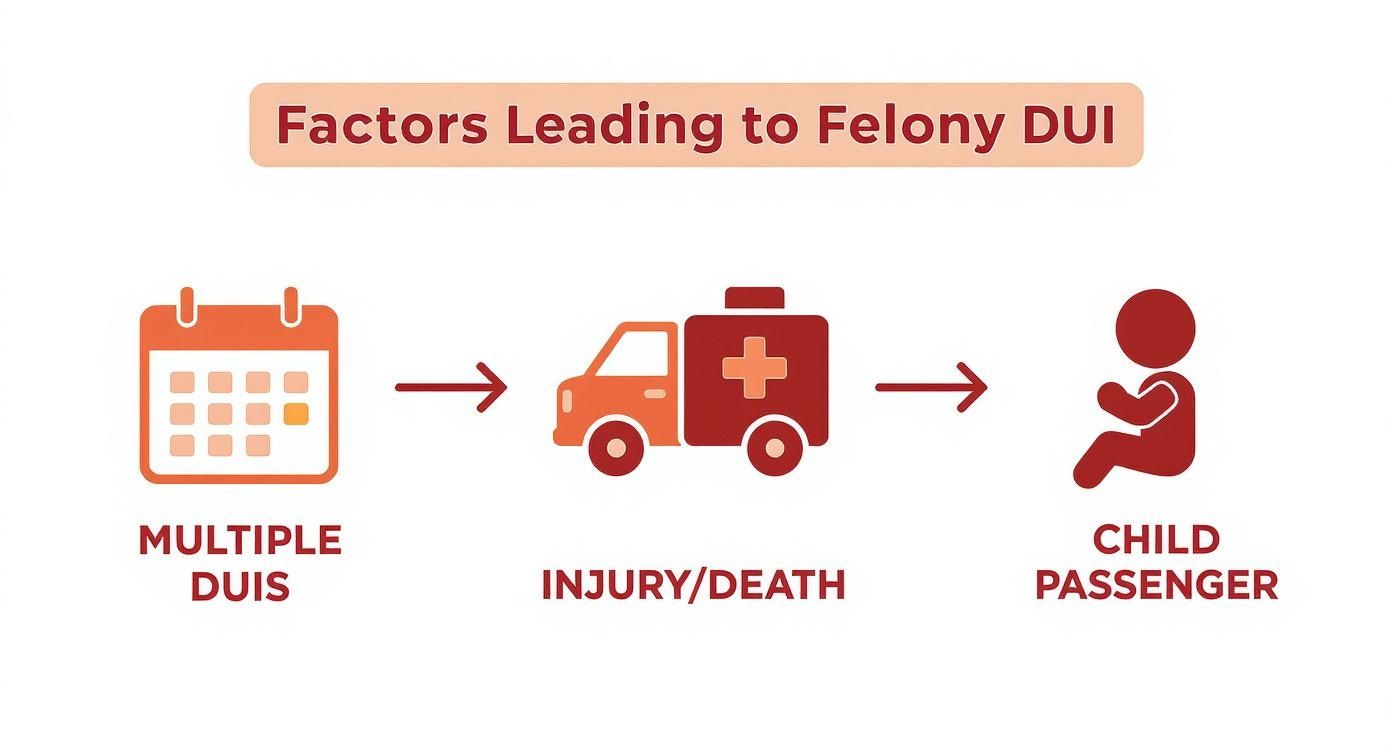
As you can see, a DUI charge doesn't just become a felony because of a high BAC. It’s the surrounding circumstances—repeat offenses, serious injuries, or endangering a child—that dramatically raise the stakes.
The Initial Stages: Arrest and Arraignment
Everything kicks off with the arrest and booking. This is where a person is taken into custody, photographed, and fingerprinted at the local jail. Soon after, they'll have their first court appearance, called an arraignment.
The arraignment is a brief but absolutely critical hearing. A judge will formally read the felony charges, and the defendant will be asked to enter a plea—usually "guilty," "not guilty," or "no contest." This is also when the judge decides on bail, which determines if the person can go home while their case moves forward.
Pre-Trial Proceedings and Plea Negotiations
Once the arraignment is over, the case enters the pre-trial phase. This is where a lot of the case's direction gets decided long before a jury ever hears about it. It’s a period for both sides to gather and exchange all the evidence in a process known as "discovery."
Here's what typically happens during this stage:
- Pre-Trial Hearings: These are meetings with the judge to handle procedural matters, file motions, and argue about evidence. For example, an attorney might file a motion to suppress breathalyzer results if they believe the machine wasn't calibrated correctly.
- Plea Negotiations: The reality is that most criminal cases, including felony DUIs, never go to trial. Instead, they’re resolved through plea bargaining. This is a back-and-forth negotiation between the prosecutor and a defense attorney to find a middle ground, which might mean pleading to a lesser charge or agreeing on a specific sentence to avoid the risk of a trial.
This is the phase where all options are explored. It's when a lawyer digs into the evidence and a path for how to beat DUI charges or, at the very least, minimize the damage, begins to form.
The Trial and Sentencing Phase
If a plea agreement can't be reached, the case will be set for trial. This is the classic courtroom scenario where both sides present their cases to a judge or jury. Witnesses are questioned, evidence is presented, and lawyers make their closing arguments. To convict, the prosecution has to prove guilt "beyond a reasonable doubt."
If the trial ends in a guilty verdict, the final step is sentencing. The judge doesn't just pick a punishment out of thin air. They weigh the specifics of the case, prior criminal history, and any other relevant factors to decide on the penalties. For a felony DUI, those penalties are severe, often including years in prison, crippling fines, and a long-term revocation of a driver's license.
The Lifelong Impact of a Felony DUI Conviction

A felony DUI conviction leaves a permanent stain that reaches far beyond prison walls and courtroom fines. Even after the proceedings are over, what are called "collateral consequences" can create a lifetime of roadblocks. These are the secondary penalties that aren't part of the official sentence but can be just as punishing, chipping away at a person's freedom and opportunities for years.
The second a felony DUI hits a record, it becomes public information. That means anyone running a background check—from a potential boss to a new landlord—is going to see it. That single event can shut doors before a person even gets a chance to knock.
Lasting Barriers to Employment and Housing
One of the toughest and most immediate challenges is simply finding a job. A lot of companies have blanket policies against hiring anyone with a felony conviction. And if a career requires a state license—think nursing, real estate, or commercial driving—a felony DUI record can make someone permanently ineligible.
Trying to find a place to live presents a very similar problem. Landlords and apartment complexes almost always run background checks on new applicants. A felony conviction is often an automatic "no," which makes finding safe, stable housing for an individual and their family incredibly difficult.
The consequences of a felony DUI conviction create a ripple effect, touching nearly every aspect of daily life. It’s not just a mark on a record; it’s a fundamental change to a person's legal status that can limit their ability to work, live, and participate fully in society.
The Crushing Financial Strain
The financial pain doesn't end with court-ordered fines. A felony DUI conviction sets off a chain reaction of long-term costs that can be absolutely devastating.
Take car insurance, for example. Premiums go through the roof after a conviction. On average, a DUI can inflate car insurance premiums by about 71%, making driving financially impossible for many people.
On top of that, a person will likely have to pay for mandatory alcohol education programs, therapy, and the installation of an ignition interlock device in their car. When those costs are combined with lost income from being in jail and fewer job prospects, it can create a crushing financial weight that can stick around for a decade or more.
Loss of Fundamental Civil Rights
Perhaps the most profound impact is the loss of fundamental civil rights. In many states, a felony conviction means a person permanently loses the right to vote, serve on a jury, or own a firearm.
A driver's license will also be revoked for a long time, which is a major challenge in itself. It's important to understand the full picture of what happens after a conviction, including how a license suspension after DUI works and what the long-term effects are.
Ultimately, a felony DUI conviction becomes part of a person's identity. It follows them into job interviews, rental applications, and financial discussions, acting as a constant reminder of a past mistake long after they've paid their debt to society.
Common Questions About Felony DUI Charges
When dealing with something as serious as a felony DUI, a lot of questions pop up. The terminology, the long-term consequences, and the specific things that can elevate a charge from a simple mistake to a life-altering event can be overwhelming. Let's clear up some of the most common points of confusion.
This information is meant to provide a better general understanding of these complex issues.
Can a First-Time DUI Be a Felony?
Most people think a felony only happens after multiple offenses, but it's absolutely possible for a first-time DUI to be charged as a felony. This occurs when specific, serious "aggravating factors" are involved. Think of it as the system's way of responding to a situation that goes far beyond a typical DUI arrest.
The most common reasons a first offense gets bumped up to a felony are:
- Causing Serious Injury or Death: If an impaired driver is in an accident that results in significant bodily harm or kills someone, the charge is almost always elevated to a felony. The focus is no longer just on the driver's impairment but on the devastating harm they caused.
- Child Endangerment: Driving under the influence with a minor in the car is another major trigger. Many states take this so seriously that it can warrant a felony charge on its own, even for someone with a perfectly clean record.
How Long Does a Felony DUI Stay on Your Record?
A felony DUI conviction is, for all intents and purposes, a permanent part of a criminal record. This is a huge difference from lesser offenses that might eventually be eligible for record restriction or sealing. Felony convictions, especially those involving injury to others, are almost never cleared.
This means that conviction will show up on background checks for the rest of a person's life, affecting things like:
- Job opportunities
- Housing and apartment applications
- Professional licenses
- The right to purchase a firearm
The permanent nature of a felony record is one of its most severe consequences. Any possibility of post-conviction relief is extremely slim and depends entirely on the specific laws of the state where the conviction occurred.
The permanency of a felony record is one of its most severe collateral consequences. Unlike a temporary punishment, it becomes a lasting part of an individual's public identity, creating persistent barriers long after any sentence is served.
What Is the Difference Between DUI and DWI?
The terms DUI (Driving Under the Influence) and DWI (Driving While Intoxicated or Impaired) cause a lot of confusion, mainly because their use changes from state to state. While they both describe similar offenses, the definitions aren't always the same.
In some states, the terms are used interchangeably—they mean the exact same thing. In others, there are clear distinctions. For example, DWI might refer only to alcohol impairment, while DUI is a broader term covering impairment from alcohol, prescription drugs, or illegal substances.
Some states even use both acronyms to signal different levels of impairment, often tied to a specific Blood Alcohol Content (BAC). A lower BAC might lead to a DWI charge, while a higher one could result in a DUI. To know for sure, one has to look at the specific laws of the state in question.
Understanding the situation is the first step toward protecting one's future. At Brian Hansford Law, we have over 25 years of experience, including time as a former prosecutor, providing a robust defense for clients in Alpharetta, Cumming, and across Forsyth and Cobb Counties. If you are facing serious charges, we are here to help. Contact us for a consultation at https://challengemycharge.com.
