
When someone is facing a DUI charge, their mind often races with questions. The first one is usually the biggest: is this a felony or a misdemeanor? In Georgia, the answer for most first-time DUIs is a misdemeanor.
That distinction is a huge deal. It immediately sets the tone for everything that comes next, separating the case from the much more severe world of felony offenses.
What a Misdemeanor DUI Really Means
It can be easy to get tangled up in terminology. So, let’s break it down. Think of the legal system like a scale of seriousness. A felony is the heaviest weight—life-altering, with consequences that can follow a person forever. A misdemeanor, while still a very serious charge that needs attention, sits on the other side of that scale.
Understanding this difference is the first step in getting one's bearings. A misdemeanor DUI follows a much more predictable path through the courts in places like Alpharetta, Cumming, and Forsyth County. The penalties, though significant, are not designed to derail a person's entire life in the way a felony conviction can.
How This Classification Affects a Case
From the moment a person is charged, the "misdemeanor" label shapes the entire process. It sets the boundaries for potential penalties, court procedures, and the overall scope of what they are up against. For most people, especially if this is their first offense, it means the system has a standard playbook.
Here's what that classification means in practical terms:
- A Known Range of Penalties: Misdemeanors in Georgia come with a specific set of potential consequences, including jail time, fines, and community service. These are far less severe than what a person would face with a felony.
- A More Straightforward Legal Process: The journey through the court system for a misdemeanor DUI is generally less complex than a felony case. The procedures in local courts, like those in Cobb County, are well-established.
- A Path Toward Resolution: While no two cases are the same, the system is built to handle misdemeanor charges efficiently. This often leads to a more predictable timeline for resolving the matter.
A misdemeanor DUI is serious. It can disrupt a person's job, family, and finances. But it does not have to ruin their future. Understanding what the charge means is the first step toward addressing it effectively.
Knowing a DUI is a misdemeanor allows a person to move past the initial panic. The question shifts from "What's going to happen to me?" to "What do I need to understand next?" This change in mindset is crucial for anyone navigating the legal system in North Georgia, from Roswell to Johns Creek. It allows a person to stop worrying about the absolute worst-case scenario and start focusing on the facts of their case and the road ahead.
Misdemeanor DUI vs Felony DUI Explained
If a person is facing a DUI charge in Georgia, one of the first things to understand is the line between a misdemeanor and a felony. This isn't just terminology—it's a critical distinction that represents a massive gap in potential consequences, impacting everything from their freedom to their future.
Think of it like this: a misdemeanor DUI is like being forced to climb a steep, difficult hill. The journey is tough and demands a lot of effort, but there's a clear path to getting to the other side. A felony DUI, however, is like being shoved toward the edge of a cliff. The fall is severe, the impact permanent and life-altering.
This flowchart gives a simple visual of how a single DUI stop can lead down two completely different legal paths.
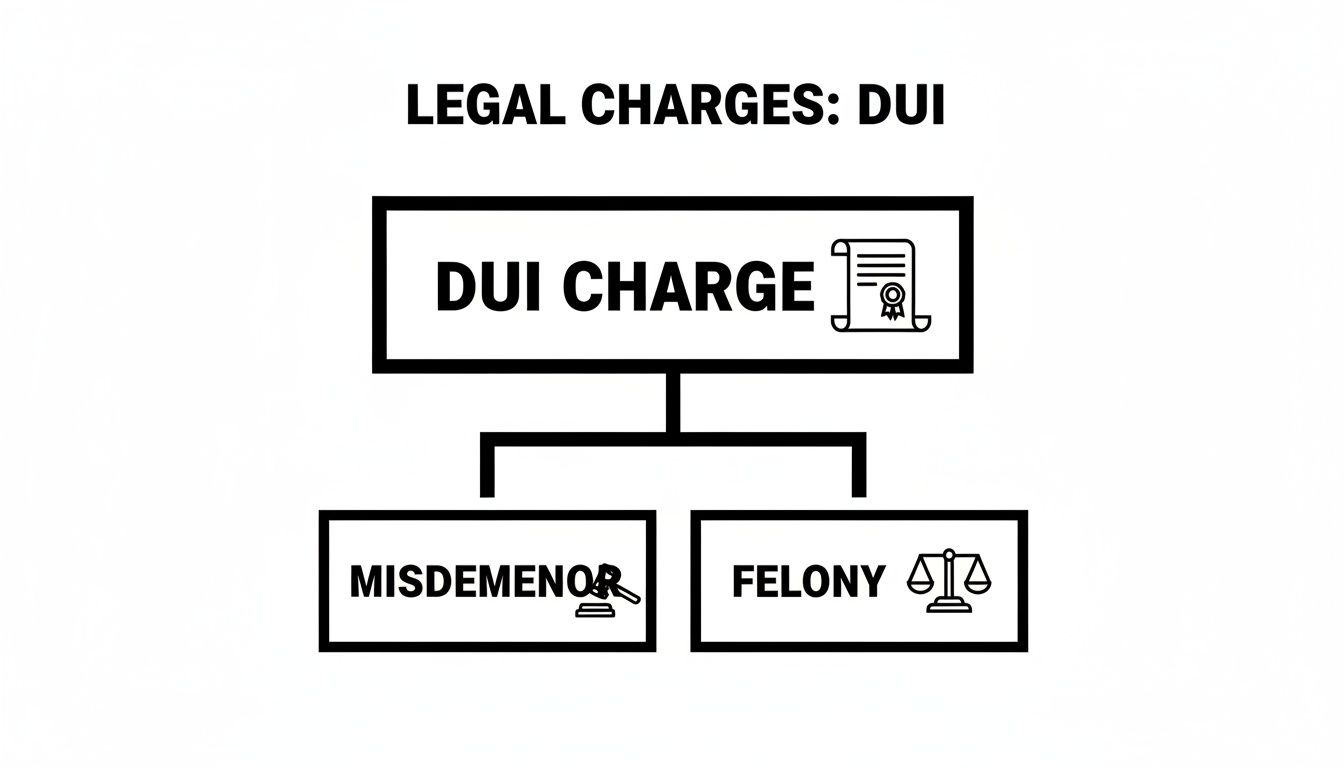
As you can see, both charges start from the same place, but the specific circumstances of the incident are what determine whether the state treats it as a misdemeanor or a much more serious felony.
What Makes a DUI a Misdemeanor
In Georgia, the vast majority of first, second, and even third DUI offenses (within a 10-year window) are classified as a misdemeanor. This is the most common type of DUI charge seen in local courts across both Cobb County and Forsyth County.
A DUI case will almost always remain a misdemeanor as long as there are no "aggravating factors" involved. These are specific circumstances the law views as serious enough to justify much harsher penalties. So, if a case stemmed from a standard traffic stop with no injuries or other unique conditions, it will almost certainly be handled as a misdemeanor DUI.
The Factors That Elevate a DUI to a Felony
A DUI charge crosses the line from that steep hill to a cliff when certain serious circumstances are present. Georgia law is crystal clear on what elevates a DUI to a felony, and these factors dramatically raise the stakes.
The jump from misdemeanor to felony isn't random; it's triggered by actions that show a much higher level of public danger.
Key aggravating factors include:
- Multiple Prior Convictions: A fourth DUI conviction within a 10-year period is automatically charged as a felony. No exceptions.
- Causing Serious Injury or Death: If a DUI driver is involved in an accident that results in serious bodily harm or a fatality, they will face severe felony charges, like Vehicular Homicide or Serious Injury by Vehicle.
- Driving with a Child Passenger: Having a passenger under the age of 14 in the car while driving under the influence can lead to a separate felony charge of Child Endangerment.
- Being a Habitual Violator: If a driver's license was already revoked because they were declared a Habitual Violator, getting caught driving—let alone getting another DUI—is a felony.
The core difference really comes down to the perceived level of public endangerment. A felony DUI signifies a situation where the act of driving under the influence has either become a repeated pattern of behavior or has resulted in direct, severe harm to others.
Misdemeanor DUI vs Felony DUI in Georgia at a Glance
To make the differences even clearer, here's a side-by-side look at what a misdemeanor and felony DUI charge typically entail in Georgia.
| Factor | Misdemeanor DUI (Typical First Offense) | Felony DUI (Aggravated or Repeat Offense) |
|---|---|---|
| Prior Convictions | Usually 0-2 prior DUIs within 10 years. | Typically the 4th DUI in 10 years or other aggravating factors. |
| Jail/Prison Time | 24 hours to 12 months in county jail. | 1 to 5 years (or more) in state prison. |
| Fines & Fees | Up to $1,000 plus court surcharges. | Up to $5,000 (or higher) plus court surcharges. |
| Driver's License | Suspension, with limited permit eligibility. | Long-term revocation (often 5+ years) with no limited permit. |
| Criminal Record | A permanent misdemeanor on your record. | A permanent felony on your record. |
| Civil Rights | No loss of civil rights. | Loss of right to vote, own firearms, and hold public office. |
| Future Impact | Can affect employment, insurance, and professional licenses. | Creates severe barriers to employment, housing, and obtaining loans. |
This table shows just how drastically the consequences escalate. A felony isn't just a more severe version of a misdemeanor; it's a completely different category of punishment with lifelong implications.
Comparing the Long-Term Consequences
The distinction between a misdemeanor and a felony plays out far beyond the courtroom in places like Johns Creek and Marietta. A misdemeanor DUI conviction, while damaging, is something many people can eventually move past. It creates hurdles for employment, especially for jobs that require driving, but it doesn't automatically slam every door shut.
A felony DUI conviction, on the other hand, is a permanent brand. It leads to the loss of fundamental civil rights, such as the right to vote or own a firearm. It can make finding housing incredibly difficult and can disqualify a person from many professional licenses and entire career fields. The social stigma and legal barriers are profound and lasting, making it critical to understand which charge a person is up against from the very beginning.
Penalties for a First Misdemeanor DUI Charge
If a person is facing a first misdemeanor DUI charge in Georgia, it's easy to assume it's just a fine and a slap on the wrist. That couldn't be further from the truth. The reality is a string of mandatory penalties that can throw a person's life off track for months, if not years.

Let’s break down exactly what a conviction means. Each penalty is required by law, from jail time to classes, and courts in Roswell, Milton, and across North Georgia enforce them without exception.
Mandatory Jail Time and Fines
First off, Georgia law requires a minimum of 24 hours in jail for a first offense. While a judge can sentence a person to up to 12 months, that first day behind bars is non-negotiable. For most people, this immediate loss of freedom is the most jarring part of the entire experience.
Then come the financial hits. The base fine for a first DUI ranges from $300 to $1,000. But that’s just the starting point. Once the court costs and various surcharges are tacked on, that number can easily double.
Community Service and Educational Programs
A conviction also comes with a serious time commitment. A person will be required to complete 40 hours of community service—unpaid work for a nonprofit or government agency.
On top of that, everyone convicted of a DUI must finish the DUI Alcohol or Drug Use Risk Reduction Program. This is a 20-hour course, better known as "DUI School," designed to teach the real risks of impaired driving. A person has to complete it before they can even think about getting their license fully reinstated.
The penalties for a first DUI are designed to be both punitive and educational. They combine financial costs, a loss of freedom, and mandatory coursework to address the seriousness of the offense from multiple angles.
The total cost of a first-time DUI goes way beyond the courtroom. A conviction can cause insurance rates in areas like Johns Creek, Milton, or Roswell to jump by 80-100% for up to five years. When you add that to court fees, which average around $10,000 nationwide, the financial stress becomes overwhelming.
License Suspension and Reinstatement
Losing a driver's license is often the penalty that hits the hardest. For a first DUI conviction within five years, a license will be suspended for up to 12 months. Suddenly, getting to work, taking kids to school, or running simple errands becomes a logistical nightmare.
A person might be able to get a limited driving permit for essential travel, but getting their full license back is a whole other process. To do that, a person must:
- Complete the DUI Alcohol or Drug Use Risk Reduction Program.
- Pay a hefty reinstatement fee.
- Serve the entire suspension period.
From the first 24 hours in jail to the final step of getting a license back, the path after a misdemeanor DUI conviction is demanding. For those feeling overwhelmed, our guide on navigating the penalties for a first-time DUI charge provides more information.
How a DUI Charge Becomes a Felony
Most people hear "DUI" and immediately think "misdemeanor." And most of the time, they're right. But it's a dangerous mistake to assume every case stays in that box. Think of it like a legal tripwire—certain circumstances can instantly launch a standard DUI into a felony.
This isn't just a small step up. It's a leap into an entirely different legal universe, one with consequences that can follow a person for the rest of their life. Understanding what triggers this change is critical. Under Georgia law, these "aggravating factors" are the bright line between a manageable misdemeanor and a life-altering felony.
The Fourth DUI: A Habitual Offense
The most common way to face a felony DUI is simply through repetition. In Georgia, the state uses a 10-year "look-back" period to track a person's history. If a person gets a fourth DUI conviction within that 10-year window, the charge is automatically filed as a felony. Period.
It doesn’t matter if the first three DUIs were simple traffic stops with no accident or injury. The act of repeatedly getting behind the wheel while impaired is enough to trigger the felony. The law treats this as a "Habitual Violator" situation, sending a clear message that the misdemeanor penalties weren’t enough of a deterrent.
For instance, someone in East Cobb could have three prior misdemeanor DUIs from 2015, 2018, and 2021. If they get arrested again in 2024, that fourth charge falls squarely within the ten-year window. It will be a felony, and that means facing state prison time, not just a stint in the county jail.
The jump from misdemeanor to felony is the court's way of saying, "This isn't a mistake anymore; it's a pattern of dangerous behavior." The penalties aren't just about punishment—they're about getting what the state sees as a threat off the road.
This isn't an abstract legal concept; it has real-world urgency. Alcohol-impaired driving continues to be a tragic reality on our roads. In 2022 alone, 13,524 people were killed in these crashes, making up a staggering 31% of all traffic fatalities. In rapidly growing areas like Alpharetta and Forsyth County, the local impact is stark. Even a second DUI can cause insurance premiums to spike by 80% or more—a financial consequence that hints at the much harsher penalties that follow.
Causing Serious Harm or Fatality
A DUI can become a felony on the very first offense if it involves an accident where someone else is seriously hurt or killed. In these awful situations, the law connects the driver's impairment directly to the harm caused, and the response is swift and severe.
- Serious Injury by Vehicle: If a DUI driver causes a crash that leaves another person with a "serious" injury—like a broken bone, disfigurement, or the loss of a limb—they will face a felony charge. This is true even for a first-time DUI.
- Vehicular Homicide: If that same crash results in someone's death, the charge becomes Vehicular Homicide. This is one of the most serious felonies on the books and comes with mandatory prison time.
Imagine a driver in Cumming who has a few drinks, runs a red light, and T-bones another car, leaving the other driver with severe injuries. Even with a perfectly clean record up to that point, that driver is now facing a felony conviction because their actions resulted in serious harm.
Endangering a Child in the Vehicle
Another immediate felony trigger is having a child in the car while driving under the influence. Georgia law is incredibly strict about protecting minors from this kind of risk.
Specifically, if a person is arrested for DUI with a passenger under the age of 14 in their vehicle, they face a separate and distinct felony charge for Child Endangerment. This is in addition to the DUI charge itself. The law doesn't see this as just reckless driving; it sees it as directly endangering a child's life, and that warrants a felony-level response. This is a critical factor for anyone facing charges, and you can learn more by reading our detailed guide on felony DUI charges in Georgia.
Navigating the North Georgia Court System
The anxiety that comes with a misdemeanor DUI charge is real, but understanding the court process can be a powerful antidote. While the legal system can feel like an intimidating maze, it follows a surprisingly predictable path. Knowing what's coming around each corner helps a person regain a sense of control.

This journey starts the moment a person is arrested. The first step is booking, which is just administrative—think fingerprints and a mugshot—before a person is typically released on bond. After that, their case officially enters the court system, kicking off a series of required appearances.
The Initial Court Appearance: Arraignment
A person's first time in front of a judge will be for the arraignment. This is where the court formally states what they are being charged with—in this situation, a DUI as a misdemeanor. The judge will then ask for a plea: guilty, not guilty, or no contest.
It's important to understand that pleading "not guilty" at this stage is a standard step. This isn't a person claiming they are innocent of everything; it's simply exercising the right to see the evidence the state has against them before any decisions are made. This plea is what officially starts the pre-trial phase of a case.
Don't underestimate how common these cases are. Misdemeanor DUIs flood the criminal justice system. In fact, data from over 400,000 jail admissions revealed that 35% were for misdemeanors. In places with aggressive traffic enforcement like Forsyth County and Cobb County, a first-offense dui a misdemeanor charge can easily land a person in the local jail, facing fines up to $1,000 and potential jail time. You can dig deeper into these jail admission statistics from the Prison Policy Initiative.
Understanding the Key Players
As a person moves through the North Georgia courts, they will be dealing with several key people. Each one has a distinct job, and knowing who's who is essential.
- The Prosecutor: This is the lawyer for the state. Their job is to prove the case and seek a conviction. They represent the government, not the officer who pulled the person over.
- The Judge: The judge is the neutral referee in the courtroom. They make sure everyone follows the rules, decide on legal arguments (called motions), and will ultimately approve any plea deal or hand down a sentence.
- The Defense Attorney: This is the defendant's representative. A defense lawyer's only job is to protect their client's rights, examine the prosecutor's evidence, and work for the best possible outcome for their client.
The court process is designed to be an adversarial system. Having a seasoned attorney who knows the local rules and personalities in Forsyth and Cobb County courts can help level the playing field.
The time after an arraignment is all about strategy. Evidence is gathered, motions are filed, and negotiations with the prosecutor often take place. This is where every detail gets scrutinized, from the reason for the traffic stop to whether the breathalyzer was calibrated correctly. Many misdemeanor DUI cases get resolved right here, without ever needing a full-blown trial. To understand more about why skilled representation matters, our guide on how to find a criminal lawyer has more information.
Common Questions After a Misdemeanor DUI Arrest
Even when the basics are understood, a misdemeanor DUI charge leaves a person with a lot of specific, urgent questions. People navigating the system for the first time in North Georgia often run into the same concerns. Here are some direct answers to the questions most often heard.
Will They Suspend My License Right Away?
No, it's not automatic, but the clock is ticking—fast. After a DUI arrest in Georgia, a person is actually facing two different risks of suspension.
The first is the Administrative License Suspension (ALS). This is triggered if a person refuses the state's chemical test or if their BAC is over the legal limit. A person has only 30 days from the date of arrest to file a special appeal to fight it. If that deadline is missed, their license can be suspended before the criminal case even gets going.
The second type of suspension is the one ordered by the court, but that only happens if the person is convicted of the DUI down the road.
Can a Misdemeanor DUI Be Wiped From My Record?
People often ask if a DUI, a misdemeanor, can be expunged. The answer is yes and no. In Georgia, if a charge gets dismissed or a person is found not guilty at trial, the arrest itself can be restricted from their public record.
But a conviction is a different story. A DUI conviction is permanent. Georgia law specifically prevents it from ever being restricted or sealed. This is a huge reason why the final outcome of a case is so critical from day one.
The permanent nature of a DUI conviction on a criminal record is a key reason why addressing the charge from the very beginning is so vital. It’s not something that simply goes away over time.
What's the Difference Between Pleading Guilty and "No Contest"?
A guilty plea is a straightforward admission that a person committed the offense. A "no contest" (or nolo contendere) plea is a bit different. The person is not admitting they did it, but they are agreeing to accept the court's punishment as if they were guilty.
For a first-time DUI, pleading no contest might stop the conviction from being used against a person in a civil lawsuit (like if the case involved a car accident). But for every other purpose—criminal penalties, driver's license points, insurance rates—the state treats a no contest plea exactly the same as a guilty plea.
Do I Have to Do the Field Sobriety Tests on the Roadside?
A person is not required to do them. In Georgia, the roadside exercises an officer asks a driver to perform—like the walk-and-turn, the one-leg stand, or following a pen with your eyes—are voluntary field sobriety tests. A person has every right to politely say no. These tests are notoriously subjective and often difficult to pass even for a completely sober person.
Just be aware that this is different from the official chemical test (breath, blood, or urine) a person is asked to take after they've been arrested. Refusing that test comes with its own set of consequences, including that potential administrative license suspension previously mentioned.
Navigating these questions and the complexities of a misdemeanor DUI can feel overwhelming. At Brian Hansford Law, we bring over two decades of experience, including time as a prosecutor, to build a strong defense for your case. If you're facing a charge in Alpharetta, Forsyth County, or the surrounding areas, contact us for a consultation to protect your rights and your future. https://challengemycharge.com
