
For a noncitizen, seeing those flashing blue lights often triggers one terrifying question: can a DUI get me deported? While a single, simple DUI conviction usually isn't a direct path to removal, it's a serious red flag that can throw your entire immigration status into jeopardy. Immigration officials may view a DUI as far more than just a bad traffic mistake.
How a DUI Charge Connects to Deportation Risk
When you're a noncitizen facing a DUI in Georgia, it can feel like you're navigating a battle on two fronts. First, there's the state criminal court, which has its own rules, fines, and potential jail time. But then there’s the federal immigration system, which looks at the very same charge through a completely different and often much harsher lens. Getting a handle on this distinction is the first critical step.
From an immigration standpoint, the final verdict in your criminal case is only part of the story. What really matters is how federal law interprets the facts of your arrest and conviction. This is where two critical ideas come into play.
Deportability vs. Inadmissibility
Think of these as two separate rulebooks. One governs whether someone can be forced to leave the U.S., and the other determines if someone is allowed to enter or stay in the first place.
-
Deportability: This set of rules applies to noncitizens already living inside the United States. To be deported, you have to be convicted of a specific "deportable offense" listed in the Immigration and Nationality Act. A first-time, straightforward DUI is not on that list.
-
Inadmissibility: These rules are like a gatekeeper. They come into play when someone tries to enter the country, apply for a green card, or change their immigration status. A DUI can very easily make a person "inadmissible," even if it doesn't make them deportable.
The difference here is huge. For example, a lawful permanent resident (a green card holder) with a single DUI might not be placed in deportation proceedings. But if they take a trip outside the U.S. and try to come back, a Customs and Border Protection officer could block their re-entry, declaring them inadmissible because of that same DUI.
The real danger is that even offenses that seem minor in criminal court can have devastating immigration consequences. A DUI conviction can be used as evidence that someone lacks "good moral character" or has a health-related issue—both are grounds for inadmissibility.
Recent data shows just how aggressively immigration enforcement pursues even non-violent offenses. As of mid-2025, ICE detention data revealed a shocking trend: the vast majority of people detained had either zero criminal convictions or were held for minor charges like traffic violations. In fact, 71.7% of the 57,861 people detained had no criminal history at all. This tells us that immigration authorities don't wait for a serious felony to take action; they frequently use lesser infractions, including DUIs, to trigger severe outcomes like deportation. You can learn more about the connection between immigration enforcement and minor offenses.
Here’s a quick breakdown of the primary ways a DUI can immediately put someone's immigration status at risk.
Initial Immigration Risk Factors from a DUI
| Risk Area | How It Can Impact Immigration Status |
|---|---|
| Inadmissibility | A DUI can be interpreted as a sign of a "physical or mental disorder" with associated harmful behavior, making an individual ineligible to adjust their status, get a green card, or re-enter the U.S. after travel. |
| Lack of "Good Moral Character" | Many immigration benefits, like naturalization (citizenship), require an applicant to prove good moral character. A DUI conviction can be used by officials to argue that an individual does not meet this standard. |
| Visa/Status Renewal | Consular officers have broad discretion. When someone applies to renew a visa, a DUI on their record gives them a powerful reason to deny the application. |
| Aggravating Factors | If a DUI involved factors like driving with a child, having a suspended license, or causing an accident, it could potentially be classified as a "crime involving moral turpitude" (CIMT), which has much more severe immigration consequences. |
Ultimately, any DUI arrest creates a paper trail that immigration officials will scrutinize for years to come. It complicates every future interaction with the U.S. immigration system, from a simple visa renewal to an application for citizenship.
Understanding Deportability and Inadmissibility
When a noncitizen gets hit with a DUI charge, the consequences go way beyond the local criminal courthouse. To really get a handle on what's at stake for immigration status, it's important to understand two critical concepts: deportability and inadmissibility. These aren't just technical terms—they're two totally different sets of rules that come into play at different times.
Here’s a simple way to think about it. Deportability is like getting kicked out of a party you're already at. Inadmissibility is like being stopped at the front door and told you can't even come in. One applies to people already inside the U.S., while the other is for anyone trying to get in or change their status.
The Rules for Staying Inside the U.S.
Deportability lays out the reasons a noncitizen already in the United States—even with a green card—can be removed. The Immigration and Nationality Act has a specific list of crimes that can get someone deported. The good news? A single, simple misdemeanor DUI usually isn't on that list. For a lawful permanent resident, that first-time DUI might not automatically trigger a notice to appear in immigration court.
But it’s important not to get too comfortable. If that DUI has "aggravating factors," the game changes. Things like driving with a child in the car, causing a serious accident, or having a drug-related element can push the charge into a much more serious category—one that is a deportable offense.
The Rules for Entering or Adjusting Status
Inadmissibility is a much bigger net, and it catches a lot more people. These rules decide who is allowed to enter the U.S. in the first place, or who can adjust their status to become a green card holder. A DUI conviction can absolutely make someone inadmissible, even if it doesn't make them deportable.
This is where the real danger lies for many noncitizens, and it creates what can be called the "inadmissibility trap." Let's walk through a common scenario:
- Scenario: A green card holder gets a first-offense misdemeanor DUI in Forsyth County. Since it's not a deportable crime, they serve their probation and think the worst is over. They continue living and working in Georgia without any immediate trouble from immigration.
- The Trap: A year later, they fly home to visit family. When they try to re-enter the U.S., the Customs and Border Protection (CBP) officer at the airport sees the DUI conviction on their record. That officer can decide the DUI makes them inadmissible and deny them re-entry. Just like that, they're stuck outside the country they call home.
This "inadmissibility trap" means a DUI conviction becomes a permanent red flag on a record. It can stop someone from renewing their visa, applying for U.S. citizenship, or even just coming back from a quick trip abroad. This chart breaks down how that single charge can send you down two very different, and very serious, paths.
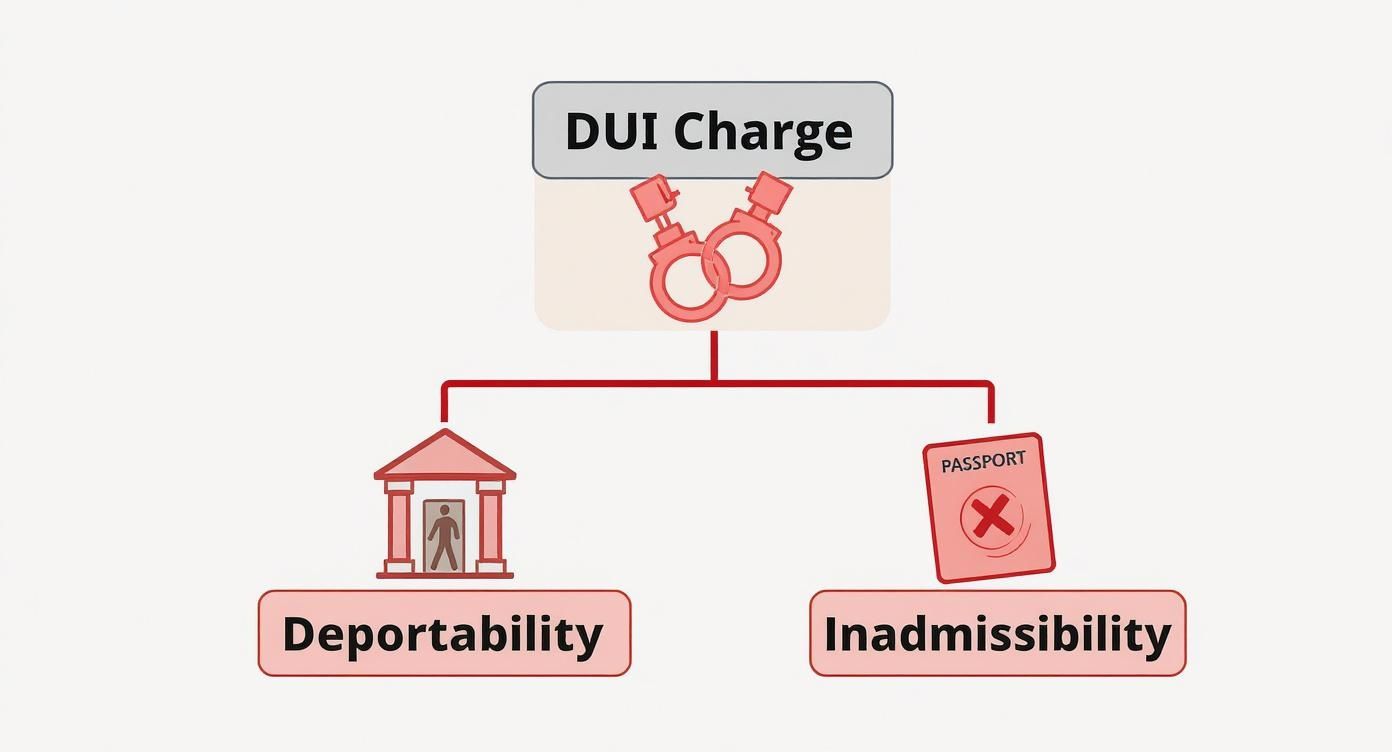
As you can see, a DUI forces an individual to think about both sets of rules at once. The next move—and their future in this country—depends entirely on their current status and what happens next.
A key takeaway is that even if a DUI doesn't lead to an immediate knock on the door from immigration agents, it creates a permanent black mark on a record that can be used to deny future immigration benefits.
At the end of the day, immigration officials have a ton of discretion. They can point to a DUI as proof that an individual lacks "good moral character" or that they have a health issue tied to harmful behavior. Either one is enough to find someone inadmissible and slam the door on their future in America.
When a DUI Becomes a Major Immigration Problem
Not all DUI charges carry the same weight in the eyes of immigration officials. While any DUI creates complications, certain elements can turn a manageable situation into a high-stakes crisis. These are often called aggravating factors, and they act like fuel on a fire, dramatically escalating the risk of severe immigration consequences, including deportation.
Immigration authorities are trained to look beyond the simple "DUI" label on a court document. They scrutinize the details of the arrest, searching for anything that suggests a heightened disregard for public safety or a deeper underlying issue. This is where a standard DUI transforms into a major problem.

Factors That Escalate a DUI Offense
Several specific scenarios can elevate a DUI from a serious mistake to an offense that triggers alarms for immigration enforcement. These aren't just minor details; they can fundamentally change how a case is classified under federal immigration law.
-
DUI with a Child Passenger: Driving under the influence with a minor in the car is rarely just a DUI. It's often charged as a separate, more serious crime like child endangerment. Immigration officials may view this as a "crime involving moral turpitude," a category of offense with severe immigration consequences.
-
Driving on a Suspended License: A DUI that happens while a license is already suspended shows a pattern of ignoring the law. This can be used as powerful evidence against an individual when they are trying to prove they have "good moral character."
-
Causing an Accident with Injury: If a DUI leads to an accident where someone is hurt or property is damaged, the charge becomes far more serious. It can be elevated to a felony and is much more likely to be considered a deportable offense.
These factors provide immigration authorities with the ammunition they need to argue that an individual poses a public safety risk, making it much harder for them to stay in the country.
The Drug Connection in DUI Cases
One of the most dangerous elements in a DUI case for a noncitizen is the involvement of controlled substances. A DUI related to drugs, rather than alcohol, falls under a completely different and far stricter section of immigration law. Any conviction related to a controlled substance can be an automatic trigger for deportability, with very few exceptions.
This creates a perilous situation. Even if the state of Georgia treats a drug-related DUI similarly to an alcohol-related one, federal immigration law absolutely does not. An officer finding a small amount of an illegal substance in a car during a DUI stop can lead to two separate charges, each with its own devastating impact on immigration status.
Immigration law makes almost no distinction between a minor drug possession charge and a major trafficking offense. A conviction for possessing even a small amount of a controlled substance connected to a DUI can lead directly to removal proceedings.
The broader context of immigration enforcement shows why these factors are so critical. Statistics from U.S. Immigration and Customs Enforcement (ICE) reveal a strong focus on deportations stemming from interior arrests and criminal offenses, which can include DUI-related cases. From fiscal years 2020 to 2024, ICE averaged 43,000 deportations annually for noncitizens arrested within the U.S. This data shows how immigrants with seemingly minor offenses, like traffic violations, can get swept up in enforcement actions. You can learn more about ICE's interior enforcement trends from Migration Policy Institute.
The Impact of Multiple DUI Convictions
A single DUI is a problem; multiple DUIs are a pattern. Immigration judges and consular officers look for patterns of behavior when assessing an individual's character. Two or more DUI convictions over several years can be used to establish that an individual lacks the "good moral character" required for many immigration benefits, most notably U.S. citizenship.
Even if neither DUI on its own was a deportable offense, the combination can be toxic. An officer reviewing a naturalization application could deny it on the grounds that repeat offenses show a disrespect for the law. This can leave someone in a permanent state of vulnerability, unable to become a citizen and constantly at risk if they travel or have any other interaction with law enforcement. Each conviction adds another layer of difficulty, making their immigration journey exponentially harder.
How Georgia DUI Laws Affect Immigration Outcomes
When you're not a citizen, a DUI charge isn't just a state-level problem—it’s a federal one, too. It is important to understand how Georgia's specific laws can be interpreted by immigration courts, because that's where the real fight for your future happens. The exact wording of a state conviction can make all the difference.

Here in Georgia, there are different types of DUI charges, and they each carry different weights in the eyes of immigration officials. A DUI Per Se charge, for instance, is pretty straightforward. It’s based on science—having a blood alcohol concentration (BAC) of 0.08% or higher.
Then there’s the DUI Less Safe charge. This one is based on an officer’s opinion that an individual was a less safe driver because of alcohol or drugs, no matter what their BAC was. It might sound like a lesser offense, but immigration authorities can dig into the arrest report from a "Less Safe" charge to find behavior they consider problematic.
Why the Wording of Georgia Charges Matters
The specific law an individual is convicted under is absolutely critical. For example, if someone is arrested for a DUI with a child under 14 in the car, they aren't just facing a standard DUI. Georgia law adds a completely separate charge of Child Endangerment.
To an immigration judge, this is a massive red flag. A child endangerment conviction can easily be labeled a "crime involving moral turpitude" (CIMT), which creates a direct path to severe consequences like dui and deportation.
The intersection of state criminal law and federal immigration law is where many noncitizens face unexpected challenges. A charge that seems manageable in a Forsyth County criminal court can be viewed very differently by an immigration judge.
This is why every single decision made in a local criminal case has to be viewed through an immigration lens. If an individual is in Cumming, Alpharetta, or Cobb County, they need to know how what happens in the local courthouse can impact their federal status.
Plea Bargains: The Hidden Immigration Risks
Plea bargains are a huge part of Georgia's criminal justice system. It’s common to negotiate a DUI charge down to a lesser offense like reckless driving. From a purely criminal defense standpoint, that’s usually a great outcome, since the penalties are far less severe than a DUI first offense.
But for a noncitizen, this isn't always a safe move. Immigration authorities have the power to look past the name of the final conviction and examine the original arrest record. If the facts of the case clearly show someone was driving under the influence, they can still hold that against them.
- Criminal Court Goal: Reduce immediate penalties like fines, jail time, and license suspension.
- Immigration Concern: Avoid any conviction that even hints at a disregard for public safety, especially if it involves drugs or other dangerous behavior.
A plea to reckless driving might feel like a victory, but it could still create major problems when applying for a green card or trying to renew a visa. The details buried in the police report can be just as damaging as the conviction itself. Understanding the nuances of a Georgia DUI first offense is critical, because even a minor charge can set a dangerous precedent. Every step taken in a local courthouse in places like Marietta or Roswell has the potential to echo for years in federal immigration proceedings.
Exploring Post-Conviction Relief and Waivers
After a DUI conviction, it can feel like the final word has been spoken. But in the legal world, that isn't always the case. The system has specific, though often complex, processes that can sometimes be used to address a conviction and its heavy impact on immigration status.
These aren't simple fixes or loopholes. They are distinct legal pathways designed for very different problems. Think of it like a toolkit: one tool might try to undo the conviction itself, while another is used to ask for forgiveness in an immigration case.
The Concept of Post-Conviction Relief
One potential avenue is known as post-conviction relief. This is a direct challenge to the criminal conviction itself, filed after the case is supposedly closed. The goal here is to prove that a critical legal error occurred during the original case, making the conviction fundamentally flawed.
For instance, if someone's constitutional rights were violated or another significant mistake was made in the legal process, they might be able to file a motion to vacate—or cancel—the conviction. If successful, it's as if the conviction legally never happened. This can have a powerful, immediate effect on any related immigration issues, as the entire basis for removal or inadmissibility may simply disappear. However, the standards for proving such an error are extremely high. You can learn more about how a criminal record is handled in our guide on getting a DUI off your record in Georgia.
Waivers of Inadmissibility
A waiver of inadmissibility is a completely different tool. Unlike post-conviction relief, a waiver doesn't erase the conviction. Instead, it’s like asking the U.S. government for a pardon in an immigration case. The individual is essentially acknowledging the conviction but arguing that they should be allowed to get a green card or visa anyway.
These waivers are only available in specific situations. They often require proving that a U.S. citizen or lawful permanent resident relative—typically a spouse or parent—would suffer "extreme hardship" if the person were denied entry or removed. Proving this is a tall order and involves a detailed presentation of financial, emotional, and physical evidence.
A waiver of inadmissibility is not a second chance at fighting the criminal charge. It is a plea for forgiveness within the immigration system, based on the potential suffering family would endure without the individual.
Cancellation of Removal as a Defensive Tool
For certain individuals already facing deportation proceedings, cancellation of removal can be a last-ditch defensive option. This is a very specific form of relief available only to certain noncitizens who have lived in the U.S. for a long time and meet an incredibly strict set of requirements.
To even be considered for this, an individual generally must demonstrate:
- Continuous physical presence in the U.S. for at least 10 years.
- Good moral character during that entire period.
- That their removal would result in "exceptional and extremely unusual hardship" to a qualifying U.S. citizen or permanent resident relative.
- That they have not been convicted of certain disqualifying offenses.
The "exceptional and extremely unusual hardship" standard is even higher than the "extreme hardship" required for a waiver. It's a very narrow path, reserved for those with deep roots in the community and truly compelling family circumstances.
To help clarify how these options differ, here is a simple breakdown.
Overview of Potential Immigration Relief Mechanisms
This table gives a comparative look at different legal mechanisms that may be explored in response to immigration consequences from a criminal conviction.
| Legal Mechanism | What It Is Designed to Do | Common Scenario for Its Use |
|---|---|---|
| Post-Conviction Relief | To challenge and overturn the original criminal conviction due to a fundamental legal error. | A noncitizen discovers their rights were violated during their DUI case and seeks to have the conviction vacated. |
| Waiver of Inadmissibility | To ask for forgiveness for a conviction that makes someone inadmissible, allowing them to get a green card. | An applicant for a green card has a DUI conviction and must prove their U.S. citizen spouse would suffer extreme hardship if they are denied. |
| Cancellation of Removal | To stop a deportation that is already in progress for a long-term resident meeting strict criteria. | A green card holder who has lived in the U.S. for 15 years is in removal proceedings and argues their U.S. citizen child would suffer immensely if they were deported. |
Each of these processes involves navigating a maze of intricate legal rules where the specific facts of an individual's criminal and immigration history are absolutely critical.
Understanding Your Next Steps After a DUI Charge

If you're a noncitizen in a place like Alpharetta, Cumming, or Forsyth County and find yourself facing a DUI charge, the sense of uncertainty can feel crushing. The best way to regain control is to start with what you have. The most critical first step is to gather every single piece of paper related to the case.
This means finding all the documents from the criminal arrest—the police report, tickets, court notices, everything. Just as important, you need to pull together your complete immigration history, including every visa, entry stamp, past application, and letter from immigration officials. This collection of documents creates the full picture needed to see the road ahead.
The Two-Front Challenge
The biggest hurdle for any noncitizen is realizing they’re not fighting one battle, but two. The criminal case and immigration status are separate but deeply intertwined problems. A resolution that seems like a win in a Cobb County criminal court might still trigger devastating consequences with federal immigration authorities.
From day one, this dual reality must be approached with extreme care. Every decision made during the early stages of a DUI case, like the arraignment and pre-trial motions, can echo for years in an immigration journey. To get a better handle on those first crucial hours and days, explore our guide on what to do after a DUI arrest.
Facing a DUI charge as a noncitizen is not just about the criminal penalties. It is about protecting an individual's ability to remain in the United States, pursue their goals, and keep their family together.
Building Your Foundation of Information
As an individual starts to navigate these complicated legal waters, having the right information is non-negotiable. It’s also important to understand your own rights. A key part of that is knowing how confidential conversations are protected, and understanding attorney-client privilege is a great place to start.
Our firm is built to handle DUI cases for people in Roswell, Marietta, and the surrounding areas with a constant focus on the immigration side of the equation. We are committed to helping you understand the unique challenges you’re up against, making sure you see how every detail of a Georgia DUI case could affect your future in this country.
A Noncitizen's Top Questions About DUIs and Immigration
When you're not a U.S. citizen, facing a criminal charge like a DUI brings on a whole different level of stress. It’s not just about court fines or a suspended license; an individual's entire future in this country can feel like it's on the line. These are some of the most common questions that arise.
Can a Single DUI Get Me Deported From Georgia?
Let's be very clear: a first-time, simple misdemeanor DUI with no aggravating factors (like a child in the car or a serious accident) does not automatically trigger deportation under current law. However, that's where the good news ends.
While it may not make someone deportable on its own, a DUI conviction creates a massive red flag for any future immigration dealings. It can be used to find a person "inadmissible," blocking them from getting a green card or visa. It also chips away at the "good moral character" requirement needed for U.S. citizenship, creating a long-term problem that can't be ignored.
How Does a DUI Affect My Green Card Application?
This is where a DUI conviction can become a brick wall. When someone is applying for a green card (lawful permanent residence), an immigration officer has a lot of discretion. They can easily look at a DUI and use it as grounds to find the applicant "inadmissible," which is terminology for denying the application.
Why? They might see the conviction as a sign of a health-related problem or a basic disregard for the safety of others. Suddenly, getting that green card approved becomes an uphill battle, and it's necessary to start looking at whether a special waiver might even be an option for the case.
A DUI might not get a current green card holder deported right away, but it can absolutely stop someone from ever becoming one. Immigration officials look at any criminal history, and a DUI is one of the brightest red flags they can see.
Is Pleading to Reckless Driving a Safe Bet for Immigration?
Pleading a DUI down to reckless driving is often a great outcome in criminal court, but it's no magic bullet for immigration. Immigration authorities are trained to look past the label of the final conviction and dig into the facts of the original arrest.
If the police report clearly shows an individual was stopped for driving under the influence, it can still be held against them in immigration proceedings. It doesn't matter what the final plea was called.
Can I Leave the Country if I Have a DUI on My Record?
For a noncitizen, traveling internationally with a DUI conviction—or even while a case is still pending—is incredibly risky. The moment an individual tries to re-enter the U.S., they will be screened by a Customs and Border Protection (CBP) officer.
That officer at the airport or border has the power to decide that the DUI makes the person "inadmissible." If that happens, they could be denied entry right then and there. This is true even if the individual is a lawful permanent resident holding a valid green card. This "inadmissibility trap" is one of the harshest and most unexpected consequences a noncitizen can face after a DUI.
Understanding how a Georgia DUI connects to federal immigration law is the first step toward building a strong defense. At Brian Hansford Law, we handle every case with a full understanding of what's at stake for our clients in Alpharetta, Cumming, and throughout Forsyth and Cobb counties. If you're a noncitizen facing a DUI, contact us for a consultation to protect your future.
