
You hear the terms DUI and DWI thrown around all the time, and it’s easy to get them mixed up. Here’s the bottom line: while some states draw a line between the two, Georgia law just calls it "DUI"—Driving Under the Influence. This one term covers a whole range of impaired driving, whether it’s from alcohol, illegal drugs, prescription medication, or any mix of them.
The Real Difference Between DUI and DWI in North Georgia
In everyday conversation, people use DUI and DWI like they’re the same thing. But when you’re dealing with the law in Georgia, the only term that really matters is DUI. This keeps the language simple, but don't let that fool you. The law is designed to cover any situation where a substance makes a person a "less safe" driver.
For folks in local communities—Cumming, Johns Creek, Milton, Alpharetta—the key takeaway is that any kind of impairment can lead to a DUI arrest. The state doesn’t have to prove a driver was drunk in the classic sense. They just need to convince a judge or jury that their driving ability was compromised.
What Georgia's DUI Law Actually Covers
Georgia’s DUI laws are intentionally broad, which is something to understand if pulled over. There isn't just one way to get a DUI; the law outlines several specific types of charges:
- DUI Per Se: This is the most black-and-white charge. It’s based entirely on a chemical test showing a Blood Alcohol Concentration (BAC) of 0.08% or higher for drivers over 21.
- DUI Less Safe: This charge doesn’t rely on a specific BAC level. The prosecutor argues that a person was a "less safe driver" because of impairment. They’ll use evidence like driving patterns, performance on field sobriety tests, and even physical appearance.
- DUI Drugs: This charge applies if a person is under the influence of marijuana, a controlled substance, or any other drug to the point where it's less safe for them to be behind the wheel.
- DUI Combination: This one is for cases involving a mix of alcohol and one or more drugs.
It’s incredibly important to know which type of DUI is being faced. The evidence the prosecution needs to prove its case changes with each one, and that directly impacts how a defense strategy might be built. Each charge has its own unique hurdles for the state to clear.
These charges are pursued aggressively for a reason. According to the National Highway Traffic Safety Administration (NHTSA), a staggering 12,429 people died in alcohol-impaired driving crashes in 2023 alone. That accounts for about 30% of all traffic fatalities in the country, a statistic that explains why prosecutors in Cobb County, Forsyth County, and across North Georgia take these cases so seriously.
Comparing DUI and DWI Standards
Even though Georgia law keeps it simple by using the single term "DUI," people searching online often see "DWI" pop up just as much. It causes a lot of confusion. Understanding the differences, especially how other states handle these charges, can give a much clearer picture of what a person might be facing here. The real distinctions boil down to what the charge covers, the specific legal limits, and the kind of evidence the prosecution needs to build its case.
When paperwork is received in Forsyth or Cobb County, it's going to say DUI. But the term DWI, which usually stands for "Driving While Intoxicated" or "Driving While Impaired," is used all over the country. In some places, DWI specifically means a person was drunk from alcohol, while DUI is a broader term for impairment from other substances. Georgia's approach is much more direct—its DUI law covers impairment from any source that makes a person a "less safe" driver.
That all-in-one approach is critical to understand. It means a DUI charge in Georgia can come from alcohol, illegal drugs like marijuana, or even a prescription medication a person is legally allowed to take. If it impacts the ability to drive safely, it all falls under the same DUI umbrella.
Scope of the Charge: What Is Covered
The main difference between DUI and DWI often comes down to what the term actually covers. Georgia's DUI law is famously broad, and that's by design. It’s meant to be a catch-all for any kind of impaired driving.
- DUI (Georgia's Standard): This covers impairment by any substance. That includes alcohol, illegal drugs, prescription medications, over-the-counter drugs, and even things like toxic vapors if they affect driving ability.
- DWI (Common Usage Elsewhere): In states that use both terms, DWI is often the go-to charge for alcohol intoxication, usually tied directly to a specific BAC level. They might have a completely separate charge for driving under the influence of drugs.
Because Georgia doesn’t split hairs, someone in Alpharetta or Roswell faces the exact same DUI charge whether they were impaired by beer, a prescription painkiller, or a mix of substances. The law's focus is on the effect of the substance, not the substance itself. This is a huge point of clarification in the DUI vs. DWI discussion.
The most important thing to remember is that in Georgia, there’s no "lesser" charge based on what substance was involved. Impairment is impairment, and the law takes it seriously no matter the cause.
The infographic below breaks down the three main ways a person can be charged with DUI in Georgia: general impairment ("Less Safe"), being over the legal alcohol limit ("Per Se"), or having illegal drugs in their system.
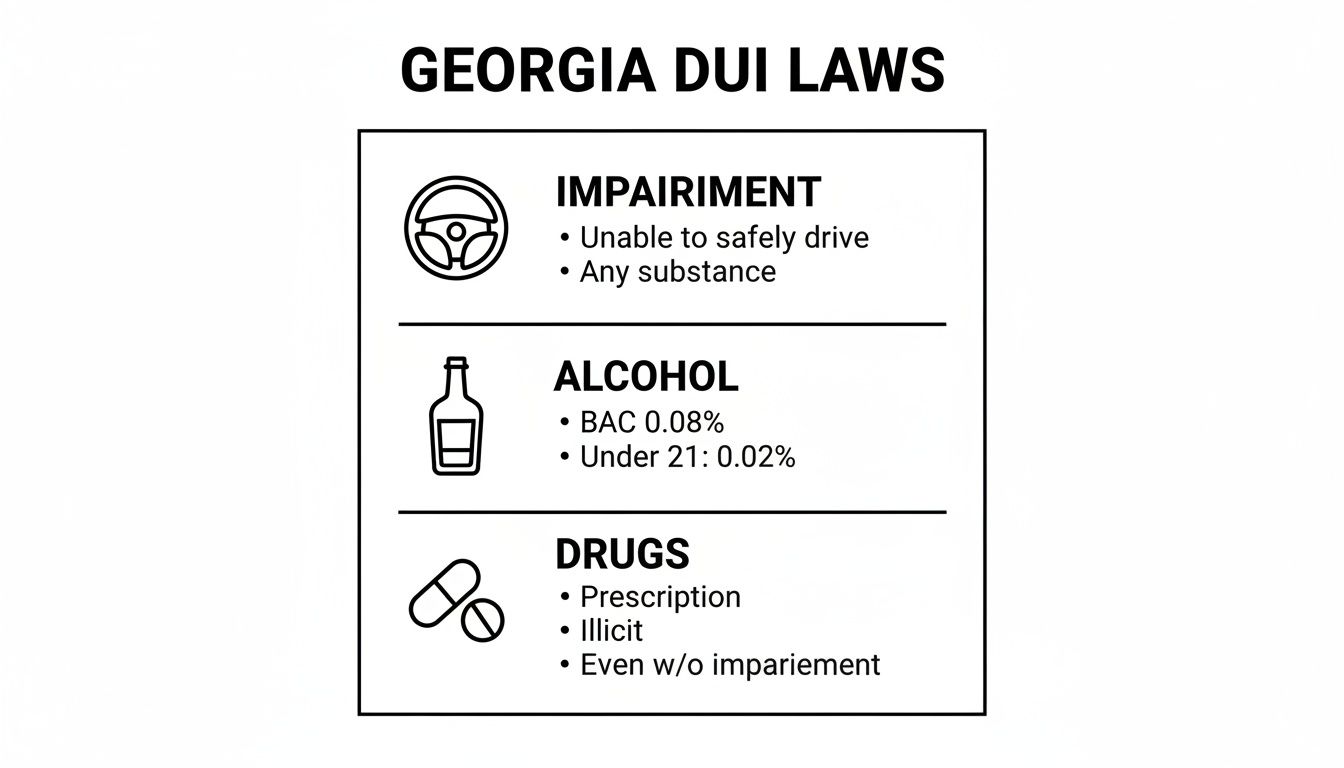
As you can see, the state has multiple ways to pursue a DUI charge. A specific BAC number isn't always required for the prosecution to move forward.
To make this even clearer, here's a quick table breaking down the terminology.
Quick Comparison of DUI vs DWI Terminology
| Aspect | DUI (Driving Under the Influence) | DWI (Driving While Intoxicated/Impaired) |
|---|---|---|
| Primary Meaning in GA | The sole term for driving while impaired by any substance. | Not used in Georgia's code but a common search term. |
| Substances Covered | Alcohol, illegal drugs, prescription drugs, OTC meds, any substance causing impairment. | In other states, often refers specifically to alcohol intoxication. |
| Basis in GA | Can be based on being "less safe" or having a "per se" illegal BAC. | Not applicable in Georgia, but elsewhere it may be tied strictly to BAC. |
This table shows why focusing on the specific Georgia definition of DUI is so important for understanding a case.
Thresholds and Evidence
Another key point of comparison is the standard of proof. Georgia has what’s known as a "per se" DUI law. All this means is that if a chemical test shows a Blood Alcohol Concentration (BAC) is 0.08% or higher (for drivers 21+), that person is, by law, considered impaired. It doesn't matter how perfectly they were driving.
But a BAC result is far from the only piece of evidence. This is where the "DUI Less Safe" charge becomes so important. For a "Less Safe" charge, the prosecutor doesn't need a BAC number at all. Instead, they build their case on other evidence and observations, such as:
- The officer's testimony about driving patterns (like swerving, speeding, or reacting too slowly).
- Physical appearance (slurred speech, red eyes, being unsteady).
- Performance on voluntary Field Sobriety Tests (FSTs).
- Any statements made about drinking or using other substances.
In states that use DWI, the evidence might look similar, but the different labels help distinguish the charges. For example, a DWI might be the "per se" charge based on a breathalyzer result, while a separate charge covers cases where impairment is suspected but there’s no chemical test. The comparison of DUI and DWI almost always comes back to these state-specific rules. To get a better handle on this common term, you can learn more about what a DWI is in our detailed guide.
Navigating the Process After a DUI Arrest
Getting arrested for a DUI in Georgia kicks off two very different, but simultaneous, processes. A person isn't just facing a criminal charge in court; they’re also involved in a separate administrative action regarding their driver's license. Knowing the steps and, more importantly, the deadlines for both is absolutely critical.

The moments after an arrest can be a blur of confusion and stress. But the actions taken in the next few days can make a difference in the case and determine whether driving privileges are kept. For folks in Forsyth County, Cobb County, and the surrounding cities like Marietta or Alpharetta, the process is standard, but without a guide, it can feel like navigating a maze blindfolded.
The Immediate Aftermath and the 30-Day Window
Right after an arrest for DUI, the officer must read Georgia's Implied Consent Notice. This is where they explain the requirement to take a chemical test—breath, blood, or urine. The answer to this one question dramatically impacts the driver's license.
If the test is refused or if the results show a 0.08% BAC or higher, the officer will likely confiscate the plastic license on the spot. They will hand over a DDS 1205 form, which acts as a temporary permit and the state's official notice that they plan to suspend the license.
There are only 30 calendar days from the date of arrest to file an appeal. This is, without a doubt, the single most important deadline to face. If it is missed, the license is automatically suspended.
This appeal is known as a request for an Administrative License Suspension (ALS) hearing. It’s a formal challenge to the state's attempt to take the license before there has been a day in court. Filing it is the key to preserving the right to drive while the criminal case is pending.
The Criminal Case Journey
While the license suspension issue is being dealt with, the criminal side of the DUI or DWI charge is just getting started. It moves through the court system in several distinct stages, each with its own purpose.
Here's what that journey typically looks like:
- Arraignment: This is the first official appearance in court. The prosecutor will formally state the charges, and a plea will be entered. At this early stage, that plea is almost always "not guilty" to keep all options open.
- Discovery and Investigation: After arraignment, the real work begins. This is where all the evidence is gathered—police reports, officer notes, dashcam and bodycam footage, and even the maintenance records for the breathalyzer machine.
- Pre-Trial Motions: This is a crucial phase where the state's case can be challenged. Motions might be filed questioning the legality of the traffic stop, how the field sobriety tests were conducted, or whether the chemical test results should even be allowed in court.
- Plea Negotiations: Throughout the process, communication with the prosecutor occurs to see if a favorable resolution can be reached without going to trial. Any potential plea offer is weighed carefully against the strength of the evidence.
- Trial: If a fair agreement can't be reached, the case goes to trial. It's then up to the prosecution to prove every element of their case beyond a reasonable doubt to a judge or a jury.
This path from arrest to resolution is full of procedural traps and strategic decisions. Understanding what to focus on right now is important. Every single step is an opportunity to defend one's rights.
Potential Penalties for a Georgia DUI Conviction
Let's be clear: a DUI conviction in Georgia is far more serious than a simple traffic ticket. The penalties are significant, and they're designed to get progressively tougher with each offense. If a DUI charge is being faced in places like Cumming, Milton, or Roswell, it's important to understand exactly what’s on the line.
The consequences go way beyond just fines and court dates. A conviction can seriously disrupt life, impacting freedom, finances, and the ability to drive. The state has a tiered system, which means a second or third conviction will hit much harder than the first.
First DUI Offense Consequences
Even though a first-time DUI is usually a misdemeanor, the penalties are nothing to scoff at. Georgia law sets mandatory minimums, giving judges very little room to be lenient. A first conviction will have consequences that stick with a person for years.
Here's what can typically be expected for a first DUI conviction:
- Jail Time: A mandatory minimum of 24 hours behind bars, but the sentence can go up to one year.
- Fines and Surcharges: The base fine is $300 to $1,000, but once court costs and various surcharges are added, that amount can easily double.
- License Suspension: The driver's license will be suspended for up to 12 months.
- Community Service: A minimum of 40 hours of community service is required.
- DUI School: A state-approved DUI Risk Reduction Program will have to be completed.
- Probation: A standard sentence includes 12 months of probation, where every single court order must be followed to the letter.
These are just the direct penalties from the court. The real-world fallout often goes much deeper. For a more detailed look, check out our guide on first offense DUI penalties.
Escalating Penalties for Second and Third Offenses
If another DUI is received within a ten-year period, the stakes get much higher, much faster. The state sees repeat offenses as a major public safety risk, and the penalties reflect that. For anyone in Forsyth or Cobb County, a second or third conviction is a whole different ballgame.
A second DUI conviction in Georgia within a ten-year "lookback" period is a high and aggravated misdemeanor, triggering mandatory jail time, lengthy license suspensions, and even the confiscation of license plates. This jump in severity shows how seriously the state treats repeat DUI or DWI offenses.
A second conviction usually means at least 72 hours in jail, fines up to $1,000, a three-year license suspension, and required substance abuse treatment. A third conviction within ten years is even worse. It's also a high and aggravated misdemeanor but comes with a minimum of 15 days in jail and a five-year license revocation, officially branding a person as a Habitual Violator.
Collateral Consequences Beyond the Courtroom
The official penalties are only part of the story. The "collateral consequences" of a DUI are the hidden costs that can follow long after the sentence is served and fines are paid. Many people don't think about these until it's too late.
Here are some of the most common long-term effects:
- Soaring Insurance Premiums: Car insurance rates will likely go through the roof. Some companies might even drop coverage completely. An SR-22A certificate will also be required, marking a driver as high-risk.
- Employment Issues: A DUI on a record can be a major red flag on background checks. This can make it tough to get hired for jobs involving driving, childcare, or government work.
- Professional Licensing: For nurses, pilots, teachers, or holders of other professional licenses, the licensing board could take disciplinary action, including suspending or even revoking the license.
- Permanent Criminal Record: In Georgia, a DUI conviction is permanent. It cannot be expunged, meaning it will follow a person for the rest of their life.
Common Defense Strategies in DUI Cases
Just because a person has been arrested for DUI doesn't mean they'll be convicted. The prosecution carries the heavy burden of proving every single element of their case beyond a reasonable doubt, and a skilled representative knows there are many places to challenge their evidence. For anyone facing a charge in places like Cumming, Johns Creek, or Milton, understanding the technical side of these cases is the first step toward building a strong defense.
Every DUI case starts with a traffic stop, and that’s the first place to look for weaknesses. An officer can’t just pull someone over on a whim or a hunch. They must have reasonable suspicion that a law has been broken, even if it's a minor traffic violation like speeding or weaving.
If that initial stop wasn't legally justified, any evidence collected after that moment—from field sobriety tests to breath or blood samples—could be thrown out. In legal terms, it's called suppression, and it can completely gut the prosecutor's case.

Questioning the Evidence from Sobriety Tests
After the stop, the officer will likely ask for performance of Standardized Field Sobriety Tests (SFSTs). These are the physical exercises designed to spot signs of impairment. It's crucial to remember that in Georgia, these tests are voluntary.
But even if they are performed, their results are far from foolproof. An experienced representative can question their validity based on several factors that can make an innocent person look impaired:
- Improper Instructions: Officers are trained to administer these tests according to strict, standardized protocols. If they deviate from the script in any way, the results become unreliable.
- Medical Conditions: A whole host of things can affect the ability to perform these coordination-based tests, including past injuries, medical issues, or even age and weight.
- Environmental Factors: Was the person asked to walk a straight line on a sloped shoulder? Was it dark, rainy, or windy? Poor conditions can absolutely impact performance.
These tests are highly subjective. They aren't concrete proof of anything—they're just an officer's observations, and those observations can be, and often are, wrong.
Scrutinizing Chemical Test Results
The prosecution’s "hard evidence" in a DUI case is usually a breathalyzer or blood test result. Those numbers might seem final, but the science and procedures behind them are anything but perfect.
A breathalyzer, for example, is a sensitive machine that needs constant maintenance and calibration to give an accurate reading. If the device used in a case has a spotty maintenance log or a history of errors, its results are immediately questionable.
The chain of custody for a blood or urine sample is another critical area to examine. This is the paper trail that documents every person who handled the sample from the moment of collection. Any gap or inconsistency in that chain casts serious doubt on whether the sample is even the original one or if it was contaminated.
The laws are strict for a reason. Impaired driving is a serious issue, with an estimated 1.25 million road deaths worldwide each year and roughly 273,000 of those involving a drunk driver. For people in Roswell, East Cobb, and across North Georgia, these sobering statistics (which you can learn more about on JMW.co.uk) explain the aggressive enforcement.
A solid defense is built by scrutinizing every detail, from the reason for the traffic stop to the final lab report. An arrest is just the beginning of the story, not the end.
Why Navigating a DUI Case May Require a Professional
When facing a DUI charge, the stakes are sky-high. The whole process is a minefield of technical rules and procedures that can trip up anyone. Winning a DUI case isn’t about making a simple argument in court; it’s about a painstaking analysis of every single detail and knowing exactly how the prosecution builds its case.
An experienced representative brings a critical eye to the table. They know how to dissect every piece of the puzzle, from the reason the officer pulled someone over in the first place to the calibration logs of the breathalyzer machine. This isn't just about knowing the law on paper. It's about having practical, in-the-trenches experience seeing how these cases are won—and lost. It means spotting the procedural mistakes that others might overlook, like an improperly conducted field sobriety test or a gap in the machine's maintenance records.
The Advantage of a Former Prosecutor's Insight
Here’s something most people don’t think about: having a former prosecutor on your side can be a game-changer. It provides a direct look into the state’s playbook—the strategies and tactics they use to get a conviction. This kind of insight allows a defense representative to see the prosecution's next move coming, spot the weak points in their case before they even present them, and build a defense specifically designed to dismantle their arguments.
Understanding how prosecutors think and prepare isn't just some theory—it's a practical skill that directly impacts the outcome of a case. This unique perspective means a more proactive and effective defense can be built from day one.
This experience translates into a smarter, more strategic defense. It’s knowing which motions will be most effective, how to properly cross-examine a police officer on the stand, and recognizing the right moment to negotiate for a lesser charge. It's about turning the prosecution's own methods against them.
Local Knowledge Is Key
On top of that, the value of local knowledge cannot be underestimated. The court systems in Cumming, Alpharetta, or Marietta each have their own rhythm. Every courthouse, every judge, and every prosecutor's office has its own unwritten rules and tendencies. A representative who has spent years in Forsyth and Cobb County courts understands these local nuances.
That kind of familiarity can be the difference-maker in protecting a person's rights and future. It’s this specific combination of a prosecutor's insight and deep local court experience that is absolutely essential for anyone facing the serious consequences of a DUI charge.
A Few Common Questions We Hear About DUI Charges
When facing a DUI, the mind is probably racing with questions. It's a confusing and stressful time, and the terminology and procedures don't make it any easier. This section aims to clear up a few of the most common things people ask about their charges here in Georgia.
Getting a handle on these basics is a good first step. It helps in understanding what is being faced so the next move can be figured out.
Is a DUI a Misdemeanor or a Felony in Georgia?
Most of the time, a first, second, or even third DUI within a ten-year window is charged as a misdemeanor in Georgia. But don't let that fool you—the penalties get significantly worse with each one, and later offenses are often treated as "high and aggravated misdemeanors" that come with mandatory jail time.
A DUI charge can absolutely jump to a felony level. This usually happens if:
- A fourth DUI conviction is received within ten years.
- Someone is seriously hurt or killed because of the incident.
- There is an attempt to flee from the police after they've pulled someone over for DUI.
Is it Required to Perform Field Sobriety Tests?
No, it is not required. In Georgia, performing any of the Standardized Field Sobriety Tests (SFSTs) is 100% voluntary. The officer has to ask for consent to do them, and a person has every right to politely say no. Keep in mind, this is very different from the state's Implied Consent law, which applies to chemical tests like a breathalyzer or blood draw after an arrest has been made.
While a person can refuse field sobriety tests without a direct penalty, refusing a state-administered chemical test after a lawful arrest automatically kicks off an administrative process to suspend the driver's license.
Can Someone Get a DUI for Their Prescription Medication?
Yes, it is possible. Georgia’s DUI laws are written broadly to cover impairment from any substance that makes a person a "less safe" driver. That includes legally prescribed medications for pain or anxiety, and even some over-the-counter drugs if they impact the ability to drive safely. The prosecutor's focus isn't on whether the drug is legal—it's on whether it impaired driving.
When dealing with the fallout of a DUI charge, it can be helpful to have someone in your corner who knows the system inside and out. At Brian Hansford Law, our experience as former prosecutors gives us a unique perspective on how to approach these cases. Visit us at https://challengemycharge.com to find out how we can help protect your rights and your future.
