
If you've been arrested for a DUI in Alpharetta, GA, the clock is already ticking. Finding a qualified attorney is an urgent first step because critical deadlines can affect your driver's license long before you ever see a judge for the criminal charge.
Right away, you're looking at a situation on two fronts: the criminal case and a separate, administrative action against your license.
What to Do Immediately After a DUI Arrest in Alpharetta
It’s easy to feel overwhelmed and confused after a DUI arrest. The most important thing is to push past the panic and get a plan together. There is a 30-day window to request an Administrative License Suspension (ALS) hearing with the Georgia Department of Driver Services (DDS), and this is a significant early priority.
This hearing is the only shot at preventing your driver's license from being automatically suspended.
Think of it this way: the ALS hearing is on a completely separate track from your criminal case. If that 30-day deadline is missed, the right to challenge the suspension is lost. It doesn't matter if your criminal charges are eventually reduced or dismissed—your license will be suspended anyway. It’s a detail many people miss in the chaos right after an arrest.
Understanding the Key Deadlines
From the moment an officer from the Alpharetta Police Department or another local agency arrests you, a strict timeline begins. That 30-day clock for your ALS hearing starts immediately, which is why waiting is not an option.
The Administrative License Suspension (ALS) process is a civil matter, totally separate from your criminal DUI case. The only thing it deals with is your driving privilege, based on whether you refused a breath test or had a result over the legal limit.
This timeline shows just how fast things move and why that 30-day hearing request is so critical.
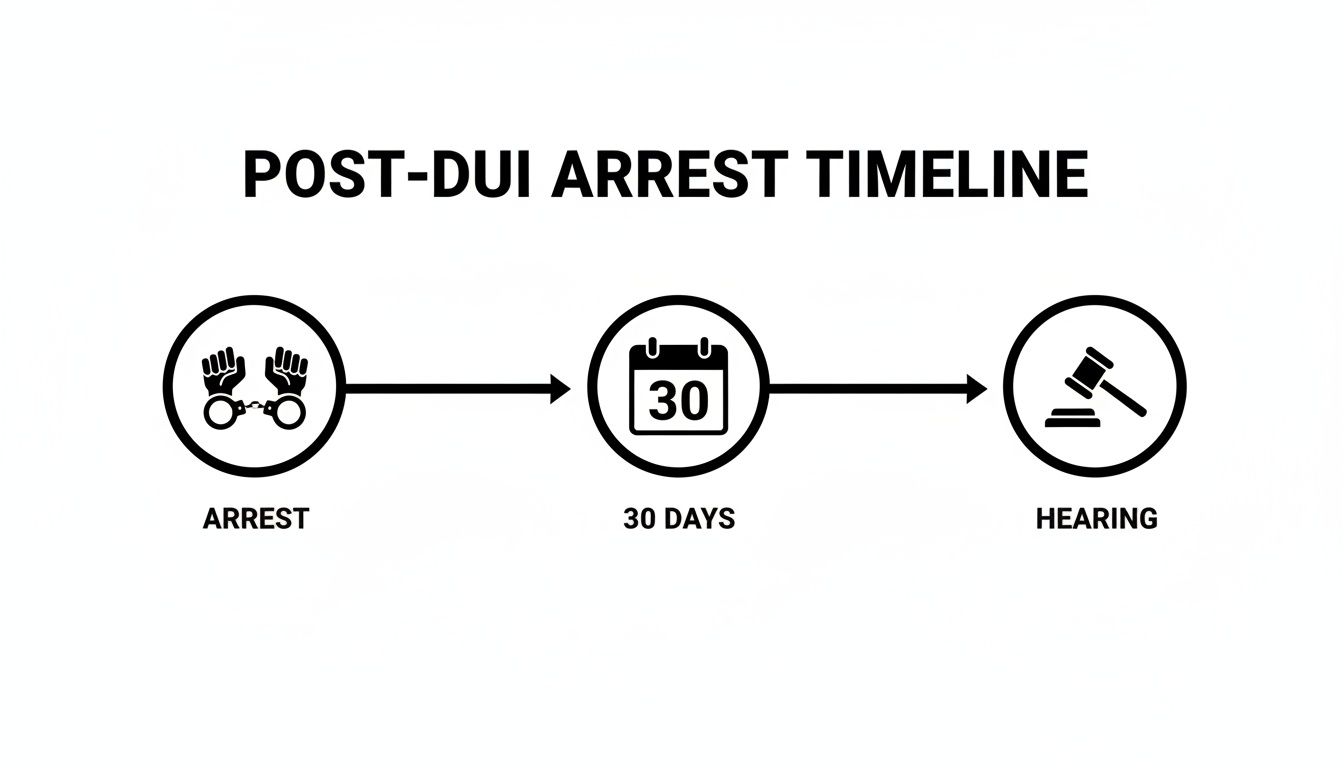
As you can see, the clock starts the second you're arrested. Your first and most pressing decision is what to do about that hearing.
Why Immediate Action Is Necessary
Acting quickly and making the right moves from the start can change the entire path of your case, both for the license suspension and the criminal charges. Getting a handle on things right away sets you up for a much better defense. For a more detailed guide, it helps to understand what to do after a DUI arrest. This initial phase is about much more than just the arrest itself—it's about protecting your rights and keeping your options open for everything that comes next.
Understanding Georgia DUI Laws and Potential Penalties
Getting arrested for a DUI in Alpharetta can feel overwhelming, and a big part of that is trying to figure out Georgia's specific laws. The state actually has a couple of different ways to charge someone with DUI, and knowing the difference is the first step in understanding what you're up against. It's not always just about a number on a breathalyzer.
The two main charges you'll hear about are DUI "Per Se" and DUI "Less Safe." Think of them as two different roads that both lead to the same destination: a DUI charge.
- DUI Per Se: This is the most straightforward of the two. It simply means your blood alcohol concentration (BAC) was 0.08% or higher. For drivers under 21, that number drops to 0.02%, and for commercial drivers, it's 0.04%. Here, the number itself is the key piece of evidence.
- DUI Less Safe: This is where things get more subjective. You can be charged with DUI Less Safe even if your BAC is below 0.08% or if you refused the state's chemical test altogether. The prosecutor builds their case on other evidence suggesting you were impaired—things like swerving, your performance on field sobriety tests, slurred speech, or even just your physical appearance.
Because of these two distinct charges, you can still face serious consequences even without a high BAC reading.
The Concept of Implied Consent
One of the most critical, and often confusing, parts of Georgia's DUI law is "implied consent." The easiest way to think about it is this: getting your Georgia driver's license is like signing a contract. Buried in the fine print of that contract is a clause stating that by accepting the privilege of driving on Georgia's roads, you automatically agree to take a chemical test (breath, blood, or urine) if a police officer lawfully arrests you for DUI.
If you refuse that test, you've broken the "contract." The immediate result isn't criminal, but it is severe. It triggers an automatic one-year "hard" suspension of your driver's license. That means no driving at all, with no option for a limited work permit. This suspension happens completely separate from your criminal DUI case and its outcome.
Penalties for DUI Convictions in Georgia
A DUI conviction in Georgia is far more than just a fine. The penalties are designed to be a serious deterrent, getting progressively harsher with each offense. They can impact your freedom, your finances, and your ability to drive for years to come.
A DUI charge is serious from the very first offense. The penalties are not just suggestions; they are mandated by state law and can have a lasting impact on your personal and professional life.
It's important to know what's at stake. Georgia prosecutes these cases aggressively, and the conviction rates reflect that. In a single recent year, Georgia recorded 19,495 DUI convictions. Of those, 17,011 were first offenses (87.3%) and 2,185 were second offenses (11.2%). You can find more details on Georgia's high DUI conviction rates. These aren't just statistics; they show how seriously the state takes these charges.
The penalties aren't a slap on the wrist. They're built on a tiered system that ramps up with every subsequent conviction. Having an Alpharetta DUI attorney who knows these statutes inside and out is crucial.
Georgia DUI Penalties at a Glance
To give you a clearer picture, here is a general overview of the potential consequences you could be facing for a DUI conviction.
| Offense Level | Potential Fines | Potential Jail Time | License Suspension Period |
|---|---|---|---|
| First Offense | $300 – $1,000 | 24 hours – 12 months | Up to 12 months |
| Second Offense | $600 – $1,000 | 72 hours – 12 months | Up to 3 years |
| Third Offense | $1,000 – $5,000 | 15 days – 12 months | 5-year revocation |
And that's not all. These penalties don't include other mandatory requirements like DUI school (officially called the DUI Alcohol or Drug Use Risk Reduction Program), a clinical evaluation for substance abuse, and a hefty number of community service hours. For a second offense within five years, the state will confiscate your vehicle's license plate. For a third, you could lose your vehicle for good.
The Critical DDS Hearing for Your Driver's License

After a DUI arrest in Alpharetta, most people think their only problem is the criminal court case. That's a huge mistake. You're actually looking at a situation on two fronts, and the second battle—with the Georgia Department of Driver Services (DDS)—starts immediately.
These two cases, the criminal and the administrative, run on separate but parallel tracks. And the DDS case moves much, much faster. This administrative action is officially called an Administrative License Suspension (ALS) hearing, and its only purpose is to take away your privilege to drive. It gets triggered automatically if you refuse a chemical test or if your results are over the legal limit.
The Unforgiving 30-Day Deadline
Here’s the single most important detail about this process: the deadline. From the moment you are arrested, you have exactly 30 calendar days to file an appeal and request a hearing. This isn’t a suggestion—it's a hard cutoff. Miss it, and you lose your chance to fight.
If that appeal is not filed within the 30-day window, your license will be automatically suspended. It doesn't matter what happens in your criminal case. Even if the DUI charge gets thrown out months later, failing to act on the DDS matter means your driving privileges are gone.
An ALS hearing isn't about whether you're guilty or innocent of DUI. It's much narrower. The only questions are whether the officer had reasonable grounds for the arrest and followed the correct procedure for the implied consent notice and the chemical test.
This is a key reason why many individuals call a DUI attorney in Alpharetta right away. A lawyer who handles these cases understands the urgency and knows precisely how to file the appeal correctly and on time, giving their client a fighting chance to keep their license.
What Happens at a DDS Hearing
The ALS hearing is a formal proceeding, but it's not as rigid as a criminal trial. An administrative law judge presides over it, and their only job is to review the specific facts of the license suspension. The arresting officer is subpoenaed and must testify about the traffic stop, what they saw, and how they handled the chemical test.
And this is where the hearing becomes an incredibly valuable tool for a bigger defense strategy.
- First Chance to Question the Officer: This is usually the first time an attorney can get the arresting officer on the record and under oath. Every word is recorded and can be used later in the criminal case.
- Gathering Evidence: A lawyer can dig into the details—the reason for the stop, how the field sobriety tests were conducted, and every step of the breathalyzer or blood test process.
- Identifying Weaknesses: When an officer has to testify, inconsistencies and procedural mistakes often come to light. These weaknesses can be used to negotiate a better outcome in criminal proceedings.
Think of the DDS hearing as a critical sneak peek at the state’s evidence against you. The information uncovered here can completely change the game plan for the criminal charge. To learn more about the mechanics of this, you can read about the Administrative License Suspension hearing in Georgia. Saving your license is the immediate goal, but the long-term strategic advantage it gives a criminal case is just as important.
How a Strong DUI Defense Strategy Works
Getting arrested for a DUI in Alpharetta is just the beginning of the process—it's certainly not the end of the story. Simply being charged doesn't automatically mean you'll be convicted. A solid defense comes from methodically examining every single detail of your case, from the moment you saw flashing lights in your rearview mirror to the final report filed at the station.
The whole process is built on a foundation of constitutional rights and very strict police procedures. If any step was mishandled, it can create a real opportunity to challenge the evidence against you. Think of it like a chain: if even one link is weak, the entire chain can fall apart.
Scrutinizing the Initial Traffic Stop
Every single DUI case starts with a traffic stop. But an officer can't just pull you over on a hunch or a gut feeling. They are required to have what's called "reasonable articulable suspicion" that a traffic violation or a crime has actually happened.
This means a defense begins by asking some pointed questions about that very first interaction.
- Why were you pulled over? Was it for a clear reason, like speeding, failing to stay in your lane, or a broken taillight? Or was the stop based on a vague or legally flimsy excuse?
- What was the officer's justification? The officer’s report must clearly state the specific facts that led them to pull you over. If that justification is weak or doesn't hold up under scrutiny, any evidence they gathered after that point could be suppressed.
Challenging the legality of the initial stop is a powerful defense strategy. If a judge rules the stop was unlawful, everything that happened afterward—including the field sobriety tests and the breathalyzer results—can be thrown right out of court.
Questioning Field Sobriety and Chemical Tests
After pulling you over, an officer will likely ask you to perform Standardized Field Sobriety Tests (SFSTs). These aren't simple pass/fail exercises. They are technical procedures that have to be administered and graded exactly according to specific national guidelines.
Plenty of factors can throw off someone's performance on these tests that have absolutely nothing to do with being impaired. Medical conditions, physical limitations, nerves, or even bad weather and poor road conditions can seriously affect your balance and coordination. An experienced DUI attorney in Alpharetta knows how to dig into these factors and use them to build your defense.
Likewise, chemical tests like the breathalyzer are far from foolproof.
A breathalyzer machine is a piece of equipment that requires regular maintenance, calibration, and proper operation. Any failure to follow strict protocols can render the results unreliable and inadmissible in court.
For example, certain medical conditions like acid reflux or GERD can contaminate a breath sample and create an artificially high reading. The machine’s maintenance logs and the officer’s own training records are all fair game for review. If a breathalyzer wasn't calibrated correctly or the officer wasn't properly certified to operate it, those results can be challenged.
This kind of careful, procedural-based defense has made a huge difference over time. In fact, Georgia's DUI convictions have plummeted dramatically, dropping 56% from 44,017 in 2008 to just 19,208 in 2019. This trend reflects a greater focus on holding police to proper procedure, more plea reductions to lesser charges, and the hard work of diligent defense attorneys. You can see more data on Georgia DUI statistics and trends. This shift shows that holding the process to a high standard produces real results.
Building a Comprehensive Defense Narrative
A winning defense isn't just about poking holes in the prosecution's case. It's about building a compelling narrative that tells your side of the story. This means gathering evidence, interviewing witnesses, and reviewing every single piece of documentation.
For instance, were there passengers in your car who can testify that you seemed perfectly fine? Do you have receipts from a restaurant showing you only had one drink over a few hours? Does the police car's dashcam footage actually contradict what the officer wrote in their report?
Each piece of information helps construct a defense tailored specifically to the facts of your situation. The goal is to make sure your rights were protected at every turn and to present the strongest possible argument on your behalf. Finding a DUI attorney Alpharetta GA who is skilled in this deep-dive investigative process is absolutely essential to protecting your future.
How to Choose the Right DUI Attorney in Alpharetta

Picking the right lawyer after a DUI arrest is a high-stakes decision, and frankly, it can be overwhelming. With so many attorneys out there, how do you know who really has the chops for your specific case? The secret is to go in with a sharp set of criteria and questions that cut through the sales pitch and reveal an attorney's actual experience.
Think of it this way: you wouldn't let a general family doctor perform open-heart surgery. You'd want a specialist who has dedicated their entire career to that single, complex procedure. It's the same thing here. You'll want to find a DUI attorney in Alpharetta who lives and breathes this area of law every single day, not a lawyer who just dabbles in DUI cases on the side.
Questions That Reveal True Experience
When you sit down for a consultation, your job is to get past the generic promises. You can dig into the real-world details of how they practice law. The answers you get will paint a very clear picture of their abilities and whether they're the right fit.
- What percentage of your practice is dedicated to DUI cases? An attorney who spends the majority of their time—ideally over 50%—on DUI defense will have a much deeper well of knowledge about the science, the police procedures, and the winning strategies.
- How familiar are you with the Alpharetta Municipal and Fulton County courts? This is huge. Local knowledge is a massive advantage. An attorney who is in these specific courts all the time knows the prosecutors, the judges, and even the clerks, which can be invaluable.
- What is your general approach to handling the DDS hearing? A sharp attorney sees the DDS hearing as more than just a fight for your license. It's a strategic opportunity to get the arresting officer on the record, under oath, and gather critical evidence for your criminal case.
These questions help you quickly filter out attorneys who don’t have the specialized focus you need. For a more exhaustive checklist, our guide on questions to ask a criminal defense attorney offers additional key insights.
Why Local Knowledge Matters So Much
The importance of hiring an attorney who is deeply familiar with the Alpharetta and Fulton County legal landscape cannot be overstated. Every courthouse has its own unwritten rules, personalities, and tendencies. An attorney who knows these local dynamics has a home-field advantage.
This familiarity means they know the local prosecutors and how they typically approach DUI cases. Do they often negotiate down to a reckless driving charge? Are certain prosecutors more open to arguments about procedural mistakes? That's insider knowledge you can only get from being in those courtrooms, day in and day out.
Choosing an attorney is about more than just credentials; it's about finding a strategic partner. An experienced local DUI lawyer understands the nuances of the local courts and can anticipate challenges and opportunities that a non-local attorney might miss.
Evaluating Your Options and Finding the Right Fit
At the end of the day, your decision should come down to two things: expertise and trust. You need to feel confident that your attorney not only has the skill to win but also communicates clearly and genuinely has your best interests at heart. A good lawyer will explain the process in plain English and set realistic expectations from the very first meeting.
Look for a professional who is open about their strategy and who takes the time to answer every single one of your questions without rushing. The right DUI attorney Alpharetta GA will be your guide through this mess, helping you make informed decisions at every turn. Your future is on the line, and you can't afford to settle for anything less than focused, experienced, and local representation.
Common Questions We Hear About DUI Cases in Alpharetta
Getting charged with a DUI in Alpharetta kicks off a wave of uncertainty and a flood of urgent questions. While every case has its own unique facts, some concerns come up time and time again. Getting clear, straightforward information is the very first step toward understanding the road ahead.
This section is designed to explain some of the most common questions individuals have. The goal here is to cut through the jargon and give you a better grasp of what you might be facing.
Should I Refuse a Breathalyzer Test in Georgia?
This is a tough one, and it’s a complicated choice with immediate consequences. Under Georgia's "implied consent" law, simply by driving on a Georgia road, you've already legally agreed to take a chemical test if you're lawfully arrested for DUI. It’s a shock to most people, but that’s the law.
Refusing the official state-administered test automatically triggers a one-year "hard" license suspension. That means no driving at all, with zero option for a limited or work permit. On the flip side, a refusal means the prosecutor has less scientific evidence—the hard number—to use against you in court.
It's a significant trade-off: you're accepting a guaranteed administrative penalty for your license in exchange for a potential advantage in your criminal case. The right choice really depends on your personal situation, like your driving history and the specific details of the traffic stop.
What Is the Difference Between DUI and Reckless Driving?
DUI and reckless driving are two completely separate charges in Georgia, each with its own definition and penalties. A DUI charge is very specific: it’s all about operating a vehicle while impaired by alcohol or drugs.
Reckless driving, in contrast, is defined more broadly as driving with a "reckless disregard for the safety of persons or property." A DUI conviction comes with mandatory penalties like license suspension and DUI school, but a reckless driving charge doesn't have those same automatic consequences built in.
In some DUI cases, a skilled DUI attorney in Alpharetta GA can negotiate with the prosecutor to get the charge reduced to reckless driving. This is almost always considered a fantastic outcome because it helps you avoid the automatic license suspension and the lasting social stigma that a DUI conviction leaves on your record.
How Long Does an Alpharetta DUI Case Usually Take?
There's just no one-size-fits-all answer here; the timeline for a DUI case in Alpharetta can vary widely. How long the process takes is influenced by several key factors that make every case's duration a bit different.
The main things that affect the timeline are:
- The Court's Schedule: Cases in the Alpharetta Municipal Court might move at a different pace than those that get sent up to the Fulton County State Court.
- The Complexity of the Case: A case with a lot going on, like a blood test or a car accident, will naturally take longer to work through.
- The Chosen Defense Strategy: The path chosen for a defense plays a huge role in how long everything takes.
If a case is resolved through a plea agreement, it might be over in a few months. But if the strategy involves filing motions to challenge evidence or if the case goes to trial, it could easily take six months to a year, or sometimes even longer. Once an attorney has had a chance to thoroughly review all the evidence in a specific situation, they can give you a much more accurate timeline.
Can a First-Time DUI Charge Be Dismissed?
It's a high bar to clear, but getting a DUI charge completely dismissed is absolutely possible under the right circumstances. A dismissal almost always hinges on finding significant procedural flaws in the prosecution's case. The very foundation of the state's case must be shaken for that to happen.
For instance, a judge might agree to throw out crucial evidence if a defense attorney can prove one of these things happened:
- The initial traffic stop lacked reasonable suspicion.
- The field sobriety tests were administered incorrectly, violating the strict protocols.
- The breathalyzer evidence is unreliable because the machine wasn't calibrated properly or the officer made a mistake.
If key evidence gets suppressed, the prosecutor can be left with a case that’s too weak to prove beyond a reasonable doubt. At that point, they may have no choice but to either dismiss the charges or offer a major reduction to a lesser offense. The chance for a dismissal lives or dies based on a meticulous investigation and a strong, well-executed defense strategy.
When you're facing the complexities of the legal system in Alpharetta, Cumming, or anywhere in Forsyth County, having an experienced lawyer in your corner is non-negotiable. At Brian Hansford Law, we are dedicated to protecting your rights and fighting for the best possible outcome in your case. If you need help, visit us at https://challengemycharge.com to learn more.
