
When you get your DUI blood test results back, the document can be a little overwhelming. It's usually packed with technical jargon and numbers that don't make much sense at first glance.
But at the heart of it all is one key number: your Blood Alcohol Concentration, or BAC. This is a direct measurement of the alcohol in your bloodstream when the test was taken, and it’s a key piece of evidence that can form the foundation of the prosecution's case.
What Your DUI Blood test Results Really Mean
Think of BAC like a specific measurement in a recipe—it’s a precise ratio of alcohol to blood. Here in Georgia, that ratio is shown in grams of alcohol per deciliter of blood (g/dL). Getting a handle on what this number means is the first step in figuring out your situation.
And make no mistake, this number is taken very seriously. In 2023 alone, the U.S. saw a staggering 12,429 deaths in crashes involving drunk drivers with a BAC of 0.08 g/dL or higher. That’s nearly a third of all traffic fatalities for the year. Numbers like these are exactly why the limits are enforced so strictly. You can find more national data on this from the NHTSA's traffic safety statistics.
Understanding Georgia's BAC Thresholds
For most drivers in Georgia age 21 and over, the key number is 0.08 g/dL. If a result is at or above that level, it’s what's called a "Per Se" DUI. This means the number itself is considered sufficient evidence to show a person was driving under the influence, whether they felt impaired or not.
But for certain drivers, the rules are even tighter:
- Commercial Drivers: Anyone operating a commercial vehicle has a much lower limit of 0.04 g/dL.
- Drivers Under 21: Georgia has a zero-tolerance policy for underage drivers, setting the legal limit at just 0.02 g/dL.
It’s also crucial to know that a BAC below 0.08 g/dL doesn’t automatically resolve the matter. A person can still be charged with a "DUI-Less Safe" if a prosecutor can convince a jury that alcohol made them a less safe driver, even with a lower BAC. These kinds of charges are seen in jurisdictions from Alpharetta to Forsyth County.
Georgia BAC Levels And Their Legal Status
To make it simple, here’s a quick breakdown of the different BAC levels and what they mean legally for various drivers in Georgia.
| Driver Type | Legal BAC Limit (g/dL) | Consequence Level |
|---|---|---|
| Drivers Age 21+ | 0.08 or higher | Per Se DUI |
| Commercial Drivers | 0.04 or higher | Per Se DUI |
| Drivers Under 21 | 0.02 or higher | Per Se DUI (Zero Tolerance) |
| Any Driver | Below 0.08 | Can still be charged with DUI-Less Safe if impairment is proven |
This table shows just how specific the law is when it comes to BAC levels. Depending on age and license type, the legal limit can change dramatically.
The BAC number from your blood test isn't just a piece of data; it's the primary scientific evidence the prosecution can build their entire case on. Because it carries so much weight, a huge part of a strong defense involves digging into how that number was obtained and where errors could have occurred. This single result often dictates the entire direction of a case in local courts throughout Roswell, Marietta, and Cobb County.
The Journey of Your Blood Sample: From Roadside to the Lab
When an officer suspects a DUI in Georgia, the process of getting and testing a blood sample is a whole lot more involved than just a quick needle poke. It's a precise journey, governed by strict legal and scientific rules. Every single step is designed to be accurate and fair, and understanding this path is crucial to making sense of DUI blood test results.
The whole process kicks off with a legal concept called implied consent. The moment a person gets behind the wheel on a Georgia road—whether in Cumming, Marietta, or anywhere in between—they’ve automatically agreed to a chemical test if an officer lawfully arrests them for DUI. This isn't a piece of paper that's signed; it’s just part of having a driver's license.
The Initial Blood Draw
Once an officer reads the implied consent notice, the blood draw itself has to follow a very specific procedure. Only qualified medical staff, like a phlebotomist, nurse, or doctor, can collect the sample. This is to make sure the draw is done safely and by someone who knows what they're doing.
One of the most critical details is how the arm is cleaned. The technician must use a non-alcoholic swab, like Betadine. If they use a standard alcohol wipe, it can contaminate the sample and artificially spike the BAC reading, potentially creating a false positive. It seems like a small thing, but it's a huge safeguard against bad results.
This flow chart gives you a bird's-eye view of how the sample collection leads to a legal outcome.
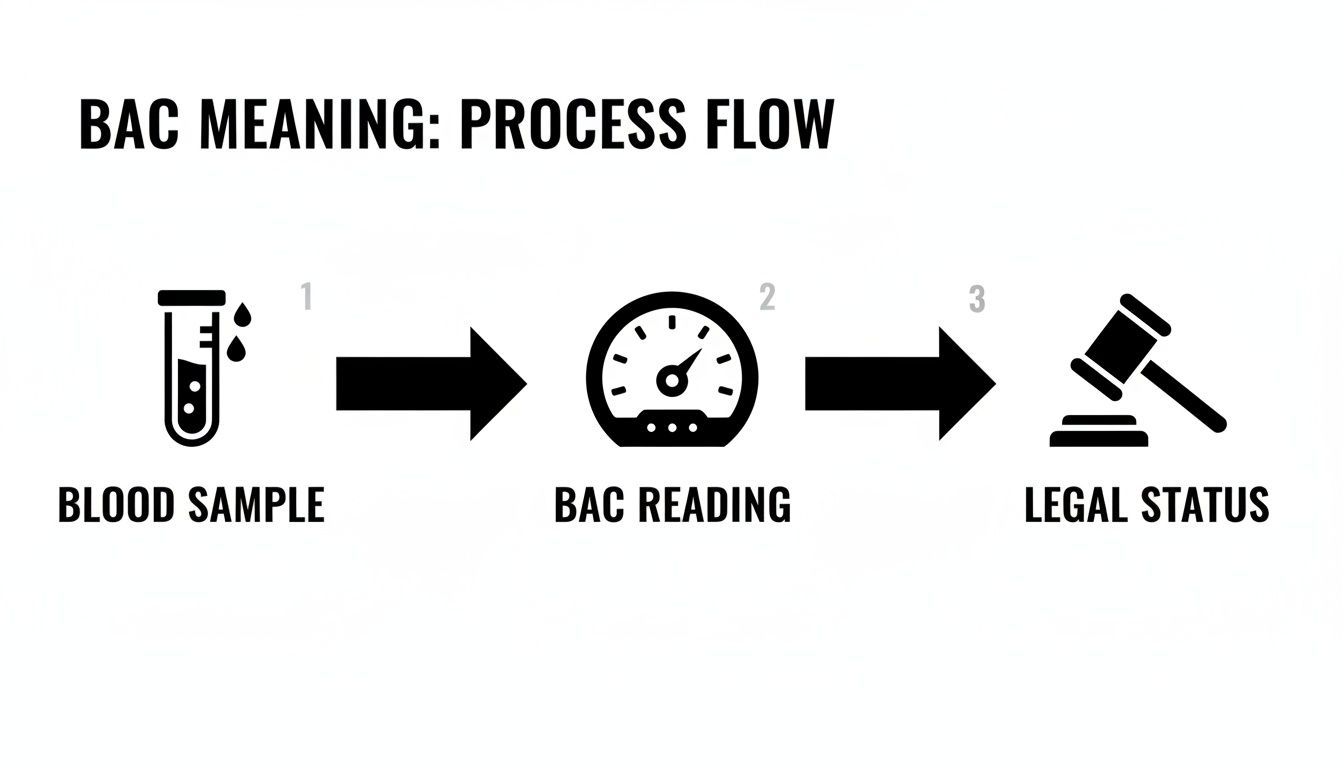
As you can see, the physical blood sample is ultimately converted into a number—the BAC—which then becomes the primary piece of evidence that determines the legal situation.
Keeping the Chain of Custody Intact
After the draw, the blood goes into a special vial that contains preservatives and anticoagulants. These chemicals are vital. One stops the blood from clotting up, and the other prevents fermentation. Fermentation is a natural process where bacteria can actually produce more alcohol right inside the vial, which would obviously throw the results way off.
From there, the vial begins its trip to a Georgia Bureau of Investigation (GBI) crime lab. This is where the chain of custody becomes absolutely essential. Think of it like a tracking number for a critical package that logs every handoff.
The chain of custody is a formal record that documents every single person who handles the blood sample—from the phlebotomist who draws it to the lab tech who tests it. To be valid in court, this chain must be unbroken and perfectly documented to prove the sample analyzed in the lab is the exact same one taken from the individual, with no tampering or mix-ups.
Any gap, smudge, or inconsistency in that log—a missing signature, an unexplained time gap, or proof of improper storage—can put the integrity of the entire test in doubt. It’s one of the first things a defense attorney will scrutinize in cases across Forsyth and Cobb Counties.
How the Lab Analyzes the Sample with Gas Chromatography
At the GBI lab, scientists use a highly sophisticated machine and a process called gas chromatography to figure out the BAC. This method is the gold standard for measuring alcohol concentration because of how precise it is. In simple terms, the machine separates the alcohol from everything else in the blood.
The machine works by heating the blood sample, which turns the alcohol into a gas. This gas is then pushed through a very long, thin tube. Because different substances move at different speeds, the alcohol separates from other compounds and is measured by a detector at the other end. The machine then spits out a report with the final BAC number.
But even with all this advanced science, the process isn't infallible. The machine has to be calibrated perfectly and maintained regularly. The lab technician running it has to follow strict protocols to the letter. A small human error or a machine that's slightly off-kilter can lead to a completely wrong result, proving that even the most advanced science has its weak spots.
How Blood Test Evidence Can Be Challenged

When a person sees a high BAC number on a lab report, it’s easy to feel like the case is over. But that number is often just the beginning of the story, not the end. While scientific evidence feels final, the process of getting DUI blood test results is full of human steps.
Every single stage, from the traffic stop in Roswell to the analysis at a GBI lab, is an opportunity for a mistake. And a mistake can make the results completely unreliable.
Challenging the evidence isn't about ignoring the facts; it's about making sure they are actually facts. A strong defense often involves digging into three critical areas: mistakes made when the blood was taken, errors at the lab, and even an individual's unique body chemistry. Finding a problem in any one of these can cast serious doubt on that final number.
Procedural Missteps and Human Error
The path a blood sample takes is supposed to follow a very strict set of rules. Any deviation can compromise the entire case. Human error is incredibly common, and it often starts the moment the needle goes in.
A flawed blood draw is one of the most frequent issues. Was the phlebotomist properly certified? Did they use an alcohol swab to clean the arm? They are required to use a non-alcoholic agent like Betadine. Using an alcohol swab can contaminate the sample right away, creating a falsely high BAC.
Then there’s the chain of custody. This is the paper trail that documents every single person who handled the blood sample, from collection to testing. A perfect, unbroken chain is non-negotiable.
- Missing Signatures: Every person who touches the sample has to sign and date the log. No exceptions.
- Unexplained Gaps: If there are long delays or periods where no one knows where the sample was, it raises questions about tampering or improper storage.
- Improper Labeling: Think about a busy lab processing hundreds of samples. A simple mix-up with a label could mean someone is facing charges based on another person’s blood.
If that chain of custody is broken, it's almost impossible for the prosecution to prove that the sample tested was the correct one and that it wasn't contaminated. These issues are often the foundation for a defense and can be powerful reasons to file a motion to suppress the evidence. You can learn more about how a motion to suppress evidence works in our detailed guide.
Lab Equipment and Sample Integrity Problems
Once a sample finally makes it to the lab, a whole new set of potential problems can pop up. The high-tech equipment they use, like a gas chromatograph, needs to be perfectly calibrated and maintained. If it's not, the results are junk. Maintenance and calibration logs can be requested to see if the machine was working correctly when a sample was tested.
The integrity of the blood sample itself is another huge factor. The vials used to hold blood aren't just empty tubes; they contain specific chemicals—an anticoagulant to stop clotting and a preservative to prevent fermentation.
If the vial is expired, doesn’t have the right amount of preservative, or isn't mixed correctly right after the draw, the blood can actually start to ferment. This process creates its own alcohol, meaning the lab result could show a BAC much higher than what it was when the person was driving.
Lab contamination is another real concern. If technicians don't clean equipment properly between tests or are simply careless, a sample could be tainted by another one, leading to a completely inaccurate reading.
Physiological Factors and Rising BAC
Finally, an individual's own body can play a role in the outcome. One of the most important concepts here is "rising BAC." When a drink is consumed, the alcohol isn't absorbed instantly. It can take anywhere from 30 minutes to a few hours for it to fully enter the bloodstream after drinking has stopped.
This is critical. It means a person's BAC could have been under the legal limit while they were driving, but it continued to climb, only peaking an hour or two later when their blood was finally drawn at the hospital or police station. The test result might be accurate for the moment the blood was drawn, but it doesn't reflect the BAC when they were behind the wheel.
Certain health conditions and even what was eaten can sometimes affect the results. While less common, these possibilities show why it's so important to look beyond just the number on the page.
It’s also worth noting that even a BAC below the 0.08 limit isn't automatically safe. Research shows that a BAC between 0.05 and 0.079 g/dL dramatically increases the odds of being in a fatal accident. This is why some safety groups have pushed for a stricter 0.05 limit nationwide, estimating it could reduce fatal alcohol-related crashes by 11%. This data shows why prosecutors and judges scrutinize every point on that BAC report, as even lower levels can carry serious weight.
Connecting BAC Levels to Physical Impairment

That number on a DUI blood test results report is far more than just data for the court file. Blood Alcohol Concentration (BAC) is the prosecution's scientific estimate of how much alcohol was coursing through a person's system, and it's directly tied to predictable levels of physical and mental impairment.
When you understand what these numbers actually mean in the real world, it becomes clear why the state pursues these charges so aggressively—even when the BAC seems low. A BAC isn't just an abstract legal figure; it's a window into how alcohol systematically shuts down the brain and body.
As that number climbs, critical driving skills like coordination, judgment, and reaction time predictably degrade. Think of it like a dimmer switch—the higher the BAC, the more a person's natural abilities are turned down. This is the core logic behind the charges that can follow a traffic stop in Alpharetta, Cumming, or anywhere in Forsyth County.
The Spectrum of Impairment from Low to High BAC
Even a small amount of alcohol can have a very real impact. The legal limit is a hard line in the sand, but the truth is that impairment begins well before it is crossed. Georgia law recognizes this fact, which is why it's so important to understand the full spectrum.
Here’s a practical breakdown of what different BAC levels typically mean for an average person:
-
BAC of 0.05%: At this level, a person might feel a little relaxed or less inhibited. But behind the scenes, judgment is already slightly clouded, coordination is off, and the ability to track moving objects starts to falter. Alertness is also reduced, making it harder to react to a sudden hazard on the road.
-
BAC of 0.08%: This is the key number—the legal limit for a Per Se DUI in Georgia. At this point, muscle coordination is noticeably poor, affecting everything from balance and speech to vision. It's much harder to spot danger, and judgment, self-control, and reasoning are all significantly impaired. This is why the law considers a person at this level intoxicated.
-
BAC of 0.15%: At nearly double the legal limit, the effects are severe. This means a major loss of balance and muscle control. Judgment and memory are seriously compromised, and the risk of blacking out becomes very real. Getting behind the wheel with a BAC this high is extremely dangerous and brings enhanced penalties in Georgia.
Georgia's Stance on High BAC and "Less Safe" DUIs
The state of Georgia comes down especially hard on high BAC results. A BAC of 0.15% or higher isn't just another DUI; it's an aggravating factor that automatically triggers harsher penalties upon conviction. This can mean higher fines, more community service, and a much bigger mark on a person's record.
The reasoning is straightforward: the higher the BAC, the greater the demonstrated risk to public safety. A 0.15% BAC shows a level of intoxication that goes far beyond a simple misjudgment, and the potential consequences reflect that severity.
It’s also critical to understand the concept of a "DUI-Less Safe" charge. This is a type of DUI that doesn't rely on a specific number at all. The prosecutor can argue a person was a "less safe" driver because of alcohol, even if their BAC was under the 0.08% limit. They'll use evidence like swerving, a poor performance on field sobriety tests, or an admission of drinking to build their case.
This "Less Safe" charge proves that any level of impairment can lead to legal trouble. Cases across Georgia frequently hinge on blood test results, a fact highlighted by sobering national statistics. In 2023, 40% of drunk driving accidents involved drivers over the 0.08% limit, contributing to over 12,000 deaths. But with BACs known for only 58% of drivers in fatal crashes in recent years, testing is far from consistent. You can learn more about these figures by reading these drunk driving accident statistics.
What Happens After You Get Your Test Results
Getting DUI blood test results back is the moment a case really gets moving. From here, the legal process splits into two separate tracks that run at the same time. One is the administrative fight over a driver's license, and the other is the criminal case for the DUI charge itself.
Knowing what’s coming down the pipe can make a world of difference. The lab results kickstart everything, and it's crucial to understand how things work in local courts, whether in Forsyth County or Cobb County. Both tracks have their own timelines and rules, and that BAC number is at the center of it all.
The Administrative License Suspension Hearing
First things first, and this is time-sensitive: the Administrative License Suspension (ALS) hearing. This is a civil matter, totally separate from the criminal DUI case, that deals only with the privilege to drive in Georgia. People often call this the "30-day rule" because there is a very narrow window to take action.
If a blood test comes back at 0.08 g/dL or higher, the Georgia Department of Driver Services (DDS) will automatically move to suspend the license. There are just 30 calendar days from the day of the arrest to request an ALS hearing to fight that suspension. If this deadline is missed, the license will be suspended, usually for a full year with no option for a limited permit.
The ALS hearing is the first real battleground in a DUI case. It's a key opportunity to challenge the traffic stop and how the blood draw was handled, long before the criminal case gets going.
Navigating the Criminal Court System
While the license suspension issue is being sorted out, the criminal case moves along its own path. The process in courts around Marietta, Roswell, and Johns Creek generally follows a few key stages, with the blood test results serving as the prosecutor's main piece of evidence.
Here's what that journey usually looks like:
- Arraignment: This is the first official appearance in court. The charges are read, and a plea is entered—usually guilty, not guilty, or no contest.
- Discovery and Motions: After arraignment, a defense team can file for "discovery." This is a chance to demand all the evidence the prosecutor has, including the full lab report, the officer's notes, and even the maintenance logs for the testing equipment. This is where problems with the blood test can be uncovered and motions filed to get that evidence thrown out.
- Pre-Trial Hearings and Negotiations: Many cases get resolved here. Depending on how strong the evidence is (and how successful challenges to the blood test are), negotiations can take place with the prosecutor for a plea to a lesser charge or a more favorable sentence.
- Trial: If a deal can't be reached, the case goes to trial. A judge or jury will hear all the evidence, listen to testimony from the arresting officer and the lab tech who tested the blood, and then make a final decision.
It's important to remember that the blood test is just one piece of the puzzle. If the test had been refused, for example, the state's strategy would be completely different. They would lean on Georgia's implied consent laws to argue the refusal is evidence of guilt. You can learn more about what happens if you refuse a chemical test in our guide to Georgia's implied consent law. The road ahead is complex, but understanding these steps is the first key to navigating it.
Frequently Asked Questions About Georgia DUI Blood Tests
When facing a DUI charge, the scientific evidence can feel overwhelming. People in Alpharetta, Cumming, and across Cobb County often have a lot of questions about their DUI blood test results, so let's walk through some of the most common ones.
How Long Does It Take To Get DUI Blood Test Results In Georgia?
Waiting for results from the Georgia Bureau of Investigation (GBI) Crime Lab is often a test of patience. There's no fixed timeline; it can take anywhere from a few weeks to several months.
This delay usually comes down to the GBI lab's current caseload, staffing levels, and the specifics of the case. It's pretty standard for the criminal case to move slowly while everyone waits for the official results. The prosecution typically won't make a big move until they have that key piece of evidence in hand.
Can I Refuse A DUI Blood Test In Georgia?
Yes, a person has the right to refuse a blood test in Georgia. But that decision has immediate and serious consequences under the state’s "implied consent" law.
The moment a person gets a Georgia driver's license, they have legally agreed to submit to chemical testing if lawfully arrested for DUI. Refusing the state's test means an automatic one-year suspension of the license. The critical part is that during this suspension, a person is not eligible for a limited driving permit. On top of that, the refusal can be used against them in court, where the prosecutor will likely argue it shows they knew they were guilty.
Are Blood Tests More Accurate Than Breathalyzer Tests?
On paper, yes. Blood tests are generally considered the more scientifically accurate way to measure Blood Alcohol Concentration (BAC). A blood test directly analyzes the alcohol content in the blood, while a breathalyzer just estimates it based on the alcohol vapor on a person's breath.
But here's the catch: that superior accuracy only exists if every single step of the process is followed perfectly. A blood test is far more invasive and has many more opportunities for things to go wrong.
The accuracy of a DUI blood test result is not a given. It's the end product of a long chain of human actions, and any single misstep can introduce doubt. A sample can be contaminated, stored improperly causing it to ferment, or compromised by a break in the chain of custody. So, while a properly handled blood test is precise, it's also incredibly vulnerable.
What If My Blood Test Results Are Over The Legal Limit?
Seeing a number over the 0.08 g/dL legal limit is serious, no question about it. But it is absolutely not the end of the story. That number is just one piece of evidence, and it deserves to be challenged from every angle.
As we've covered, a whole host of issues can wreck the reliability of that result. Problems with how the blood was drawn, how the sample was handled and stored, the calibration of the lab equipment, or even an individual's medical conditions can create legitimate doubt about the number. A high BAC reading is just the starting point for a deep dive into every detail of the case, from the initial traffic stop all the way to the lab's final report. To learn more about possible defense strategies, you can read our guide on how to beat DUI charges in Georgia.
This kind of thorough review is essential. It's how a complete picture of what happened can be built to ensure the evidence is both fair and accurate.
Making sense of DUI blood test results is a crucial first step, but it's only the beginning. At Brian Hansford Law, a strong defense is built by scrutinizing every piece of evidence. If you're facing charges in Cumming, Johns Creek, Milton, Alpharetta, Roswell, Marietta, or anywhere across Forsyth and Cobb Counties, we have the experience to guide you.
Navigating this system requires a real understanding of both the science and the law. For a detailed review of your situation, contact us today through our website at https://challengemycharge.com.
