
Only three U.S. states use DUI license plates for convicted offenders: Georgia, Minnesota, and Ohio. Georgia does allow DUI-related plates in some cases, but they are not the bright public “scarlet letter” plates many people fear. They are a more subtle coded system that can still create serious problems.
If you were arrested for DUI in Alpharetta, Cumming, Roswell, Johns Creek, Milton, Marietta, Duluth, or anywhere in North Atlanta, this issue can feel bigger than the criminal charge itself. People hear “whiskey plates” and immediately think of a car marked for everyone to see. They worry about neighbors, employers, school pickup lines, and being stopped every time they drive through Fulton County, Forsyth County, Cobb County, Cherokee County, or Gwinnett County.
That fear is understandable. It’s also often based on the wrong picture of how Georgia handles these cases.
The actual problem in Georgia usually isn’t public humiliation in the obvious Ohio sense. It’s the hidden consequence of a coded plate that can still draw law enforcement attention and add pressure to an already difficult DUI case. For someone trying to protect a job, avoid license suspension, or keep a first mistake from turning into a long-term record problem, that distinction matters.
A DUI lawyer in Alpharetta or a DUI attorney in Cumming should be looking at this issue early, not after the plea is done. The underlying charge, the license consequences, the court strategy, and the practical effect on your day-to-day driving are tied together. If you wait too long, you can lose options that might have kept the plate issue off the table entirely.
The Fear of Special Plates After a DUI Arrest
A common call after a DUI arrest in North Atlanta starts the same way. Someone was stopped late at night in Alpharetta, Roswell, or Cumming. They’ve bonded out, barely slept, and now they’re hearing from friends or reading online that they may have to drive around with a “DUI plate.”
That rumor lands hard because it hits more than legal fear. It hits shame.
A parent worries about pulling into school. A sales professional worries about client parking lots. A college student in Johns Creek or Milton worries that one bad night will follow them every time they get behind the wheel. Families often assume Georgia puts a giant public label on your car the way some other states do. That’s where the panic starts.
Why this rumor spreads so fast
The phrase dui license plates gets used broadly online, but the laws are not broad at all. Different states handle DUI penalties very differently. People often read about another state’s rules and assume Georgia works the same way.
That creates bad decisions early in a case. Some people plead too quickly because they think the plate issue is unavoidable. Others focus only on jail or fines and ignore vehicle and license consequences that may affect them much longer.
The most expensive mistake in a DUI case is usually not asking the right question early enough.
What clients need to know right away
If you’re facing a DUI charge in Fulton County, Forsyth County, or Cobb County, the first step isn’t guessing what the DMV or court will do. It’s getting clear on what’s real in Georgia and what isn’t.
A few immediate points matter:
- Georgia is not Ohio: The dramatic yellow plate image many people have in mind usually comes from another state, not a standard Georgia visual marker.
- The danger is still real: A coded plate can still affect how officers view the vehicle.
- Your case strategy matters early: A DUI attorney, reckless driving lawyer, or license suspension lawyer should evaluate the charge before a conviction locks in consequences.
- Traffic details matter: In many cases, the stop itself, the roadside investigation, and the paperwork create openings for the defense.
People searching for a DUI lawyer near me, a traffic ticket attorney in Marietta, or a court representation lawyer in Roswell usually want one answer: can this be contained before it spreads into every part of life? Often, that’s the right question.
What Are DUI Whiskey Plates
A driver in Roswell gets arrested for DUI on a weekend and goes home convinced the next step is a bright, humiliating plate that tells everyone what happened. That fear is common. In Georgia, the label people use is often broader than the law itself.
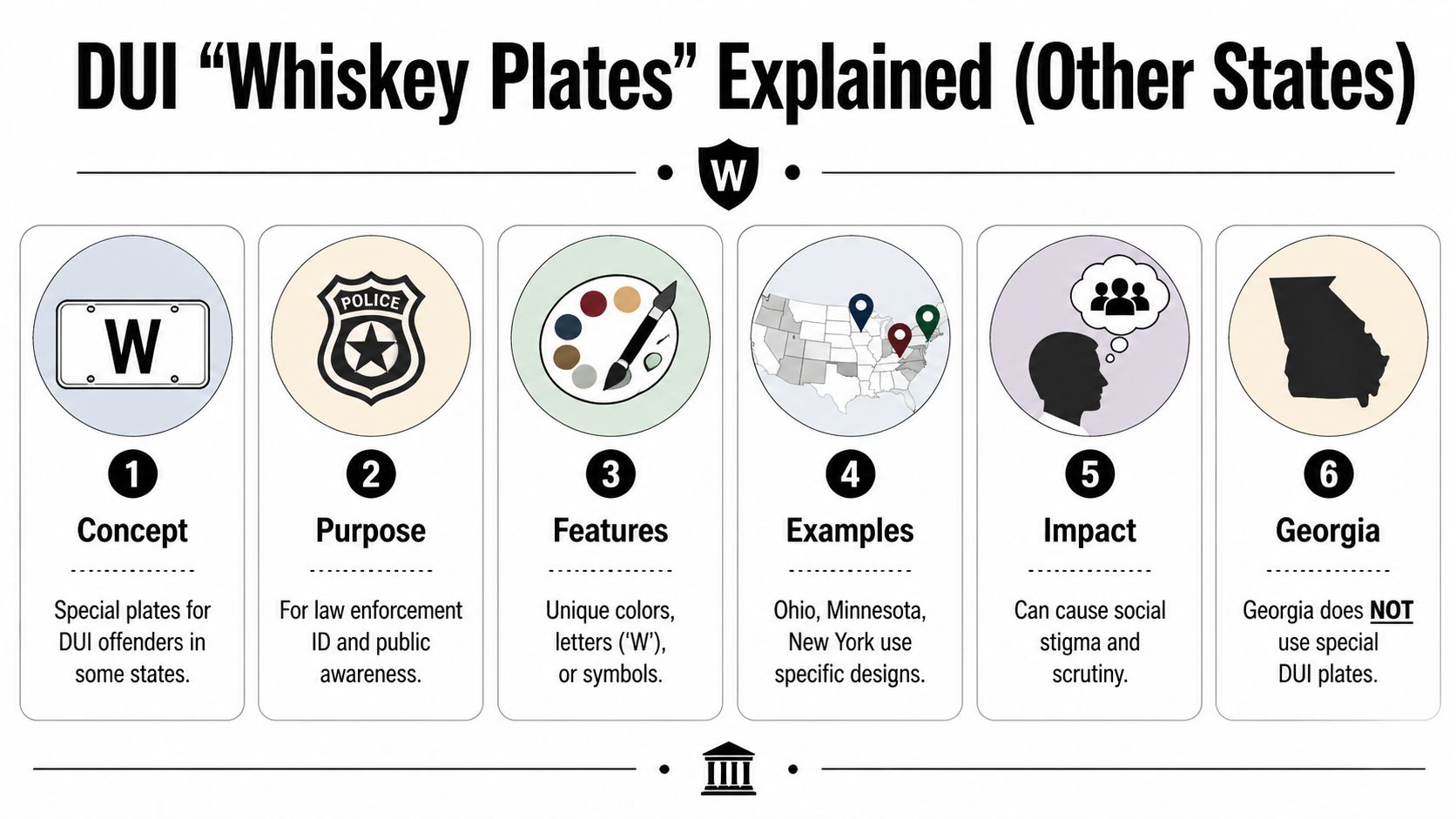
The term “whiskey plates” usually refers to special registration plates linked to DUI-related restrictions in a few states. The public knows the phrase because of highly visible systems in places like Minnesota and Ohio, where the plate itself can signal the issue. In Georgia, the better question is not what people call the plate. The better question is what information the plate or registration can communicate to law enforcement and what triggers that consequence under Georgia law.
What the phrase really means
“Whiskey plate” is shorthand, not a precise Georgia legal term. Clients use it to describe any DUI-related plate consequence, whether that means a visibly unusual plate in another state or a coded identifier tied to a Georgia driver after a qualifying case.
That distinction matters in real cases. If a person walks into my office in Alpharetta or Cumming focused only on avoiding a public badge of shame, we need to correct the frame quickly. Georgia’s risk is usually less obvious to the public and more important where it counts: traffic stops, police attention, registration consequences, and the long tail of a DUI disposition.
Why the myth persists
The phrase sticks because drivers search online, see yellow Ohio plates or Minnesota “W” plates, and assume Georgia uses the same model. Georgia does not operate that way in the plain, public-facing sense people fear.
Still, treating the issue as harmless is a mistake. A code that means little to a neighbor can matter a great deal to an officer running a tag or looking at a vehicle more closely after a stop. That is why drivers should also understand related Georgia driver license restriction codes and how administrative penalties can follow a DUI case outside the courtroom.
Why defense strategy starts here
The practical fight is rarely about a dramatic plate scene in the grocery store parking lot. It is about preventing the kind of DUI outcome that triggers added scrutiny and restrictions in the first place.
That changes plea decisions. It changes how carefully the stop, field sobriety work, implied consent notice, blood or breath testing, and prior history should be examined. In Fulton, Forsyth, and north Fulton courts, a disciplined defense lawyer looks at the whole chain early because once a conviction or qualifying resolution is entered, plate and registration consequences are much harder to contain.
The Truth About DUI License Plates in Georgia
Georgia is where the myth and the actual situation split.
Many drivers assume Georgia uses the same public-facing DUI plates seen in Ohio or the letter-marked plates associated with Minnesota. That is not the practical reality. Georgia uses coded identifiers for some DUI offenders, and those identifiers are not obvious to the general public in the same way.
Georgia does not use the obvious scarlet letter model
A useful summary appears in this discussion of scarlet-letter plate laws and Georgia’s approach. It explains that Georgia uses coded identifiers on license plates for some DUI offenders that are not publicly obvious like Ohio’s red/yellow plates or Minnesota’s “W” plates. It also notes the practical concern that these coded plates can still lead to heightened police scrutiny and potential harassment, including for drivers in places like Alpharetta, Roswell, and Milton.
That distinction matters because it changes how you should think about the risk.
Your neighbors may not recognize the code. A patrol officer may.
Why that difference changes the defense strategy
When a penalty is hidden from the general public, some people underestimate it. They assume that if the plate doesn’t look embarrassing, it isn’t a serious problem. That’s the wrong analysis.
A coded identifier can still affect traffic enforcement decisions. It can still influence how a stop unfolds. It can still make a driver feel watched every time they travel through North Atlanta. In practice, that can turn routine driving into repeated legal exposure.
For many clients, the better question isn’t “Will strangers know?” It’s “Will this make future contact with police more likely or more difficult?” In Georgia DUI defense, that’s often the sharper question.
Where this fits with license consequences
Georgia DUI cases rarely involve just one issue. The criminal charge often overlaps with license restrictions, administrative consequences, and vehicle-related conditions. If you’re already dealing with a suspension concern, understanding Georgia driver license restriction codes can help you see how tightly these problems can connect.
A DUI attorney in Alpharetta or Roswell should evaluate the full picture early:
- The underlying DUI allegation
- Whether a reduction is realistic
- Whether license-related penalties can be limited
- Whether the client’s work and family driving needs change the court approach
Georgia’s system is less theatrical than Ohio’s. It can still be punishing in ways that matter more to a working driver.
That’s why the “scarlet letter” myth needs correcting. Georgia usually doesn’t brand the plate for the whole world. But it can still mark the vehicle in the one place that often matters most, police visibility.
The Real Consequences of a Coded Georgia DUI Plate
A coded Georgia plate creates a different kind of risk. It’s quieter. It’s less obvious to the public. It can still affect your daily life in ways that become obvious very quickly.
The biggest problem is attention from law enforcement.

Why small issues start to matter more
A driver with no known history may get a warning for a minor plate display problem. A driver linked to a DUI-related coded plate may feel that the same issue turns into a full roadside investigation.
That concern isn’t theoretical. This discussion of plate display violations and traffic stops explains that minor plate issues, like temporary tags in the wrong window or an obscured plate, can create reasonable suspicion for a traffic stop, and that such stops can escalate into a DUI investigation. It also notes a reported rise in metro Georgia stops for minor plate violations, including in areas like Marietta and Sandy Springs.
Once that stop happens, the officer doesn’t need the original suspicion to remain the center of the case. The conversation shifts fast to odor, speech, movement, admission, roadside tests, and arrest decisions.
The hidden costs clients usually feel first
Some consequences show up before the case is even over. Others appear after court.
A coded plate can affect:
- Driving comfort: People become tense every time they pass a patrol car.
- Insurance pressure: DUI-related consequences often come with rate increases and more scrutiny from carriers.
- Work reliability: Jobs that depend on steady driving become harder to protect.
- Family impact: A shared household vehicle can become a source of worry for everyone using it.
The public may not know what the plate means. The driver usually does. That alone changes behavior.
What does not work
Clients sometimes think the answer is “be extra careful.” Caution helps, but it doesn’t solve the legal problem. If the coded plate exists because of a conviction, the safest move was usually earlier in the process, attacking the case before that consequence attached.
Another common mistake is treating the plate issue as separate from license defense. It isn’t. If you’re trying to keep your ability to drive, understanding license suspension after DUI in Georgia should be part of the same strategy, not an afterthought.
A practical way to think about it is this:
| Issue | Why it matters |
|---|---|
| Traffic stops | Minor violations can become gateways to bigger investigations |
| Insurance | DUI-related driving consequences often follow you outside court |
| Employment | Driving-based work can become harder to maintain |
| Family use of vehicle | Shared vehicle stress affects more than the defendant |
A coded plate doesn’t have to embarrass you publicly to create a private, recurring problem.
For drivers in Alpharetta, Cumming, Roswell, and Marietta, that’s the true trade-off. The plate may be subtle. The consequences usually are not.
How an Experienced DUI Attorney Fights These Penalties
The best way to fight a DUI plate consequence is usually not to fight the plate first. It’s to fight the DUI case that creates the exposure.
That means looking at the stop, the officer’s observations, field sobriety testing, chemical testing issues, body camera footage, and the paperwork trail. A DUI attorney in Alpharetta, Cumming, or Johns Creek who handles these cases regularly should be evaluating whether the state can prove the charge at all, whether a reduction is realistic, and whether a court has room to avoid the plate-related outcome.

Challenging the stop and the chain that followed
One of the most useful principles in this area comes from Minnesota. This analysis of plate impoundment and whiskey plate stops explains that a 2003 Minnesota Supreme Court ruling made it illegal for police to stop a driver based solely on a whiskey plate. The same discussion notes that the plate alone does not create reasonable suspicion and that defense counsel can use that principle to challenge stops and argue for alternatives such as ignition interlock.
That isn’t a Georgia case, but the constitutional logic matters. Police still need a lawful basis for a stop. If an officer used the plate as the actual reason and then stretched a weak traffic issue into a full DUI investigation, the defense should look closely at suppression arguments.
What a practical defense strategy looks like
An experienced DUI lawyer or traffic ticket attorney may pursue several paths at once:
- Attack the initial stop: If the stop was weak, later evidence may be vulnerable.
- Challenge roadside observations: Many DUI reports use broad conclusions that don’t hold up well when compared to video.
- Push for a non-DUI resolution: In the right case, avoiding the DUI conviction may avoid the plate issue entirely.
- Argue for alternatives: Interlock-based solutions can sometimes present a better rehabilitation argument than a stigmatizing vehicle consequence.
A defense lawyer who also handles reckless driving, license suspension, and related court representation is often better positioned to see those overlaps. If you’re trying to beat DUI charges in Georgia, the plate question should be part of the case plan from the start.
Why local court knowledge matters
The law is statewide. The decision-making is local.
A lawyer appearing in courts serving Alpharetta, Roswell, Cumming, Marietta, and surrounding North Atlanta communities learns quickly how judges view plea proposals, what prosecutors focus on, and when a mitigation argument is likely to gain traction. Brian Hansford Law handles DUI and license-related criminal defense matters in this region, including cases where a client’s driving future matters as much as the criminal record itself.
The strongest DUI defense usually isn’t one argument. It’s a coordinated attack on the stop, the evidence, and the penalty structure.
That’s what works. What doesn’t work is waiting until after conviction to start caring about DUI license plates.
Immediate Steps to Protect Your License in Georgia
After a DUI arrest, the most urgent mistakes usually happen in the first days. People focus on court and ignore the separate threat to their license. That can cost driving privileges long before the criminal case is resolved.
If you’ve been arrested in Alpharetta, Roswell, Milton, Johns Creek, Cumming, Sandy Springs, or Marietta, act quickly.
What to do first
Write down everything now
Record where the stop happened, what the officer said, whether field tests were requested, whether you consented to testing, and what was taken from you. Small facts disappear fast.Preserve every document
Keep the citation, bond paperwork, any temporary driving permit, tow information, and any DDS-related notice together. Don’t rely on memory.Stop discussing the case casually
Don’t explain it by text, don’t post about it, and don’t “clarify” things with police later. Loose statements become prosecution exhibits.
What needs legal attention quickly
Georgia DUI cases often involve immediate license issues. If your goal is to avoid suspension, protect work driving, or keep a restricted option available, time matters.
Focus on these priorities:
- License protection: A license suspension lawyer should review the deadlines tied to your arrest.
- Court date management: Missing a date can create a separate problem even when the DUI itself is defensible.
- Vehicle and driving restrictions: Don’t assume you understand them from internet summaries.
- Case screening: A DUI lawyer should evaluate whether the stop, testing, or arrest procedure provides an advantage.
What clients in North Atlanta often overlook
Drivers looking for same-day legal help usually ask whether they can still drive to work tomorrow. That’s the right urgency. They should also ask whether the case can be positioned early to avoid a chain of collateral consequences that includes coded plates, license restrictions, and more aggressive future traffic enforcement.
A speeding ticket lawyer, reckless driving lawyer, or misdemeanor defense attorney may handle traffic-related matters. A DUI arrest with possible license and plate consequences calls for a more focused review. Early action gives the defense more room to protect your record and your ability to drive.
Common Questions About Georgia DUI Charges
Can a Georgia DUI plate be removed later
Sometimes, but the answer depends on what occurred in court and with the Department of Driver Services. Georgia does not use a simple public "DUI plate" system the way people often fear. The central issue is whether a case outcome triggers a coded registration or driving restriction that follows you after the arrest. Once that consequence is in place, fixing it is usually harder than preventing it through the initial case strategy.
If I plead to reckless driving instead of DUI, will I still face the same plate issue
A reckless driving plea does not automatically create the same DUI-related plate concern. That is one reason plea negotiations matter in courts like Alpharetta, Roswell, and Cumming. The label on the final charge can affect far more than fines. It can affect how you are treated on the road, by insurers, and in any later traffic stop.
Can police stop me just because they think my plate is a DUI plate
Police still need a lawful basis for the stop. If an officer claims a traffic violation, equipment issue, or other reason, the defense should test whether that reason holds up. In some cases, coded plate information may shape the officer's attention even if it is not stated openly. That makes the stop, the officer's report, and any video especially important to review.
Is this only a problem for repeat offenders
No. First offenders often assume the worst consequence is the court date and fine. In practice, a first DUI can create license trouble, insurance fallout, and coded driving consequences that last longer than many people expect. The "scarlet letter" fear is often overstated in Georgia, but the hidden consequences are real.
Should I hire a DUI lawyer or can a general court-appointed process handle it
That depends on what you need protected. If the only goal is resolving the charge as fast as possible, any lawyer may look the same on paper. If the goal is protecting your license, avoiding avoidable plea terms, challenging the stop, and reducing the chance of future problems tied to a coded record or registration issue, focused DUI defense usually makes a difference.
What should I ask in a consultation
Ask questions that get past the sales pitch and into strategy:
- Can the stop, arrest, or testing be challenged?
- What deadlines affect my license right now?
- Is a reduction to a non-DUI offense realistic in this court?
- Could this outcome create coded plate or registration problems in Georgia?
- What should I avoid doing before court?
Those answers tell you quickly whether the lawyer understands the case as a driving-privilege problem, not just a calendar problem.
