
You searched dui limit california because something about a DUI charge feels immediate. Maybe you were arrested in Alpharetta after dinner and drinks. Maybe you're a Georgia driver traveling for work who wants to know whether California is stricter. Maybe you already blew under what you thought was the legal limit and now you're trying to figure out how that can still turn into a criminal case.
That confusion is common.
People often treat the legal BAC number like a bright line that decides everything. It doesn't. In real DUI cases, the number matters, but so do timing, testing method, officer observations, and the law of the state where the arrest happened. For drivers in Roswell, Johns Creek, Milton, Cumming, Marietta, and the rest of North Atlanta, California is a useful benchmark because it shows how aggressively states build DUI cases and how much risk can sit behind a single traffic stop.
Why California DUI Laws Matter in Georgia
A lot of Georgia drivers assume California has its own world of DUI rules and that those rules don't matter here. That assumption gets people into trouble. California is often the benchmark people picture when they think about strict DUI enforcement, and it helps frame how seriously prosecutors treat these cases anywhere.
That matters because a DUI charge rarely feels serious until the arrest is over and the paperwork starts. Then the situation becomes clear. There may be a court date. There may be a license issue. Your employer may find out. If you're charged in Fulton County, Forsyth County, Cobb County, or Gwinnett County, the question isn't whether Georgia is "nicer" than California. The question is whether the state can prove the case, and what you do next.
The numbers explain the pressure prosecutors feel
California's DUI climate shows why courts and prosecutors approach these cases aggressively. Approximately 1,355 people died in alcohol-related crashes in California in 2023, accounting for nearly one-third of all traffic fatalities in the state, according to California DUI fatality reporting.
That kind of statewide death toll shapes how law enforcement talks about DUI, how judges view repeat conduct, and how prosecutors present these cases. Even if your case happened in Sandy Springs or Cherokee County, the same public-safety logic shows up in charging decisions and plea discussions.
Courts don't look at DUI as a paperwork offense. They treat it as a public safety case first.
What that means for a North Atlanta driver
For someone arrested in North Atlanta, California's rules matter less as a travel guide and more as a warning label. They show that DUI law isn't built around common-sense assumptions like "I only had a few drinks" or "I seemed fine."
Three practical takeaways matter right away:
- The legal limit isn't the whole case. A BAC result can trigger one kind of charge, but impairment evidence can support another.
- The same facts can be framed very differently. An officer may describe ordinary behavior as signs of impairment unless the defense pushes back.
- Early strategy matters. Waiting to "see what happens" usually gives the state a cleaner path.
If you're reading this after an arrest in Alpharetta, Roswell, or Cumming, don't treat this like a traffic ticket. A DUI case develops quickly, and the first review of the stop, test, and timeline often determines what defenses are realistic.
Understanding California's BAC Tiers
A driver can be legally over the limit in California without ever reaching 0.08%.
That catches people off guard. They hear "legal limit" and assume the same number applies to everyone. California does not work that way, and that is one reason DUI cases get misjudged early. For a Georgia reader, the takeaway is practical: if a state known for aggressive DUI enforcement uses different BAC thresholds depending on the driver, you should expect Georgia prosecutors to take the same hard line with category-based DUI rules here at home.
The BAC thresholds California uses
California DMV guidance recognizes different BAC limits for different drivers:
| Driver Category | Legal BAC Limit | General Rule |
|---|---|---|
| Drivers age 21 and older | 0.08% | Standard adult per se limit |
| Commercial drivers | 0.04% | Lower limit while operating a commercial vehicle |
| Drivers under 21 | 0.01% | Zero-tolerance standard |
Those numbers come from California DMV DUI alcohol and drug limits guidance.
In real cases, those categories change the defense analysis immediately. A 0.05% result may not create the same exposure for a 35-year-old office worker that it creates for a CDL holder. An under-21 driver has even less room because the state treats almost any measurable alcohol result as a licensing problem and, in some situations, part of a broader DUI case.
Why these tiers matter in practice
The legal threshold shapes the prosecutor's starting position, but it also shapes the technical review. Lower-limit cases often turn on details that get ignored by people who focus only on whether they felt impaired.
I look at four things first:
- Driver status at the time of the stop. Age and commercial status can change the applicable limit.
- The testing method used. Breath and blood cases present different attack points.
- Timing. The gap between driving and testing matters, especially in close-call cases.
- Records. Maintenance logs, collection procedures, and chain-of-custody documents can decide whether a BAC number holds up.
That is where many North Atlanta cases are won or lost. A prosecutor in Alpharetta or Forsyth County may sound very confident about a number on paper. Confidence is not proof. If your case involves a blood draw, a close review of DUI blood test results and collection issues often exposes timing problems, lab questions, or gaps in the paperwork.
California's tiered system is a useful benchmark for Georgia drivers because it shows how little tolerance the law gives once you fall into a stricter category. The lesson is not just "know the number." The lesson is to identify which number applies, how the state plans to prove it, and where that proof can be challenged.
Per Se vs Impairment How Limits Are Applied
A BAC number does not decide every DUI case. Prosecutors usually build one of two theories, and that distinction matters because a driver can be charged even when the chemical test is disputed or the result sits below the familiar legal limit.
Per se DUI
Under California law, a per se DUI focuses on the test result itself. If the state can prove the driver was at or above the legal BAC threshold while driving, it does not need much else. The prosecutor will still present the stop, the arrest, and the testing process, but the chemical result carries the case.
From a defense standpoint, that changes the fight. The key questions become whether the officer had legal grounds for the stop, whether the breath machine was working properly, whether the blood sample was collected and handled correctly, and whether the state can tie that result to the actual time of driving. In a close case, those details matter more than the officer saying the driver smelled of alcohol.
Impairment DUI
California also allows the state to proceed on an impairment theory. That approach asks whether alcohol or drugs affected the person's ability to drive safely. A prosecutor may rely on driving conduct, statements, physical appearance, field sobriety exercises, body camera footage, and the officer's opinion.
That is why "I blew under 0.08" is not a complete defense. It may help, sometimes a great deal, but it does not end the case.
Georgia drivers need to pay attention here. California is often treated as the strict example, yet this split between number-based DUI and impairment-based DUI should sound familiar to anyone charged in Alpharetta, Roswell, or Forsyth County. Local prosecutors also know how to build a case around observations when the BAC evidence is weaker. That is one reason a defense strategy for a first DUI offense in Georgia has to start with the state's theory of proof, not just the breath result.
Why timing changes the case
The hardest DUI cases are often the ones that look simple on paper. A test taken later is only a snapshot of one moment. The legal question is what the BAC was when the person was driving.
If drinking happened shortly before the stop, alcohol may still have been absorbing. If the test happened after a delay, the prosecutor may need to infer backward from the later result. Defense counsel should examine every part of that timeline: when the last drink was consumed, when driving occurred, when the stop happened, when the arrest happened, and when the sample was collected.
That is where per se and impairment cases often separate in practice.
- In a per se case, the state has to connect the test result to the time of driving.
- In an impairment case, the prosecutor may try to rely more heavily on roadside observations and driving behavior.
- In either case, weak timing evidence can reduce the force of a BAC number that first looked damaging.
I tell clients the same thing in North Atlanta cases all the time. Courts do not convict on labels like "over the limit" or "seemed drunk." They convict on proof that holds up under scrutiny. The job is to test the stop, the testing, the timeline, and the officer's conclusions with the same discipline the state should have used before filing the charge.
How Georgia DUI Laws Compare
For Georgia drivers, this is the section that matters most. California's impairment model has a direct practical parallel here. In Georgia, a driver can still be convicted even without a BAC result over the per se limit.

Georgia's less safe theory
Georgia law, O.C.G.A. § 40-6-391(a)(1), allows a DUI Less Safe charge based on evidence that alcohol made the driver less safe to drive, even if the driver's BAC was below 0.08%, according to this discussion of Georgia's less safe DUI standard.
That surprises people in Alpharetta, Milton, and Johns Creek all the time. They believe the breath number ends the analysis. It doesn't. A lower reading may help the defense, but it doesn't block the prosecution from moving forward.
What the state usually relies on
In a Georgia less safe case, the prosecutor often builds around subjective evidence:
- Driving behavior. Lane deviations, braking, speed changes, or an accident narrative.
- Officer observations. Odor of alcohol, red eyes, balance, speech pattern, or admissions.
- Field sobriety tests. How the officer says you performed on divided-attention tasks.
- Video evidence. Dashcam or bodycam may either support or undermine the report.
Local court knowledge matters in these jurisdictions. A lawyer handling DUI defense in Roswell, Cumming, Marietta, or Forsyth County needs to know how these cases are litigated, not just what the statute says. Judges and prosecutors differ in how they view field tests, roadside statements, and video quality.
The practical comparison with California
California and Georgia reach the same destination through slightly different language. California frames one path as impairment under section 23152(a). Georgia frames it as less safe. For the person charged, the takeaway is the same. Blowing under doesn't end the case.
That reality changes what an effective defense looks like.
- Challenge the field tests. They are not magic, and they are often affected by instructions, environment, footwear, fatigue, anxiety, age, and medical issues.
- Compare the report to the video. In many cases, the officer's summary sounds worse than the footage.
- Pin down the timeline. The sequence of driving, stop, questioning, and testing often exposes weaknesses.
- Review prior exposure. If this is your first arrest, the defense strategy may differ from someone with a more complicated record. A useful starting point is understanding a Georgia DUI first offense case in practical terms.
In Georgia DUI litigation, "less safe" often means the state is asking the judge or jury to trust an officer's interpretation. That interpretation can be challenged.
If you're facing charges in Fulton County, Cobb County, or Forsyth County, don't assume a modest BAC makes the case minor. In many files, the lower number shifts the fight from chemistry to credibility.
A Look at DUI Penalties in California and Georgia
Penalties are where the abstract legal discussion becomes personal. The arrest starts one problem. The sentence, license consequences, and court conditions can create several more.
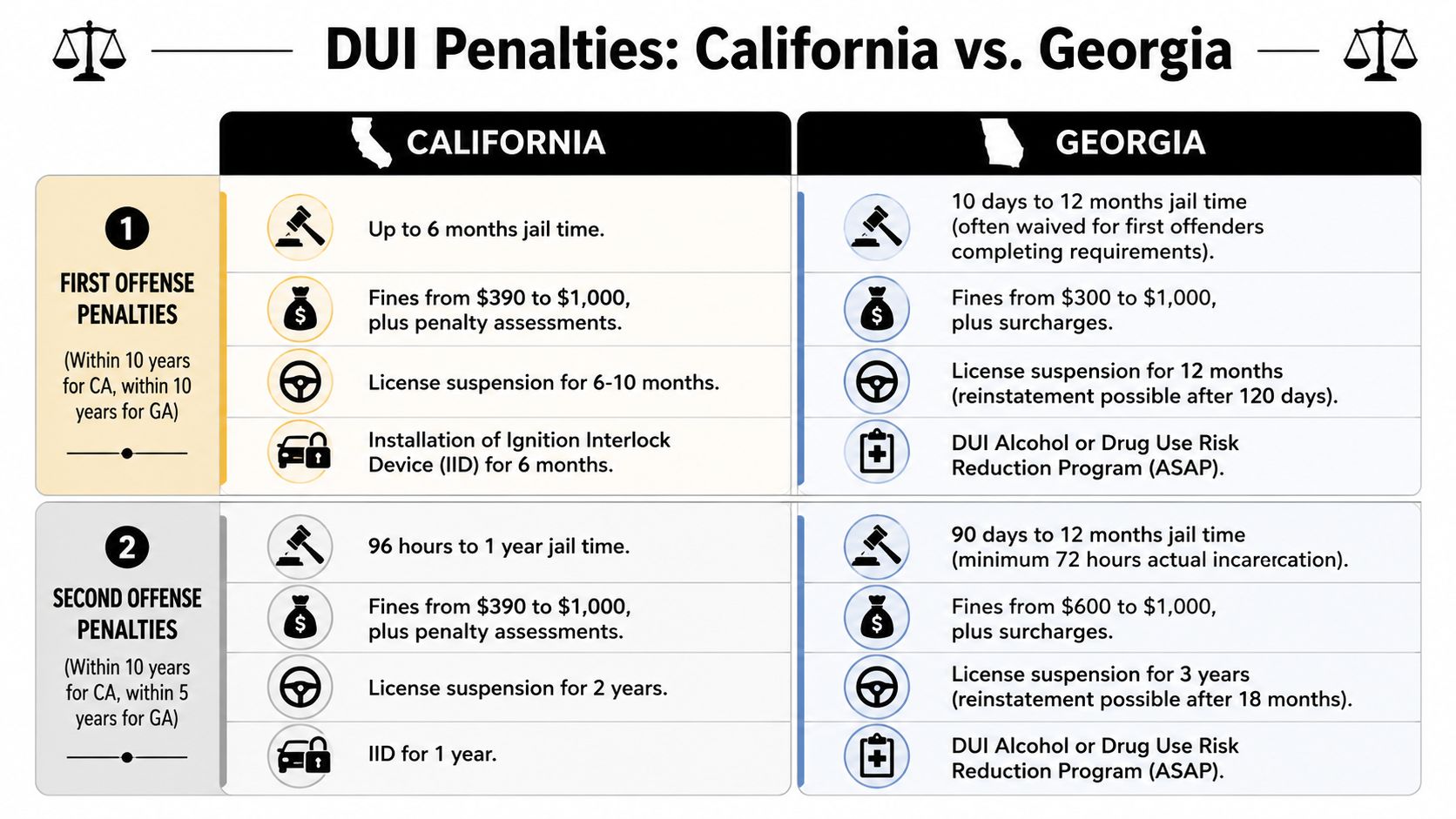
The visual below compares common first and second offense penalty ranges in California and Georgia.
First offense comparison
For a first offense, California exposure commonly includes up to 6 months in jail, fines from $390 to $1,000, license suspension for 6 to 10 months, and possible IID installation for 6 months. Georgia first offense exposure commonly includes 10 days to 12 months in jail, fines from $300 to $1,000, license suspension for 12 months with possible reinstatement after 120 days, and the DUI Alcohol or Drug Use Risk Reduction Program (ASAP).
The numbers in that comparison show the essential point. Georgia is not soft. In some ways, it is less forgiving. A driver in Sandy Springs or Duluth who assumes California is the "strict" state and Georgia is manageable is making a serious mistake.
Second offense comparison
For a second offense, California commonly carries 96 hours to 1 year in jail, fines from $390 to $1,000, license suspension for 2 years, and IID for 1 year. Georgia commonly carries 90 days to 12 months in jail, including a minimum 72 hours actual incarceration, fines from $600 to $1,000, and license suspension for 3 years with possible reinstatement after 18 months.
That escalation changes how a prosecutor views the file and how urgently the defense has to move. Repeat allegations usually mean less flexibility, more scrutiny, and a stronger push for conditions that affect your daily life.
What matters more than the chart
A penalty chart helps, but it never tells the whole story. In actual practice, the key questions are narrower:
- Can the state prove the stop was valid?
- Can it prove the testing was reliable?
- Does the video match the report?
- Is there room to negotiate the charge or the sentence?
A lot of clients focus only on the maximum jail line. That's understandable, but incomplete. A first-time DUI can still disrupt your license, your schedule, your insurance situation, and your record long after the court date is over.
The North Atlanta reality
In North Atlanta courts, what works is getting ahead of the case early, preserving deadlines, and attacking weak assumptions before they harden into the official narrative. What doesn't work is waiting until the first court appearance to start gathering facts.
If you're charged in Alpharetta, Roswell, Marietta, or Cumming, the case should be approached as both a criminal matter and a license-protection matter. Those tracks can move differently, and ignoring one can create damage even if the other is still being litigated.
Beyond Fines The Hidden Costs of a DUI Conviction
Many drivers think first about court fines. That makes sense because fines are visible and immediate. But in North Atlanta, the more damaging consequences are often the ones that don't appear on the first page of the citation.
A DUI conviction in Georgia can lead to professional license revocation, job loss, and insurance denial, and Georgia law, O.C.G.A. § 35-3-37, may provide a pathway for record restriction that can reduce some long-term damage for eligible people, according to this discussion of collateral DUI consequences and record restriction.
Career damage often starts before sentencing
For professionals in healthcare, finance, law, tech, and real estate, the danger isn't limited to the courtroom. Background checks, internal reporting rules, and licensing boards can create pressure almost immediately.
That means the case has to be analyzed with your job in mind, not just your next court date.
- Licensed professionals may have disclosure duties that create separate risk beyond the criminal case.
- Commercial and safety-sensitive workers may face employer action even before the case resolves.
- Anyone subject to background checks can feel the effect in hiring, promotions, or contract work.
The hidden cost of a DUI is often reputational. A manageable court outcome can still create serious workplace consequences if no one plans for them.
Insurance and record consequences
Insurance problems can linger longer than the court sentence. Some people can absorb fines. Fewer can absorb long-term insurance trouble combined with a damaged record and employment instability.
This is why record strategy matters. Not every case qualifies for the same relief, and not every outcome produces the same future risk. But waiting until after conviction to think about long-term damage is backwards. Those issues should shape the defense from the start.
What actually helps
The most useful approach is practical, not dramatic:
- Identify every collateral risk early. Employer rules, license rules, and pending renewals matter.
- Fight the underlying charge with those risks in mind. The best resolution is often the one that protects future employability, not just the one that closes fastest.
- Review record restriction options when eligible. That step can matter for housing, work, and reputation.
For a client in Johns Creek, Milton, or East Cobb, the right question often isn't just "Can I avoid jail?" It's "How do I protect my license, my job, and my future file?"
Your Next Steps After a DUI Arrest in North Atlanta
After a DUI arrest, most mistakes happen in the first few days. People talk too much. They miss deadlines. They assume the court date is the only date that matters.
Start with a short checklist.
The immediate checklist
- Stay quiet about the facts. Don't explain the stop, the drinks, or the roadside testing to police after the arrest. Don't try to talk your way out of it after the decision to charge has been made.
- Don't consent to extra searching or extra questioning without legal advice. Be polite. Be firm.
- Get the paperwork organized. Citation, bond paperwork, temporary permit, tow information, and any notice about license consequences should be in one place.
- Talk to a lawyer fast. If you need a practical primer, this guide on what to do after a DUI arrest is a useful starting point.
The deadline that can hurt you fast
Georgia drivers often focus on the criminal court date and miss the administrative side. The 30-day deadline to file an administrative license suspension appeal can be critical if you want to protect your driving privileges.
That deadline is not something to "circle and think about later." If you drive to work in Roswell, commute from Cumming, or need your car for school pickups in Milton, losing your license can become the most immediate problem in the case.
A practical note about cost
People also delay getting help because they aren't sure what speaking with a lawyer will cost. If you're comparing firms and trying to understand how legal pricing works, this overview of attorney consultation fees can help you ask better questions before you hire counsel.
The right move after a DUI arrest in Alpharetta, Marietta, Johns Creek, or anywhere in North Atlanta is simple. Protect your words. Protect your deadlines. Protect your license.
If you need immediate help, contact Brian Hansford Law. Brian Hansford is a North Atlanta criminal defense attorney and former prosecutor who handles DUI and criminal cases in Alpharetta, Roswell, Johns Creek, Milton, Cumming, Marietta, and the surrounding counties. If you're facing a DUI charge and need fast guidance on court dates, license protection, and defense strategy, reach out for a free consultation.
