
Here’s a common scenario: you’ve had a few drinks in Alpharetta or Roswell, and you decide to ride your bike home, thinking you're making the responsible choice. While it’s certainly better than getting behind the wheel of a car, it's not a get-out-of-jail-free card.
In Georgia, the simple answer is no, you cannot get a traditional motor vehicle DUI while on a bicycle. But that's where the simplicity ends. You can absolutely still find yourself in handcuffs facing other serious charges, like public intoxication or reckless conduct, if an officer believes you're impaired.
The Reality of a DUI on a Bicycle
Many people assume that hopping on a bike after drinking is a foolproof way to avoid certain charges. And while it's true you won't face the specific charge of Driving Under the Influence (DUI) that applies to cars, the situation isn't black and white. Georgia's laws draw a sharp line between a motor vehicle and a human-powered bicycle, which is why a standard DUI charge just doesn't fit the circumstances.
Think of it this way: you can't get a DUI for walking home while intoxicated, either. But if you stumble into traffic or cause a scene, an officer can certainly arrest you. Cycling while impaired is viewed through a similar lens. The focus isn't on the act of driving, but on whether you are being publicly intoxicated and creating a danger to yourself or others on the road.
This is a critical distinction because it completely changes the framework. While you might dodge a DUI, other misdemeanor charges carry their own penalties that can create a lasting headache.
Understanding the Possible Charges
When a police officer in Forsyth County or East Cobb stops a cyclist they suspect is impaired, they aren't looking for proof of a DUI. They're evaluating whether your behavior is a public nuisance or a danger to others. This can lead to several misdemeanor charges, including:
- Public Intoxication: This is a go-to charge. It applies if you're in a public space and so intoxicated that you're a danger to yourself or others.
- Reckless Conduct: If you're weaving all over the road, ignoring traffic signals, or otherwise cycling in a way that endangers others, you could be charged with reckless conduct.
- Disorderly Conduct: This is a catch-all charge that can be used if your behavior is generally disruptive or offensive in public.
This decision tree helps visualize how these situations typically unfold.
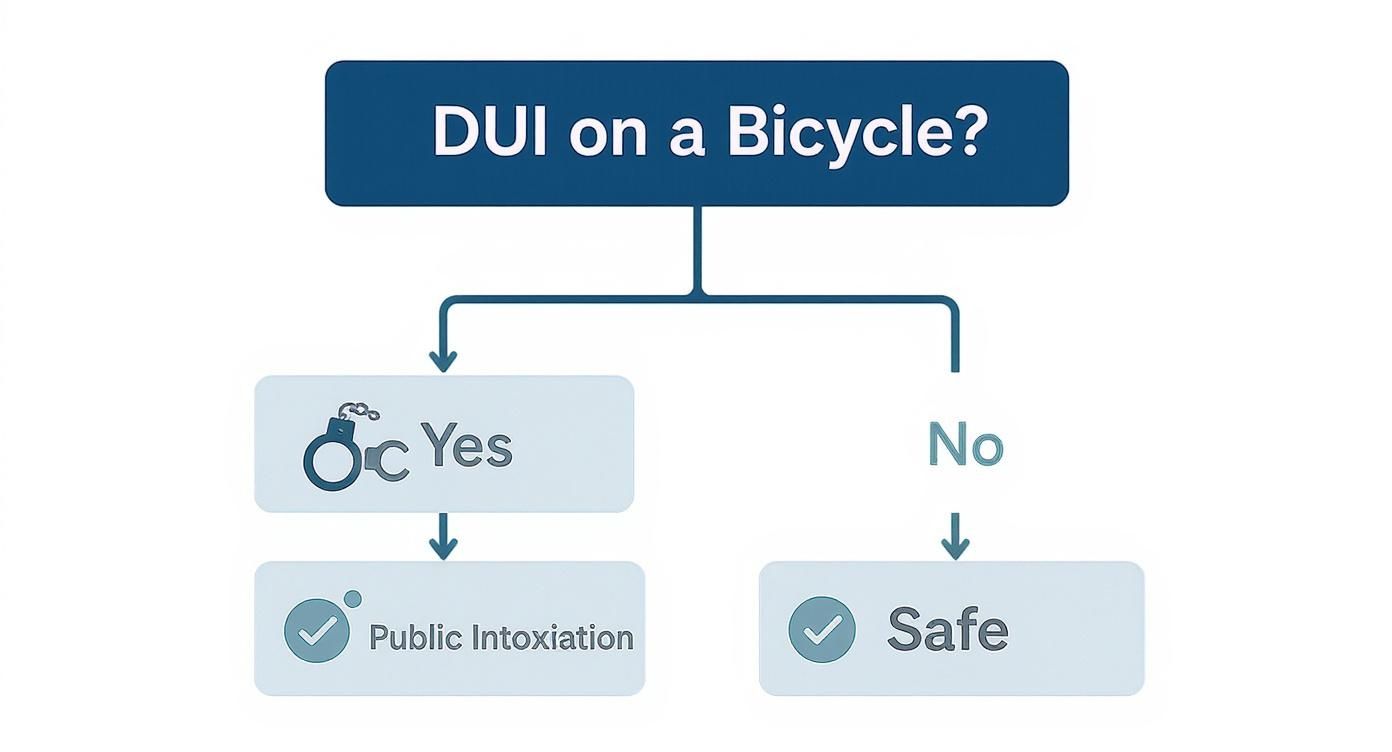
As you can see, even though the path doesn't lead to a DUI, it can easily end with an arrest and a criminal charge.
Vehicle DUI vs Bicycle Intoxication Charges in Georgia
It's helpful to lay out exactly how these alternative charges stack up against a standard motor vehicle DUI. While both involve impairment, the framework and potential punishments are worlds apart. Seeing them side-by-side clarifies why the state treats these incidents so differently.
| Aspect | Standard Vehicle DUI | Intoxicated Cycling |
|---|---|---|
| Primary Charge | O.C.G.A. § 40-6-391 (DUI) | O.C.G.A. § 16-11-41 (Public Intoxication) |
| Impact on License | Automatic license suspension | Typically no direct impact on driver's license |
| Testing Laws | Implied Consent laws apply | Implied Consent laws generally do not apply |
| Potential Penalties | Jail time, fines, license suspension, DUI school | Fines, potential jail time, community service |
| Criminal Record | Creates a permanent criminal record | Also creates a permanent criminal record |
The table makes it clear: the biggest difference is the immediate threat to your driver's license. A DUI conviction triggers an automatic suspension, while a public intoxication charge from cycling typically won't.
However, don't overlook the final row. Both scenarios can result in a misdemeanor conviction on your permanent record, which can pop up on background checks and affect your job, housing, and future opportunities. An arrest is an arrest, and a conviction is a conviction.
How Georgia Law Sees Bicycles and Intoxication
To get to the bottom of why you can't get a typical DUI on a bicycle in Georgia, we have to look at how state law actually defines a "vehicle." It’s a small detail, but it makes all the difference and explains why an impaired cyclist in Marietta or Johns Creek plays by a different set of rules than a driver.
The main DUI law in Georgia, O.C.G.A. § 40-6-391, is very specific. It applies to people who are driving or in actual physical control of any moving vehicle. That last phrase is everything. While you definitely ride a bike, the law doesn't lump it in with cars, trucks, or motorcycles when it comes to a DUI charge.
Instead, a bicycle is typically defined as a device moved by human power. Because it doesn't have a motor, it simply falls outside the scope of this serious traffic offense. It's like a puzzle—the pieces for a DUI just don't fit when a bicycle is involved. This is why law enforcement can't use the main DUI statute against a cyclist.
The Focus Shifts from Driving to Public Behavior
Since a traditional DUI is off the table, the police have to pivot their focus from the act of driving to your public behavior. The issue is no longer about operating a motor vehicle while impaired. Instead, it’s about whether an intoxicated person is creating a risk to the public.
This is where other laws come into play. When an officer in Forsyth County sees a cyclist swerving dangerously, they aren’t thinking about blood alcohol content for a DUI. They're looking at whether that person's actions meet the definition of a completely different offense—one that has nothing to do with traffic law.
The system in Georgia isn't looking at this through the lens of a traffic violation. It's looking at it through the lens of public order. The question becomes: is this person a danger to themself or others because of how intoxicated they are?
This change in perspective is huge. It means the entire situation, from the moment the officer stops you to the charges you might face, follows a completely different playbook than a regular traffic stop.
Alternative Charges Police Can Use
Without the DUI law at their disposal, officers will turn to other parts of the Georgia Code to handle the situation. The most common charge in a DUI on a bicycle scenario is Public Drunkenness, found in O.C.G.A. § 16-11-41.
This law makes it a misdemeanor for someone to be intoxicated in public to the point where they are a danger to themselves or others. A cyclist who can't keep their balance, rides into traffic, or falls over in an intersection would easily fit that description.
Other charges could include:
- Reckless Conduct: If your cycling is so out of control that it puts other people in danger.
- Disorderly Conduct: This is a broad law that can cover all sorts of disruptive or chaotic behavior in public.
It’s important to understand that because these aren't motor vehicle crimes, the penalties tied to Georgia's implied consent law usually don't apply. That complex law, which deals with chemical testing after a DUI arrest, is tied specifically to operating a motor vehicle. The framework for a cyclist is fundamentally different, which changes everything about how an officer will handle the stop from the very beginning.
The Real-World Consequences of Cycling Under the Influence
Just because you can't get a standard DUI on a bicycle in Georgia doesn't mean your ride home is consequence-free. The real-world outcomes of being stopped while impaired can still be serious, creating problems that extend far beyond a single night in Cumming or Johns Creek. The focus just shifts from traffic law to other parts of the criminal code.
When an officer decides a cyclist is intoxicated to the point of being a danger, charges like public intoxication or reckless conduct come into play. These aren't just minor tickets; they are misdemeanor criminal offenses that carry their own set of penalties designed to address public safety, not unsafe driving.
While the specifics can vary from case to case, the penalties for these charges often look a lot like what you’d expect from other misdemeanors. It’s not at all uncommon for a conviction to result in hefty fines, mandatory community service hours, and a period of probation where you have to follow a strict set of rules.
The Immediate Financial and Personal Costs
The first and most direct impact is financial. A conviction for something like public intoxication will almost certainly come with fines and court fees that can easily stack up to hundreds or even thousands of dollars. This financial hit is often a shock, since many people mistakenly believe a bicycle-related incident is a minor issue.
Beyond the fines, there are other immediate consequences to think about:
- Mandatory Classes: A judge might order you to attend alcohol education or public safety awareness programs—all at your own expense.
- Community Service: You could be required to complete a set number of community service hours, taking up your personal time.
- Probation: This means regular check-ins with a probation officer and strict rules you have to follow, like avoiding any other offenses.
These penalties are designed to be corrective, but they can significantly disrupt your daily life and finances. The consequences can feel surprisingly similar to other criminal misdemeanors. You can learn more about how penalties for even first-time offenses can stack up in our detailed guide on first-time DUI penalties.
The Shadow of a Criminal Record
Perhaps the most damaging consequence is getting a permanent criminal record. A misdemeanor conviction for public intoxication or disorderly conduct doesn't just disappear. It becomes a part of your official history, visible to anyone who runs a background check.
This is what's known as a collateral consequence—a penalty that isn't part of the official court sentence but affects your life long after the case is closed. The impact can be incredibly far-reaching and pop up when you least expect it.
A misdemeanor charge is more than just a procedural headache; it's a permanent mark on your record that can close doors to future opportunities. It follows you into job interviews, housing applications, and professional licensing reviews.
Think about applying for a new job in a competitive market like Alpharetta or Milton. Many employers run thorough background checks as a standard part of their hiring process. A recent misdemeanor conviction could be the one thing that makes them choose another candidate over you.
Long-Term Impacts on Your Future
The effects of a criminal record can linger for years, impacting all sorts of personal and professional areas of your life. The danger here goes far beyond the immediate risk of an accident.
Impaired cycling is a significant public health issue. Across the country, the data shows its tragic consequences. In fact, approximately 37% of fatal bicycle crashes involve riders with blood alcohol levels above the legal limits, highlighting just how much of a factor impairment is in cyclist fatalities.
Here are just a few ways a conviction could affect you down the road:
- Employment: Certain fields, especially those requiring trust or handling sensitive information, may become inaccessible.
- Professional Licenses: If you hold a license for nursing, real estate, or another regulated profession, a conviction could trigger a review by your licensing board.
- Housing Applications: Landlords in communities like Marietta and Roswell often run background checks, and a criminal record can easily lead to a denied application.
- Educational Opportunities: Some higher education programs or scholarship applications may require you to disclose any criminal history.
At the end of the day, a charge that starts on a bicycle path can create obstacles that affect your career, housing, and reputation for a very long time.
What to Expect During a Bicycle Stop
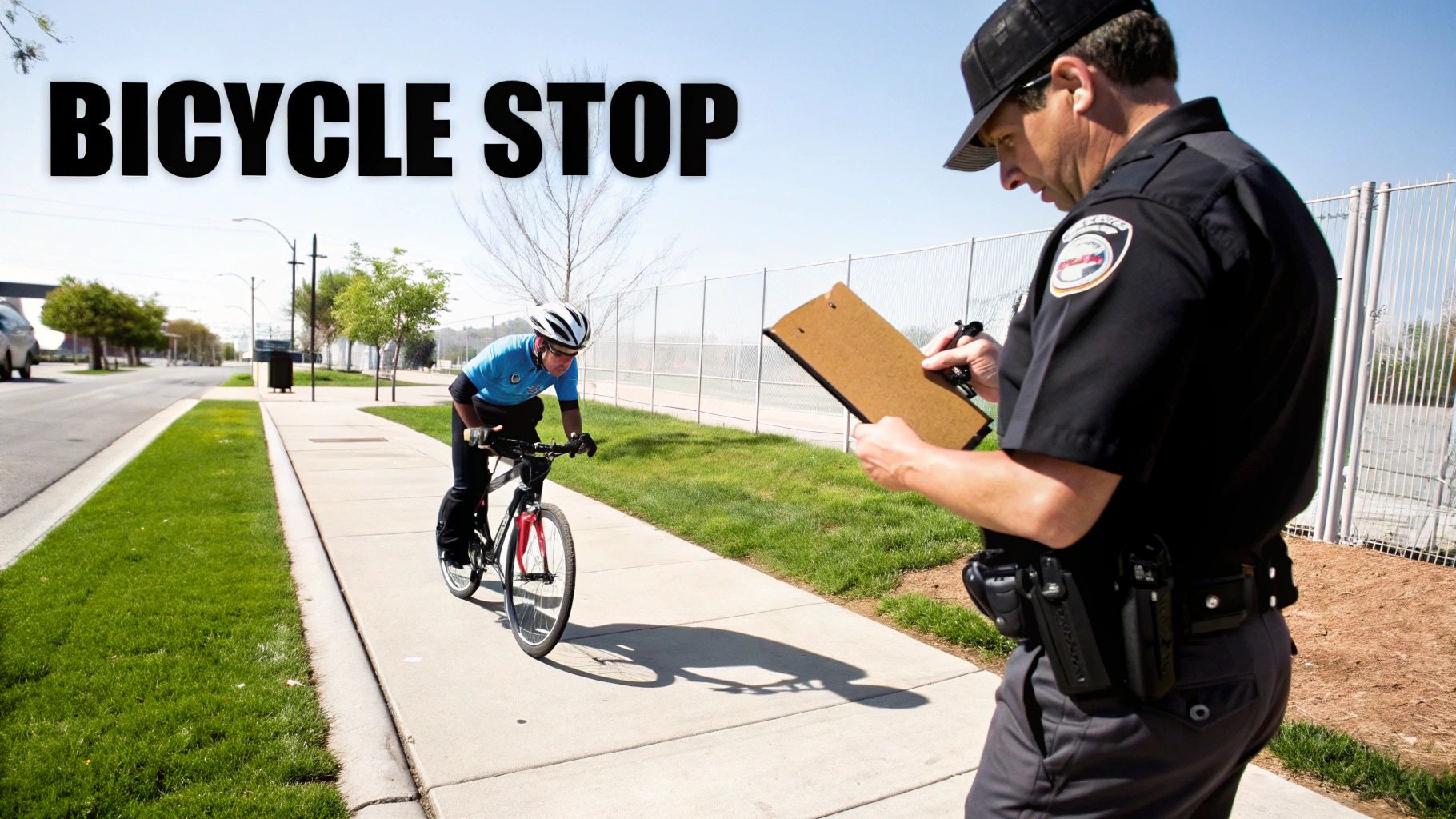
Imagine you’re riding home through a quiet street in Alpharetta or Roswell after an evening out. Suddenly, you see those familiar blue and red lights flashing behind you. Being stopped by an officer on a bicycle for suspected impairment is a very different kind of encounter than a typical traffic stop, and knowing the process can make a stressful situation a little clearer.
The whole thing usually starts because an officer sees something specific. They aren't looking for a broken taillight or an expired tag like they would with a car. Instead, their attention is drawn to signs that suggest a rider might not have full control of their bicycle, which could create a hazard for themselves or others on the road.
Common Reasons for a Stop
An officer's decision to stop a cyclist is almost always based on observable actions that point to impairment. This isn't about pulling someone over for a routine check; it’s about responding to what they perceive as a public safety risk.
Some common signs an officer looks for include:
- Difficulty Balancing: Struggling to stay upright, especially when you’re stopping or starting.
- Erratic Weaving: Drifting from side to side in a bike lane or on the road.
- Ignoring Traffic Rules: Biking through stop signs, failing to yield, or riding on the wrong side of the road.
- Physical Signs: After you’ve dismounted, an officer might also note slurred speech, the smell of alcohol, or unsteady movements.
These observations are what give the officer the basis for the stop. From there, their goal is to determine if your condition makes you a danger to yourself or the public—the key element for a charge like public intoxication, not a DUI on a bicycle.
Field Sobriety Tests for Cyclists
After the initial stop, the officer may ask you to perform Standardized Field Sobriety Tests (SFSTs). While these are the exact same tests used in car DUI stops, how they’re applied and interpreted can be completely different for someone on a bicycle. Think about it: a cyclist might already be off-balance from physical exertion, making a test like the walk-and-turn much more challenging even when perfectly sober.
The purpose of these tests is still the same: to gather evidence of impairment. The context, however, is what matters. An officer is using them to build a case for public intoxication or maybe even reckless conduct, not a motor vehicle DUI. That distinction is critical and shapes the entire framework of the encounter.
The core difference in a bicycle stop is the question being asked. It shifts from "Is this person illegally operating a motor vehicle?" to "Is this person's level of public intoxication creating a hazard?"
This fundamental difference leads directly to another key point about testing.
Understanding Implied Consent and Bicycles
One of the most significant differences between a car stop and a bicycle stop in Georgia involves implied consent. Georgia's implied consent law is what requires anyone operating a motor vehicle on a public highway to submit to chemical testing (like a breathalyzer) if they are arrested for DUI.
But here’s the crucial part: a bicycle is not considered a motor vehicle under this specific law. Because of that, the implied consent rules typically do not apply. This means the severe administrative penalties for refusing a chemical test, like an automatic driver's license suspension, generally aren't triggered in a bicycle-related incident.
That doesn't mean an officer won't ask you to take a portable breath test on the side of the road. They might. But the framework surrounding that request is fundamentally different. Your interaction with law enforcement during a stop for a suspected DUI on a bicycle is governed by a distinct set of rules that have very little to do with traditional traffic laws. Understanding this process gives you clarity on what to expect if you're ever in this situation in communities like Forsyth County or Cobb County.
Understanding the Risks in North Georgia Communities
While Georgia's state laws give us the main rulebook for a bicycle DUI, how those rules play out on the ground really depends on the local community. For anyone living in North Georgia, it’s crucial to understand how cycling, social life, and law enforcement connect in places like Cumming, Alpharetta, Roswell, and Marietta. These areas are packed with vibrant downtowns, beautiful trails, and community events where hopping on a bike is the easiest way to get around.
It’s often around these local hotspots where cyclists and police cross paths. Picture a busy weekend evening on Canton Street in Roswell, the bustling energy of The Avalon in Alpharetta, or the popular Big Creek Greenway that winds through several of our communities. These are exactly the kinds of places people gather, and it's where officers are most likely to be on patrol, keeping an eye on things. A cyclist leaving a brewery in downtown Woodstock or rolling through the historic Marietta Square after dinner could easily get an officer's attention if they look even a little unsteady.
Local Ordinances and Increased Patrols
On top of state laws, some cities in Forsyth and Cobb County have their own local ordinances that can factor in. These rules might be about public drinking, park curfews, or specific regulations for using multi-use paths like the Silver Comet Trail in Cobb County. While they may not be "DUI on a bicycle" laws, they can give an officer a different reason to stop you in the first place.
For instance, an officer might pull a cyclist over for not having proper lights after dark—a simple safety violation—and then notice signs of impairment during that conversation. This is why knowing the local rules matters so much. A minor ticket can quickly escalate into a much more serious problem if an officer develops a reason to suspect you've been drinking.
The bottom line is that in busy suburban centers like Johns Creek or Milton, police are focused on public safety, especially in and around entertainment districts. A bicycle is not an invisibility cloak; if your actions would get you noticed on foot, they will definitely get you noticed on two wheels.
This heightened focus on public order means behavior is under a microscope. What seems like a harmless ride home can turn into a procedural headache if it’s seen as a danger to the public.
Who Is Most Affected in Our Communities
When we look at the data on bicycle incidents involving alcohol, certain patterns show up that are especially relevant to our North Georgia communities. The numbers show that these situations don't affect everyone equally, and understanding these trends gives local cyclists some important context.
The statistics for bicycle-related fatalities involving alcohol show a major gender gap. Men account for about 86% of all bicyclist deaths. When you narrow it down to alcohol-related incidents, men are 6 times more likely to be injured in a bicycle crash than women. This difference probably reflects a combination of factors, including more men cycling for commutes in urban areas and a higher tendency for risky riding behaviors. You can dig deeper into bicycle accident statistics and their contributing factors to learn more.
In areas like East Cobb and Forsyth County, where cycling is a huge part of recreational life and a common way to visit local festivals or farmers' markets, these statistics are a stark reminder of the risks. It shows that impaired cycling is a serious safety issue with very real, and sometimes tragic, consequences for individuals and families right here in our own neighborhoods. Being aware of these local dynamics is the first step toward making safer choices and understanding what’s truly at stake when you mix alcohol and cycling.
What to Do After a Bicycle Stop Incident
An encounter with law enforcement while you're on a bike can be confusing, especially in North Georgia communities like Cumming, Milton, or Johns Creek. It's not like a typical traffic stop, and you're often left wondering what just happened and what comes next. The moments right after the stop are critical.

Your first move should be to carefully look over any citation or paperwork the officer gave you. Since Georgia law doesn't have a specific charge for DUI on a bicycle, your ticket will probably list something else, like public intoxication or maybe even reckless conduct. Figuring out that exact charge is the first step to understanding what you're up against.
Just as important, write down everything you remember about the incident as soon as you can. Memories fade fast. Jotting down the details of the stop, what you and the officer said, and any tests you were asked to do creates a solid record of the event from your point of view.
Your Situation Is Unique
While this article gives you a general roadmap, it's crucial to remember that no two cases are the same. The facts of every stop—whether it happened in Marietta or somewhere else—are unique, right down to the specific observations the officer made. This is why broad explanations can only take you so far.
Several factors can change the outcome of your case, including:
- The exact law you were charged with violating.
- The evidence the officer collected at the scene.
- Any prior history you might have.
- The specific jurisdiction, whether it's Forsyth County or Cobb County.
Because of all these variables, the right path forward for one person could be completely wrong for another. For a better sense of what to do right after an arrest, you can read our guide on what to do after a DUI arrest, which outlines some fundamental steps that apply in many situations.
Getting Clarity on Your Case
If a bicycle stop results in a criminal charge, getting clear on your options is paramount. And if an injury was involved, looking into resources like an Atlanta Bicycle Accident Lawyer can be a critical move. Successfully handling the aftermath requires a sharp understanding of the specific details of your case.
Every situation deserves a focused, professional look. If you're facing charges after being stopped on your bike in Alpharetta, Roswell, or nearby areas, getting a clear picture of what you're dealing with is a sensible thing you can do.
Your future is too important to leave to chance. A confidential case evaluation can provide the clarity needed to understand your options and protect what matters most.
At Brian Hansford Law, we help people make sense of these confusing situations. We invite you to contact us for a confidential review of your case. Let us help you understand the charges and figure out the best path forward for your specific circumstances.
When you're dealing with something as unexpected as a police stop on your bicycle, a lot of questions pop into your head. Here are some straightforward answers to the ones we hear most often.
Will a Bicycle Charge Suspend My Driver's License?
Generally, no. A public intoxication charge from a bicycle stop doesn’t fall under the Georgia DUI laws that trigger an automatic driver's license suspension. Those penalties are tied specifically to operating a motor vehicle.
That said, every case has its own unique facts, and the final outcome can sometimes depend on the specific circumstances.
Can I Refuse a Breathalyzer if Stopped on My Bike?
Yes, you can. Georgia’s implied consent law—the rule that requires you to submit to a breathalyzer or other chemical test—only applies to people operating motor vehicles on public roads. Since a bicycle isn't a motor vehicle under that law, the usual penalties for refusal, like a license suspension, don’t apply here.
An officer might still ask you to take a portable breath test on the side of the road, but the procedural rules surrounding it are completely different than in a car DUI case.
Is an Open Container of Alcohol Illegal on a Bicycle?
It certainly can be. Georgia's open container law prohibits having an open alcoholic beverage in the passenger area of any vehicle on a public highway.
Local courts in places like Cobb and Forsyth County often interpret this law to include bicycles. This means that riding with an open beer or other alcoholic drink could get you a separate ticket, completely apart from any charge related to being impaired.
If you're facing a public intoxication charge or another citation after being stopped on your bike in Alpharetta, Cumming, or anywhere in North Georgia, the first thing you need is clear information. The team at Brian Hansford Law is here to confidentially review your case and help you figure out where you stand.
Contact us today to understand your options. You can reach us by visiting challengemycharge.com.
