
If you're looking up information about impaired driving laws, you'll run into two acronyms over and over again: DUI and DWI. The most important thing to know is that in Georgia, DUI (Driving Under the Influence) is the only term used in the official statutes. While other states use DWI (Driving While Intoxicated), here, it's all handled under the DUI statute.
Simply put, there is no "DUI vs DWI" distinction in Georgia law. They are one and the same.
Understanding Georgia's Approach to DUI vs DWI

Many people use "DUI" and "DWI" as if they mean the same thing, and in Georgia, they'd technically be right. But understanding the official framework is a key part of understanding a charge. Some states have entirely separate laws for Driving While Intoxicated and Driving Under the Influence, creating different standards and penalties. Georgia doesn't.
Our state consolidates every type of impaired driving offense under a single, powerful "DUI" law.
This means it makes no difference whether a driver is suspected of being impaired by alcohol, marijuana, prescription drugs, or even something like paint fumes. The charge will always be DUI. The law isn't focused on the label; it’s focused on the level and nature of the impairment. This unified approach makes the terminology simple, but it doesn't make the charge any less serious.
What Does This Mean for a Case?
Because Georgia law doesn’t get tangled up in DUI vs. DWI, the prosecutor's job is singular: prove a person was impaired to the point of being a "less safe" driver. This standard is the same everywhere in the state, from Forsyth County and Cobb County to cities like Alpharetta, Cumming, and Roswell.
Proof could come from a blood alcohol concentration (BAC) over the legal limit, but it can also be based on other evidence showing impairment from any substance.
The critical takeaway is that in Georgia, any discussion of DWI ultimately redirects to the state's comprehensive DUI laws. The specific substance causing impairment matters for the case details but not for the official charge.
A Closer Look at the Terminology
While the terms are effectively interchangeable in Georgia, it's helpful to know how they differ elsewhere. Across the U.S., DUI and DWI can have very different meanings in the statutes. Historically, DUI often refers to impairment by any substance, while DWI might be tied to a specific blood alcohol concentration (BAC), like 0.08% or higher, sometimes leading to more severe penalties in states that use both charges.
For more on how other states draw these lines, you can read the full research on national impaired driving terminology.
Georgia's Legal Framework for Impaired Driving

While you might hear "DUI" and "DWI" used interchangeably on TV or in other states, Georgia keeps it simple. Our state law focuses exclusively on one charge: Driving Under the Influence (DUI). But that single charge is surprisingly complex, broken down into two very different categories.
Understanding how these two types of DUI charges work is the first step in examining a defense, whether the case is in Forsyth County, Cobb County, or anywhere else in North Georgia.
The first type is what is called a DUI Per Se charge. This is all about the numbers. The term "per se" is Latin for "by itself," which means a Blood Alcohol Concentration (BAC) reading, on its own, is enough evidence for the state to bring a charge. Of course, this assumes the test was administered correctly.
With a Per Se charge, the prosecutor doesn't need to prove a driver was swerving or driving erratically. If the BAC is over the legal limit, the law presumes impairment. It creates a seemingly straightforward case for the prosecution, but it is not without potential challenges.
Georgia DUI BAC Thresholds and Types of Charges
To help clarify how these charges work, the table below breaks down the specific BAC limits in Georgia and how they correspond to either a DUI Per Se or a DUI Less Safe charge.
| Driver Category | Per Se BAC Limit | Charge Type | Basis for 'Less Safe' DUI Charge |
|---|---|---|---|
| Adults (21+) | 0.08% or higher | DUI Per Se | Any amount of alcohol or drugs shown to impair driving ability |
| Commercial Drivers | 0.04% or higher | DUI Per Se | Any amount of alcohol or drugs shown to impair driving ability |
| Minors (Under 21) | 0.02% or higher | DUI Per Se | Any amount of alcohol or drugs shown to impair driving ability |
As you can see, the specific number is the backbone of a Per Se charge, while a Less Safe charge is based on observable evidence of impairment, regardless of the BAC level.
The Specific BAC Limits in Georgia
Georgia law is very strict about its BAC limits, and they change depending on who is behind the wheel. These aren't just guidelines; they are hard lines that form the foundation of any Per Se case.
- Drivers Over 21: The limit is 0.08% BAC.
- Commercial Drivers: For anyone operating a commercial vehicle, the standard is cut in half to a much stricter 0.04% BAC.
- Drivers Under 21: Georgia has a zero-tolerance policy for underage drivers. The limit is just 0.02% BAC.
If a chemical test result is over that line, it gives the state an automatic basis to bring a DUI Per Se charge, no matter how sober a person felt or how perfectly they were driving.
The core of a DUI Per Se case is the chemical test result. A number above the legal threshold is considered direct evidence of impairment, shifting the focus of the case to the validity of the test itself.
The second type of charge, DUI Less Safe, is a completely different animal. It doesn't rely on a specific BAC number at all. In fact, a person can be charged with DUI Less Safe even if they blow under the 0.08% limit—or if they refuse to take a chemical test entirely.
A Less Safe charge is built on the police officer's observations and any other evidence suggesting a person was impaired. The prosecutor’s job is to convince a judge or jury that alcohol or drugs made a driver less safe than they would have been otherwise.
Building a Case for DUI Less Safe
Because there's no magic number for the prosecution to lean on, a Less Safe case is constructed from a variety of evidence to paint a picture of impairment. This makes the case much more subjective and opens up many more opportunities for a strong defense. The evidence typically includes things like:
- Driving Behavior: Weaving in the lane, speeding up or slowing down erratically, or failing to use a turn signal.
- Physical Appearance: The officer will note things like bloodshot eyes, fumbling for a license, slurred speech, or the smell of alcohol.
- Field Sobriety Tests: Performance on exercises like the walk-and-turn or one-leg stand test will be used as evidence.
- Admissions: Any statements made to the officer about having "a couple of drinks" or taking medication can become key evidence.
This is where the details of the stop become critical. Every moment, from the reason a driver was pulled over in Roswell to an arrest in Alpharetta, can and should be scrutinized.
To get a better sense of how a Less Safe charge can move forward even without a BAC reading, you can learn more about Georgia’s Implied Consent law and what happens if you refuse a test. This rule makes the officer's testimony and other subjective evidence the most important part of the state's case.
The Escalating Consequences of a DUI Conviction
In Georgia, any DUI charge is a serious matter. But the consequences aren't always the same—they can ramp up dramatically depending on the specific circumstances of a case. The law draws a very firm line between a misdemeanor and a felony DUI. Understanding that distinction is important, as it can be the difference between temporary penalties and a lifetime of irreversible consequences.
A first-offense DUI is usually charged as a misdemeanor, but the penalties are still significant. Even for a first conviction, a person could be looking at jail time, substantial fines that can exceed $1,000, and a mandatory license suspension. The court will also require completion of at least 40 hours of community service and a state-approved DUI Alcohol or Drug Use Risk Reduction Program.
While disruptive, those immediate penalties are designed to be temporary. A felony conviction, on the other hand, creates permanent barriers that can alter the entire course of a person's life. It’s not just about facing stricter penalties; it’s a fundamental change in legal status.
When a DUI Becomes a Felony
The jump from a misdemeanor to a felony DUI isn't random. Georgia law outlines specific aggravating factors that elevate the charge. These situations are seen as reflecting a much higher degree of danger to the public, which triggers far more severe repercussions.
Several scenarios can turn a standard DUI into a felony:
- Repeat Offenses: A fourth DUI conviction within a ten-year period is automatically charged as a felony in Georgia.
- Causing Serious Harm: If a driver is involved in an accident while under the influence that results in serious injury or death to another person, they will face felony charges, like Vehicular Homicide.
- Endangering a Child: Driving under the influence with a child under the age of 14 in the vehicle is a separate felony offense known as DUI Child Endangerment.
These factors completely transform the landscape of the case. You can learn more about how these classifications work by reviewing our guide on when a DUI is considered a felony in Georgia.
Real-World Scenarios and Long-Term Impact
It's easy to dismiss these as abstract rules, but real-world situations show just how quickly a DUI can escalate. For example, imagine a driver who has two prior DUIs from the last eight years. A third arrest would still be a high and aggravated misdemeanor. But if that same person is arrested a fourth time within that ten-year window, they are suddenly facing a felony with a mandatory prison sentence.
Here's another scenario: a parent leaves a restaurant in Marietta after a couple of drinks with their child in the car. Even if it's their first offense and their driving is flawless, a simple traffic stop for a broken taillight could lead to a DUI investigation and a felony child endangerment charge. The mere presence of the child elevates the entire case.
A felony conviction extends far beyond the courtroom and prison walls. It becomes a permanent part of a public record, impacting a person's ability to find employment, secure housing, obtain professional licenses, or even own a firearm.
The stark realities of impaired driving are highlighted in national statistics. Fatal crashes involving drunk drivers underscore the tragic outcomes that can happen in these cases. According to the National Highway Traffic Safety Administration (NHTSA), in 2023, 12,429 people died in alcohol-impaired driving crashes—that’s one death every 42 minutes. You can explore additional data and discover more insights about these drunk driving statistics on the NHTSA website. These numbers show why prosecutors in areas like Cobb County, East Cobb, and Forsyth County pursue these cases so aggressively, especially when aggravating factors are present.
Navigating a DUI Stop and Arrest in Georgia
Knowing the definitions is one thing, but understanding what actually happens when those blue and red lights flash in the rearview mirror is another entirely. Those first few moments of a traffic stop are often confusing and incredibly stressful. From the reason a driver was pulled over to a potential arrest, every single step is dictated by specific procedures that can make or break a DUI case.
It all starts with something called reasonable suspicion. An officer can't just pull someone over on a whim; they need a legitimate, observable reason to believe a traffic violation or some other crime has been committed. This could be as obvious as speeding or weaving between lanes, or as simple as a broken taillight.
Once stopped, the officer's investigation begins. They'll be watching closely, making mental notes about physical appearance, speech, and coordination. They are trained to look for signs like bloodshot eyes, slurred words, or the smell of alcohol, and every observation is documented for their report.
The Stages of a Roadside Investigation
During the stop, the officer will likely ask a driver to get out of the vehicle to perform a series of Field Sobriety Tests (FSTs). What many people don't realize is that in Georgia, these tests are 100% voluntary. The same goes for the small, portable breathalyzer they might ask a driver to blow into at the roadside—that preliminary test is also optional.
The results of these voluntary tests are used by the officer to build probable cause, which is the standard they need to meet before they can make an arrest. The performance on the tests, combined with all their other observations, will determine if they believe they have enough evidence to place a person in handcuffs for DUI.
The initial traffic stop is the foundation of the entire DUI case. If an officer cannot justify the reason they pulled a driver over, any evidence gathered afterward—including field sobriety tests and chemical test results—could potentially be challenged.
The journey from a routine traffic stop to a full-blown DUI arrest unfolds in several distinct stages, each with its own set of rules and potential consequences. The flowchart below gives a sense of how an initial charge can escalate.
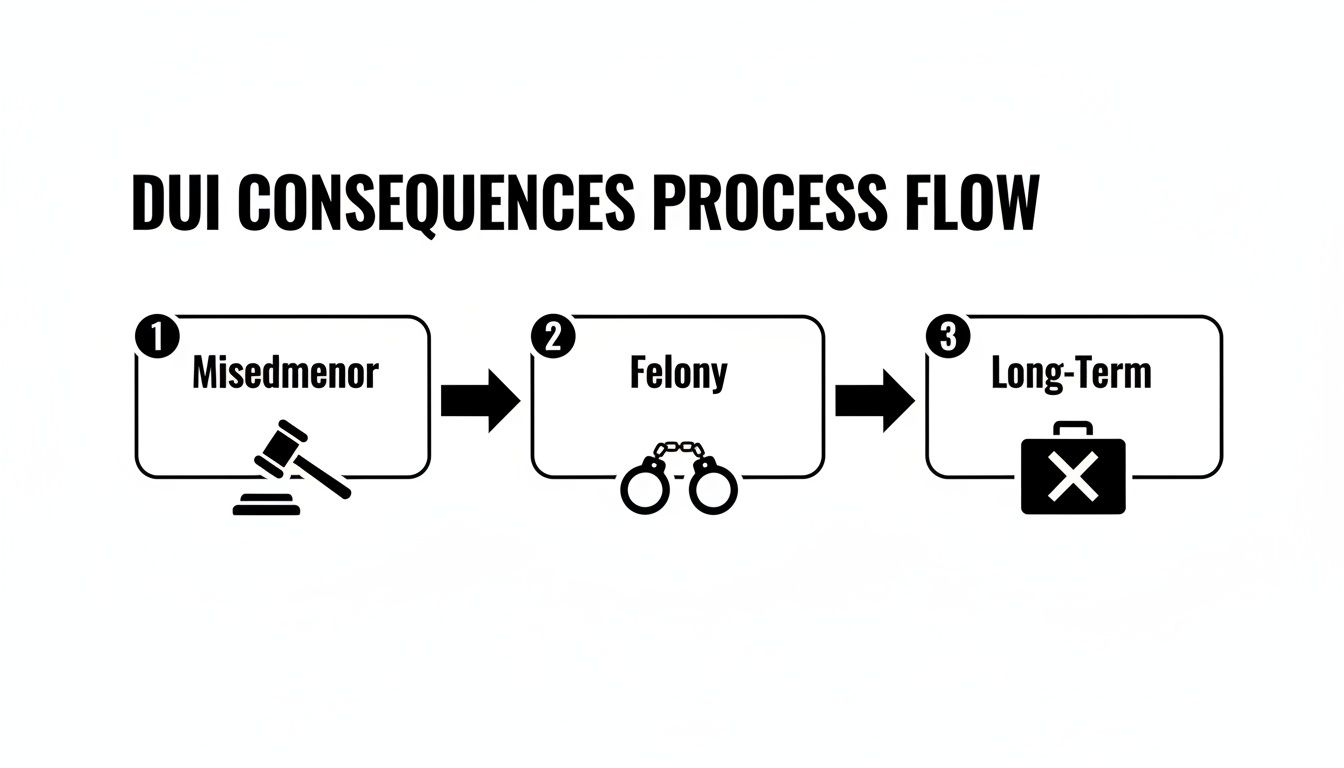
As you can see, the decisions made at each point can dramatically impact how severe and long-lasting the penalties will be. To give a clearer picture of what to expect, here’s a breakdown of the typical DUI stop procedure.
Understanding a Georgia DUI Stop Step-by-Step
A DUI investigation follows a structured process. Knowing these stages can help in understanding what is happening and what a person's rights are at each point.
| Stage | What Happens | Important Considerations | Potential Defense Angles |
|---|---|---|---|
| The Traffic Stop | Officer observes a traffic violation or erratic driving and initiates a stop. | The officer must have "reasonable suspicion" to pull a driver over. | Was the initial stop legally justified? Lack of reasonable suspicion can invalidate the stop. |
| Initial Interaction | Officer approaches, asks for license/registration, and engages the driver in conversation. | They are observing appearance, speech, and coordination for signs of impairment. | Were the officer's observations exaggerated or inaccurate? Do they conflict with video evidence? |
| Field Sobriety Tests | The driver is asked to exit the car to perform physical and mental coordination tests. | These tests are voluntary in Georgia. A driver can politely decline. | FSTs are notoriously inaccurate. Medical conditions, nerves, or poor instructions can affect performance. |
| Arrest Decision | Based on observations and FST results, the officer decides if there is "probable cause" for an arrest. | This is the standard required to take a person into custody for a DUI. | Did the officer truly have enough evidence to establish probable cause, or was the arrest based on a hunch? |
| Implied Consent | Post-arrest, the officer reads the Implied Consent Notice and requests a chemical test (breath, blood, or urine). | Refusing this official test results in an automatic 1-year license suspension. | Was the notice read correctly and in a timely manner? Was the driver coerced or confused about their rights? |
Each stage presents opportunities for a skilled defense attorney to scrutinize the officer's actions and challenge the evidence.
Georgia's Implied Consent Law
Once a person is formally arrested, the dynamic changes dramatically because of Georgia’s Implied Consent law. This law essentially says that by having the privilege of driving on Georgia roads, a driver has already given their consent to a state-administered chemical test of their blood, breath, or urine to check for alcohol or drugs.
Unlike the voluntary tests at the roadside, refusing this official, post-arrest test comes with immediate and harsh administrative penalties. A driver's license will be automatically suspended for one full year, with absolutely no chance of getting a limited driving permit. This is an administrative suspension handled by the Department of Driver Services, and it happens completely separately from the criminal DUI case a person will face in court.
It's a critical moment where a person has to make a fast decision with very real consequences. A refusal means the prosecutor won't have a key piece of evidence—the BAC number—but it also means the driver is guaranteed to lose their license for a year.
Historically, the focus on DUI enforcement has ebbed and flowed, which has impacted arrest patterns in local areas like Forsyth County and Cobb County. Data from the Bureau of Justice Statistics reveals that from 1970 to 1986, DUI arrests across the nation shot up by an astonishing 223%. This explosion in arrests far outpaced the 42% increase in licensed drivers over the same timeframe. Arrest rates peaked in 1983 at 1,921,000. You can dig deeper into these trends in the government's full report on driving under the influence.
Common Defenses Against Georgia DUI Charges
When a person is facing a DUI charge in Georgia, it’s easy to feel like the case is already closed. But an arrest is a long way from a conviction.
Every DUI case rests on the evidence gathered by the police, and every single piece of that evidence is open to scrutiny. There are a number of potential defenses that can be explored, all of which hinge on one key question: were proper procedures followed from the very moment the traffic stop began?
Understanding these defenses is the first step toward challenging the prosecution's case. The entire process, from the flashing blue lights in the rearview mirror to the final breath or blood test, has to follow strict procedural rules. Any misstep by law enforcement can create an opportunity to have the evidence suppressed.
Questioning the Initial Traffic Stop
The first line of defense almost always starts with why a driver was pulled over in the first place. A police officer can't just stop a vehicle on a whim. They must have a "reasonable and articulable suspicion" that a law has been broken. This means they need a concrete reason—like speeding, weaving out of a lane, or even a simple broken taillight.
If the stop was based on a vague hunch or for a discriminatory reason, it may not be a legal stop. And if that initial stop is ruled unlawful, any evidence collected because of it—field sobriety test results, statements, and even the breathalyzer reading—could be suppressed. This can often lead to the entire case falling apart.
A DUI case is like a chain. For the prosecution to win, every link has to be solid. If the very first link can be broken—the legality of the stop—the rest of the case often crumbles.
The Reliability of Field Sobriety Tests
After pulling a driver over, the officer will likely ask them to perform a few Standardized Field Sobriety Tests (SFSTs). It is important to know that these tests are designed to be difficult. They're usually administered on the side of a busy road, under the stress of flashing lights and passing cars.
There are countless reasons why a completely sober person might "fail" these tests. Some of the most common include:
- Medical Conditions: Old injuries, inner ear problems affecting balance, or neurological conditions can make it physically impossible to perform the tests as instructed.
- Environmental Factors: Was the ground uneven? Was the lighting poor? Were there distractions from passing traffic? Even the weather can affect performance.
- Improper Instructions: If the officer fails to give clear, correct instructions or doesn't demonstrate the tests properly, the results can be challenged as unreliable.
Because these tests are so subjective and full of potential errors, their validity is a frequent battleground in DUI cases across Georgia, from Roswell to Marietta and beyond.
Scrutinizing Chemical Test Results
The breathalyzer or blood test results might seem like hard science, but that evidence is far from perfect. The machines used for these tests are complex instruments that need regular calibration, proper maintenance, and a trained operator to give an accurate reading.
Defense strategies often include a deep dive into the machine’s history and the officer's qualifications. This includes looking at maintenance logs to see if the device was serviced correctly and checking if the officer who ran the test was properly certified. On top of that, certain medical conditions like acid reflux (GERD) or even diabetes can produce chemicals in a person's breath that mimic alcohol, causing a false high reading.
When it comes to blood tests, the chain of custody is absolutely crucial. The blood sample has to be drawn, stored, and transported to the lab following a very strict protocol to prevent contamination or degradation. Any broken link in that chain can make the results inadmissible in court.
Important Next Steps After a DUI Arrest
After an arrest for a DUI, the clock starts ticking immediately. A person is facing critical deadlines that can seriously impact their future, and the administrative and criminal processes move much faster than most people realize. Taking the right steps right away is essential to protecting one's rights.
One of the most urgent deadlines is the 30-day window to appeal a potential license suspension. This is a civil matter, completely separate from the criminal case, triggered by either refusing a chemical test or having a result over the legal limit. If this deadline is missed, driving privileges could be lost for an entire year.
Seeking Professional Guidance
The moments after an arrest are confusing and overwhelming, but a person does not have to face this alone. It is helpful to speak with a criminal defense lawyer who focuses specifically on DUI cases. An experienced attorney can review every detail of an arrest, from the initial traffic stop in Roswell to the chemical testing procedures back at the station in Alpharetta.
Understanding the difference between a DUI vs DWI charge is less important than understanding the immediate procedural steps that must be taken. Acting quickly is a critical factor in protecting the ability to drive and building a strong defense.
When looking for help, it’s beneficial to find someone who knows the local court systems in Forsyth County, Cobb County, and other North Georgia jurisdictions. Every courthouse has its own prosecutors and judges, and that local experience can be invaluable. A professional can help an individual understand the charges, explain what the potential outcomes look like, and lay out a clear path forward.
Protecting Your Future
A DUI charge can have lasting consequences, affecting everything from a person's job to their personal freedom. Being proactive is the best approach. By consulting with a qualified professional, an individual can ensure that every part of their case is thoroughly examined.
This includes:
- Analyzing Police Reports: Scrutinizing the officer's written account for any inaccuracies or procedural mistakes.
- Reviewing Evidence: Examining any available dashcam or bodycam footage and challenging the validity of the field sobriety tests and chemical tests.
- Meeting Deadlines: Making sure all necessary paperwork, like the 30-day license suspension appeal, is filed correctly and on time.
An experienced professional can give you a comprehensive evaluation of your case. Contact Brian Hansford Law for a consultation to discuss your specific circumstances and learn more about your options.
Answering Your Questions About Georgia DUI Charges
When you're facing a DUI arrest, a lot of questions start running through your head. The whole process can feel overwhelming, and it's completely normal to feel confused. While the specifics of every case are different, getting a handle on the basics can help you see the path forward. Here are some of the most common questions we hear from people facing DUI charges in Georgia.
Can I Still Get a DUI if My BAC Is Under 0.08%?
Yes, it is possible. People are often surprised by this. In Georgia, a Blood Alcohol Concentration (BAC) of 0.08% or higher leads to what’s called a “DUI Per Se” charge. In that situation, the number itself is the main piece of evidence the state needs.
But there’s another type of charge called a "DUI Less Safe," and it doesn't depend on a specific BAC number. A Less Safe charge can be brought even if a person's BAC is below the legal limit. It all comes down to whether the prosecutor can prove the driver was impaired and therefore less safe. They'll use evidence like driving behavior, performance on field sobriety tests, slurred speech, or any statements made about drinking to build their case. Their entire goal is to show impairment, not just hit a magic number.
How Is a DUI for Prescription Drugs Handled Differently Than an Alcohol DUI?
The state takes a DUI for prescription drugs just as seriously as one for alcohol, but how they try to prove it is different. With an alcohol DUI, the case often revolves around that BAC number from a breath or blood test. It’s relatively straightforward.
When prescription drugs are involved, the evidence shifts. The prosecutor is going to lean heavily on the arresting officer’s testimony about how a person was acting and what they observed. They'll also rely on the results of any blood or urine tests and often bring in a Drug Recognition Expert (DRE) to testify. It’s important to know that having a valid prescription isn't a defense if the medication impaired a person's ability to drive safely.
The bottom line in any DUI case is impairment. Whether it’s from alcohol, illegal drugs, or a perfectly legal prescription, the core issue is whether a person was safe to be behind the wheel. The only thing that changes is how the prosecution tries to prove it.
What Are the Consequences of Refusing a Breathalyzer Test in Georgia?
Refusing the official state-administered chemical test after a lawful arrest triggers immediate and serious consequences. Under Georgia’s Implied Consent law, a person's driver's license will be automatically suspended for one full year. There is no possibility of getting a limited driving permit during that time.
This is an administrative penalty handled by the Department of Driver Services, and it's completely separate from the criminal DUI case. While refusing the test means the prosecutor won't have a BAC number to use against the accused, they can—and will—use the refusal as evidence in court. They'll argue it shows the person knew they were impaired and were trying to hide it.
Is It Possible to Get a DUI Charge Off My Record in Georgia?
Once a person is convicted of a DUI, it stays on their Georgia criminal record for life. It's permanent. However, there is hope if the charge is handled differently. If the case is dismissed or reduced to a less serious offense, like reckless driving, it might be possible to get the original DUI arrest restricted from a public record.
This process, which used to be called expungement, is complicated and isn't guaranteed. Getting a result that allows for record restriction is one of the biggest reasons people seek an experienced attorney to handle their case from the very beginning.
Navigating the system is tough, and a DUI charge can follow a person for years. At Brian Hansford Law, we have the experience to walk people through this difficult process and fight to protect their future. Contact us today for a consultation.
