
If you’ve maintained a positive track record and consistently followed every rule, Georgia law allows for the possibility of ending your probation ahead of schedule. This process is called early termination of probation. It isn't a guarantee, but it’s a real opportunity for those who have proven they’ve made significant progress. A judge can grant an early discharge after a formal request, restoring personal freedoms and lifting the financial weight of ongoing supervision.
Understanding Early Termination of Probation
Think of your probation sentence like a path you have to walk for a certain amount of time. Early termination is like a shortcut the court approves because you've proven you can handle the responsibility without needing to walk the full distance. It’s not about erasing the sentence; it's about the court acknowledging you've fulfilled its purpose sooner than expected.
This isn’t something you can just ask your probation officer to do. It’s a formal court process. It involves filing a specific motion with the same court that originally sentenced you, asking the judge to reconsider the length of your supervision based on your good conduct.
Why Pursue an Early Discharge
The benefits of ending probation early go way beyond just not having to check in anymore. For most people, it’s about getting their life fully back on track.
The main advantages include:
- Restored Freedoms: You can travel, move to a new city, or take a new job without first getting permission from a probation officer.
- Financial Relief: No more monthly supervision fees. These costs can add up to a serious financial burden over months or years.
- Peace of Mind: The constant stress of a potential violation disappears, allowing you to move forward without the weight of supervision hanging over your head.
This isn't just wishful thinking; people successfully complete probation all the time. In 2023, 59% of all known exits from adult probation in the U.S. were because people successfully finished their terms. The numbers are even better for misdemeanors. This shows that if you do what's required, you have a good chance at a positive outcome.
For a clearer picture of what a judge will look for when considering your motion, this table breaks down the most important factors.
Key Factors for Early Probation Termination at a Glance
| Factor | General Requirement | Why It Matters |
|---|---|---|
| Time Served | Typically, at least half of the probation sentence must be completed. | Judges need to see a substantial period of compliance before considering a reduction. |
| Compliance | No new arrests or technical violations (e.g., missed appointments, failed drug tests). | A clean record demonstrates that you respect the court's orders and are no longer a risk. |
| Financial Obligations | All fines, fees, and restitution must be paid in full before filing. | The court sees fulfilling financial duties as a key part of completing your sentence. |
| Special Conditions | All court-ordered classes, counseling, or community service must be completed. | This shows you've completed the rehabilitative aspects of your sentence. |
| Probation Officer Support | The PO's opinion is influential, so maintaining a good relationship is crucial. | A supportive PO can confirm your positive progress to the judge and prosecutor. |
Ultimately, a strong motion supported by a solid track record gives you the best shot at getting your freedom back sooner.
Probation vs Parole: A Quick Clarification
People often mix up probation and parole, but they are very different. Probation is a sentence that is served instead of jail time, letting you stay in the community under supervision. Parole, on the other hand, is an early release from prison, followed by a period of supervision.
The process for getting off probation early is completely separate from anything related to parole. You can learn more about the critical differences between parole and probation in our detailed guide.
Understanding the Eligibility Requirements
Before you can even think about asking a judge to end your probation early, you have to hit a few key milestones. Think of it like a checklist the court uses to see if you’ve truly earned the privilege of an early discharge. Georgia law is very clear about these requirements, and they’re designed to make sure the original goals of your sentence have been met.
This isn’t something that happens automatically. You have to be proactive and show the judge that you’ve held up your end of the bargain. That means proving you’ve consistently followed the rules and finished every single task the court assigned you.
The Non-Negotiables for Eligibility
When it comes to eligibility, a few things are absolutely non-negotiable. Without these pieces in place, filing a motion for early termination in any Georgia court is almost certainly a non-starter.
Here’s the bare minimum a judge will look for:
- Time Served on Probation: You must have successfully completed a specific portion of your probation sentence.
- Full Compliance: Your record while on probation has to be clean. That means no new arrests and no major violations of your probation rules.
- Financial Obligations Paid: Every penny of court-ordered fines, fees, and victim restitution must be paid off.
- Special Conditions Completed: All court-ordered programs, classes, or other tasks have to be finished.
Let's dig into each of these so you know exactly what the court expects.
The Minimum Time Requirement
One of the first things a judge checks is the calendar. Georgia law sets minimum timeframes you must serve before you can even ask for your probation to end. While the exact time can vary depending on your specific case, you generally need to have finished a significant portion of your sentence without any issues.
For many felony offenses, there’s a specific guideline that makes a huge difference. Thanks to a 2021 law change, many people on felony probation can now request early termination after just three years, as long as they’ve met all the other requirements. This isn't just a law on the books; it’s a real opportunity. In fact, this change has already helped over 20,000 Georgians get off probation ahead of schedule.
Fulfilling Your Financial Duties
Getting all your financial obligations paid in full is another deal-breaker. This isn’t just about the main fine from your case—it means every single dollar the court ordered you to pay.
A judge doesn't just see paying off your financial obligations as clearing a debt. They see it as a powerful sign of accountability and proof that you've satisfied a core part of your sentence. Getting this done sends a strong message that you’re serious about making things right.
Your financial checklist includes:
- Court Fines: The penalty tied to your specific offense.
- Court Costs and Fees: Various administrative fees the court system charges.
- Supervision Fees: The monthly payments you make to your probation office.
- Victim Restitution: Any money ordered to be paid back to victims who lost money because of the crime.
You need proof that all of these are paid off before you file your motion. A judge will often deny a request for early termination immediately if there's any outstanding balance, no matter how small it seems.
Completing All Special Conditions
Finally, the judge will want to see proof that you’ve completed every "special condition" of your sentence. These are the rehabilitative tasks you were ordered to do, designed to address the issues that may have led to your offense in the first place. This is the active part of your sentence, where you put in the work to build a better future.
Common examples of special conditions include:
- Community Service Hours: Finishing a specific number of volunteer hours.
- Counseling or Treatment Programs: Attending and completing programs for things like substance abuse or anger management.
- Educational Classes: Finishing courses like DUI school or a defensive driving class.
- No-Contact Orders: Strictly following any orders to stay away from certain individuals or places.
Having completion certificates, letters from counselors, or other documentation is crucial. It provides the judge with solid proof that you took these requirements seriously. When you successfully complete them, you're showing the court you’ve done more than just stay out of trouble—you've actively worked on yourself.
The Step-By-Step Process to Request an Early Discharge
Getting your probation terminated early isn’t as simple as just asking. It’s a formal court process with distinct steps, and you have to get each one right. Think of it as building a case for the judge—a case that proves you've not only met the court's requirements but gone above and beyond.
This journey really starts long before you ever see the inside of a courtroom. It begins with methodically building a rock-solid file of evidence that backs up your request. Every document you pull together is another piece of the puzzle, showing the judge a complete picture of your rehabilitation.
Gathering Your Supporting Documents
First things first: you have to assemble your file. This is where you gather every piece of paper that proves you've done what you were told to do. The goal is to leave no room for doubt that you've fulfilled every single obligation of your sentence.
Your evidence file should contain:
- Proof of Financial Fulfillment: This means receipts or official statements showing all fines, court costs, supervision fees, and restitution to victims have been paid in full.
- Completion Certificates: Collect the official paperwork from any programs the court ordered, like DUI school, anger management classes, or substance abuse treatment.
- Community Service Records: You'll need the logs or letters that verify you completed every single required hour of community service.
- Letters of Support: These can be incredibly powerful. Positive character references from your boss, a community leader, a mentor, or a counselor add a personal touch that facts and figures can't.
This flowchart breaks down the absolute must-haves you need to check off before you can even begin this process.
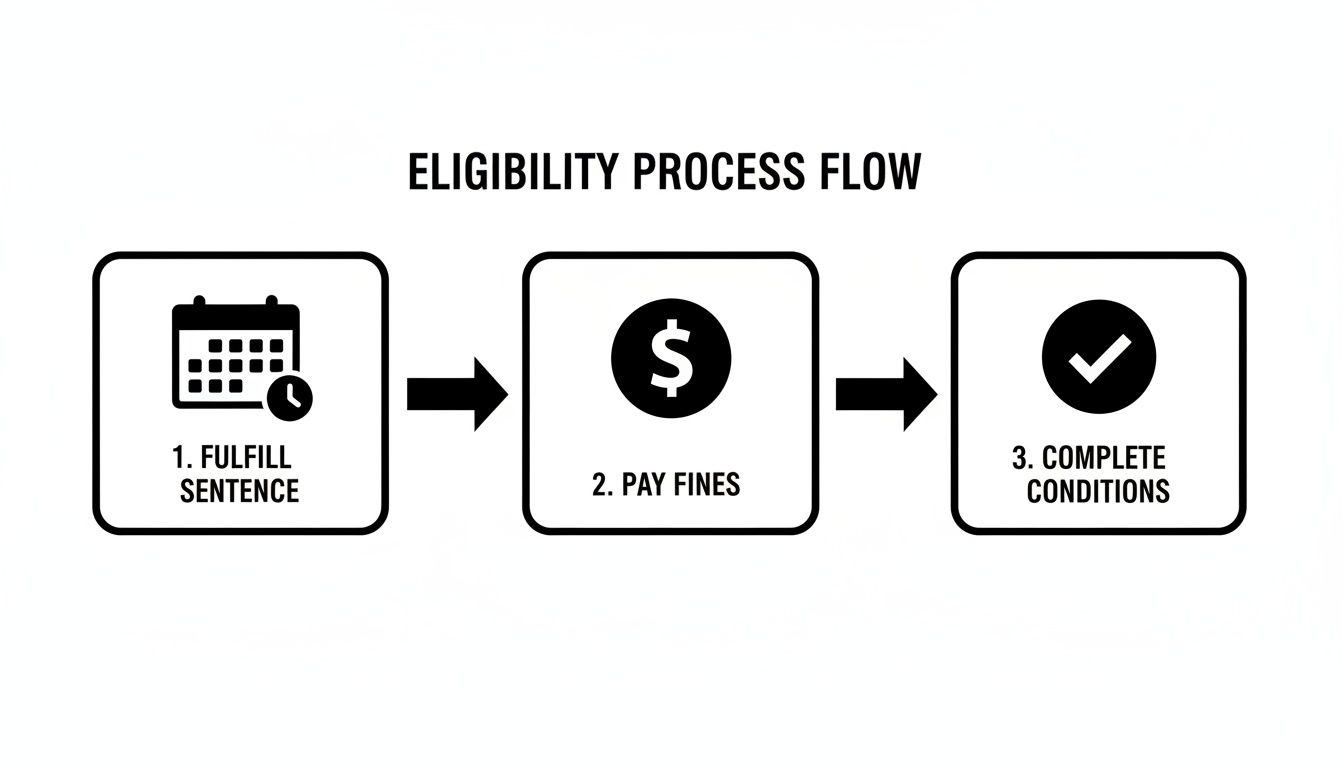
As you can see, hitting your required time on probation, paying off everything you owe, and finishing all your special conditions are the non-negotiable pillars of any successful request.
Drafting and Filing the Formal Motion
Once you have all your documents organized, the next step is to draft a formal “Motion for Early Termination of Probation.” This isn’t just a form you fill out; it’s a persuasive document. It tells the court why you may be a good candidate, details how all the requirements have been met, and highlights the positive life changes you’ve made.
This motion is then filed with the clerk of the same court that originally sentenced you. Filing it officially puts your request on the court's calendar and gets the ball rolling. The document should clearly and respectfully ask the judge to end your supervision early based on the evidence you've provided.
Involving the Prosecutor and Probation Officer
After the motion is filed, the judge will almost certainly want to hear from two key people: the prosecutor and your probation officer. What they think carries a lot of weight.
The court views the probation officer as its eyes and ears on the ground. A supportive recommendation from your officer, confirming your excellent compliance and positive attitude, can be one of the most influential factors in your favor.
The prosecutor will also review your case to see if the state has any objections. A common strategy involves communicating with both of them before a hearing is even set. By presenting your documents and addressing their concerns upfront, it's often possible to build a consensus that makes the judge's decision much easier.
The Court Hearing and Final Decision
The last step is often a court hearing. Here, the judge will review your motion, listen to any arguments, and make the final call. While some judges might grant a motion without a hearing, you should always be prepared to show up in court. The judge may want to ask you questions directly or hear from your probation officer.
If the judge agrees you've earned it, they will sign a court order that officially terminates your probation. That signed order is the document that sets you free from supervision. Once it's signed and filed with the clerk, your obligations are officially over, and you can finally move forward with your life.
What Judges Consider When Reviewing Your Motion
Meeting the bare-minimum requirements for early termination is really just the first step. It gets your motion through the courthouse door, but it’s no guarantee a judge will sign off on it. The final decision always comes down to a mix of hard facts and the overall impression you make. The judge needs to see who you are today, not just who you were on the day you were sentenced.
Think of it this way: the judge is a risk assessor. Their number one job is to protect public safety. They have to be convinced that letting you off supervision early won’t cause a new problem for the community. Every piece of information you provide helps them weigh the benefits against any potential risks.
Your Track Record on Probation
The single most important factor is how you’ve handled yourself while under supervision. This is the clearest evidence you can offer about your ability to follow rules and respect authority. A spotless record sends a powerful message that you’ve taken the court's orders seriously from day one.
Judges are going to look closely at your entire probation history. They’ll be asking:
- Have you had any violations? Any new arrests or even technical slip-ups—like a missed check-in or a failed drug screen—can be a major red flag.
- Do you always report on time? Punctuality and clear communication with your probation officer show you’re responsible.
- What is your attitude like? Your probation officer’s report often includes notes on your demeanor. A cooperative, respectful attitude goes a surprisingly long way.
A perfect or near-perfect probation record is your best asset. It shows you’ve done more than just stay out of trouble; you’ve actively followed every single rule. If you have had a minor issue, it's helpful to understand what happens when you violate probation, but a clean slate is always the goal.
The Nature of the Original Offense
The judge will always circle back to the reason you were put on probation in the first place. The seriousness of that original crime plays a huge role in their decision. They will consider if the offense was violent, if it involved a vulnerable victim, or if it seemed to be part of a bigger pattern of behavior.
For example, a judge is naturally going to look more favorably on a motion for a first-time, non-violent theft case than one tied to something far more serious. It’s not about re-trying the old case; it's about context. They are asking themselves if enough time has passed and if you’ve changed enough to outweigh the concerns raised by that original charge.
Evidence of Genuine Rehabilitation
Beyond just checking the boxes and following the rules, judges want to see real proof of positive change. They need to see that you've used your time on probation to build a stable, law-abiding life. This is where you get to show, not just tell, that you are a different person.
At its core, a judge’s decision hinges on one fundamental question: Has the purpose of the sentence been achieved? They are looking for compelling assurance that you are no longer a risk to the public and that continued supervision offers no further benefit.
Strong signs of real rehabilitation include things like:
- Stable Employment: Holding down a steady job shows responsibility and proves you’re a contributing member of society.
- Educational Advancement: Enrolling in school, finishing your GED, or getting a vocational certificate are all powerful indicators of self-improvement.
- Community Involvement: Volunteering, getting active in a local church, or mentoring others shows you’re committed to being a positive force.
- Strong Support System: Proving you have stable housing and supportive family and friends can also reassure a judge that you have a solid foundation to lean on.
Ultimately, your motion for early termination is your story. It’s the story of your progress, your commitment to doing better, and your readiness to move forward as a responsible citizen. When you can back that story up with solid proof, you give the judge the confidence they need to grant your request and finally close this chapter of your life.
Navigating Local Court Procedures in North Georgia
While Georgia state law sets the ground rules for early termination of probation, how your request is actually handled can feel worlds apart from one county to the next. Every courthouse, whether it's in Cumming, Marietta, or Johns Creek, has its own unique rhythm and unwritten rules. Knowing these local tendencies is a huge part of understanding the process.
Think of it like this: the state provides the map, but you still need to know the local traffic patterns. A shortcut that works in Forsyth County might be a dead end in Cobb County. Understanding how each specific court and prosecutor’s office operates is key.
Forsyth County and Cumming Procedures
The Forsyth County court system is known for being very structured and by-the-book. When a motion for early termination is filed here, the judge is going to put a lot of weight on the probation officer’s formal report. They want to see a clear, official picture of your compliance.
The prosecutor’s office in Forsyth County also does its homework. They will carefully review your file, looking at everything from your payment history on fines and restitution to the facts of the original offense. This is a jurisdiction where having every single piece of your documentation perfectly organized from the start is absolutely critical.
Cobb County and Marietta Procedures
The courts in Cobb County, including those serving Marietta and East Cobb, are busy. They handle a massive volume of cases. Because of this, the process often feels more collaborative, and a judge will pay close attention to whether the prosecutor is on board with the termination.
In a high-volume court, getting the prosecutor, probation officer, and defense attorney on the same page is a game-changer. When you present a unified front showing that everyone involved agrees you’ve been rehabilitated, it makes the judge’s decision that much easier.
A proactive approach often works best here. Getting supporting documents over to the prosecutor’s office well in advance gives them time to review everything without feeling rushed. In a fast-paced courthouse like Marietta's, that little bit of professional courtesy can make a real difference.
North Fulton County, Including Alpharetta, Roswell, and Johns Creek
Up in North Fulton, which covers cities like Alpharetta, Roswell, and Johns Creek, the courts often want to see more than just a checklist of completed tasks. They are looking for a compelling story of genuine change.
This means that things like letters of support, proof of a stable job, or evidence of community involvement can be incredibly persuasive. While the prosecutor's opinion is still vital, a strong, positive recommendation from your probation officer carries enormous weight in these courts. Success here isn’t just about following the rules—it’s about showing you’ve truly turned a corner.
How an Experienced Attorney Can Navigate the Process
While you can request an early termination of probation on your own, the process is much more than just filling out a form and hoping for the best. Having a seasoned attorney in your corner can make all the difference in how your case is presented—and ultimately, how it’s seen by the court. The goal isn't just to ask; it's to build a compelling story of your rehabilitation, and a skilled lawyer knows exactly how to tell that story.
The first thing an attorney will do is a deep dive into your case to make sure you actually meet all the established requirements. This simple step prevents wasting time and money on a motion that’s dead on arrival. They can spot potential roadblocks, like a forgotten fee or a missing certificate, and help you get everything squared away before you even file.
Crafting a Persuasive and Powerful Motion
The formal motion filed with the court is your single best shot at making a strong first impression. It’s not just a request—it’s a detailed argument explaining why you've earned the right to have your supervision end. A professional can draft this document to shine a spotlight on your accomplishments and frame your progress in the most positive way possible.
This involves a few key things:
- Gathering Compelling Evidence: They help you pull together all the necessary paperwork, from receipts showing you've paid everything off to powerful letters of recommendation from employers or community leaders.
- Telling Your Story: The motion will lay out the positive changes you’ve made, whether that’s holding down a steady job, going back to school, or getting involved in your community.
- Addressing Potential Concerns: If you had a few minor hiccups during your probation, an attorney knows how to frame them in a way that minimizes their impact and keeps the focus on your overall success.
Advocating on Your Behalf
Beyond just the paperwork, an experienced lawyer handles the critical conversations with the prosecutor and your probation officer. Getting these key players on board can often smooth out the entire process, making a judge’s final approval much easier. This is where relationships and a deep understanding of the system really matter.
Having a guide who understands the system from the inside out is a huge advantage. An attorney with a background as a former prosecutor knows exactly what the other side is looking for and can anticipate their questions or objections before they even come up.
This insider knowledge is invaluable for negotiating a good outcome and preparing you for any court hearing. If a hearing is necessary, your attorney will be the one standing before the judge, making the case for you, answering the tough questions, and reinforcing all the reasons your request should be granted. For more on choosing the right person for the job, you can find some valuable insights in our article on how to find a criminal lawyer in North Georgia.
Ultimately, having a professional guide ensures your petition isn't just technically correct, but truly persuasive. If you think you're a good candidate to get off probation early, a consultation can give you a clear, honest assessment of your situation and map out a path forward.
Frequently Asked Questions About Probation Termination
When you're thinking about ending probation early, a lot of specific questions pop up. Here are some answers to common queries, giving you a clearer picture of how things work in Georgia.
Can I Get Off Probation Early If I Still Owe Restitution?
This is a big one, and the short answer is almost always no. In Georgia, judges expect all financial obligations to be completely paid off before they’ll even consider an early termination request. That includes all your fines, court costs, and especially victim restitution.
Think of it from the judge's perspective: paying restitution is a core part of making things right. It shows you've taken responsibility for the offense and done what you could to compensate the victim. Leaving an unpaid balance is usually a non-starter for the court.
Does My Probation Officer Have to Agree?
Ultimately, the judge makes the final call. But realistically, your probation officer’s opinion carries a lot of weight.
Your probation officer gives the judge a firsthand account of how you’ve been doing. A glowing recommendation from them can be the tipping point that gets your motion approved. On the flip side, if they object, you’ve got a serious uphill battle. While a strong motion can sometimes overcome an officer’s objection, getting their support makes everything much smoother.
It's crucial to remember that the judge has the ultimate say. The probation officer offers a recommendation, but the court weighs every factor to decide if ending your probation early is the right move.
What If I Had a Minor Violation in the Past?
A past slip-up doesn’t automatically kill your chances, but it definitely makes things tougher. The judge will want to look closely at what happened—what the violation was, when it occurred, and how you've behaved since.
A missed appointment in your first month followed by two years of perfect compliance is a completely different story than a failed drug test last month. You have to show the court that the violation was an isolated incident, not a pattern of behavior. The goal is to build a case that your long, consistent track record of doing the right thing far outweighs that one mistake from the past.
Figuring out if you're a good candidate for ending your probation ahead of schedule means taking a hard, honest look at your entire case. For a straightforward assessment of where you stand, contact Brian Hansford Law. We can discuss your situation and see what options you have. You can find more information or schedule a consultation at https://challengemycharge.com.
