
When we talk about emancipation in Georgia, we're stepping back into the American Civil War and the historic process that brought an end to chattel slavery. It wasn't a single event where freedom was declared overnight. Instead, it was a slow, difficult journey made possible through military action, executive orders like the Emancipation Proclamation, and finally, the 13th Amendment in 1865.
This article walks through that monumental chapter in Georgia's history, focusing on the path from bondage to freedom for hundreds of thousands of people.
Understanding the Journey to Freedom
The road to freedom in Georgia was paved during the turmoil of the Civil War. Emancipation triggered a massive shift in the state’s social, economic, and political fabric, ending an institution that had defined life for generations. Freedom didn't arrive on one specific day that everyone agreed on; it was a complicated process that unfolded over several years. It was shaped by military campaigns, federal laws, and the incredible courage of enslaved people who seized their own freedom.
To really get what emancipation meant, you have to understand the sheer scale of slavery in Georgia. By 1860, on the eve of the war, there were about 462,198 enslaved people in the state, making up 44% of the entire population. This number had exploded over the previous decades, nearly tripling from 149,656 in 1820. Most were forced to labor in the fertile Black Belt region, where huge cotton plantations drove the economy. You can learn more about the scale of slavery in antebellum Georgia and its deep impact on the state's history.
Key Milestones on the Path to Emancipation
Several critical moments pushed the needle forward, each one building on the last to slowly tear down the institution of slavery. Three dates in particular stand out:
-
The Emancipation Proclamation (January 1, 1863): President Abraham Lincoln's executive order declared all enslaved people in Confederate-held territory were to be set free. Its immediate impact in Georgia was limited because there were no Union troops to enforce it, but it was a powerful statement that officially turned the war into a fight for liberation.
-
Union Army Advancement (1864-1865): As Union forces, especially under General William T. Sherman, marched through Georgia, they brought emancipation with them. For countless enslaved individuals, the sight of Union soldiers was their first real taste of freedom.
-
The 13th Amendment (December 18, 1865): This constitutional amendment formally and permanently abolished slavery across the entire United States. It made freedom the undeniable law of the land, no longer subject to the outcomes of war.
The timeline below helps visualize these pivotal events and how they fit together.
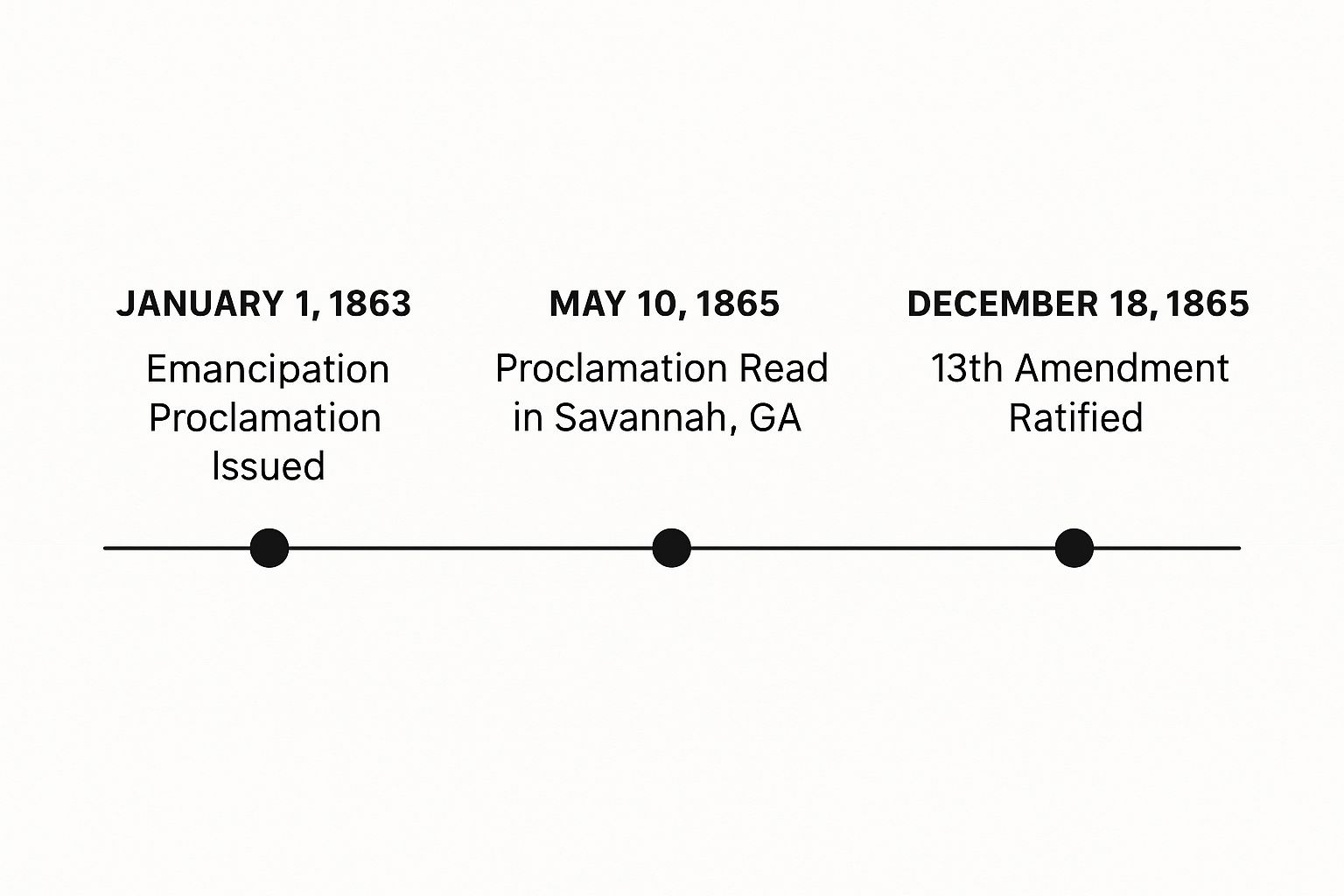
This process-oriented view shows that emancipation wasn't just a signature on a document; it was a nearly three-year struggle from presidential declaration to constitutional law.
The following table summarizes the pivotal events and their significance in the journey toward emancipation in Georgia.
Key Milestones in Georgia's Emancipation Timeline
| Event | Date / Period | Significance in Georgia |
|---|---|---|
| Emancipation Proclamation | January 1, 1863 | Symbolically declared freedom for enslaved people in Confederate territory, though enforcement in Georgia was delayed until Union troops arrived. |
| Sherman's March to the Sea | November 15 – December 21, 1864 | The advance of Union troops directly liberated thousands of enslaved Georgians, turning the proclamation's promise into reality for many. |
| 13th Amendment Ratification | December 6, 1865 | Formally abolished slavery nationwide, making freedom a permanent and legally binding constitutional right for all. |
| Georgia's Ratification of the 13th Amendment | December 9, 1865 | Georgia's official acceptance of the amendment, cementing the end of slavery within the state's own legal framework. |
Each of these steps represented a monumental leap forward, dismantling an institution that had been entrenched for centuries and reshaping the future of the state.
It is important to note that this historical exploration of emancipation from slavery is distinct from the modern legal concept of "emancipation of a minor." Our focus here is solely on the 19th-century historical events that reshaped Georgia and the nation. This article provides historical information and context, not guidance on contemporary legal matters.
The Unfolding Path to Freedom During the Civil War

For the hundreds of thousands of enslaved people in Georgia, freedom wasn't a single event. It didn't arrive with the stroke of a pen. Instead, emancipation was a dangerous and uncertain path they forged themselves during the chaos of the Civil War. The war itself became the engine of their liberation, turning a distant promise into a perilous, day-to-day reality.
As Union armies pushed deeper into the South, the institution of slavery began to fracture. For enslaved Georgians, the sight of federal troops on the horizon presented a life-altering choice. Staying on the plantation meant remaining under a system of brutal control. But fleeing meant risking everything for an unknown future, often with nothing more than the clothes they wore.
This was not a decision anyone took lightly. The act of self-emancipation—of freeing oneself—demanded incredible courage. Escapees had to navigate hostile territory, evade Confederate patrols, and face the constant threat of being recaptured and violently punished. Still, thousands took that chance, seeking safety behind Union lines and, in doing so, fundamentally changing the war itself.
Sherman's March and the Acceleration of Freedom
When General William Tecumseh Sherman’s army arrived in late 1864, the process of emancipation in Georgia kicked into high gear. His famous March to the Sea was more than just a military campaign; it was a wrecking ball that shattered the Confederacy's power to enforce slavery.
As Sherman’s troops carved a path from Atlanta to Savannah, an estimated 10,000 enslaved people abandoned their plantations to follow the army. They saw it as their only real path to freedom. This massive migration created huge logistical problems for the Union forces but also stood as a powerful symbol: the Confederacy was collapsing from within. The sheer number of newly freed people made it impossible to ignore the question of their future.
In the face of this growing humanitarian crisis, General Sherman issued a radical order. It offered a brief glimpse of a different future, highlighting how military necessity could trigger profound social change, even if the results didn't last.
This period was defined by both hope and incredible hardship. The army offered some protection, but the journey was filled with hunger, danger, and uncertainty. The stories from this time paint a picture of the amazing resilience of people who walked through a war zone to claim their own freedom.
Special Field Orders No. 15: A Controversial Promise
One of the most significant moments came with Sherman’s Special Field Orders No. 15, issued in Savannah on January 16, 1865. This order set aside a huge portion of confiscated coastal land in Georgia and South Carolina for the exclusive settlement of freed families. It famously promised "forty acres and a mule," a phrase that became a powerful symbol of hope for economic independence.
The order was a direct, practical response to the thousands of refugees trailing his army. It was a temporary solution to a very immediate problem.
- Land Allocation: The order designated 400,000 acres of coastal land, stretching from Charleston, South Carolina, down to Florida's St. Johns River.
- Self-Governance: It allowed these new settlers to build their own communities and govern themselves, without white interference.
- Immediate Impact: Thousands of families started settling this land, building new lives from scratch and creating a tangible vision of what freedom could actually look like.
But the promise was tragically short-lived. After President Lincoln was assassinated, President Andrew Johnson reversed the order, giving the land back to its former Confederate owners. This betrayal was a crushing blow to the newly freed population and laid the groundwork for decades of economic struggle.
After the Confederacy's defeat in 1865, Georgia began taking official steps toward emancipation. Slavery was legally abolished nationwide with the 13th Amendment, ratified on December 18, 1865. Around that time, more than 6,000 freed African Americans flocked to cities like Atlanta, and even more sought refuge in Savannah to escape ongoing violence and exploitation. You can explore more about the history of slavery in Georgia to get the full picture. The journey to freedom was just beginning, and the road ahead was filled with new challenges.
Navigating a New World After Emancipation
When the Civil War ended and the 13th Amendment was ratified, freedom wasn't a finish line. For Georgia's nearly half-a-million newly freed African Americans, emancipation kicked off a journey that was uncertain and often dangerous. It was a time of incredible hope but also massive challenges as they took on the huge task of building new lives from nothing.
The first thing on everyone's mind was family. Decades of slavery had ripped spouses, parents, and children apart, scattering them all over Georgia and the South. In the first days of freedom, there was a desperate, widespread push to reunite these broken families. People walked hundreds of miles, put ads in newspapers, and asked organizations like the Freedmen's Bureau for help—anything to find loved ones they hadn't seen in years.
This search for family was more than just a reunion; it was a powerful statement of identity and humanity. It was a direct rejection of a system that had treated people like property and denied them the basic right to a family.
Building the Pillars of a New Community
As families slowly found each other, the next step was to build the foundations of a stable community. Before emancipation, enslaved people had zero control over their own institutions. Now, they moved quickly to create the two pillars that would become the heart of Black life in Georgia: independent churches and schools.
Black churches, free from the watch of white masters, were the very first truly independent Black-owned institutions. They were so much more than places to worship; they became community centers, political organizing hubs, and a source of leadership and support. This is where people organized, shared news, and found the strength to deal with the daily struggles of their new reality.
The desire for an education was just as strong. Denied the right to read and write under slavery, freedpeople of all ages flooded into newly created schools, which were often set up in church basements or rough-hewn cabins. The hunger for knowledge was powerful because education was seen as the clearest path to real freedom and opportunity. Groups like the American Missionary Association and the Freedmen's Bureau helped start hundreds of schools, but the real drive came from the communities themselves.
The creation of these institutions was a powerful sign of the incredible resilience and vision of a people determined to shape their own futures. It proved that freedom wasn't just about losing the chains but about building a community and having control over your own destiny.
The Rise of Sharecropping and Economic Entrapment
While freedpeople made huge gains in building their social and cultural institutions, economic freedom was still painfully out of reach. The dream of "forty acres and a mule"—a promise of land redistribution—was quickly shut down, leaving most Black Georgians without land or money.
This economic void led to the rise of the sharecropping system. At first glance, it looked like an improvement over slavery. Families could rent a plot of land from a white landowner, farm it, and get a share of the crop as payment.
In reality, though, it was often just a new kind of slavery.
- Cycles of Debt: The landowners, who were almost always the former slaveholders, set all the terms. They charged incredibly high prices for tools, seeds, and food, all provided on credit.
- Unfair Contracts: Since most freedpeople couldn't read, they were forced to sign contracts that were heavily skewed in the landowner's favor.
- Lack of Control: At the end of the year, after the landowner took his share and subtracted the debts, the sharecropper was often left with almost nothing—or even deeper in debt than when they started.
This system effectively trapped millions in a cycle of poverty and dependence, making it impossible to build wealth or gain true economic independence. This new reality showed how freedom could exist on paper but be choked by an unfair economic and legal system. If you're interested, you can explore more about how the complexities of the modern legal system operate today. The fight for economic justice after emancipation in Georgia would go on for generations, proving that the struggle for true freedom had only just begun.
Building Communities and Facing New Barriers

As the dust settled from Reconstruction, it became clear that the promises of emancipation in Georgia weren't going to be fully kept. But this didn't crush the spirit of progress. Instead, African American communities looked inward, channeling their energy into building the very institutions that would sustain them for generations. This era saw the birth of Black-owned businesses, mutual aid societies, and cultural hubs that became the foundation of a new, self-reliant identity.
Nowhere was this drive more powerful than in the pursuit of education. Understanding that knowledge was the real key to autonomy, communities pooled their scarce resources to build their own schools. This grassroots effort led to the creation of some of the nation's most respected Historically Black Colleges and Universities (HBCUs), right here in Georgia. Powerhouses like Morehouse College and Spelman College in Atlanta quickly became beacons of intellectual and cultural life, shaping the minds of future leaders, thinkers, and activists.
These weren't just schools; they were sanctuaries. They offered a space where Black Georgians could chase excellence, develop leadership skills, and celebrate their heritage without the crushing weight of a hostile society. It was a remarkable period of community-building against nearly impossible odds.
The Rise of Jim Crow and Systematic Oppression
Even as these communities were making incredible strides, a violent and powerful backlash was brewing. The progress made during Reconstruction was met with fierce opposition from white Southerners intent on clawing back control. This resistance took legal form as Jim Crow laws—a tangled web of state and local statutes crafted to disenfranchise African Americans and enforce rigid racial segregation.
These laws methodically tore down the political and social gains of the post-emancipation era. They created a society where Black Georgians were legally pushed into second-class status, forced to use separate and deeply unequal facilities for everything from public transit and schools to housing and healthcare.
The enforcement of these laws was often brutal, backed not just by the state but by vigilante violence. To truly grasp how the fight for freedom was far from over, it's essential to understand the scope of these oppressive measures. For more context on how such laws operate within the justice system, you can explore information about https://challengememycharge.com/tag/georgia-criminal-law/.
The Jim Crow era was a calculated effort to undo the progress of emancipation. It was not just about social segregation; it was a comprehensive system designed to strip Black Georgians of their political power, economic opportunity, and basic human dignity.
Violence and the Great Migration
The enforcement of Jim Crow was frequently punctuated by horrifying acts of racial violence. Events like the 1906 Atlanta Race Riot were a stark reminder of the constant danger Black communities endured. This savage, multi-day massacre saw white mobs attacking Black residents and burning their businesses, sending a clear and brutal message: economic success or social progress would be met with violence.
Facing this suffocating new system of oppression, many Black Georgians started looking for a way out. This was the beginning of the Great Migration, a mass movement of African Americans from the rural South to the industrial cities of the North. The broken promises of emancipation—economic freedom, political voice, and personal safety—pushed hundreds of thousands to leave their homes behind in search of something better.
By 1900, Georgia had the largest African American population in the South, with over 1,034,813 Black residents. Of these, an estimated 22% were old enough to have been enslaved before 1865. This huge population shaped the state's culture and politics, but the relentless violence and lack of opportunity fueled an exodus that would reshape the demographics of the entire nation. This migration was a direct response to the failure of emancipation to deliver true freedom, marking yet another chapter in the long, painful struggle for equality.
Historical Versus Modern Emancipation Concepts
When you search for "emancipation in Georgia," it's easy to get tangled up in two very different topics that just happen to share the same name. One is a monumental event in American history, and the other is a modern legal process for teenagers.
This article is focused squarely on the 19th-century historical emancipation from slavery. To avoid any confusion, let’s draw a clear line in the sand between these two ideas right from the start.
The historical emancipation we're discussing here is the end of chattel slavery in Georgia during and after the American Civil War. This was a massive, society-altering event that freed nearly half a million enslaved people in our state alone. It was driven by war, presidential decrees, and constitutional amendments that forever changed the course of the nation.
On the other hand, there's a modern legal proceeding called the emancipation of a minor. This is a court process where a person under 18 can be granted some of the legal rights and responsibilities of an adult, allowing them to live independently from their parents. It's a specific, individual court action and is completely unrelated to the historical events of the 1860s.
Distinguishing Between Two Worlds
Understanding the difference is crucial. Think of it like the word "crane." One is a bird, the other is a piece of construction machinery. They share a name but exist in totally different worlds. It's the exact same situation with these two types of emancipation.
Historical emancipation was a collective liberation of an entire population, aimed at dismantling a brutal economic and social system. Modern emancipation is an individual petition to a court, based on a single minor's personal circumstances.
It is critical to recognize that this guide provides historical information only. We are exploring the events of the 1860s and their aftermath, not the requirements or steps involved in the modern legal process for minors.
To make this distinction crystal clear, the table below offers a side-by-side comparison. It’s designed to reinforce the purely historical focus of this article.
Historical Emancipation vs. Modern Emancipation of a Minor
| Aspect | Historical Emancipation (19th Century Georgia) | Modern Emancipation (Of a Minor) |
|---|---|---|
| Who It Affects | The entire enslaved African American population. | An individual person under the age of 18. |
| Context | The American Civil War and the abolition of slavery. | Contemporary family and juvenile court systems. |
| What It Grants | Freedom from chattel slavery and legal recognition as a person. | The legal rights and duties of an adult, such as signing contracts. |
| How It Happens | Through military action, executive orders, and the 13th Amendment. | A court petition process initiated by the minor. |
| Primary Goal | To end the institution of slavery. | To grant a minor legal independence from parental control. |
| Scope | A nationwide, societal transformation. | An individual, case-by-case determination. |
This distinction is important not just for historical accuracy, but to make sure you're on the right track with your own research. Anyone looking for information on the modern process for minors needs to explore current state statutes and court procedures.
For a deeper dive into how different aspects of Georgia law function today, you can find valuable context in related legal resources. This article, however, will stick to the 19th-century journey from bondage to freedom.
The Enduring Legacy of Freedom
The story of emancipation in Georgia isn't about a single day or a simple decree. It's a powerful saga—a difficult, drawn-out struggle where freedom was seized with courage, pushed forward by armies, and finally written into law.
As we've seen, the path from bondage wasn't instant. It was a journey filled with both incredible hope and profound hardship, from the chaos of war to the disappointments of Reconstruction.
This history is truly defined by the incredible resilience of newly freed individuals. They were faced with overwhelming odds, but they didn't just survive; they built.
From the ashes of slavery, they forged new families. They established independent churches that became the cornerstones of their communities and founded schools to chase the education that had been denied to them for so long. This determination in the face of systemic opposition is the real heart of the emancipation story.
The Ongoing Pursuit of Equality
Understanding this complex history is absolutely essential. It reminds us that the fight for freedom didn't just end in 1865. The challenges that freedpeople faced laid the groundwork for future generations' struggles for civil rights and justice.
The legacy of emancipation is a testament to the enduring power of the human spirit to seek liberty and build a future against all odds. It serves as a crucial reminder that the pursuit of true equality is a continuous journey, one that requires our constant attention and commitment.
This chapter of American history reinforces a vital lesson: building a more just society demands that we honestly confront our past. By acknowledging the long and difficult road from enslavement to freedom, we can better appreciate the work that's still required to fulfill the promise of liberty and justice for all.
This isn't just about the past. This history shapes our understanding of the present and our responsibilities for the future.
Frequently Asked Questions
Digging into the complex history of emancipation in Georgia often brings up a lot of questions. This section cuts straight to the point, offering clear answers to some of the most common inquiries about this critical time in our state's past.
Think of it as a quick reference to help clarify the timeline, the immense challenges, and the key definitions you'll encounter.
When Did Emancipation Officially Happen in Georgia?
There wasn't a single day when freedom arrived for everyone in Georgia; it was a slow, unfolding process. While President Lincoln issued the Emancipation Proclamation on January 1, 1863, its power was limited. The proclamation only applied to Confederate-held territories, meaning it couldn't be enforced in Georgia until Union troops physically arrived to make it a reality.
The real turning point was General William T. Sherman's March to the Sea in late 1864, which brought liberation to large parts of the state. Freedom finally became universal and legally binding with the surrender of the Confederacy in 1865, followed by the nationwide ratification of the 13th Amendment on December 18, 1865. That was the final, undeniable end to slavery in Georgia and across the country.
What Were the Biggest Challenges for Freedpeople After Emancipation?
For the newly freed, the end of slavery was just the beginning of another monumental struggle. The challenges they faced were overwhelming, touching every single part of their lives—from making a living to simply staying safe.
- Economic Hardship: Most formerly enslaved people started their new lives with absolutely nothing. They had no land, no money, and no resources, which pushed many right back into a system of sharecropping. This often trapped them in an endless cycle of debt to the very same landowners who had once enslaved them.
- Social and Physical Threats: Freedom was met with brutal resistance. White supremacist groups like the Ku Klux Klan used terror and violence to intimidate Black communities, while a wave of discriminatory "Black Codes" was passed to control their labor and movement.
- Political Disenfranchisement: For a brief period during Reconstruction, Black men gained the right to vote. But that progress was quickly and violently rolled back through poll taxes, literacy tests, and other voter suppression tactics designed to strip them of any political voice.
These obstacles built a new system of oppression that would take generations of struggle to begin to dismantle.
The aftermath of emancipation teaches a hard lesson: legal freedom is not the same as true liberty. The fight for economic justice, physical safety, and a political voice became the next chapter in the long journey toward equality.
What Is the Difference Between Historical Emancipation and Emancipation of a Minor?
It's really important not to confuse these two terms, as they are completely unrelated concepts that just happen to share a name.
Historical emancipation refers to the 19th-century movement that abolished the institution of chattel slavery. This was a massive societal event that freed an entire population from bondage, and it's the sole focus of this article.
On the other hand, the "emancipation of a minor" is a modern legal action. It’s a court process where someone under the age of 18 is granted the legal rights and responsibilities of an adult, freeing them from the control of their parents. The two terms come from entirely different contexts and have nothing to do with one another.
At Brian Hansford Law, we understand that navigating complex legal situations can be challenging. While this article focuses on historical events, if you are facing criminal charges in Georgia today, having an experienced advocate on your side is critical. To learn how over 25 years of legal experience can help protect your rights and your future, visit us at https://challengememycharge.com.
