
To get a real-world feel for entrapment, picture this: someone with absolutely no criminal record or desire to sell drugs gets hounded for weeks by an undercover officer. The officer doesn't just present a one-time opportunity; they apply constant pressure, play on sympathies, and basically refuse to take no for an answer. This isn't just setting a trap—it's manufacturing a crime that was never going to happen otherwise. That's the heart of this complex topic.
What Entrapment Looks Like in the Real World
"Entrapment" is a word thrown around a lot in movies and TV shows, but in a real courtroom, it has a very specific meaning. It happens when law enforcement doesn't just catch someone in the act but actually persuades, coerces, or pressures them into breaking the law when they had no previous intention of doing so. The critical difference is whether police are setting a trap for the "unwary innocent" versus the "unwary criminal."
A legitimate police investigation, often called a sting operation, is perfectly lawful. It simply provides a chance for someone who is already willing to commit a crime to do so. For example, if an undercover officer poses as a buyer and asks to purchase drugs from a known dealer, that's not entrapment. The dealer was already predisposed to that criminal activity; the officer just provided the opportunity.
The Landmark Case of Jacobson v United States
For a clear-cut example of entrapment, we can look at a famous U.S. Supreme Court case that really set the standard. In the 1992 case of Jacobson v. United States, a man named Keith Jacobson received persistent mailings from undercover government agents for 26 months. The mailings promoted child pornography, and despite Jacobson showing no prior interest or criminal history, he eventually gave in to the relentless pressure and ordered materials.
The Supreme Court overturned his conviction. Their reasoning was that the government's prolonged and aggressive actions went too far, effectively manufacturing a crime instead of just uncovering one.
The core issue in entrapment is not whether the defendant committed the crime, but whether the government’s conduct implanted the criminal design in the mind of an otherwise innocent person.
Differentiating Entrapment from a Lawful Sting
It is absolutely crucial to understand the line between lawful police work and unlawful government inducement. A sting operation is designed to catch criminals who are already out there. Entrapment, on the other hand, creates criminals out of people who wouldn't have otherwise broken the law.
This flowchart helps visualize the fundamental differences between an acceptable sting operation and illegal entrapment.
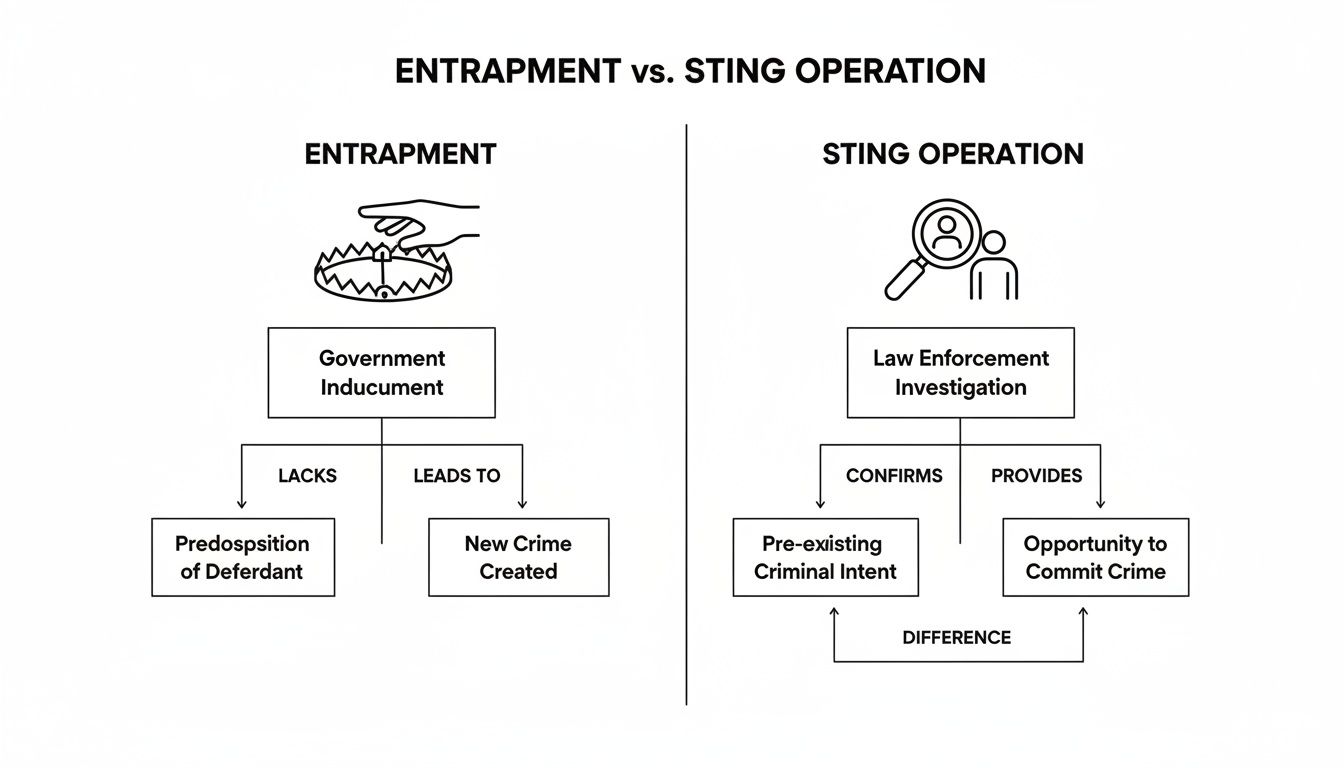
As you can see, the key factor is pre-existing intent. A sting operation targets someone who already has that criminal intent. Entrapment involves the government creating that intent through improper pressure or persuasion.
To help you get a better handle on this, the table below breaks down the key differences at a glance.
Sting Operation vs. Entrapment At a Glance
| Characteristic | Lawful Sting Operation | Illegal Entrapment |
|---|---|---|
| Target's Mindset | The person is already willing and ready to commit the crime. | The person is not inclined to commit the crime until pushed by law enforcement. |
| Government's Role | Provides an opportunity for a crime to happen. | Induces, coerces, or persistently persuades the person to act. |
| Source of Intent | Originates from the individual's own predisposition. | Implanted by the government's actions. |
| Outcome | Evidence is admissible, and the investigation is valid. | Can be used as an affirmative defense, potentially leading to acquittal. |
Recognizing this distinction is the first step in knowing when law enforcement may have crossed a serious boundary.
Scenarios that might point toward entrapment often involve a combination of these elements:
- Excessive Pressure: This isn't just a simple request. It includes repeated badgering, threats, appeals to sympathy, or offers so extreme that a reasonable person would find them hard to resist.
- Creating the Crime: The government agent doesn't just suggest the crime; they provide all the essential tools, develop the plan, and supply the motivation from scratch.
- Targeting the Unwilling: The individual initially says no or shows a clear lack of interest in the criminal activity before the government's intervention begins.
Ultimately, a true example of entrapment shows law enforcement officers going beyond their role as investigators and becoming the creators of the crime itself. The entrapment defense exists as a critical check on government power, making sure people are prosecuted for their own criminal intent—not for caving to improper official persuasion.
Understanding the Two Pillars of an Entrapment Defense
An entrapment defense isn’t as simple as saying, “the police set me up.” It’s a specific argument that has to be built on two foundational pillars: government inducement and the defendant's lack of predisposition. If both cannot be shown, the whole defense is likely to fall apart.
At its core, the defense claims that law enforcement didn't just stumble upon a crime in progress—they actually manufactured it. This means showing that the police went way too far and, just as importantly, that the individual was not the kind of person looking to break the law anyway.
The First Pillar: Inducement by the Government
The first part of the argument, inducement, is all about the government's actions. It’s not enough for an undercover officer to simply offer someone a chance to commit a crime. For example, if an agent walks up to someone and asks to buy drugs, that’s just providing an opportunity. It isn't inducement.
Inducement requires something much more forceful—a level of persuasion or pressure that a normal person wouldn't offer. This could look like:
- Persistent Pressure: The officer just won't take "no" for an answer, calling or showing up repeatedly over days or weeks.
- Threats or Harassment: Law enforcement hints that bad things will happen if the person doesn't go along with their criminal plan.
- Appeals to Sympathy: The agent makes up a sob story about needing money for a sick child or some other emergency to emotionally manipulate the target.
- An Excessive Offer: The money or reward promised is so ridiculously high that it would tempt even an ordinary, law-abiding citizen to consider it.
The goal here is to demonstrate that the police tactics were so aggressive or manipulative that they essentially steamrolled the person's own judgment.
The real question isn't whether the government gave someone a chance to commit a crime. It's whether their conduct was so persuasive that it actually created the criminal idea in the mind of a person who was otherwise innocent.
The Second Pillar: Lack of Predisposition
This second pillar, lack of predisposition, shifts the focus entirely to the defendant's mindset before any law enforcement officer ever got involved. Honestly, this is often the tougher part of the defense to prove. The key question is: Was this person already inclined to commit this kind of crime?
Courts look at several factors to figure this out:
- Prior Criminal History: Does the person have a rap sheet with similar offenses? A history of dealing drugs makes it pretty hard to argue you weren't predisposed to sell them again.
- Initial Hesitation: Did the person immediately say no or show a lot of reluctance when the idea was first brought up? This can be powerful proof that they weren't predisposed.
- Ready Response: On the other hand, did the person jump at the chance and eagerly agree to the plan? A quick "yes" suggests a pre-existing willingness.
- Knowledge and Skills: Did the individual already have the know-how, equipment, or contacts to pull off the crime without the officer's help?
For an example of entrapment to stick, the defense has to successfully argue that the individual was an "unwary innocent"—not an "unwary criminal" just waiting for a chance. The argument paints a picture of someone who would have gone on living a law-abiding life if the government hadn't intervened so aggressively. The specific rules and how they're applied can get complicated, especially when you look at the nuances of criminal defense law in Georgia. But without both of these pillars firmly in place, it can be difficult to build a defense showing the crime started with the government, not the individual.
How Georgia Law Specifically Defines Entrapment
If you're facing a criminal charge, you might hear the term "entrapment" and assume it means the same thing everywhere. That's a common mistake. Georgia actually carved out its own unique path on this defense, and it’s a path that looks very different from the federal standard used in many other states. Getting this distinction right is absolutely critical because it completely changes how an entrapment defense is built.
While federal courts use a "subjective" test—focusing on the defendant's state of mind and whether they were already inclined to commit the crime—Georgia takes a different route. The state uses what’s known as an "objective" standard.
What does that mean? It means the spotlight isn't on the defendant's past or potential motives. Instead, it shines directly on the actions of the police or their informants.

The Objective Standard Explained
Under Georgia's objective standard, the court asks one powerful question: was the conduct of law enforcement so over the top that it would have persuaded an ordinary, law-abiding person to commit the crime? This reframes the entire argument. It’s less about proving you were an "unwary innocent" and more about demonstrating that the government's tactics were just plain wrong.
Think of it this way. Imagine a government informant hounds someone to get involved in a fraudulent deal. The person has a clean record and says no, repeatedly. But the informant doesn't stop. They invent a sob story about a sick child needing surgery, creating immense emotional pressure until the person finally breaks down and agrees.
In Georgia, a court would likely see this as a classic example of entrapment. The reason isn't because the defendant was a saint, but because the informant's manipulative pressure was so extreme that it could have tricked a typical, non-criminal person into breaking the law.
This objective view acts as a vital check on police power. It's designed to stop law enforcement from going beyond investigating crime and starting to manufacture it.
How This Differs From the Federal Subjective Test
The gap between Georgia’s objective standard and the federal subjective test is huge, and it affects every part of a criminal defense strategy. The subjective test essentially puts the defendant's character on trial. Georgia’s objective test puts the government's behavior under the microscope.
Here’s a simple breakdown of the core differences:
| Standard Type | Primary Focus | Key Question | Defendant's Past |
|---|---|---|---|
| Georgia's Objective Test | The actions of law enforcement. | Would an ordinary person have been induced by the government's conduct? | The defendant's criminal history is far less relevant. |
| Federal Subjective Test | The defendant's state of mind. | Was the defendant already predisposed to commit this crime? | The defendant's criminal history is often a central piece of evidence. |
This isn't a minor detail—it's a game-changer. Someone with a prior drug offense would have a tough time claiming entrapment in federal court, as a prosecutor would just point to their record as proof of "predisposition." But in a Georgia state court, that same person could have a very strong case if they can show the police used coercive, aggressive, or deceptive tactics to set them up.
What Georgia Courts Look For
When a Georgia judge hears an entrapment claim, they zero in on the specific methods used by law enforcement. The defense has to show that the government's tactics created a "substantial risk" that someone not otherwise ready to break the law would be pushed into doing so.
Here are some examples of police conduct that could meet Georgia's standard for entrapment:
- Undue Persuasion or Flattery: Going way beyond a simple offer to emotionally manipulate someone or build a false sense of friendship.
- Fraudulent Representations: Outright lying about why they need help or what the criminal act actually involves.
- Coercive Tactics or Threats: Using intimidation—whether spoken or implied—to force someone to comply.
- Appeals to Sympathy: Exploiting a person’s compassion with made-up stories of personal hardship.
At the end of the day, Georgia law is structured to make sure people are convicted for their own criminal choices, not for crimes that were dreamed up and manufactured by the government. This objective standard provides a powerful line of defense when police overstep their boundaries in communities from Cumming and Alpharetta to Marietta and across Cobb County.
Common Scenarios Where an Entrapment Defense May Arise
The idea of entrapment can feel a bit theoretical, but it plays out in very real situations every day. This defense isn't just for one type of crime; it can pop up in any case where police cross the line from investigating a crime to manufacturing one. Learning to spot these patterns is the first step in understanding how a legitimate sting operation can go wrong.
Most often, entrapment claims surface in cases involving undercover work. It’s in these situations that the boundary between observing criminal activity and actively encouraging it can get dangerously blurred. It forces us to ask not just what happened, but how and why it happened.
Drug Stings and Undercover Buys
Drug investigations are the classic breeding ground for entrapment claims. An undercover officer simply offering to buy drugs from someone known to be a dealer isn't entrapment. That’s just providing an opportunity. But the whole picture changes when that officer stops being a passive buyer and becomes an active, aggressive motivator.
Let's look at an example. Imagine a college student, "Alex," with a clean record and no history of selling drugs. An undercover cop, posing as a classmate, befriends Alex. Over the next few weeks, the officer constantly complains about being broke and repeatedly begs Alex to help sell a small bag of weed "just this one time" to make rent.
Alex says no, again and again, making it clear they're not interested. But the officer is relentless, dialing up the pressure with sob stories about getting evicted. Finally, worn down by the constant emotional appeals, Alex gives in. That’s not an opportunity; that's a crime created entirely through persistent, manipulative pressure.
Online Solicitation and Cybercrime Stings
The internet has opened up a new frontier for police stings, but it's also created new ways for law enforcement to overreach. Investigations into cybercrime, especially those on forums or messaging apps, can easily become traps if agents aren't careful.
Consider this: "Jordan" is a member of an online coding forum. An undercover agent joins the group and starts a conversation, praising Jordan's programming skills. The agent then floats the idea of using those skills to hack into a company's database for a big payout.
Jordan immediately says it's illegal and they want no part of it. Instead of backing off, the agent spends the next month building a fake friendship, offering to teach Jordan advanced hacking skills and framing the whole thing as a victimless prank on a faceless corporation. The agent supplies the target, the software, and the step-by-step plan. They essentially hold Jordan's hand until they finally agree.
This type of scenario demonstrates a key element of entrapment: law enforcement not only suggests the crime but also provides the means, motive, and expertise that the target originally lacked.
This isn't just a local issue. In 2020, an international sting called Operation Carding led to the arrest of 24 hackers across 13 countries. Undercover agents posed as buyers and partners to lure suspects into committing cybercrimes. Operations like this walk a fine line, highlighting the very real risk of entrapment when there's no clear international standard for these tactics. You can read more on the complexities in a piece from the Chicago Journal of International Law.
Prostitution Investigations
Prostitution stings are another area where entrapment is a common concern. An officer posing as a potential client or a sex worker is a standard police tactic, but it's how they engage that makes all the difference. A straightforward offer is one thing. Coercive, deceptive, and relentless persuasion is something else entirely.
Here's how a prostitution sting could cross the line into entrapment:
- An officer starts a conversation on a dating app.
- The chat is friendly and normal at first.
- The officer steers the topic toward exchanging money for sex, but the other person says no.
- The officer then changes tactics, inventing a story about being lonely and just wanting company, offering money simply to hang out.
- Once they meet in person, the officer becomes aggressive, pressuring them to accept more money for a sexual act and making them feel trapped until they reluctantly agree.
In every one of these examples—drug buys, cybercrime, and prostitution stings—the government agent shifts from being an investigator to an instigator. They aren't just finding a crime; they are creating one where none would have existed otherwise.
Potential Entrapment Indicators in Common Sting Operations
It's helpful to see how these tactics play out across different types of investigations. The table below outlines common stings and the red flags that suggest law enforcement may have crossed the line from providing an opportunity into outright entrapment.
| Type of Sting Operation | Potential Red Flag for Entrapment |
|---|---|
| Drug Buys | An officer repeatedly badgers someone who initially refused, using sympathy pleas or threats to wear them down. |
| Online "John" Stings | An undercover agent initiates sexually explicit conversation and continues to push for an exchange of money for sex after being rejected. |
| Child Solicitation Stings | An agent posing as a minor aggressively pursues an adult, initiates sexual topics, and overcomes their initial lack of interest. |
| Cybercrime ("Hacking") Stings | An agent provides the target, the software, and the specific instructions to someone who otherwise lacked the skills or intent to commit the crime. |
| Illegal Firearm Sales | Law enforcement supplies a prohibited weapon to an individual who was not seeking one and had no prior intent to obtain one illegally. |
| White-Collar Crime | An undercover agent creates a fake "can't-miss" business opportunity and relentlessly pressures a target to commit fraud. |
Remember, the presence of one of these indicators doesn't automatically mean entrapment occurred. However, they are powerful signs that the government's conduct needs to be scrutinized by an experienced defense attorney. The key is whether the crime originated with the defendant or with the government agent.
What to Do If You Suspect You Were Entrapped
That feeling of being set up by law enforcement can be overwhelming. If you think police unfairly pressured or coerced you into committing a crime you otherwise wouldn't have, the steps you take next are absolutely critical. This isn't just about feeling wronged—it's about understanding your options.
The very first thing you need to do is write everything down. Memories get fuzzy, especially under stress, and the small details can make or break an entrapment defense.
Document Everything Immediately
Preserving the facts is your top priority. As soon as you possibly can, create a detailed record of every single interaction you had with the law enforcement officers or their informants. Don't summarize; be as specific as you can recall.
Think about these points as you create your timeline:
- Dates and Times: When exactly did each conversation or meeting happen?
- Locations: Where did these interactions take place? Be precise.
- Communication Methods: Were they text messages, phone calls, in-person meetings, or online chats?
- Specific Words: What was actually said? Write down any threats, promises of reward, or pleas for sympathy. Crucially, note how many times you said no or showed hesitation.
- Witnesses: Was anyone else there? Did anyone see or hear what happened?
If you have any physical proof—like text messages, emails, or voicemails—save them somewhere safe. This kind of evidence provides a concrete picture of what happened and is a vital part of understanding how to address these situations.
The heart of an entrapment defense often comes down to showing a clear pattern of government inducement. A detailed timeline, complete with specific quotes and repeated contacts, can be the most powerful tool you have to prove the pressure was persistent and crossed a line.
Exercise Your Right to Remain Silent
After an arrest, you have the right to remain silent. It is often wise to use it. Police officers are trained to ask questions designed to get you talking, and anything you say can be misinterpreted or used against you.
Even if you feel you have a textbook example of entrapment, trying to explain your side of the story to the police without professional assistance is a huge risk. Statements made under stress can come out jumbled and may only complicate things. Politely state that you are exercising your right to remain silent and that you want to speak with a professional.
Seek Professional Guidance Promptly
An entrapment defense is complex, especially when you consider the different standards between federal and Georgia state law. This is not something to navigate alone. An experienced criminal defense attorney can dive into the details of your situation and analyze whether law enforcement's conduct was problematic.
Here’s what you can expect that process to look like:
- Initial Consultation: You’ll share your detailed account of what happened, using the notes you took.
- Case Analysis: A professional will measure the facts of your case against the specific standards for entrapment.
- Strategy Development: Based on the evidence, they can start explaining potential defense strategies tailored to your situation.
Taking these deliberate, thoughtful steps is the best way to handle the situation. It all starts with careful documentation, exercising your right to silence, and getting the right guidance to see you through the process.
How an Experienced Attorney Investigates an Entrapment Case
Building an entrapment defense isn’t some "aha!" moment you see on TV. It's a methodical, often grueling, process of taking the government's case apart, piece by piece. A professional's goal from day one is to shift the spotlight off their client and squarely onto the actions of law enforcement.
It all starts with what’s called discovery—the evidence the prosecutor provides. It is not just skimmed. It is examined in detail. This means a line-by-line review of every police report, scrutinizing hours of audio and video, and mapping out every single text, call, and conversation between the client and the undercover officer or their informant. What is being looked for are the little things that tell the real story: the client's hesitation, their initial refusals, and the constant, relentless pressure from the government's agent.

Uncovering the Facts Through Various Tools
You can't just take the prosecution's word for it. Every tool available must be used to dig deeper and find what they didn't include in that initial file. This is where a proactive defense can completely change the game.
Here are some of the key steps that are taken:
- Filing Discovery Motions: These are demands filed with the court. They are used to compel the prosecution to hand over things they might prefer to keep hidden, like an informant's payment records, their criminal history, or internal police memos about the sting operation.
- Interviewing Witnesses: Work begins immediately to find and talk to people who knew the client before law enforcement ever showed up. These are the friends, family, or coworkers who can testify about their character and state of mind, which is crucial for showing they weren't predisposed to commit the crime.
- Subpoenaing Records: Subpoenas can be issued to get phone records, social media messages, and other documents. This helps build a detailed timeline that shows exactly how often the government was contacting the client and how aggressive their tactics were.
Much of this work is laying the foundation for a motion to suppress evidence. This is a powerful argument asking a judge to throw out illegally obtained evidence, which can sometimes cripple the prosecution's case.
Analyzing the Conduct of Informants and Officers
A huge part of an investigation is putting the government’s agents under a microscope. This is especially true when they use a confidential informant, or CI. These individuals are often working to get a lighter sentence on their own charges or for cash payments. That gives them a massive incentive to deliver arrests, even if they have to bend or break the rules to do it.
An experienced attorney will dig into the informant's entire background—their deal with the police, how much they were paid, and their track record on other cases. If a pattern of manufacturing crimes or pushing people too far can be shown, it becomes a powerful argument for entrapment.
Ultimately, a deep-dive investigation is all about answering one fundamental question: was this crime the client’s idea, or was it planted in their head by the government? By meticulously gathering every report, recording, and witness statement, a compelling narrative can be built to show that law enforcement didn't just investigate a crime—they created one.
Common Questions About Entrapment
When you're trying to understand an entrapment defense, a lot of specific questions come up. The line between a legitimate police sting and illegal government coercion can feel blurry, which leads to some common confusion about what makes for a valid defense. Let's clear up a few of the most frequent questions.
Keep in mind, these answers break down complex situations into simpler ideas, but every single case is different.
Is It Entrapment if an Officer Offers to Sell Me Drugs?
Generally, no. A simple, one-time offer from an undercover officer to sell you drugs is almost always seen as a standard investigative tactic. The courts look at this as just giving someone the opportunity to commit a crime, not actually forcing them to do it.
To rise to the level of entrapment, law enforcement's actions have to be much more aggressive. We're talking about repeated pressure, threats, emotional manipulation, or phony promises designed to push someone into breaking the law when they weren't ready and willing to do it on their own. A single offer, without more, almost never meets the standard.
Can I Still Claim Entrapment if I Have a Criminal Record?
Having a prior record definitely makes an entrapment defense harder, but it doesn't automatically kill it. You can expect the prosecutor to use past convictions to argue you were predisposed to commit this new crime—basically, that you were already the type of person inclined to break the law.
But the real issue is whether you were ready and willing to commit this specific crime at this specific time.
A past mistake does not automatically prove a present willingness to commit a new crime. An effective defense can argue that a prior record is irrelevant to the government's overbearing conduct in the current situation, especially under Georgia's objective standard.
Can You Argue Entrapment if You Deny Committing the Crime?
This is a tricky one, and it gets into strategy where the answer can change depending on the court. In some jurisdictions, defendants are allowed to raise what are called "inconsistent defenses." This means you can argue two things at once: first, that you didn't commit the crime at all, and second, that if the jury finds you did, it was only because the government illegally entrapped you.
The rules on this strategy vary quite a bit from place to place. Going down this road requires careful thought with a professional who knows how the local courts handle inconsistent defenses. It can be a risky move, but sometimes it's necessary.
Navigating the complexities of an entrapment defense requires a deep understanding of Georgia law and how prosecutors operate. At Brian Hansford Law, we bring over 25 years of experience, including time served as a former prosecutor, to protect the rights of our clients in Cumming, Alpharetta, Roswell, Marietta, and throughout Forsyth and Cobb Counties. If you believe you were unfairly targeted by law enforcement, contact us for a consultation to figure out your options. You can find us at https://challengemycharge.com.
