
Understanding the difference between a legitimate police sting and potential entrapment can be difficult. It’s a defense that may be raised when law enforcement officials, or their agents, induce a person to commit a crime they otherwise would not have committed. The core of this concept isn't simply about being caught; it’s about questioning whether the government's actions essentially manufactured a crime that wouldn't have otherwise occurred.
This article provides a detailed breakdown of this principle by exploring several significant examples of entrapment, from landmark precedents to common real-world scenarios. We will analyze cases and hypothetical situations that illustrate the fine line between permissible police work and improper government inducement. The goal is to offer informational clarity on this complex area of criminal defense, particularly for those in communities like Alpharetta, Cumming, and throughout Forsyth and Cobb Counties.
Throughout this guide, we will examine specific tactics and red flags that may indicate entrapment without offering any form of guidance. Instead, the focus is on explaining different situations and investigative methods to help you better recognize the dynamics at play. We will look at:
- Key Court Cases: Examining the standards set by cases like Jacobson v. United States and Georgia's own interpretations.
- Common Scenarios: Breaking down how entrapment arguments can surface in DUI checkpoints, drug stings, and financial crime investigations.
- Defense Elements: Explaining the concepts of predisposition and government inducement.
This information is designed to help you understand this critical aspect of the criminal justice system.
1. Jacobson v. United States (1992) – The Entrapment Standard
The U.S. Supreme Court case Jacobson v. United States is a cornerstone in understanding the entrapment defense. It established the modern federal standard, clarifying that law enforcement cannot implant a criminal design in an innocent person's mind and then induce them to commit a crime. The case centered on Keith Jacobson, who, after a lawful purchase of child pornography, was targeted by government agents for over two years through fictitious organizations. They used repeated mailings and emotional appeals to persuade him to order material that had become illegal, which he eventually did.

The Supreme Court overturned his conviction, ruling that the government failed to prove he was predisposed to commit the crime before they began their campaign. The government's extensive, persistent efforts essentially created the crime. This case is a critical example of entrapment because it shows that even if a person has a past interest in something that later becomes illegal, law enforcement cannot spend years pressuring them into breaking the new law.
Strategic Analysis
The key takeaway from Jacobson is the concept of predisposition. The government must prove the defendant was ready and willing to break the law before law enforcement intervention. The Court's decision highlights that providing an opportunity to commit a crime is different from manufacturing one.
Key Insight: The government's conduct over an extended period can be the determining factor. A single offer from an undercover agent is less likely to be considered entrapment than a prolonged, persuasive campaign designed to overcome a target's reluctance.
This standard is directly relevant in areas like East Cobb and Marietta, where federal and multi-jurisdictional task forces conduct sting operations for financial or drug-related offenses. If an undercover agent repeatedly contacts a business owner in Roswell, pressuring them to engage in money laundering they initially refused, the Jacobson standard could be a powerful point of comparison in a defense.
Actionable Takeaways
- Document Everything: Keeping detailed records of every interaction with individuals suspected to be undercover agents can be important. This includes saving emails, text messages, and voicemails.
- Preserve Refusals: Evidence that a person repeatedly said "no" or showed hesitation is vital. This helps demonstrate a lack of predisposition.
- Request Discovery: A defense attorney can file motions to get all government communications, surveillance logs, and internal reports about the sting operation.
- Consult an Attorney: An attorney experienced with federal defense standards can analyze whether the government's actions crossed the line from investigation to inducement, building a defense based on this important precedent.
2. State v. Holley (Georgia) – Georgia's Entrapment Standard
While federal courts follow the Jacobson standard, Georgia has its own specific interpretation of entrapment, as highlighted in cases like State v. Holley. Under Georgia law (O.C.G.A. § 16-3-25), entrapment occurs when the government's conduct would induce a person who is not otherwise predisposed to commit an illegal act. This standard focuses heavily on the source of the criminal idea; if the concept originated with law enforcement and was implanted in the mind of an otherwise innocent person, an entrapment defense may succeed.
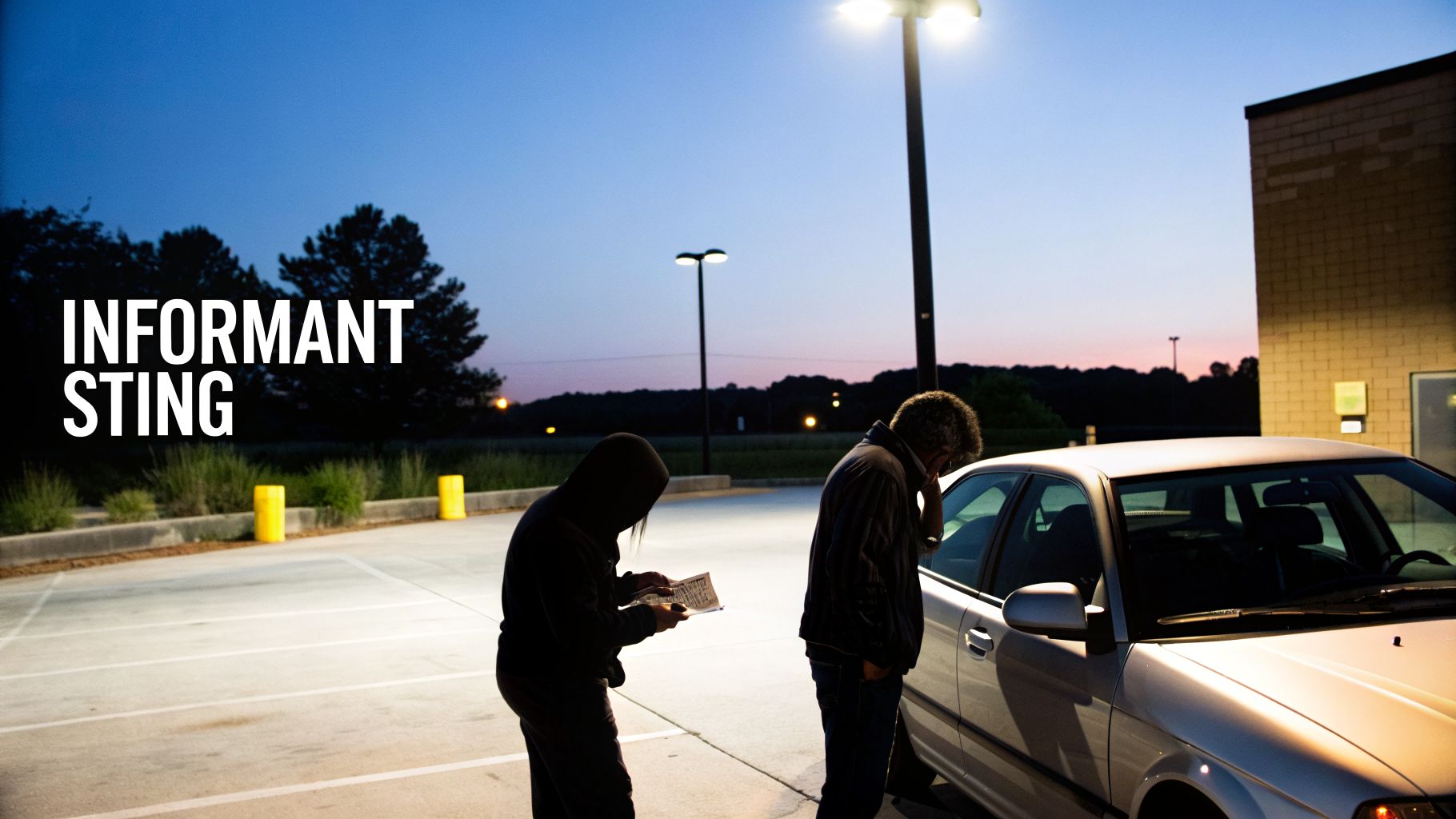
The Georgia standard creates a critical distinction from the federal rule. The focus is less on a defendant's past and more on the government's actions in the specific situation. For entrapment to be a viable defense, the defendant must show that the criminal design originated with the government agent, they were persuaded to commit the act, and they were not already predisposed to violate the law before the agent's involvement. This case is a key example of entrapment at the state level because it sets the stage for how local police conduct must be evaluated.
Strategic Analysis
The crucial element in the Georgia standard is the origin of the criminal intent. Unlike the federal standard's deep dive into the defendant's entire history, Georgia courts often concentrate on whether police manufactured the crime. If an officer's conduct is overly persuasive, coercive, or involves repeated requests after initial refusals, it strengthens an entrapment argument.
Key Insight: Under Georgia law, the government's actions, not just the defendant's character, are under intense scrutiny. The defense must show that the government did more than simply present an opportunity; they had to plant the criminal idea itself.
This state-specific standard is vital in local law enforcement contexts. For example, in prostitution sting operations in Johns Creek or Roswell, if an undercover officer aggressively pressures an individual into an illegal act they initially showed no interest in, the Holley standard provides a framework for a defense. Similarly, if an informant in a Cumming drug case uses threats or appeals to friendship to induce a sale, it could constitute entrapment.
Actionable Takeaways
- Document the Timeline: Carefully recording the sequence of events is often critical. When did law enforcement first make contact? How many times did they reach out? What exactly did they say to persuade the person?
- Identify the Source of the Idea: The most important question is: Whose idea was it? Evidence showing the plan came from the undercover officer or informant is fundamental.
- Gather Character Witnesses: Testimony from friends, family, or colleagues can help establish that a person was not predisposed to this type of criminal activity before law enforcement's intervention.
- Consult a Georgia-Licensed Attorney: An attorney familiar with Georgia's specific entrapment laws can review discovery materials from agencies like the Forsyth County Sheriff or Alpharetta PD to analyze if their conduct meets the state's criteria for inducement.
3. United States v. Russell (1973) – Police Conduct and Predisposition
The Supreme Court case United States v. Russell addressed a critical question in entrapment law: does the government's involvement, specifically by providing an essential (and sometimes illegal) ingredient for a crime, automatically create entrapment? The Court said no, ruling that the defendant's predisposition to commit the crime remains the most important factor. In this case, an undercover federal agent supplied Richard Russell with phenyl-2-propanone, a necessary chemical to manufacture methamphetamine, in exchange for a share of the finished product.

Russell argued that the government's action of supplying the chemical was so outrageous that it constituted entrapment, regardless of his own willingness to produce the drugs. The Supreme Court disagreed, finding that Russell was an "unwary criminal" who was already involved in manufacturing methamphetamine before the agent appeared. Because he was already predisposed, the agent merely provided an opportunity to continue his illegal activity. This case is one of the key examples of entrapment because it solidifies the principle that predisposition often outweighs even significant government involvement.
Strategic Analysis
The core lesson from Russell is that law enforcement can participate in a criminal enterprise to a certain degree without it being considered entrapment, as long as the defendant was already inclined to commit the crime. The defense cannot solely focus on what the police did; it must also prove the defendant lacked prior intent. This is especially relevant in drug manufacturing investigations, a common focus for federal task forces in areas from East Cobb to Forsyth County.
Key Insight: The government supplying an ingredient or some form of assistance is not, by itself, entrapment. The focus remains on whether the idea and intent originated with the defendant or the government.
For instance, if a DEA operation in a rural part of Forsyth County involves an agent offering to sell a hard-to-find precursor chemical to someone they know is already running a lab, the Russell standard makes an entrapment defense difficult. However, if that same agent approached someone with no history of drug manufacturing and persuaded them to start a lab by offering free supplies and instructions, the defense becomes much stronger.
Actionable Takeaways
- Establish a Timeline: A defense strategy must clearly show when the defendant’s involvement began versus when law enforcement initiated contact.
- Prove Lack of Predisposition: Gathering evidence demonstrating a person had no prior involvement, interest, or history in the specific criminal activity before the government's intervention can be useful.
- Analyze Government Conduct: While predisposition is key, documenting overly aggressive or coercive government actions can still be persuasive. Evidence obtained through such conduct may be challenged. An attorney can help determine if filing a motion to suppress evidence is a viable option.
- Consult an Attorney: In cases involving undercover agents and government informants, representation is essential to dissect the interactions and build a defense that effectively argues against predisposition.
4. Hampton v. United States (1976) – Government-Supplied Contraband
The Supreme Court case Hampton v. United States addressed a critical question in entrapment law: can a defendant claim entrapment if the government not only suggested the crime but also supplied the illegal contraband? The case involved a defendant, Hampton, who was convicted of selling heroin that had been supplied to him by a government informant. Hampton argued that this level of government involvement was so outrageous that it constituted entrapment regardless of his predisposition.
The Supreme Court disagreed, holding that as long as the defendant was predisposed to commit the crime, the fact that the government supplied the necessary contraband was not, by itself, a valid defense. This decision reinforced that the primary focus of an entrapment defense is the defendant's state of mind and pre-existing willingness to engage in criminal activity, not just the conduct of law enforcement.
This ruling has a significant impact on drug-related cases, as it permits undercover operations where informants or agents provide the drugs involved in a sting. It clarifies that simply being the source of the illicit substance does not automatically create one of the clearest examples of entrapment.
Strategic Analysis
The core principle from Hampton is that predisposition trumps government supply. If the prosecution can prove the defendant was ready and willing to traffic drugs, it doesn't matter if the drugs came from a government informant. The defense cannot solely rely on the fact that an agent was the source of the contraband.
Key Insight: The defense must shift focus from where the contraband came from to why the defendant engaged in the transaction. Was it due to their own criminal intent, or was it the result of overwhelming pressure, coercion, or inducement by the government agent?
This precedent is directly applicable to drug task force operations throughout Georgia. For instance, if an informant in Cumming or Johns Creek provides a target with narcotics to sell to an undercover officer, the Hampton ruling makes an entrapment defense more challenging. The defense must prove the target had no prior intent to sell drugs before the informant's intervention.
Actionable Takeaways
- Investigate the Informant: Scrutinizing the confidential informant’s background, motivations, and any deals made with law enforcement can be a key factor.
- Document Your History: Evidence showing a person was not involved in drug sales before contact with the informant is crucial to demonstrate a lack of predisposition.
- Analyze Communications: A defense attorney can request all communications between the informant and law enforcement, looking for evidence of undue pressure or inducement.
- Establish a Timeline: A detailed timeline can show whether the criminal idea originated with the individual or was planted by the government agent, which is essential for countering the predisposition argument.
5. DUI Entrapment Scenarios – Checkpoint and Undercover Operations
While DUI checkpoints are generally permissible, the tactics used by law enforcement can sometimes blur the line and create scenarios that might be considered entrapment. This defense arises when police actions go beyond simply enforcing the law and instead improperly induce or encourage an individual to drive while intoxicated. Examples include an undercover officer in a bar persistently urging a patron to drive home or setting up a checkpoint in a way that leaves drivers no reasonable alternative but to pass through it after leaving a venue serving alcohol.
True DUI entrapment is rare and difficult to prove, as an officer merely providing the opportunity for a crime (like being present outside a bar) is not entrapment. However, if an officer's conduct is the direct cause of the crime, an entrapment defense may be viable. For instance, if an officer tells a person they must move their car immediately from a certain spot, knowing the person is intoxicated and intending to arrest them for doing so, the argument for inducement becomes much stronger. This makes DUI scenarios one of the more complex, fact-specific examples of entrapment.
Strategic Analysis
The critical factor in a DUI entrapment claim is whether the officer's actions planted the idea to drive drunk in the mind of someone who was not already predisposed to do so. In the context of holiday weekend sobriety checkpoints in Alpharetta or saturation patrols near Marietta's bar districts, the focus would be on whether police conduct actively encouraged the act of driving. Learning more about how a DUI checkpoint operates can provide context for identifying unusual or coercive police behavior.
Key Insight: Entrapment in DUI cases is less about the existence of a checkpoint and more about the specific interactions between an officer and a driver. Was the driver coerced or misled into operating the vehicle while impaired by a state agent?
This defense becomes particularly relevant in undercover operations. If an undercover officer in a Roswell bar not only buys drinks for a patron but also pressures them to drive, perhaps by offering a fake emergency reason, their actions may have crossed the line from observation to inducement. Similarly, Forsyth County DUI task force operations must ensure their methods don't create the very offenses they seek to prevent.
Actionable Takeaways
- Document Officer Conduct: Noting every word and action from the interacting officer is important. Did they command the person to move their vehicle? Did they make threats or false promises?
- Request All Footage: An attorney can request all available dashcam and bodycam footage, which provides an objective record of the encounter and can support claims of improper inducement.
- Identify Witnesses: If the interaction occurred in a public place like a bar or parking lot, other patrons or employees may have witnessed the officer's conduct.
- Consult an Attorney: A defense attorney can dissect the facts of the arrest, from the initial police interaction to the field sobriety tests, to determine if law enforcement conduct provides the basis for an entrapment defense.
6. Drug Sting Operations – The Informant-Induced Crime Scenario
Drug sting operations frequently rely on confidential informants (CIs) or undercover officers to identify and prosecute drug offenses. However, this method can create serious questions about entrapment. The central issue is whether the police and their informant simply provided an opportunity for a predisposed individual to commit a crime, or if their actions improperly induced an otherwise unwilling person into selling or distributing drugs. This is a common scenario in many local jurisdictions, from Alpharetta narcotics task force operations to informant-led investigations in Cumming and Forsyth County.
A common example of potential entrapment involves a CI who, often to receive leniency for their own charges, relentlessly pressures an acquaintance to procure drugs for an "out-of-town friend" who is actually an undercover officer. If the target initially refuses but eventually gives in after repeated pleas, threats, or appeals to sympathy, an entrapment defense may be viable. The prosecution must prove the target was already inclined to commit the crime before the informant's persuasion began, a detail that is often the entire focus of the case.
Strategic Analysis
The critical factor in these cases is the origin of the criminal intent. Was the defendant already looking for a buyer, or did the government, through its informant, plant the idea and then overcome the defendant’s hesitation? An informant with a significant criminal history or a strong motivation to produce arrests for the police can be a major liability for the prosecution. Their credibility and methods will be heavily scrutinized. This is one of the most frequent factual patterns that gives rise to an entrapment defense in drug cases.
Key Insight: The informant's relationship with the defendant and the nature of their communication are crucial. A CI who exploits a friendship, feigns a personal crisis, or makes threats to coerce a drug transaction is acting as an agent of the government to induce a crime, not just investigate one.
This analysis is directly applicable to cases arising from Johns Creek, Milton, and Marietta narcotics unit stings. For instance, if a person with no prior drug convictions is repeatedly called by a CI and finally agrees to help them find a small amount of drugs just to get them to stop, the defense would focus on the defendant's lack of predisposition and the government's undue persuasion.
Actionable Takeaways
- Document All Contact: Saving every text, call log, voicemail, and social media message from the informant is essential. The timeline and content are critical.
- Preserve Refusals: Evidence that a person said "no" or tried to avoid the situation demonstrates their lack of predisposition. This is one of the strongest facts for an entrapment defense.
- Investigate the Informant: A defense attorney can request discovery on the informant, including their criminal history, their agreement with law enforcement, and any payments or benefits they received.
- Identify Witnesses: If others saw the informant pressuring someone or can testify that the person is not involved in the drug trade, their statements can help show they were not predisposed.
7. Undercover Financial Crime Operations – White Collar Entrapment
In the complex world of finance and business, law enforcement agencies often conduct sophisticated undercover operations to target white-collar crimes. These stings involve agents posing as investors, business partners, or clients to expose fraud, embezzlement, or money laundering. However, these tactics can sometimes create a situation where entrapment becomes a viable defense, especially when agents induce an otherwise law-abiding individual to commit an offense they were not predisposed to commit.
This scenario frequently arises in federal investigations, such as FBI financial fraud task force operations in the Alpharetta business district or Georgia Bureau of Investigation white-collar crime stings. For example, an undercover agent might propose a seemingly legitimate but complicated real estate deal in Forsyth County. Over time, the agent could aggressively pressure a business owner to cut corners or falsify documents, providing false assurances about the transaction's legality. If the business owner initially resisted these suggestions, this creates one of the most compelling examples of entrapment in a white-collar context.
Strategic Analysis
The critical element in white-collar entrapment cases is whether the government's inducement was the primary reason the defendant committed the crime. Unlike street-level drug stings, financial crime operations can be intricate and prolonged. An agent may spend months building trust with a target in a Cobb County business, only to later introduce a criminal element to their dealings. The defense must demonstrate that the government didn't just provide an opportunity but actively manufactured the crime by overcoming the defendant's initial reluctance.
Key Insight: The government's misrepresentation of legality is a powerful factor. If an undercover agent falsely assures a target that a complex financial transaction is lawful and permissible, it can negate the criminal intent required for a conviction and strengthen an entrapment claim.
This defense is particularly relevant for business professionals in North Atlanta's commercial hubs. An aggressive undercover agent could target a successful Roswell entrepreneur, exploiting their ambition or a temporary financial downturn to push them into an illegal scheme they would have otherwise avoided.
Actionable Takeaways
- Preserve Business Records: Maintaining meticulous records of all communications and transactions related to the suspicious deal, including emails, meeting notes, and contracts, is important.
- Document Your History: Evidence of a legitimate, law-abiding business history can be used to show a lack of predisposition to commit financial crimes.
- Challenge Agent Representations: A defense attorney can challenge the undercover agent’s instructions and any statements they made regarding the legality of the proposed transaction.
- Consult an Attorney Immediately: If you suspect you are being targeted in a sting operation, securing a white-collar criminal defense attorney is crucial to understand your rights and analyze the potential for an entrapment defense.
8. Prostitution and Vice Sting Operations – Gender and Vulnerability-Based Entrapment
Vice enforcement stings, particularly those targeting prostitution and solicitation, are common operations that frequently give rise to entrapment claims. These stings often involve undercover officers or informants posing as sex workers or clients to arrest individuals for soliciting or related offenses. An entrapment defense in these situations centers on whether the defendant was already predisposed to commit the crime before the officer's involvement, or if the officer's actions improperly induced them. These cases can be particularly complex when they involve the target's personal vulnerabilities.
Many of these operations occur in specific local areas, such as hotel corridors in Roswell and Johns Creek or through undercover investigations of Alpharetta massage businesses. The core issue is whether the officer simply provided an opportunity or actively coerced the individual. For instance, if an undercover officer pressures a reluctant person, perhaps by appealing to their loneliness or financial desperation, their actions could cross the line from investigation into inducement, forming the basis for an entrapment defense. These are clear examples of entrapment where law enforcement creates the crime.
Strategic Analysis
The critical element in defending against vice charges is scrutinizing the officer's conduct for coercion and inducement. An entrapment defense argues that the defendant would not have committed the crime without the government's improper persuasion. This is especially relevant if the defendant has no prior criminal history related to such offenses and repeatedly hesitated or refused the officer's advances before finally agreeing.
Key Insight: Law enforcement's exploitation of a person's emotional, financial, or psychological vulnerability can be a powerful argument for entrapment. If an officer's tactics go beyond a simple offer and involve manipulation or persistent pressure, the defense becomes much stronger.
This strategy is directly applicable to operations conducted by the Forsyth County Sheriff’s vice task force or multi-agency stings in East Cobb. An attorney would analyze all communications to show that the officer, not the defendant, was the primary driver of the criminal act. Showing the defendant's lack of predisposition is fundamental to proving the government manufactured the crime.
Actionable Takeaways
- Obtain All Communications: It is vital to get every text message, app chat log, and recorded phone call between the undercover officer and the defendant.
- Request All Video: Demanding access to any body camera footage or surveillance video from the operation can be important, as it may show the defendant's hesitation or the officer's aggressive tactics.
- Document Vulnerabilities: Compiling evidence of any personal issues that made someone susceptible to manipulation, such as a recent job loss, a difficult breakup, or substance abuse problems, can be relevant.
- Identify Coercive Language: Pinpointing any threats, promises, or unusually persistent persuasion used by the undercover officer during interactions helps separate a simple opportunity from improper inducement.
Entrapment: 8-Case Comparison
| Scenario / Case | Complexity 🔄 | Resource requirements ⚡ | Expected outcomes 📊 | Ideal use cases 💡 | Key advantages ⭐ |
|---|---|---|---|---|---|
| Jacobson v. United States (1992) — Entrapment Standard | 🔄🔄 Moderate — predisposition analysis | ⚡⚡ Moderate — discovery, witness evidence, counsel | 📊 Defense strong if lack of predisposition shown; high defendant burden | 💡 Federal and many state undercover sting defenses | ⭐ Provides clear predisposition test; protects against undue inducement |
| State v. Holley (Georgia) — Georgia Entrapment Standard | 🔄🔄🔄 Moderate–High — dual objective/subjective tests | ⚡⚡ Moderate — state-specific records and testimony | 📊 Applicable in Georgia courts; outcome depends on state-focused proof | 💡 Local criminal charges in Georgia (Forsyth, Cobb, Alpharetta) | ⭐ Georgia-tailored framework; considers inducement methods |
| United States v. Russell (1973) — Police Conduct & Predisposition | 🔄🔄🔄 High — complex factual inquiry on intent vs. supply | ⚡⚡⚡ High — detailed evidentiary record, material provenance | 📊 Prosecution-favorable in drug manufacturing cases; entrapment difficult | 💡 Federal drug manufacturing/distribution prosecutions | ⭐ Clarifies limits on entrapment when government supplies materials |
| Hampton v. United States (1976) — Government-Supplied Contraband | 🔄🔄🔄 High — focuses on predisposition despite supplied contraband | ⚡⚡⚡ High — informant records, chain-of-custody, witness evidence | 📊 Courts defer to prosecution; entrapment rarely established by supply alone | 💡 Drug sales/distribution cases involving informants | ⭐ Confirms predisposition is controlling; narrows entrapment claims |
| DUI Entrapment Scenarios — Checkpoints & Undercover | 🔄🔄 Low–Moderate — factual, procedural stop analysis | ⚡⚡ Low–Moderate — dashcam/bodycam, sobriety test records | 📊 Suppression possible in misconduct cases but generally difficult | 💡 Checkpoint challenges, undercover alcohol provision claims | ⭐ Can yield evidence suppression and protect constitutional rights |
| Drug Sting Operations — Informant-Induced Crimes | 🔄🔄🔄 Moderate–High — multiple contacts and motive analysis | ⚡⚡⚡ High — informant communications, prior records, expert witnesses | 📊 Defense viable when inducement proven; prior convictions weaken claims | 💡 Undercover buys, repeated informant approaches | ⭐ Rich factual record and subpoenaable communications to show inducement |
| Undercover Financial Crime Operations — White-Collar Entrapment | 🔄🔄🔄 High — complex transactional and intent analysis | ⚡⚡⚡ High — financial records, discovery, expert testimony | 📊 Entrapment claims challenging; success when agent misrepresented legality | 💡 Sophisticated fraud, embezzlement, and business-scheme stings | ⭐ Detailed paper trails and agent reports available for cross-examination |
| Prostitution & Vice Sting Operations — Vulnerability-Based Claims | 🔄🔄 Moderate — focus on coercion, vulnerability, and inducement | ⚡⚡ Moderate — bodycam, communications, medical/psych evidence | 📊 Possible defense for coerced/vulnerable defendants; jury bias a factor | 💡 Vice stings involving addiction, coercion, or exploitation | ⭐ Often strong factual records (video/communications) to highlight coercion |
Key Takeaways and Navigating Your Situation in North Georgia
The numerous examples of entrapment detailed in this article, from landmark Supreme Court cases like Jacobson v. United States to specific Georgia scenarios, all circle a central, defining question: Was the criminal intent born from the defendant's own mind, or was it implanted there by the government? Understanding this distinction is the foundation of recognizing a potential entrapment defense. The line between a legitimate opportunity and improper government inducement is often blurry and depends entirely on the specific facts of each case.
As we've seen, the government is permitted to set traps and use deception to catch those already inclined to commit a crime. However, its power is not limitless. When law enforcement's conduct becomes so overbearing that it effectively manufactures a crime that would not have otherwise occurred, the entrapment defense becomes a powerful shield for the accused. This is not about excusing criminal behavior; it is about holding the government accountable and ensuring that its methods do not cross the line into creating criminals out of otherwise law-abiding citizens.
Recapping the Red Flags of Entrapment
Synthesizing the insights from the cases discussed, several key indicators of potential entrapment emerge. Recognizing these patterns is the first practical step for anyone who feels they were unfairly targeted.
- Excessive Pressure and Persuasion: Did an agent or informant refuse to take "no" for an answer? Constant badgering, appealing to sympathy, or making threats can shift the focus from a defendant's predisposition to the government's coercive tactics.
- Unusual or Extraordinary Inducements: The government cannot offer a reward so great that it would tempt an ordinary, non-predisposed person to break the law. This was a key factor in the Jacobson case, where years of manipulation were needed to secure a single illicit purchase.
- Government-Sourced Contraband: While not an automatic defense, as clarified in Hampton v. United States, the fact that the government supplied the very drugs or illegal items involved in the crime can be a strong contributing factor in an entrapment claim, especially when combined with other forms of inducement.
- Targeting Vulnerabilities: Law enforcement exploiting a person's known financial struggles, addiction, or personal weaknesses to instigate a crime is a significant red flag. This moves beyond simply providing an opportunity and into the realm of manipulation.
Your Path Forward in North Georgia
The information presented here is intended to explain the complex concept of entrapment through various real-world and hypothetical scenarios. It is an informational resource, not a substitute for professional representation. The nuances of Georgia's subjective entrapment standard, which focuses heavily on a defendant's predisposition, require a detailed factual analysis that can only be performed by a qualified attorney.
If you are facing charges in Alpharetta, Cumming, Roswell, Marietta, or the surrounding communities in Forsyth and Cobb County, and you believe your situation involves some of the red flags we've discussed, the most important action is to secure representation. An experienced attorney can meticulously review every interaction with law enforcement, analyze the evidence for signs of improper inducement, and determine the viability of an entrapment defense. The difference between a conviction and a dismissal can often lie in identifying these subtle but critical details. Protecting your rights begins with understanding the possibilities, and taking decisive action is the next vital step.
Navigating the complexities of an entrapment defense requires deep knowledge of both prosecutorial tactics and criminal defense strategies. With over 25 years of experience, including his time as a prosecutor, Brian Hansford of Brian Hansford Law is uniquely positioned to analyze your case from every angle. If you believe you were unfairly targeted by law enforcement, contact Brian Hansford Law to discuss the specifics of your situation.
