
The term 'manslaughter' often appears in news headlines, but its legal meaning is specific and complex, differing significantly from murder. This article provides a comprehensive overview of various scenarios that could lead to a manslaughter charge in Georgia, breaking down the key elements and potential consequences. We will explore several detailed examples of manslaughter, examining the critical differences between voluntary and involuntary acts. It is crucial to understand that this information is for educational purposes only and is not a substitute for consultation with a qualified legal professional.
The distinctions are subtle but have profound implications on how a case is charged and defended, especially in local jurisdictions like Cumming, Johns Creek, Milton, Alpharetta, Roswell, Marietta, Forsyth County, East Cobb, and Cobb County. Understanding these nuances is a key step in comprehending the gravity of such charges.
This guide is designed to provide clarity by dissecting real-world situations that fall under Georgia's manslaughter statutes. For each example, we will analyze:
- The Scenario: A clear description of the events leading to a fatality.
- Legal Elements: The specific components prosecutors must prove under Georgia law.
- Potential Charges: How the act would likely be classified and the associated penalties.
- Common Defenses: Strategies that might be employed to challenge the prosecution's case.
By examining these detailed examples of manslaughter, you will gain a clearer understanding of how unintentional or reckless actions can result in serious felony charges. From DUI-related fatalities to deaths resulting from a sudden quarrel, this article offers a structured look into the legal framework governing these complex and life-altering situations.
1. Involuntary Manslaughter – Death During Commission of a Misdemeanor (Georgia Case Example)
One of the most common examples of manslaughter in Georgia is involuntary manslaughter that occurs during the commission of a misdemeanor. This type of charge arises when a person causes the death of another human being, without any intention to do so, while engaged in an unlawful act that is not a felony. This often applies in traffic-related incidents where a misdemeanor violation, such as reckless driving or speeding, leads to a fatal accident.
The core of this charge is the link between the unlawful act (the misdemeanor) and the resulting death. The prosecution does not need to prove the defendant intended to kill anyone. Instead, they must show that the defendant’s misdemeanor act was the proximate cause of the victim's death. This is a serious felony charge despite stemming from a lesser offense.
Scenario: A Fatal Traffic Violation
Consider a driver in a busy area like Alpharetta or Roswell. They are running late and decide to speed through an intersection just as the light turns red. This act, running a red light (O.C.G.A. § 40-6-20) and speeding (O.C.G.A. § 40-6-181), are both misdemeanors. If the driver collides with another vehicle and a passenger is killed, the driver could face charges for involuntary manslaughter.
The legal argument hinges on whether the unlawful act (running the red light) directly caused the death. Even without intent to harm, the reckless nature of the underlying misdemeanor elevates the tragic outcome to a felony offense.
Legal Elements & Potential Penalties in Georgia
Under Georgia law (O.C.G.A. § 16-5-3(a)), the prosecution must prove:
- The defendant committed an unlawful act that was not a felony (e.g., speeding, reckless driving, DUI less safe).
- This unlawful act was the direct cause of another person's death.
- The defendant had no intention of causing the death.
A conviction for this type of involuntary manslaughter is a felony in Georgia. It carries a potential prison sentence of one to ten years.
Common Defenses & Strategic Considerations
Building a strong defense in these types of cases requires a proactive and detailed approach to scrutinizing the evidence. Key strategies include:
- Challenging Causation: A central defense strategy is to argue that the misdemeanor act was not the direct cause of death. For example, another factor, like the victim's own negligent driving or a mechanical failure, could be the superseding cause.
- Accident Reconstruction: An independent accident reconstruction expert can analyze the scene, vehicle damage, and physics of the crash to provide an alternative explanation that challenges the police report's conclusions.
- Preserving Evidence: Immediately securing dashcam footage, nearby surveillance video from businesses, and witness statements is critical. This evidence can provide a more complete picture of the event than the official report alone.
Strategic Insight: The accuracy of the initial police report is paramount. Any inconsistencies in witness statements, speed calculations, or scene diagrams can be leveraged to create reasonable doubt about the defendant's actions being the sole cause of the fatality.
For those facing such serious allegations in Forsyth County, East Cobb, or surrounding areas, understanding these complexities is the first step. If a person finds themselves in a similar situation, exploring their options with a legal professional can be a critical next step. The team at Brian Hansford Law can provide information and guidance tailored to the specifics of a particular circumstance.
2. DUI Manslaughter – Death Caused by Impaired Driving (Georgia O.C.G.A. § 16-5-20)
One of the most severe and intensely prosecuted examples of manslaughter is DUI manslaughter, also known in Georgia as Vehicular Homicide in the First Degree. This charge applies when a person causes the death of another while driving under the influence of alcohol or drugs. Unlike some other forms of manslaughter, there is no requirement to prove a specific misdemeanor traffic violation beyond the act of impaired driving itself.

The crucial elements for the prosecution are proving the driver's impairment and establishing a direct causal link between that impairment and the victim's death. Because of the inherent danger of impaired driving, the law assigns a high degree of culpability, resulting in serious felony consequences that are often more severe than other types of involuntary manslaughter. The penalties can escalate further depending on the circumstances, such as the number of victims or if a child was a passenger.
Scenario: A Nighttime Pedestrian Fatality
Imagine a person leaving a restaurant in downtown Cumming or Johns Creek after having several drinks. Believing they are fine to drive, they get behind the wheel. While driving, their reaction time is slowed by alcohol, and they fail to see a pedestrian crossing the street in a dimly lit area, striking and killing them.
The driver would likely face charges for First Degree Vehicular Homicide. The prosecution's case would focus on evidence of impairment, such as field sobriety test results, a breathalyzer reading over the legal limit, and witness testimony, to argue that the driver's intoxicated state was the direct cause of the fatal collision.
Legal Elements & Potential Penalties in Georgia
Under Georgia's Vehicular Homicide statute (O.C.G.A. § 40-6-393), the prosecution must prove:
- The defendant was operating a motor vehicle.
- The defendant was under the influence of alcohol or drugs to the extent that they were a less safe driver.
- This impaired driving caused the death of another person.
- The death was caused without malice aforethought (intent to kill).
A conviction for Vehicular Homicide in the First Degree is a felony with a mandatory minimum prison sentence of three years and a maximum of fifteen years for a single victim. Those facing these charges should understand the gravity of the situation and the complex legal landscape. You can learn more about how a DUI charge can become a felony in Georgia.
Common Defenses & Strategic Considerations
Defending against a DUI manslaughter charge is incredibly complex and requires immediate, aggressive action. Key strategies often include:
- Challenging the Impairment Evidence: Scrutinize every aspect of the DUI investigation. This includes challenging the administration and results of field sobriety tests, the calibration and maintenance records of the breathalyzer, and the procedures used for blood or urine tests. An independent toxicologist may be hired to re-examine the results.
- Contesting Causation: A critical defense is arguing that the impairment was not the proximate cause of the accident. An accident reconstruction expert can analyze the scene to show that other factors, such as the pedestrian's actions, poor lighting, or road conditions, were the true cause of the fatality.
- Filing Pre-Trial Motions: An attorney may file motions to suppress evidence that was improperly obtained. If the initial traffic stop was unlawful or the sobriety tests were administered incorrectly, key evidence could be excluded from trial, significantly weakening the prosecution's case.
Strategic Insight: Immediately preserving all available evidence is non-negotiable. This includes securing any dashcam or surveillance footage from nearby businesses in areas like Marietta or Roswell before it is erased, as it may show a completely different version of events than what is described in the police report.
The stakes in a DUI manslaughter case are exceptionally high. For individuals in Cobb County, Forsyth County, and surrounding areas, gaining a clear understanding of the evidence and potential defense angles is the first and most critical step. Engaging with a legal professional, such as the team at Brian Hansford Law, can provide the necessary information and a strategic path forward.
3. Vehicular Assault Resulting in Death – Reckless Endangerment Escalation (Georgia Case Law)
One of the more severe examples of manslaughter is when reckless or aggressive driving initially classified as vehicular assault escalates to a homicide charge if the victim later dies from their injuries. This form of second-degree vehicular homicide in Georgia focuses on acts of reckless driving that demonstrate a willful and wanton disregard for the safety of others. This is distinct from cases involving simple traffic misdemeanors.
The core of this charge is the defendant's conscious disregard of a substantial and unjustifiable risk. The prosecution must prove the driving behavior was so reckless that it amounted to a gross deviation from the standard of care a reasonable person would observe. This often involves extremely high speeds, dangerous maneuvers like street racing, or fleeing from law enforcement.
Scenario: A Road Rage Incident Turns Fatal
Imagine a scenario on a busy highway like GA-400 near Roswell or Johns Creek. A driver, angered by another vehicle, engages in aggressive and dangerous behavior. This includes tailgating, weaving through traffic at over 80 mph, and attempting to cut off the other driver. This conduct alone constitutes reckless driving (O.C.G.A. § 40-6-390).
If this aggressive driving causes a collision that seriously injures the other driver, the initial charge might be serious injury by vehicle. However, if the victim succumbs to those injuries days or weeks later, the charge can be elevated to vehicular homicide. The driver's willful and wanton conduct is the key element that elevates the tragic outcome to a serious felony.
Legal Elements & Potential Penalties in Georgia
Under Georgia law (O.C.G.A. § 40-6-393(a)), the prosecution must prove:
- The defendant was operating a vehicle in a manner defined as reckless driving.
- This reckless driving was the direct cause of another person's death.
- The act was not committed with malice aforethought or an intent to kill.
A conviction for this type of vehicular homicide is a felony in Georgia. It carries a potential prison sentence of three to fifteen years.
Common Defenses & Strategic Considerations
Defending against these charges requires a meticulous examination of the events leading up to the incident and the immediate aftermath. Key strategies include:
- Contesting "Reckless" Conduct: The defense can argue that the driving, while perhaps negligent, did not rise to the level of "reckless" as defined by law. This involves presenting evidence that the driver's actions were not a gross deviation from standard care.
- Expert Analysis of Vehicle Data: Immediately preserving and analyzing the vehicle's event data recorder (EDR), or "black box," is crucial. This data can provide objective information on speed, braking, and steering that may counter the prosecution's narrative.
- Investigating External Factors: Thoroughly documenting road conditions, weather, visibility, and any potential contributing negligence from other parties can help create reasonable doubt about causation.
Strategic Insight: The line between simple negligence and criminal recklessness is often subjective. Securing all available evidence, including cell phone records, dashcam footage, and independent witness statements, is vital to building a defense that re-characterizes the driver's actions and challenges the state's interpretation of events.
For those facing serious charges in areas like Marietta or Cobb County, the complexities of vehicular homicide cases can be overwhelming. Understanding how these cases are constructed is a crucial first step. If a person finds themselves in a similar situation, exploring their options with a legal professional can provide clarity. For more information, you can learn more about how assault charges can be elevated in Georgia.
4. Involuntary Manslaughter – Death During Unlawful Felony (Felony Murder Rule Application)
One of the most complex examples of manslaughter involves Georgia's felony murder rule. This legal doctrine allows a person to be charged with murder if someone dies during the commission of certain dangerous felonies, even if there was no intent to kill. While the primary charge is often murder, involuntary manslaughter can become relevant as a lesser included offense or in plea negotiations, depending on the specifics of the underlying felony and the defendant's role.
The principle is that the intent to commit the dangerous felony supplies the malice required for a murder charge. If a death is a foreseeable consequence of the felony, all participants in that felony can be held responsible for the death. This applies whether the death was accidental, caused by a co-defendant, or even occurred during the immediate flight from the crime scene.
Scenario: A Burglary Gone Wrong
Imagine two individuals decide to burglarize a home in a quiet Milton or Johns Creek neighborhood, believing it to be empty. As they are inside, the homeowner unexpectedly returns and confronts them. In the ensuing panic and chaos, one of the burglars shoves the homeowner, who falls, strikes their head, and dies from the injury.
Under the felony murder rule, both individuals could be charged with murder because the death occurred during the commission of a felony (burglary). Even the accomplice who did not physically touch the homeowner could face the same charge. The prosecution would argue that a confrontation and resulting harm are foreseeable risks of committing a residential burglary.
Legal Elements & Potential Penalties in Georgia
Under Georgia’s felony murder statute (O.C.G.A. § 16-5-1(c)), the prosecution must prove:
- The defendant was committing or attempting to commit a felony.
- The defendant caused the death of another person during the commission of that felony, irrespective of malice.
- The underlying felony must be inherently dangerous or committed in a dangerous manner.
A conviction for felony murder carries the same severe penalties as malice murder, including life imprisonment with or without the possibility of parole. Understanding the difference between a felony and a misdemeanor is crucial, as the classification of the underlying crime dictates the application of this rule.
Common Defenses & Strategic Considerations
Defending against felony murder charges is incredibly complex and requires a meticulous deconstruction of the prosecution's case. Key strategies include:
- Attacking the Underlying Felony: If it can be proven that the underlying felony was not actually committed or that the defendant was not a willing participant, the felony murder charge cannot stand.
- Challenging Causation: A defense can argue that the death was not a foreseeable consequence of the felony or was caused by an intervening event unrelated to the defendant's actions.
- Disputing Participation: For accomplices, a key defense is to argue they were not a party to the crime. This could involve showing they withdrew from the criminal enterprise before the act causing death occurred.
- Expert Testimony: Forensic experts and medical examiners can be hired to challenge the prosecution’s theory of how the death occurred, potentially creating doubt about the link between the felony and the fatality.
Strategic Insight: One of the most critical areas to challenge is the timeline. Establishing a clear and precise sequence of events can demonstrate that the death did not occur "in the commission of" the felony but was an independent and unforeseeable event, which can break the causal chain required for a conviction.
For individuals in Cobb County, Marietta, or the surrounding areas facing such grave charges, the stakes are immense. If a person finds themselves implicated in a situation where a felony led to a death, seeking experienced legal guidance is imperative. The team at Brian Hansford Law can help examine the evidence and explore every available defensive avenue.
5. Involuntary Manslaughter from Criminal Negligence – Negligent Supervision or Professional Misconduct
Another of the critical examples of manslaughter in Georgia involves death caused by criminal negligence. This is not simple carelessness or a mistake. Criminal negligence involves a deviation from the standard of care that a reasonable person would exercise, and it must show a wanton or reckless disregard for the foreseeable risk to human life. This often applies in situations involving professional misconduct or a complete failure in a duty of care, such as negligent supervision by a caregiver.
This charge hinges on proving that the defendant’s actions (or inactions) were so reckless that they created a high risk of death or great bodily harm, a risk they should have been aware of. Unlike other forms of manslaughter, it focuses on the gross deviation from a duty owed to the victim, whether that duty is professional, parental, or otherwise established. The prosecution must demonstrate that the death was a direct result of this extreme negligence, not just an unfortunate accident.

Scenario: A Tragic Failure of Supervision
Imagine a situation in a Forsyth County daycare facility. A staff member, responsible for supervising several toddlers during outdoor playtime, becomes deeply engrossed in their mobile phone for an extended period. During this lapse in attention, a child wanders off to an unfenced swimming pool on the property and tragically drowns. The caregiver’s failure to supervise is not just a momentary mistake; it is a profound dereliction of their professional duty of care.
In this scenario, the prosecution would argue that the caregiver's conduct showed a conscious disregard for a known and substantial risk. The argument would be that any reasonable person in that position would understand the grave danger of leaving toddlers unsupervised near a body of water.
Legal Elements & Potential Penalties in Georgia
Under Georgia law (O.C.G.A. § 16-5-3(b)), this form of involuntary manslaughter requires proof that:
- The defendant caused the death of another person.
- The death was caused by an act of criminal negligence.
- There was no intent to kill the victim.
Criminal negligence is defined as a reckless disregard for the safety of others. A conviction is a felony and carries a sentence of one to ten years in prison, reflecting the serious nature of such a profound failure of care.
Common Defenses & Strategic Considerations
Defending against a criminal negligence charge requires a nuanced and evidence-based approach to demonstrate that the conduct did not rise to the level of wanton disregard for human life.
- Establishing Reasonable Conduct: The defense can work to show that the defendant’s actions, while perhaps unfortunate, were not a gross deviation from the standard of care. This may involve presenting evidence of compliance with facility policies or industry standards.
- Challenging Causation: A key strategy is to investigate and present alternative or contributory causes of death. For example, was there a pre-existing medical condition, an unforeseeable equipment failure, or another intervening factor that broke the chain of causation?
- Expert Witness Testimony: Retaining experts on industry standards (e.g., childcare, medical practice, coaching) is crucial. These experts can testify whether the defendant's actions met the required standard of care or if the tragic outcome was an unforeseeable accident rather than a result of negligence.
Strategic Insight: Preserving all relevant documentation is non-negotiable. This includes training records, certifications, facility safety protocols, and any logs or reports from the day of the incident. This paper trail can be used to build a timeline and demonstrate that the defendant was acting reasonably within their professional capacity.
For individuals in areas like Johns Creek or Milton facing devastating accusations of this nature, understanding the high bar for proving criminal negligence is vital. If a person finds themselves in a similar situation, the team at Brian Hansford Law can offer information and explore the details of the case.
6. Voluntary Manslaughter – Heat of Passion Killing (Georgia O.C.G.A. § 16-5-21)
Among the most intense and complex examples of manslaughter is a voluntary manslaughter charge arising from a "heat of passion" killing. This occurs when a person causes the death of another, with the intent to kill, but does so under the influence of a sudden, violent, and irresistible passion resulting from serious provocation. This provocation must be sufficient to excite such passion in a reasonable person, effectively stripping the individual of self-control and judgment at that moment.
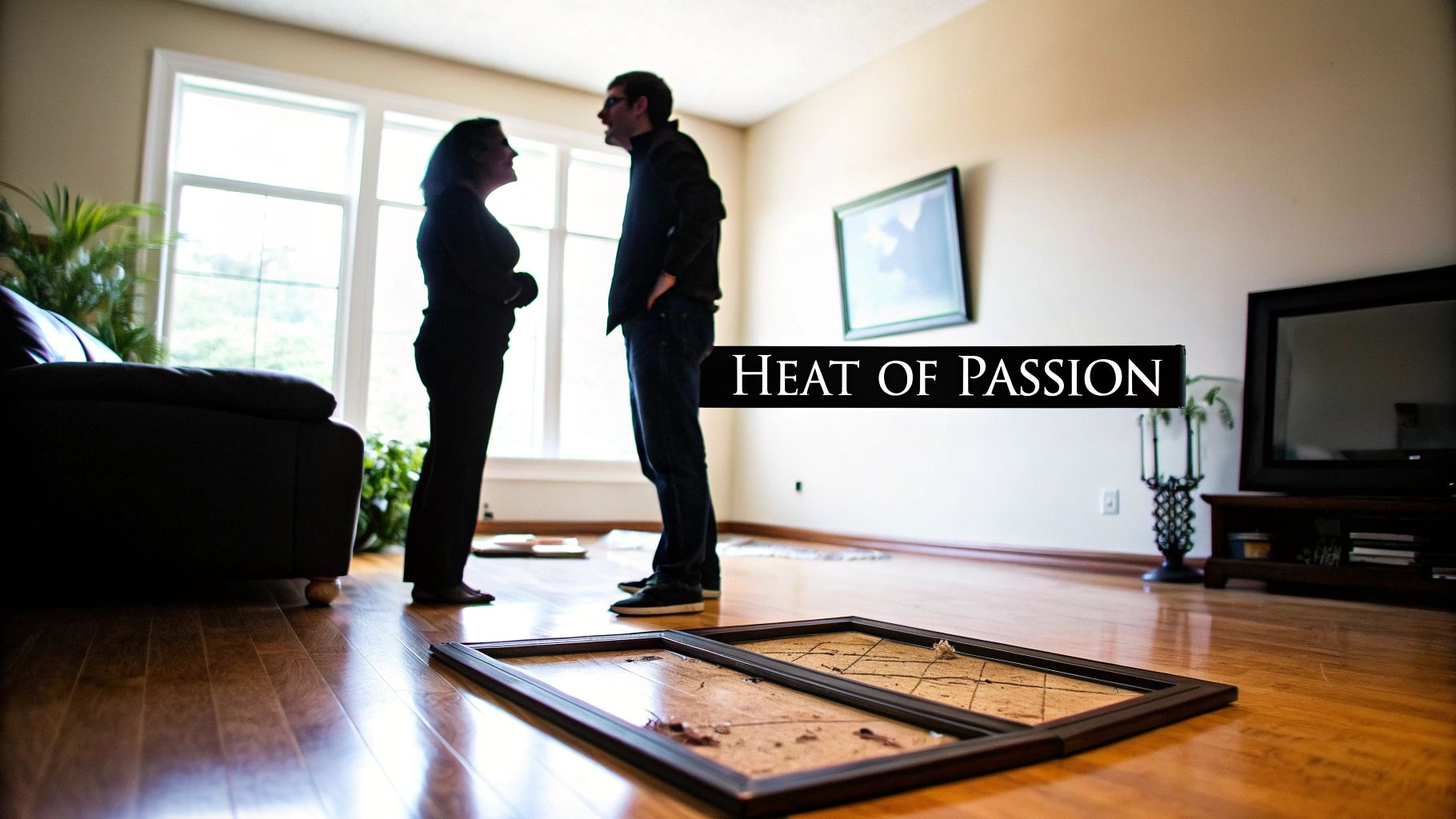
The critical distinction between this offense and murder is the absence of malice aforethought due to the immediate and overwhelming provocation. The law recognizes that even a reasonable person can be pushed past their breaking point, and while the killing is not excused, it is considered less culpable than a premeditated act of murder.
Scenario: A Confrontation Turns Fatal
Imagine a homeowner in a Cumming or Johns Creek neighborhood who returns to find their spouse in an act of infidelity. Overcome by immediate rage and a sense of betrayal, the homeowner grabs a heavy object and strikes the spouse's partner, causing a fatal injury. In this scenario, the discovery of infidelity could be argued as the serious provocation that led to a sudden, violent passion.
The prosecution would likely initially pursue a murder charge. The defense's task would be to introduce evidence showing the killing was not a product of malice or premeditation, but rather an immediate and uncontrollable reaction to a profoundly provocative event, thus justifying a reduction to voluntary manslaughter.
Legal Elements & Potential Penalties in Georgia
Under Georgia law (O.C.G.A. § 16-5-2), the prosecution must establish the elements of murder, but the defense can reduce the charge by showing:
- The defendant acted under a sudden, violent, and irresistible passion.
- This passion resulted from a serious provocation sufficient to excite the same in a reasonable person.
- There was no significant interval between the provocation and the killing for the passion to cool (the "cooling off" period).
Voluntary manslaughter is a serious felony in Georgia, punishable by one to twenty years in prison.
Common Defenses & Strategic Considerations
Defending against a homicide charge with a "heat of passion" argument requires a nuanced and evidence-rich approach. Key strategies include:
- Establishing the Timeline: The defense must meticulously reconstruct the sequence of events to prove there was no "cooling off" period. This involves using witness testimony, text messages, and call logs to show the killing was an immediate reaction to the provocation.
- Demonstrating Provocation: The nature of the provocation must be compelling. This often involves gathering evidence of the victim's actions, such as evidence of an affair, a violent threat, or a physical assault immediately preceding the incident.
- Psychological and Character Evidence: Expert testimony from a psychologist can help explain the defendant's state of mind. Character witnesses from the community in areas like Milton or Alpharetta can testify to the defendant's typically non-violent nature, reinforcing the argument that the act was an aberration caused by extreme circumstances.
Strategic Insight: The concept of a "reasonable person" is key. The defense must frame the provocation in such a way that a jury can understand how a person of ordinary temperament could be driven to such an extreme reaction. The focus is less on justifying the act and more on contextualizing the defendant's mental state to negate the element of malice.
These situations are incredibly fact-specific and emotionally charged. If a person finds themselves involved in a situation with these elements, getting information from a legal professional is a crucial step. The team at Brian Hansford Law is available to discuss the specifics of your circumstances and outline potential pathways.
7. Involuntary Manslaughter – Distribution of Substances or Failure to Provide Medical Aid
A less common but increasingly relevant category for examples of manslaughter involves deaths resulting from the distribution of dangerous substances or the failure to provide necessary medical aid. This type of involuntary manslaughter charge often arises when a person's reckless actions or omissions, without intent to kill, lead to a fatal outcome. This can include scenarios like a party host over-serving a guest or a caregiver neglecting a dependent in distress.
The legal foundation for such charges is the concept of a duty of care and the foreseeable harm caused by reckless behavior. The prosecution's goal is to demonstrate that the defendant's actions (like providing deadly drugs) or inaction (like failing to call 911) were a significant and direct cause of the victim's death. This area of law is complex, especially in cases of drug overdoses involving substances like fentanyl.
Scenario: A Social Gathering Turns Tragic
Imagine a scenario in a Johns Creek or Milton residence where a person hosts a party. They know one of their guests has a severe allergy or a serious medical condition. Despite this knowledge, they serve food containing the allergen or furnish illicit substances that trigger a fatal medical event. Another example is a person who supplies drugs to a friend, who then suffers a lethal overdose. In these cases, the host or supplier could face involuntary manslaughter charges.
The critical legal question is whether the individual’s actions were so reckless that they showed a conscious disregard for a substantial and unjustifiable risk. The death was not intended, but it was a foreseeable consequence of the reckless conduct.
Legal Elements & Potential Penalties in Georgia
Under Georgia's involuntary manslaughter statute (O.C.G.A. § 16-5-3(a)), the prosecution would need to establish:
- The defendant committed an unlawful act (e.g., distributing a controlled substance) or a lawful act in an unlawful manner (e.g., reckless endangerment).
- This act or omission was the proximate cause of the victim's death.
- The defendant acted with criminal negligence, meaning their conduct was a gross deviation from the standard of care a reasonable person would exercise.
A conviction for this type of involuntary manslaughter is a felony, punishable by one to ten years in prison. If the underlying act is a felony itself, like distributing a Schedule I controlled substance, more severe charges could apply.
Common Defenses & Strategic Considerations
Defending against these allegations requires a detailed investigation into causation and the defendant’s state of mind. Key strategies include:
- Contesting Causation and Foreseeability: A primary defense is arguing that the death was not a foreseeable result of the defendant's actions. For instance, the victim may have had an unknown underlying condition or consumed other substances from a different source.
- Expert Testimony: Medical and toxicology experts are essential. They can analyze autopsy reports to challenge the official cause of death and provide alternative explanations for the tragic outcome.
- Challenging Knowledge: The defense can work to prove the defendant had no knowledge of the victim's specific vulnerability (like a medical condition) or the lethal nature of the substance provided (e.g., not knowing it was laced with fentanyl).
Strategic Insight: Communications are critical evidence. Text messages, social media posts, and witness interviews can establish what the defendant knew and when. Preserving and analyzing this data can be pivotal in demonstrating a lack of intent or knowledge, which is central to undermining the prosecution's claim of criminal negligence.
For anyone in Cobb County, Marietta, or nearby areas facing accusations related to these difficult circumstances, understanding the nuances of causation and duty of care is vital. If a person finds themselves in such a position, exploring the matter with a legal professional can help clarify the options. The team at Brian Hansford Law is available to review the specifics of your situation.
7-Case Manslaughter Comparison
| Case Type | Typical Elements 🔄 | Key Evidence & Resources ⚡ | Expected Outcomes / Penalties 📊 | Ideal Use Cases 💡 | Key Advantages ⭐ |
|---|---|---|---|---|---|
| Involuntary Manslaughter – Death During Commission of a Misdemeanor | Death from unlawful non-felony act; reckless/wanton or criminal negligence; no intent required | Accident reconstruction; witness statements; traffic cams/dashcam; police reports | Felony exposure; commonly 2–20 years; plea potential | Traffic-related misdemeanors (red light, speeding, school zones) | ⭐ Defense can challenge recklessness and causation; often lower than murder |
| DUI Manslaughter (O.C.G.A. § 16-5-20) | Driving under influence causing death; impairment + causal link required | BAC/toxicology; breathalyzer records; sobriety tests; expert toxicologist; video | Enhanced felony; mandatory minimums possible (often ~10 yrs); up to 20 yrs or more | Impaired-driving fatalities on interstates, pedestrian/night crashes, child passenger cases | ⭐ Forensic testing and procedure challenges can weaken prosecution |
| Vehicular Assault Resulting in Death | Willful/wanton reckless driving (extreme speeds, dangerous maneuvers); may include fleeing police | Vehicle EDR data; dashcam/surveillance; eyewitnesses; reconstruction experts | Felony-level exposure; typical 2–20 years; multiple victims increase penalties | Street racing, high-speed weaving, road rage, fleeing police | ⭐ Defense can argue negligence vs. recklessness; road/third-party factors may complicate causation |
| Involuntary Manslaughter — Death During Unlawful Felony (Felony Murder) | Death during commission of an inherently dangerous felony; no intent to kill; accomplice liability possible | Forensic and timeline evidence; co-defendant statements; surveillance; witness testimony | Severe felony exposure tied to underlying felony; accomplice theories increase liability | Robbery, burglary, drug deals, confrontations escalating to fatality | ⭐ Opportunity to contest whether underlying felony occurred and accomplice liability |
| Criminal Negligence Manslaughter (Negligent Supervision/Professional) | Gross negligence beyond ordinary negligence; duty of care; foreseeable death | Training records; policies; medical records; professional testimony; industry experts | Felony potential (commonly 2–20 yrs); professional licensing and civil fallout | Caregivers, medical professionals, facility operators, childcare incidents | ⭐ Industry standards and expert testimony can distinguish accident from criminality |
| Voluntary Manslaughter — Heat of Passion (O.C.G.A. § 16-5-21) | Intentional killing in sudden heat of passion after adequate provocation; no cooling-off period | Timeline evidence; witness accounts; psychological evaluations; contextual proof of provocation | Serious felony but mitigated vs murder; up to ~20 years depending on facts | Domestic disputes, immediate altercations, provoked confrontations | ⭐ Fact-intensive defense allows mitigation via provocation and psychological evidence |
| Involuntary Manslaughter — Distribution/Failure to Provide Aid | Reckless distribution of substances causing overdose or failure to obtain/provide medical aid; foreseeability required | Toxicology and ME reports; communications/texts; witness accounts; medical experts | Felony exposure; growing statutory/case-law liability; severe public-policy consequences | Party hosts, drug suppliers, caregivers withholding medical aid, campus incidents | ⭐ Knowledge/causation often contestable; toxicology and communications are technical evidence |
Key Takeaways and When to Seek Information
As the detailed examples of manslaughter explored throughout this article illustrate, the circumstances leading to such a serious charge are incredibly varied and legally complex. The line between a tragic accident and a criminal act is not always clear. It is often defined by nuanced legal concepts like intent, recklessness, criminal negligence, and the "heat of passion."
For residents in North Georgia communities, from Cumming and Johns Creek to Marietta and Alpharetta, understanding these distinctions is a key step toward navigating an incredibly challenging situation.
Recapping the Critical Distinctions
The core lesson from these examples of manslaughter is that the specific facts of each case are paramount. Two incidents that appear similar on the surface can result in drastically different legal outcomes based on subtle but critical details.
- Intent is the Dividing Line: The primary difference between voluntary and involuntary manslaughter is the element of intent. Voluntary manslaughter involves an intent to kill, but one that is provoked by a sudden, violent passion. Involuntary manslaughter involves no such intent; the death is an unintentional result of either an unlawful act or a lawful act performed with criminal negligence.
- Negligence vs. Accident: In cases of involuntary manslaughter, particularly those involving vehicles or professional duties, the prosecution must prove that the defendant's actions went beyond a simple mistake. They must demonstrate a conscious disregard for a substantial and unjustifiable risk, a standard known as criminal negligence. This is a much higher bar than the ordinary negligence found in civil cases.
- The "Unlawful Act" Foundation: Many involuntary manslaughter charges are predicated on a lesser offense. A death that occurs during the commission of a misdemeanor (like reckless conduct) or a non-inherently dangerous felony can be elevated to manslaughter. This means the defense strategy must often focus on challenging the elements of that underlying offense.
Strategic Insights for Navigating Manslaughter Allegations
Understanding the legal framework is one thing; applying it strategically is another. The examples of manslaughter discussed highlight several key strategic takeaways for anyone facing an investigation or formal charges in Forsyth County, Cobb County, or surrounding areas.
Key Strategic Point: The initial moments of a law enforcement investigation are often the most critical. Statements made without a clear understanding of rights and potential legal implications can be incredibly difficult to overcome later. The prosecution will scrutinize every word for admissions of guilt, recklessness, or intent.
Consider these actionable insights gleaned from our analysis:
- Preserve All Evidence Immediately: It is important not to assume the police will collect evidence that is favorable to the defense. This includes securing contact information for witnesses, taking photos of the scene if possible, preserving text messages or social media posts, and documenting any conditions that may have contributed to the incident (e.g., poor road conditions, inadequate lighting).
- Challenge the "Cause" of Death: The state must prove beyond a reasonable doubt that the defendant's actions were the direct and proximate cause of the victim's death. An experienced defense will explore whether an intervening event, pre-existing medical conditions, or another party’s actions broke the chain of causation.
- Deconstruct the State of Mind: For voluntary manslaughter, the defense must present compelling evidence that the accused acted under an irresistible passion, with insufficient time for the "voice of reason and humanity to be heard." For involuntary manslaughter, the goal is often to frame the conduct as an unfortunate accident or simple negligence, not the gross deviation from care required for a criminal conviction.
The diverse examples of manslaughter, from DUI-related fatalities in Roswell to tragic outcomes of altercations in Milton, underscore the necessity of a tailored and aggressive defense strategy. Generic approaches are insufficient when a person's freedom and future are at stake. This is not a situation to navigate alone.
If you or a loved one is under investigation or has been charged in connection with an unintentional death in the North Georgia area, the time to act is now. With over 25 years of experience, including valuable time as a prosecutor, Brian Hansford Law understands how the other side builds its case and knows how to challenge it effectively. Contact us for a consultation to protect your rights and explore your defense options by visiting Brian Hansford Law.
