
At its core, the expectation of privacy is a crucial concept that helps define the line on when the government can look into your personal affairs. It's a key factor in determining if a police search is a constitutional violation or a standard procedure.
It’s not just a vague feeling of being left alone; it’s a specific, two-part test that is used to figure out if you believed a situation was private and, more importantly, if society as a whole would agree your belief was reasonable. Think of it as an invisible shield for your personal spaces.
What Is an Expectation of Privacy
The concept of an "expectation of privacy" is central to understanding your rights when dealing with law enforcement. It’s the boundary between your personal life and government snooping. If there is a "reasonable" expectation of privacy in a specific place or thing, police generally need a warrant to search it.
This framework comes from a famous U.S. Supreme Court case, Katz v. United States. That case set up a simple but powerful two-part test to determine if privacy is legally protected in any given scenario.
The Two-Part Test for Expectation of Privacy
To figure out if a search was permissible, one must look at both a personal viewpoint and what society considers normal. Both pieces typically need to be in place.
| Component | What It Means In Simple Terms | Real-World Analogy |
|---|---|---|
| Subjective Expectation | Did you actually believe the situation was private and act like it? | Whispering a secret to a friend in a quiet corner. You're actively trying to keep the conversation private. |
| Objective Expectation | Would a typical, reasonable person in society agree that your belief was valid? | Society agrees that whispering a secret in a quiet corner deserves privacy. Shouting it in a crowded mall? Not so much. |
As you can see, it's a one-two punch. Personal actions matter, but they are measured against a broader, common-sense standard.
H3: Your Personal Belief: The Subjective Expectation
The first part of the test is all about your perspective: Did you genuinely believe the situation was private? This is what is called the subjective expectation.
For instance, when you close and lock the front door of your home in Alpharetta, you're sending a clear signal. You personally believe that what happens inside is your business and nobody else's.
On the other hand, if you don't take steps to keep something private, it’s hard to argue you had this expectation. Leaving a backpack on the front seat of your unlocked car in a public parking lot in Cumming shows very little effort to maintain its privacy.
H3: Society's View: The Objective Expectation
The second part is where things get interesting, because it’s not just about what you think. The key question is: Would most people in society agree that your belief in privacy was reasonable? This is the objective expectation.
Society absolutely agrees that what you do inside your own home is protected. But that same protection doesn't follow you everywhere. For example, society wouldn't agree that a loud conversation you have in a crowded Roswell coffee shop is private—anyone nearby can overhear it. This objective standard is what keeps people from claiming privacy in obviously public places.
This flowchart helps break down how both parts of the test work together.
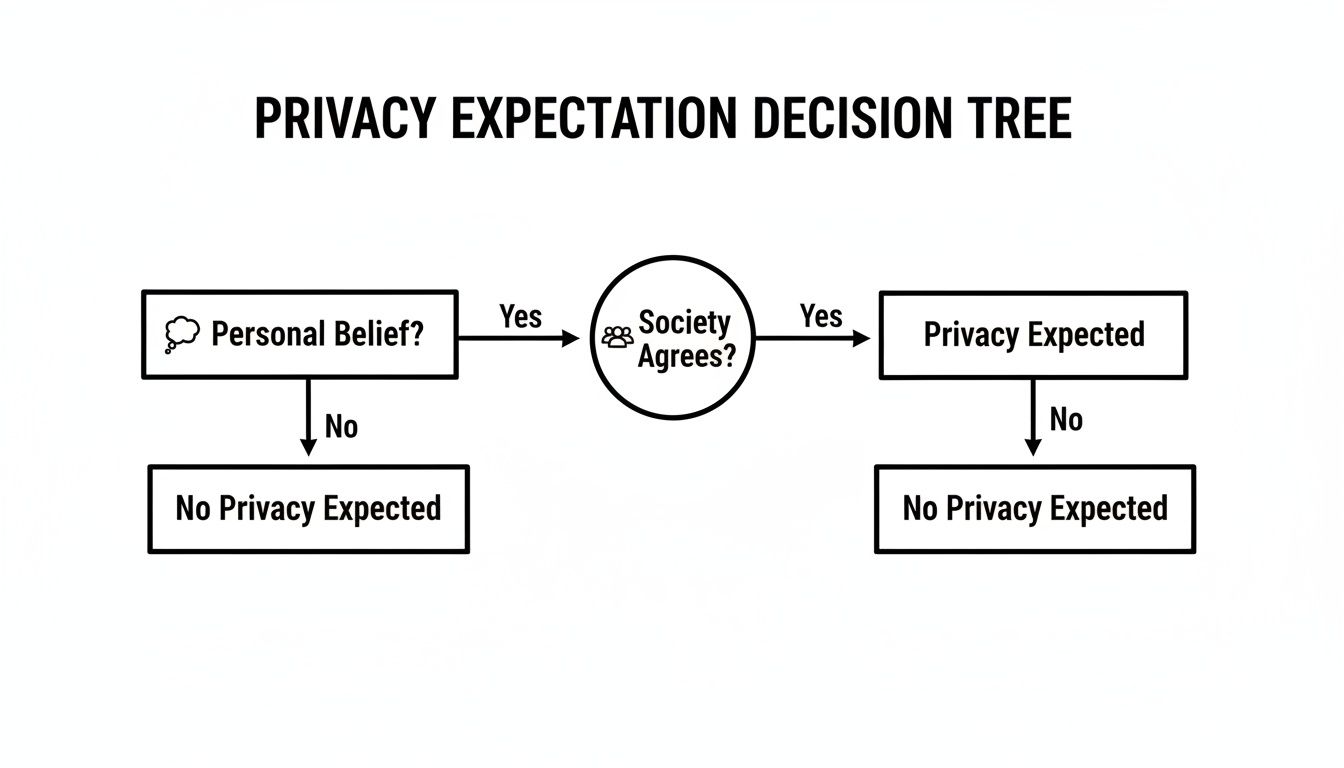
As the graphic shows, both a personal belief and society's agreement are needed for privacy to be constitutionally protected from a warrantless search. If either one is missing, the Fourth Amendment's shield likely won't apply.
The Fourth Amendment: Your Constitutional Shield
The Fourth Amendment to the U.S. Constitution is a critical shield against government intrusion. It’s not just some old text; it’s a living protection that directly guards the expectation of privacy. Think of it as the bedrock that keeps law enforcement from searching you, your home, or your property without a very good reason.
This powerful amendment guarantees the right "to be secure in your persons, houses, papers, and effects, against unreasonable searches and seizures." When this right is respected, police can't just decide to rifle through your belongings on a whim. This protection is what gives real teeth to the two-part privacy test we discussed earlier.
How the Fourth Amendment Works in Practice
At its core, the Fourth Amendment creates a barrier between you and government overreach. For law enforcement to legally cross that barrier, they almost always need two things: probable cause and a warrant signed by a judge. A warrant is simply a legal document authorizing a specific search of a particular place for certain items.
This whole process exists to make sure a neutral judge—not the officer on the street—makes the final call on whether a search is justified. Here in places like Forsyth County and Cobb County, this principle is tested every single day. If police gather evidence by breaking these rules, that evidence can be challenged in court.
The entire system is designed to prevent arbitrary searches. The requirement for a warrant acts as a critical check on power, ensuring that intrusions into your privacy are based on legitimate suspicion, not just curiosity.
When police find evidence by violating a reasonable expectation of privacy, that evidence can often be thrown out of court. This is a powerful defensive tool, as it can completely gut a prosecution's case. You can learn more about how this works by reading our guide on the motion to suppress evidence.
Georgia Law and Your Privacy Rights
While the Fourth Amendment sets the national standard, Georgia's own constitution provides its own layer of parallel protections. It's up to local courts in communities like Alpharetta, Roswell, and Marietta to interpret these rights, and their decisions create a body of case law that directly impacts everyone living here.
Georgia courts have consistently ruled that the home gets the highest level of protection. But they also have to tackle complex situations involving cars, phones, and other personal property, applying the old principles of the Fourth Amendment to our modern lives.
New Challenges in a Digital Age
Technology has completely changed the conversation around the expectation of privacy. The rules written in the 18th century now have to be applied to smartphones, cloud accounts, and social media data. Courts are constantly wrestling with how to adapt these foundational rights to new tools and technologies.
For instance, a key Supreme Court case, Kyllo v. United States (2001), established that using a thermal imager to scan a home from the street was a "search." Why? Because it revealed information about the inside of the home that couldn't otherwise be known without physically going inside. That decision reinforced that a home’s privacy extends even to details not visible to the naked eye.
Still, our general sense of privacy has shifted. A 2022 survey found that 85% of adults globally feel they need to do more to protect their online privacy. This highlights a massive concern in our connected world and shows a widespread desire for the very protections the Fourth Amendment was designed to provide. You can dig into this trend by checking out the full data privacy report.
Understanding how these protections work is the first step in being aware of your rights in any criminal case.
Where You Have a Strong Expectation of Privacy
To really get a handle on how privacy rights work in the real world, we need to move from abstract ideas to actual places. Certain locations and personal items get the highest level of protection because, as a society, we all pretty much agree they should be off-limits to the government without a very good reason. These are the spots where the expectation of privacy is at its peak, and where police almost always need a warrant to search.
The strength of this shield changes depending on where you are, but the core idea is simple. The more personal and private a space is, the more justification the government needs to enter. Let's break down the key areas where this protection is strongest.
Your Home: The Ultimate Sanctuary
Nowhere is the expectation of privacy more powerful than inside your own home. The courts have consistently treated the home as a sacred space, giving it the highest possible protection under the Fourth Amendment. This applies to you whether you live in a house in Milton, an apartment in Marietta, or a condo in Johns Creek.
When you shut your front door, you're creating a private bubble. That's why law enforcement must almost always get a warrant, backed by probable cause, before they can step inside to conduct a search.
A core legal principle states that "the home is a castle." This isn't just a poetic phrase; it’s a shorthand for the powerful protections that prevent warrantless government intrusion into your most private space.
This high standard means an officer can't just walk in because they have a hunch or see something suspicious. They have to present solid evidence to a judge to get permission first. Any evidence they find during an illegal, warrantless search of a home is almost always going to be suppressed in court.
Curtilage: The Area Immediately Around Your Home
The strong protection of your home doesn't just stop at the front door. It extends to what the law calls curtilage—the area immediately surrounding your house that's tied to the daily activities of home life. Think of it as an extension of your living room, just outdoors.
What exactly counts as curtilage can depend on the specifics, but it generally includes:
- Your Porch or Deck: These are considered part of the home's private area.
- A Fenced-In Backyard: An enclosed yard is seen as a private space for family gatherings and relaxation.
- A Detached Garage Close to the House: Since garages are often used for storage and personal projects, they are closely linked to the home's privacy.
An officer can't just wander onto your back porch and start peering through your windows without a warrant, any more than they can walk through your front door. The curtilage is protected because it’s so intimately connected to the privacy of the home itself.
Your Personal Vehicle
While your car doesn't have the same fortress-like protection as your home, you still have a significant expectation of privacy. You don't lose all your rights the moment you hit the road. The contents of your car—the glove box, the center console, the trunk—are generally considered private.
This means that during a routine traffic stop in Forsyth County, an officer can't just start rummaging through your car without a valid reason. To legally search it, they would need your consent, probable cause to believe evidence of a crime is inside, or a warrant.
Landmark Supreme Court cases like United States v. Jones (2012) even confirmed that attaching a GPS tracker to a vehicle to monitor its movements is a "search." This precedent is hugely important as technology advances. It's no surprise that 72% of Americans support federal privacy laws, a public sentiment that can influence outcomes in local cases from Roswell thefts to East Cobb felonies. You can explore more on this by checking out these data privacy statistics.
Your Cell Phone: A Window to Your Life
In this day and age, a smartphone holds more personal information than a house ever could. Our phones contain our private conversations, photos, financial records, location history, and deepest thoughts.
Recognizing this reality, the Supreme Court made a game-changing decision in Riley v. California (2014). The court ruled unanimously that police generally need a warrant to search the digital contents of a cell phone, even if they seize it during a lawful arrest.
This decision made it clear that a cell phone isn't just another object you carry in your pocket. It’s a portal to the most intimate details of your life, and searching one is a massive invasion of privacy. This ruling provides one of the most critical modern protections for your personal data.
Where You Have Little or No Expectation of Privacy
Knowing your rights is crucial, but it's just as important to understand where those rights may end. The legal shield protecting the expectation of privacy isn't a blanket that covers everything; it has clear boundaries and well-defined exceptions. Understanding these limits is important.
There are many common situations where you have little to no reasonable expectation of privacy. In these scenarios, police can observe or collect evidence without needing a warrant. Recognizing them is key to being aware of your surroundings, whether you're in Alpharetta, Cumming, or anywhere in Cobb County.
The Plain View Doctrine
One of the most clear-cut exceptions is the plain view doctrine. At its core, the rule is simple: if a police officer is legally allowed to be somewhere and sees evidence of a crime out in the open, they can seize it. The right to privacy doesn't cover things left exposed for anyone to see.
For instance, if you're pulled over for speeding in Roswell and have a bag of illegal drugs on the passenger seat, the officer doesn't need to "search" the car to see it. The same is true for an illegal firearm left on the dashboard. Because those items are in plain sight, they aren't protected. You can dive deeper into the specific rules for vehicle searches in our guide on when police can search your car.
This concept isn't just for cars. If an officer is lawfully at your front door and happens to see contraband inside your home through an open window, the plain view doctrine might kick in.
The Open Fields Doctrine
While your home and the area immediately surrounding it (the curtilage) have strong privacy protections, that shield doesn't extend to what the law calls open fields. The name can be a bit misleading—it applies to more than just pastures.
The "open fields" doctrine covers any unoccupied or undeveloped area outside of a home's curtilage, including wooded areas, empty lots, and large fields. The core idea is that these areas are not considered private, and society doesn't recognize a reasonable expectation of privacy in them.
This means an officer can legally walk onto a field on your property, far from your house, to look for evidence without a warrant. Even putting up "No Trespassing" signs won't typically create a protected privacy interest in these areas. The law sees these spaces as accessible and not tied to the intimate activities of your home life.
Information Voluntarily Shared with Third Parties
We live in a world where we're constantly sharing information. A key thing to understand is that once you voluntarily hand over information to a third party, you often lose your reasonable expectation of privacy over it.
This is a huge category that covers a lot of daily activities:
- Social Media Posts: Anything you post online, even in a "private" group, can potentially be accessed and used. A Federal Court recently found that posts in a Facebook group with around 20,000 members were public, not private.
- Bank Records: Your financial records are held by the bank—a third party. Law enforcement can often get these records with a subpoena, not the higher standard of a warrant.
- Phone Call Records: The phone company keeps a log of the numbers you dial. Police can typically get a list of those numbers (though not the content of your calls) without a warrant.
When you choose to share your data with a company or a wide audience, you're giving up exclusive control. The law's reasoning is that you can't reasonably expect something to stay private after you've already shared it with someone else. It's a critical principle to remember every time you post, text, or make a transaction.
How Privacy Violations Can Impact a Criminal Case
When we talk about the expectation of privacy, this isn't just an abstract theory—it has real, powerful consequences right inside the courtroom. This is where theory becomes a critical part of a defense. If law enforcement oversteps and conducts an illegal search, the entire dynamic of a criminal case can shift in an instant.
For someone facing charges in communities like Alpharetta or Forsyth County, a violation isn't just a procedural mistake; it's an opportunity to challenge the very foundation of the prosecution's case. The key is understanding how that opportunity can be used in a defense.
The Motion to Suppress Evidence
The primary tool used against an illegal search is the motion to suppress evidence. This is a formal legal document filed with the court asking the judge to throw out any evidence the police obtained illegally. If the motion is granted, the prosecution is legally forbidden from using that evidence against you at trial.
Think of it like a referee calling a penalty in a football game. If one team scores a touchdown but committed a flagrant foul to get there, the points come right off the board. It's the same principle in court. If the police find evidence by violating Fourth Amendment rights, that evidence gets tossed.
This all comes back to a core legal doctrine. The "exclusionary rule" is the rule that keeps illegally gathered evidence out of the courtroom. It exists for one big reason: to hold law enforcement accountable and protect constitutional rights.
A Real-World Example of a Successful Motion
Let's paint a picture. A young driver gets pulled over for a minor traffic stop late one night in Milton. The officer seems overly aggressive, and without a warrant or probable cause, decides to pop the trunk and start searching. Inside, they find something illegal.
On the surface, it looks like a slam-dunk case for the prosecutor. But a skilled defense attorney sees it differently. The driver had a reasonable expectation of privacy in their car's trunk, and the officer had no legal justification for the search—it was just a hunch, and hunches aren't enough.
A motion to suppress is filed, arguing the search was unconstitutional. The judge hears the arguments and agrees, ruling that the evidence was the "fruit of the poisonous tree." With that evidence now suppressed, the prosecution's case completely crumbles. The charges are dismissed.
This is a perfect illustration of why understanding privacy rights is so critical. A successful motion to suppress doesn't just weaken the state's case—it can completely dismantle it, often leading to reduced charges or an outright dismissal.
What’s at Stake Beyond Your Case
The fight for privacy isn't just about winning one case; it’s about shaping the law for everyone. Landmark decisions like Carpenter v. United States (2018) set massive new precedents, requiring police to get a warrant for seven or more days of cell-site location data. This was a huge win for protecting digital privacy, especially when you consider that 61% of people often trade privacy for convenience.
Despite these protections, research shows that around 51% of people have no idea how to respond when their data is misused. As technology advances, the stakes only get higher. By 2025, an estimated 60% of large businesses are expected to use Privacy-Enhancing Technologies (PETs) to protect their customers. The data privacy software market is projected to skyrocket from $5.37 billion to $45.13 billion by 2032.
For an individual facing charges in Cobb County, these trends matter. They highlight just how important personal information is and why defending it so fiercely is essential. A deep understanding of the expectation of privacy isn't just academic—it's one of the most practical and powerful concepts for protecting your freedom.
Answering Your Questions About Privacy Rights
When you're trying to wrap your head around the expectation of privacy, things can get confusing fast. The theory is one thing, but how it plays out in a real-life traffic stop or police encounter is another. Let's break down some of the most common questions people ask.
These aren't just hypotheticals. These are the kinds of situations that come up every day for people in our local communities, from Alpharetta and Roswell to Johns Creek and beyond.
Does My Expectation of Privacy Apply to My Work Computer or Phone?
This is a big one. Generally speaking, there is very little, if any, expectation of privacy when you're using a computer or phone owned by your employer. Most companies have policies that flat-out state they can monitor work devices, networks, and emails.
When you use company property, you're essentially agreeing to their terms. It's always safest to assume that anything you do or say on a work device is not private.
What if Police Say They Have a Warrant but Won’t Show It to Me?
If an officer tells you they have a warrant, the first rule is not to physically resist the search. That can lead to more serious charges and make a bad situation much worse. It is important, however, to state clearly and calmly, "I do not consent to this search."
You can, and should, politely ask to see the warrant. After the encounter, a defense attorney can scrutinize that warrant—its validity, what it allowed police to search for, and how the search was actually carried out—to see if any rights were violated.
Can Police Search Trash Cans I Put on the Curb?
The U.S. Supreme Court has been very clear on this. Once you haul your trash cans out to the curb for pickup, you've given up your expectation of privacy in whatever is inside. Legally, it's considered abandoned property, accessible to anyone.
This means police don't need a warrant to go through it. While there might be some hyper-specific local ordinance that changes things, the general rule across the country is that your curbside trash is fair game.
What Should I Do If I Think My Privacy Was Violated?
If you walk away from a police encounter feeling like your rights were violated, the most important thing you can do is write everything down. Do it as soon as possible, while the details are still fresh in your mind.
- Key Details to Record:
- The date, time, and exact location of the stop.
- The officers' names or badge numbers, if you got them.
- What you said and what they said, as close to verbatim as you can remember.
- Anyone else who was there and might have seen what happened.
This isn't just busywork. That detailed account is gold for an attorney. It gives them the facts needed to build a defense and challenge how evidence was obtained.
If you're facing criminal charges because of a search you believe was illegal, you need someone in your corner who knows how to fight back. At Brian Hansford Law, we bring over 25 years of experience, including my time as a prosecutor, to the table. We know how to pick apart a case and challenge evidence. Contact us for a consultation today by visiting our official website.
