
If you're looking to expunge a record in Georgia, it's critical to know that the state doesn't have "expungement" in the traditional sense. Instead, there is a process called record restriction and sealing.
This process doesn't completely erase the past, but it does make the record inaccessible to most employers and the general public. It's a powerful tool that can move a past charge from a constant obstacle to a managed part of your history, effectively giving you a fresh start.
What It Means to Expunge a Record in Georgia

When people hear "expunge a record," they usually picture a file being shredded or deleted forever, as if the incident never happened. While some states follow that model, Georgia’s approach is different. Here, it’s all about limiting access, not total destruction.
When a record is successfully restricted, it gets hidden from your official criminal history report—the one available to the public. This is the exact document that most private employers, landlords, and even colleges check.
There's also a second step called sealing, which can hide the actual case file from public view at the courthouse. Together, restriction and sealing provide a powerful one-two punch for protecting your privacy and future.
The Real-World Impact of Record Restriction
Think about applying for a new job in Forsyth County or an apartment in Alpharetta. With a visible criminal record, even for a minor charge that was dismissed years ago, you might face an automatic rejection before you even get a chance. Record restriction completely changes that narrative.
By limiting access to these past events, you can confidently apply for opportunities without a mistake from years ago creating an immediate barrier. The whole system is designed to help people move forward.
The benefits are real, tangible, and often life-altering:
- Better Job Prospects: A restricted record won’t show up on most background checks run by private companies.
- Easier Access to Housing: Landlords and property managers won't see the restricted charges, which improves your chances of getting a lease.
- Educational Opportunities: Applying for college or specialized training programs becomes much more straightforward.
- Peace of Mind: Maybe the most important benefit is just lifting the weight and stigma that comes with a past criminal charge.
A criminal record can feel like a lifelong sentence, even for minor offenses. Georgia's record restriction laws recognize that people deserve a chance to move beyond their past and contribute fully to their communities.
To help clarify, let's look at the key differences between the common understanding of "expungement" and what Georgia law actually allows.
Record Restriction vs Traditional Expungement At a Glance
| Feature | Traditional Expungement Concept | Georgia Record Restriction & Sealing |
|---|---|---|
| Record Status | The record is physically destroyed or erased. | The record is hidden from public view but not destroyed. |
| Public Access | Inaccessible to everyone, including the public. | Inaccessible to the public, landlords, and most employers. |
| Law Enforcement Access | Generally not accessible, as if it never existed. | Law enforcement and some government agencies can still see it. |
| Legal Effect | Legally, you may be able to deny the event occurred. | The event still legally occurred, but access is limited. |
| Goal | To completely remove a past event from history. | To provide a second chance by limiting the negative impact. |
This table shows why it's so important to understand the specific terminology used here in Georgia. It’s not about erasing the past, but about sealing it off so it no longer controls your future.
Not Erasure, But a New Beginning
It’s important to have a realistic perspective. Record restriction doesn't make the information vanish forever. Law enforcement and certain government agencies can still access these records under specific circumstances, like for criminal justice purposes or when you apply for a sensitive security clearance.
For the vast majority of day-to-day situations, though, the record is effectively invisible. This distinction is vital. You can get more details in our article explaining the difference between expunged and sealed records.
This push for second chances is happening nationwide. Over 18 million Americans are eligible for record clearing under Clean Slate legislation, a number that's only going to grow. It shows a widespread understanding that clearing old records removes lifelong barriers for the one in three U.S. adults with some kind of criminal history. You can learn more about these national trends from the Clean Slate Initiative.
Ultimately, the goal in Georgia is to give you a path forward, turning a past mistake from a permanent roadblock into a closed chapter of your life. It’s about creating a hopeful future, unburdened by events that no longer define who you are.
So, Can I Get My Record Restricted?
Figuring out if you even qualify for record restriction is often the most confusing part of this whole thing. Georgia's laws are very specific, and unfortunately, not every case is eligible. But understanding the rules is the first big hurdle to clear on your way to a clean slate.
The good news is that Georgia law creates clear pathways for many common situations. Your eligibility really boils down to two things: how your case ended and what the original charge was.
The Most Common Ways to Qualify
For many individuals, eligibility falls into one of three buckets. Each one has its own rules and, just as importantly, its own timelines that must be followed before an application can be filed.
- Arrests That Didn't Lead to a Conviction: This is the cleanest path. If you were arrested but the prosecutor dropped the charges (nolle prossed), the judge dismissed the case, or you were found not guilty at trial, you're usually good to go right away.
- Certain Misdemeanor Convictions: This is a huge deal and a relatively recent change in Georgia law that gives a lot of people a second chance. If you were convicted of certain misdemeanors, you might be eligible after a specific waiting period.
- Cases from When You Were Younger: The law has special rules for people who got into trouble before they turned 21. It's a recognition that a youthful mistake shouldn't follow you for the rest of your life.
These categories cover a ton of ground, from a dismissed shoplifting charge in Marietta to a minor conviction in Alpharetta from years ago.
Taking a Closer Look at Misdemeanor Convictions
That change mentioned for misdemeanor convictions is a game-changer, but it comes with one very important string attached: the waiting period.
To qualify under this rule, two key milestones must be met:
- First, you must have completely finished your sentence. That means all probation, fines, community service, and any required classes are done.
- Second, you have to stay out of trouble for four straight years after your sentence is complete. This means no new arrests or convictions for anything other than a minor traffic ticket.
Let's say a person was convicted of a misdemeanor in Cobb County and their probation ended on June 1, 2020. They would have to wait until at least June 1, 2024, without any new criminal charges, before they could file for record restriction.
This four-year clock is non-negotiable. It’s the law's way of making sure the old offense was a one-time thing and that you've been on the straight and narrow ever since.
What Charges Can't Be Restricted?
While Georgia has opened the door for many people, it’s not wide open. Some offenses are simply not eligible for restriction, and it’s just as important to know if a case falls into one of these categories from the start.
The law specifically carves out several serious offenses. You generally can't restrict convictions for:
- Serious Driving Offenses: Things like DUI, Reckless Driving, and Fleeing or Attempting to Elude are almost always ineligible.
- Violent Crimes: Convictions for battery, assault, and especially family violence battery are typically excluded.
- Sex-Related Offenses: Any conviction for a crime of a sexual nature is not eligible for restriction in Georgia.
This isn't a complete list, and the details of a specific case always matter. But having a realistic understanding of what's possible helps set the right expectations.
Getting this right can change everything. Successfully restricting a record makes a massive difference, with research showing just a 4.2% five-year recidivism rate for people who've had nonviolent misdemeanors cleared. That’s a world away from the rates for those with a visible record. Georgia’s law is a step in the right direction, but success really comes down to paying close attention to every detail. You can review the full research about these findings on recidivism rates.
The Georgia Record Restriction Process Explained
Trying to get a record restricted in Georgia can feel like you've been dropped into a maze with no map. It's a formal process, and it involves multiple government agencies, each with its own specific role. If a mistake is made, you can face frustrating delays or even an outright denial, so knowing the path from start to finish is critical.
This isn't as simple as just filling out a form and mailing it in. A person has to methodically build a case, track down official documents from years ago, and make absolutely sure every agency gets the correct paperwork in the right order.
This flowchart gives you a bird's-eye view of how eligibility often works depending on how your case was resolved.
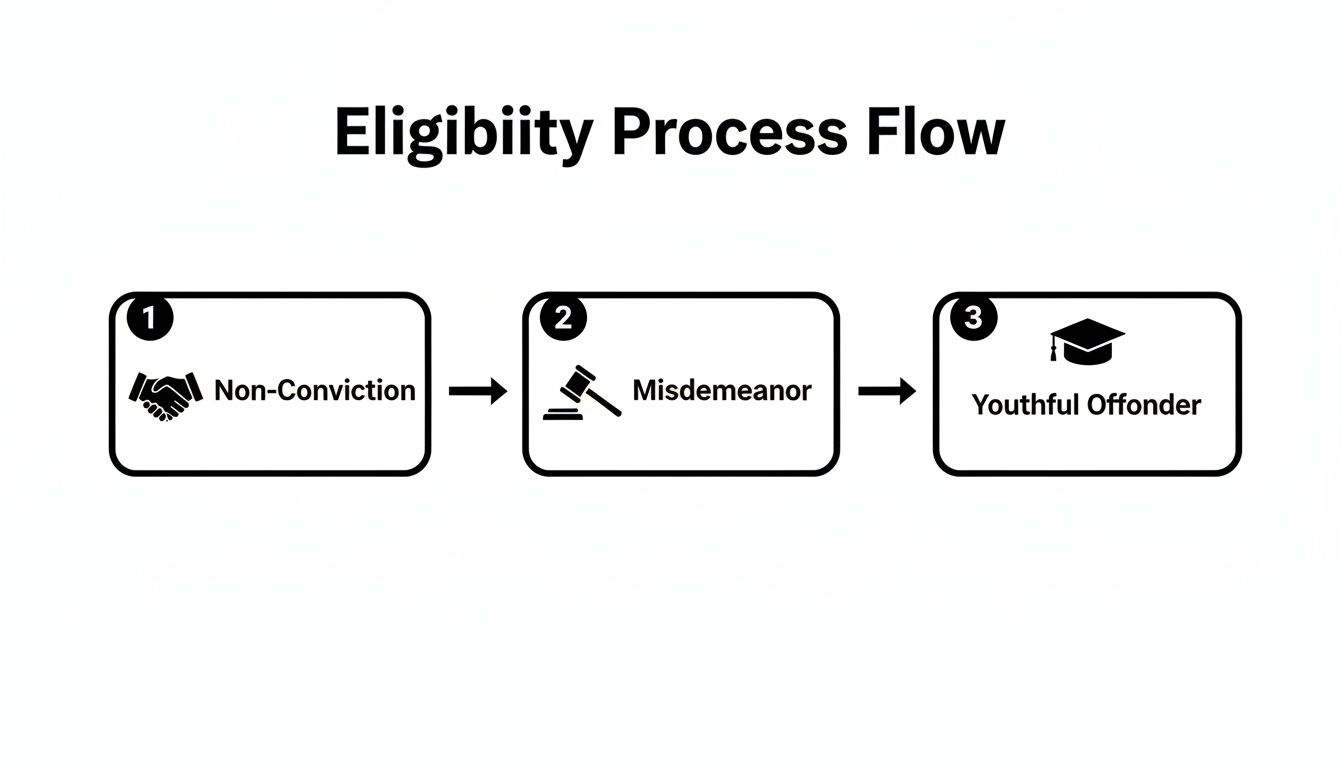
As you can see, the final outcome of the case—whether it was a non-conviction, a certain type of misdemeanor, or a youthful offense—is the key that unlocks the door.
Starting with the Right Paperwork
First things first: you need the foundational documents from the criminal case. Without them, you can't even get out of the starting gate. The two most important pieces of paper are the arrest report and the final court disposition.
- The Arrest Report: This is the official report created by the police department that made the arrest. It details the charges initially faced. You have to contact that specific law enforcement agency to get a certified copy.
- The Final Court Disposition: This document from the court tells the official story of how the case ended. It will state if the charges were dismissed, if a person was found not guilty, or if they were convicted and sentenced.
Hunting these down can be a pain. Where you get them depends entirely on where the arrest happened. An arrest in Alpharetta means you’ll be dealing with the Alpharetta Police Department, while a case in Marietta puts you in contact with a Cobb County agency. The disposition will always come from the Clerk of Court in the county that handled the case, like the Forsyth County Clerk of Court in Cumming.
Completing the Correct Forms
Once you have the documents in hand, you can tackle the official application for record restriction. Georgia provides a standard form, but it has to be filled out with 100% accuracy. Applications can be kicked back for the smallest errors—a wrong case number, an incorrect date—forcing the whole process to start over.
Think of this form as a formal request that gets passed from one government office to the next. Each one scrutinizes it for mistakes before it moves on.
The record restriction process is a chain of approvals. A mistake on the initial form is like a broken link—it stops the entire process cold until it's fixed. This is why meticulous attention to detail at the start saves so much time and frustration later on.
The Multi-Agency Review Process
To get a record restricted in Georgia, the request has to clear two key agencies before a judge ever sees it. This two-part sign-off is a distinct feature of our state's system.
- The Arresting Law Enforcement Agency: Your first stop is submitting the completed application to the police or sheriff's department that made the arrest. They pull their old files to make sure the details on the application match their records.
- The Prosecutor's Office: Once the arresting agency signs off, the packet goes to the prosecutor who handled the case. This could be the Cobb County Solicitor-General for a misdemeanor or the District Attorney for a felony. They review the final disposition to confirm legal eligibility for restriction.
Only after both of these signatures are obtained can the petition finally be filed with the Clerk of Court. This system is designed so that by the time a petition lands on a judge’s desk, the basic facts and eligibility have already been vetted. The court then makes the final call. For more on that final stage, you might find our guide on how to seal criminal records helpful.
Understanding the Associated Costs
It’s important to go into this with a realistic view of the expenses. While the process is meant to be accessible, it’s rarely free. A person is likely to run into a few different fees.
- Agency Fees: Some police departments and prosecutor's offices charge a small administrative fee just to process an application. These usually fall in the $25 to $50 range for each agency.
- Court Filing Fees: When an approved petition is taken to the Clerk of Court, there will be a filing fee. This cost varies widely by county but can easily be $200 or more.
- Copying Costs: Don't forget there might also be a small fee for the certified copies of the arrest report and court disposition.
These costs can add up, so it's smart to call each agency ahead of time to ask about their fees. Knowing what to expect financially helps you prepare for the entire journey without any last-minute surprises.
How Local Courts in Forsyth and Cobb County Differ
A generic guide on record restriction can give you a solid foundation, but it often misses a critical truth: every local court system has its own personality. While state law provides the rulebook, the way each county applies those rules can be surprisingly different. Navigating the specific procedures in Forsyth County versus Cobb County means understanding these local quirks.
These differences aren't about changing the law; they're about the day-to-day administrative realities of how things get done. From the front desk at the clerk's office to the prosecutor's internal review process, local customs and workloads will shape the experience. What works smoothly in Cumming might hit a snag in Marietta if you aren’t prepared for their unique way of handling things.
Filing Protocols and Intake Processes
One of the first places these differences are noticeable is in the simple act of filing paperwork. Each Clerk of Court and prosecutor's office has its preferred method for receiving and processing petitions.
- Forsyth County: The process in Cumming often feels more centralized. The Forsyth County Clerk of Court might have a very specific intake checklist and could be more hands-on in guiding a person to the correct window or department for each step.
- Cobb County: With a much larger population and higher case volume, the system in Marietta can feel more compartmentalized. The Cobb County Solicitor-General’s Office (for misdemeanors) and the District Attorney's office (for felonies) have distinct procedures that may not align perfectly. It's crucial to confirm you are in the right place for your specific type of case.
For example, one county might prefer e-filing for certain documents, while another sticks strictly to in-person submissions. These small details are critical; submitting paperwork the wrong way is one of the fastest routes to an unnecessary delay.
Timelines and Processing Speed
Patience is a virtue in any formal process, but the wait time can vary significantly depending on the jurisdiction. The backlog and staffing levels in Forsyth County are just different from those in Cobb County, which directly impacts how quickly a petition moves through the system.
In a smaller jurisdiction like Forsyth, it's sometimes possible for a petition to move from the prosecutor's review to the judge's desk more quickly. On the other hand, a larger system like Cobb County's is often a well-oiled machine built for volume, which can sometimes lead to predictable, if not always speedy, processing times. A realistic expectation for Cobb might be several months, while Forsyth could potentially be a bit faster—or slower if they are dealing with their own backlogs.
No matter the county, the timeline is never guaranteed. The key is understanding that the "average" processing time is heavily influenced by local factors you can't control.
Local Forms and Preferences
While the state of Georgia provides a standard application for record restriction, some local offices have supplemental forms or specific preferences for how information should be presented. The Cobb County Solicitor's Office might have an internal worksheet they ask people to complete, whereas Forsyth may just require the standard state form.
Before filing anything, it's a smart move to check the website or even call the specific Clerk of Court's office for your jurisdiction. It can be helpful to ask if they have any local forms or special instructions for record restriction petitions. Making that call can save you from having your entire packet rejected because of a single, county-specific document.
The goal is to make the process as easy as possible for the clerks and prosecutors reviewing the case. Understanding the nuances of a Cobb County criminal defense filing, for instance, can be key to a smooth process. Submitting a perfectly prepared packet tailored to their local preferences is the best way to avoid preventable delays and get a positive outcome.
Common Mistakes That Can Derail Your Petition

It happens more times than one can count. A person does all the hard work to get their record restricted, only to have their petition tossed out over a small, avoidable oversight. These little mistakes can create massive setbacks, leading to frustrating delays or even an outright denial.
Understanding where people usually trip up is the best way to make sure it doesn't happen. It's not just about filling out a form; it's about knowing the procedural traps that can stop a petition in its tracks.
The Case of the Incorrect Case Number
One of the most frequent—and frankly, most frustrating—errors is simple bad data. A single transposed digit in a case number, a wrong arrest date, or a misspelled name can get an entire petition rejected before anyone even looks at the merits of the case.
Imagine submitting an application, waiting weeks for a response, and finally getting a letter back saying the case number doesn't match the court's official records. That one typo just cost months of time. The form has to be fixed, refiled, and put back in line.
To avoid this, triple-check every single detail on the forms against the certified copies of the official court disposition and arrest report. Accuracy isn't just important; it's everything.
Miscalculating the Waiting Period
Another huge pitfall is misunderstanding Georgia’s waiting periods, especially for eligible misdemeanor convictions. The four-year clock doesn't start ticking from the day of conviction. It begins the day the sentence is 100% complete.
What does that mean? It means every last requirement has been met:
- All probation terms are finished.
- Every fine and fee has been paid in full.
- All court-ordered classes or community service hours are done.
If probation officially ended on May 15, 2021, a petition cannot be filed a single day before May 15, 2025. Filing early is an automatic denial, and the whole process will have to be started over again once eligibility is actually met.
Formal processes run on procedure. Failing to follow the timeline rules precisely is one of the most common reasons a petition gets denied, no matter how deserving the case might be.
Forgetting to Follow Up with the GCIC
Getting a judge to sign a record restriction order feels like the finish line has been crossed. But it hasn't. There's one more critical step that many people miss. That signed court order has to be sent to the right agencies, especially the Georgia Crime Information Center (GCIC).
The GCIC is the state's central hub for criminal history information. If they never receive and process the signed order, the record won't actually be restricted on an official background check, even with a judge's approval.
Once the judge grants the petition, it's important to ensure a certified copy is transmitted to the GCIC and the original arresting law enforcement agency. A quick follow-up to confirm they received it can be the difference between a clean record and all that hard work going to waste.
Record Restriction Checklist Common Oversights
To help stay on track, this table summarizes these common errors. Think of it as a final review before filing—a quick way to catch the little things that can cause big problems.
| Potential Pitfall | Why It Matters | How to Avoid It |
|---|---|---|
| Incorrect Case Numbers or Dates | Clerks will reject paperwork with mismatched information, causing significant delays. | Compare every entry on your forms against your certified court and arrest documents. |
| Filing Before the Waiting Period Ends | Premature filings are automatically denied, forcing you to refile and pay fees again. | Calculate your eligibility date from the day your entire sentence was completed, not the conviction date. |
| Incomplete Sentence Requirements | An unpaid fine or unfinished class means the eligibility clock hasn't even started yet. | Obtain proof from the court or probation office that all financial and other obligations are fully satisfied. |
| Not Sending the Order to GCIC | The judge's order is not self-executing; your record remains unrestricted if GCIC isn't notified. | After the order is signed, follow up to confirm that certified copies were sent to and processed by GCIC. |
| Missing Signatures or Notarization | Forms that are not properly signed or notarized are considered incomplete and will be returned. | Read the instructions for each form carefully. Don't rush through the final signature pages. |
This isn't an exhaustive list, but it covers the issues that derail most self-filed petitions. By being mindful of these details, you dramatically increase the chances of a smooth and successful process.
Georgia Record Restriction: Your Questions Answered
Going through the record restriction process naturally brings up a lot of questions. It can feel like a maze, and it’s completely normal to want clear answers before you start. Here, we'll tackle some of the most common questions, giving you straightforward information to help you understand what to expect.
How Long Does It Take to Expunge a Record in Georgia?
This is probably the number one question asked, and the honest answer is: it depends. There’s just no single timeline that fits every case. Generally, a person should be prepared for the process to take anywhere from several months to over a year.
Several things can really slow down or speed up a case:
- The Prosecutor's Workload: The prosecutor’s office, whether in Cobb County or Forsyth County, has to review and sign off on a petition. How quickly they move plays a huge role.
- The Clerk of Court's Office: After the initial side is handled, the clerk's office has to process all the filings and court orders. Their backlog can definitely affect the timeline.
- Paperwork Accuracy: This can't be stressed enough—the single biggest cause of delay is incorrect or incomplete paperwork. Even one small mistake can send an application right back to the beginning.
Can a Felony Conviction Be Restricted in Georgia?
This is a tough one. While restricting a felony conviction in Georgia is technically possible, the reality is that it's far more limited than the options for misdemeanors or cases that didn't result in a conviction. Eligibility is tied to very specific and, frankly, uncommon situations.
For example, a person might have a chance if they receive a full pardon from the State Board of Pardons and Paroles. There are also a few narrow provisions for certain felonies committed as a youthful offender. But it's critical to understand that most felony convictions are not eligible for restriction under current Georgia law.
The paths for restricting felony convictions are incredibly narrow. This is a challenging area that requires a deep, practical understanding of some very specific exceptions in the law.
What Is the Difference Between Record Restriction and Sealing?
In Georgia, "restriction" and "sealing" aren't the same thing, though they work together. Think of them as two connected steps in the same overall process. Getting this distinction right is key to knowing what is actually being accomplished.
Record restriction comes first, and it’s the most important step. This is what limits who can see the arrest on an official criminal history report. It makes it invisible to the general public and most private employers who run a background check.
Sealing is an extra, separate step. Once a record is restricted, a person can then petition the court to seal the actual court files—both the physical papers and the electronic records. This prevents someone from just walking into the courthouse in Marietta or Cumming and looking up the public file on the case. Not every restricted record is automatically eligible to be sealed, though.
If My Record Is Restricted, Do I Have to Disclose It?
This is a tricky area, so please remember this information is for educational purposes only. Once a record is successfully restricted and sealed in Georgia, a person generally does not have to disclose the arrest on most standard job applications in the private sector.
However, there are some very important exceptions. A person may still be required to disclose the arrest when applying for certain types of jobs, like:
- Law enforcement positions
- Government jobs that require a security clearance
- Certain professional licenses (e.g., in healthcare or education)
The exact wording on the application form matters a great deal. Understanding precisely what the court's restriction order covers is essential to answering these questions correctly and with confidence.
Navigating the maze of record restriction requires a sharp eye for detail and a solid grasp of local court procedures. For personalized guidance on your specific situation in Alpharetta, Cobb County, or Forsyth County, contact Brian Hansford Law. With over two decades of experience, we can help you figure out your best path forward. Visit our website at https://challengemycharge.com to schedule a consultation.
