
So you received a failure to yield ticket in Georgia. That piece of paper in your hand might list a fine, but that's just the starting point. When all is said and done, the total hit to your wallet can easily range from a few hundred to over a thousand dollars once you factor in the base fine, mandatory court fees, and multi-year insurance premium hikes.
The True Cost of a Failure to Yield Ticket
Getting a failure to yield ticket is a bit like hitting a small iceberg. The fine you see on the ticket is just the part sticking out of the water. The real damage—the much larger, more expensive part—is hiding beneath the surface, waiting to impact your budget for years to come.
To really get a handle on what you might be facing, you need to understand all the different layers of cost that pile up. This isn't a single payment; it's a series of financial hits.
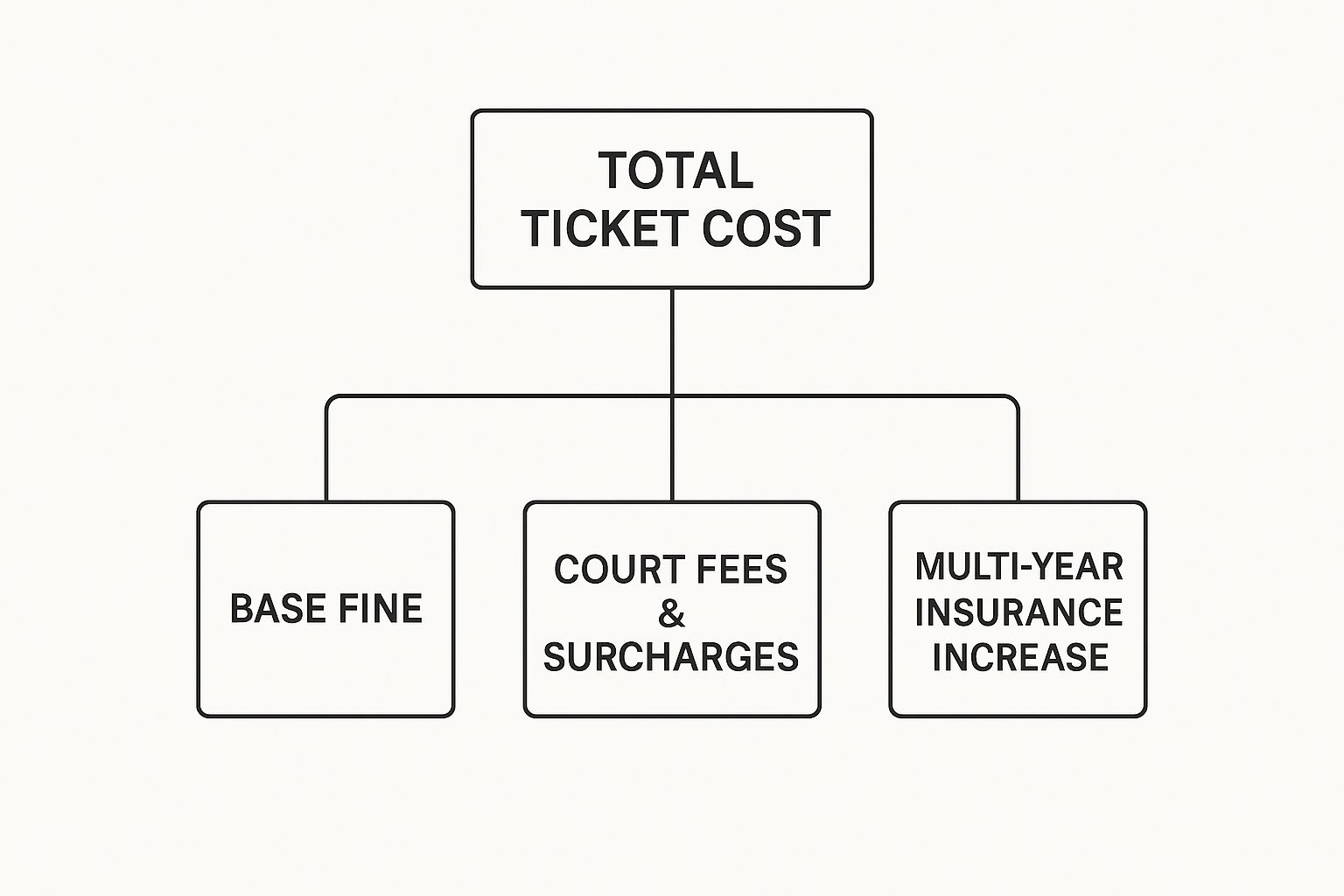
As you can see, the path forks into two major problems: the immediate costs you have to pay the court and the long-term pain of higher insurance rates.
Breaking Down the Financial Impact
The final amount you'll pay isn't a fixed number. It's influenced by several moving parts that go way beyond the violation itself. To really understand the total failure to yield ticket cost, we need to look at it from four different angles:
- The Base Fine: This is the core penalty for the violation. It can vary a lot depending on which court in Georgia handles your ticket, whether it's in a place like Alpharetta or Forsyth County.
- Court Surcharges: Think of these as mandatory administrative fees tacked onto every single ticket. This money is used to fund all sorts of state and local programs, and these are required payments.
- Points on Your Record: A conviction for failure to yield will add points to your driving history. To your insurance company, those points are a big red flag that screams "higher risk."
- Insurance Premium Increases: This is often the most expensive consequence of all. A moving violation conviction can cause your auto insurance rates to climb and stay there for three to five years.
To make this clearer, let's lay out the potential costs in a simple table.
Quick Breakdown of Potential Ticket Costs
This table summarizes the different financial elements you're likely up against after getting a failure to yield ticket in Georgia.
| Cost Component | Typical Impact | What It Covers |
|---|---|---|
| Base Fine | Varies by court ($150 – $400+) | The direct penalty for the traffic violation itself. |
| Court Costs & Surcharges | Can add 50-100% on top of the base fine | Administrative fees funding state/local programs (e.g., peace officer training). |
| Points on Your Record | 3 points added to your license | A non-monetary penalty that signals risk to your insurance company. |
| Insurance Rate Increase | 10-25% or more for 3-5 years | The long-term financial fallout as your insurer raises your premiums. |
Each of these components adds up, turning what might seem like a minor ticket into a significant and lasting financial burden.
Deconstructing Fines and Mandatory Court Fees
That number you see printed on a failure to yield ticket? It's almost never the final amount you'll end up paying. Think of the failure to yield ticket cost like buying a concert ticket. The price on the poster is just the starting point. By the time you get to the checkout, you’ve been hit with service fees, facility charges, and taxes that jack up the total. Traffic tickets work the same way.
The base fine for the violation itself is just one piece of the puzzle. That amount isn't even standardized across Georgia; it changes from one jurisdiction to the next. A ticket handed out in Alpharetta could have a totally different base fine than one from Marietta or somewhere else in Cobb County. This local control means your starting cost can swing wildly before any other fees are tacked on.
On top of that base fine, state and local governments layer on all sorts of mandatory surcharges. These aren't optional. They are required fees that get funneled into a wide range of state programs, from funding peace officer training to supporting local government services.
The Anatomy of Surcharges
Believe it or not, these extra costs can sometimes double the original fine. It’s a nasty surprise for drivers who expect to pay only the amount listed for the violation itself. You can see how these costs stack up differently across jurisdictions by looking at how other violations are handled, like with speeding citations in Forsyth County.
Here are just a few examples of the fees that get added on:
- State-Mandated Surcharges: A percentage tacked onto most traffic fines to fund specific state initiatives.
- County or City Fees: Local courts often add their own administrative costs to help keep their own lights on.
- Special Program Fees: Money that gets earmarked for specific things, like victim assistance programs or courthouse security.
The reality is that the "fine" is just the entry point. The accumulation of these mandatory surcharges is what creates the final, often much higher, figure you are required to pay to the court. This is the immediate, out-of-pocket hit to your wallet.
How Points on Your Record Impact Your Future
A failure to yield ticket does a lot more than just hit you in the wallet right now; it leaves a lasting mark on your driving record. This mark comes in the form of points, which essentially act as a risk score that follows you around. In Georgia, the Department of Driver Services (DDS) uses this very system to keep track of every driver's behavior on the road.
Think of your driving record like a credit report, but for driving. Every moving violation adds a negative item—in this case, points—which signals to insurance companies and the authorities that you might be a higher-risk driver. A clean record suggests you're a safe bet, but a record cluttered with points raises some serious red flags.

The Georgia Point System Explained
Here in Georgia, a conviction for failure to yield will typically add 3 points to your license. While that might not sound like a huge deal on its own, these points start to add up, and that's where the real trouble begins. The DDS has very clear rules about how many points are too many within a specific timeframe.
The real danger here is accumulation. If a driver who is 21 or older racks up 15 or more points in any consecutive 24-month period, their license will be suspended. Period.
This is how a single, seemingly minor ticket can spiral into a much bigger problem. It can be the first step toward losing your driving privileges entirely, turning a simple fine into a massive disruption to your life. If you're concerned about where you stand, it's a good idea to know how to check for a suspended license and stay ahead of any surprises.
How Points Translate to Higher Costs
These points aren't just some internal number the state keeps. They have a direct, and often long-lasting, impact on your finances.
Insurance carriers all over Georgia, from Cobb County to Forsyth County, use your point total as a key factor in calculating your premiums. To them, more points mean you're more likely to file a claim in the future. To offset that perceived risk, they hike up your rates.
Suddenly, the points from that one ticket become a recurring expense that can stick with you for three to five years, making the true cost of that citation far higher than the initial fine.
The Long-Term Effect on Your Car Insurance Rates
While the points on your license are an immediate problem, the real financial pain comes from your car insurance provider. A failure to yield conviction sends a clear message to insurers: you’re a higher risk. Their response? Higher premiums. This isn't just a one-time fee—it’s a surcharge that can inflate your bills for years.
Think of your driving record as a credit score for your insurer. A clean record gets you the best rates, but a moving violation like this one puts a serious dent in it. The second that conviction hits your record, your insurance company can—and likely will—re-evaluate your risk profile at your next renewal, leading to a noticeable price hike.

Understanding the Rate Increase
The exact percentage increase varies between insurance companies, but it's not unusual for a single moving violation to raise your rates by 10% to 25%, or sometimes even more. This increase will typically haunt your policy for three to five years, making it the single most expensive part of the total failure to yield ticket cost in the long run.
A $30 monthly increase might not sound like a disaster, but over three years, that adds up to over $1,000. That’s a lot more than the original fine and court fees combined.
The ongoing insurance surcharge is where the true financial sting of a failure to yield ticket is felt. It transforms a one-time mistake into a multi-year financial burden that quietly drains your budget long after the court date is over.
Factors That Amplify the Increase
Certain situations can make that insurance rate hike even worse. Insurers don't just see the ticket; they look at the whole picture of what happened.
Key factors that can make things worse include:
- A Resulting Accident: If your failure to yield caused a crash, you can bet the premium increase will be on the higher end of the scale.
- Your Existing Record: Already have a few recent tickets? This new one can have a compounding effect, pushing your rates even higher.
- Your Insurance Carrier: Every company has its own playbook for assessing risk, so the financial hit can be different from one provider to the next.
At the end of the day, the points on your license are just the trigger. The lasting financial damage comes directly from how your insurance company reacts to that new information on your record.
Why a Failure to Yield Ticket is So Much More Than a Fine
When you see the price tag on a failure to yield ticket, it's easy to focus on the dollars and cents. But the steep fines, points against your license, and insurance hikes are there for a reason: these violations are a major threat to public safety. This isn’t considered a minor slip-up; it's one of the leading causes of preventable accidents on Georgia's roads.
Think about it. From a busy intersection in Alpharetta to a simple crosswalk in Marietta, failing to give the right-of-way puts everyone in immediate danger—other drivers, your own passengers, and pedestrians. These mistakes are a direct cause of T-bone collisions, rear-end crashes, and tragic pedestrian accidents. The rules of the road are designed to work together. When one driver misses their cue, the whole system can fall apart, often with devastating results. That’s why the state’s penalties are so firm.
The Direct Line Between a Ticket and Road Safety
The penalties aren't random; they're a direct response to a common and dangerous driving habit. Failure to yield is one of the most frequent traffic violations anywhere, and it’s a major contributor to crash statistics. In fact, it's estimated that violations of traffic controls, including failure to yield, are responsible for around 22% of crashes at intersections with signals like red lights or stop signs. You can find more on the connection between these violations and accident data on PMC NCBI.
This clear link between the action and the potential outcome is why the offense is treated so seriously.
When a driver fails to yield, they create a ripple effect of risk that extends to everyone around them. The ticket, therefore, serves not only as a penalty but as a critical reminder of the shared responsibility we all have to keep our roads safe.
Every ticket issued is a response to a decision that could have ended far more tragically. The cost reflects that potential danger, framing the violation as a serious breach of public trust, not just a simple error. This context is key to understanding why the financial and administrative consequences are so significant.
Common Questions About Failure to Yield Tickets
When you get hit with a failure to yield ticket, a lot of questions probably start swirling through your head. It’s a common violation, and most drivers have the same initial concerns about what comes next. Getting some clear answers can help you understand the situation.
So, does a failure to yield ticket always mean points on your Georgia license? Almost certainly, yes. A conviction for this kind of moving violation will tack 3 points onto your driving record. To your insurance company, those points are a clear signal that you've become a higher-risk driver.
That naturally leads to the next big question: how long will this ticket mess with my insurance rates? You can generally expect a moving violation to inflate your premiums for anywhere from three to five years after the conviction date.
Why Are These Violations Still So Common?
Here's something interesting: even though police are writing fewer tickets overall, our roads are actually getting more dangerous. Recent data shows a surprising trend where nationwide traffic citations dropped by about 13%, yet driving fatalities jumped by 22% in the same timeframe. It’s a stark reminder that even with less enforcement, the risks out there are very real.
Finally, a lot of drivers want to know if the fine is the same everywhere in Georgia. The answer is a definite no. The failure to yield ticket cost isn't a flat rate. It can vary wildly depending on where you got the ticket—whether it was in Alpharetta, Marietta, or Forsyth County—because each court sets its own base fines and adds on different fees. Knowing what to do when being pulled over can also help you stay calm and be aware of your situation from the very beginning.
If you're dealing with the consequences of a traffic violation in Georgia, having experienced guidance can make all the difference. Contact Brian Hansford Law today for a consultation to understand your options. Visit us at https://challengemycharge.com.
