
It's a feeling every driver dreads: the sudden flash of blue and red lights in the rearview mirror on a busy Alpharetta road. That initial jolt of stress only gets worse when an officer asks you to step out of your car for a series of roadside exercises. It's a confusing, high-pressure moment, and what you choose to do next is absolutely critical. If you've been pulled over in Alpharetta, Johns Creek, or anywhere in North Fulton, do not speak to police without representation. Your first move should be to call an attorney.
These exercises are known as field sobriety tests (FSTs). Police in Alpharetta and throughout Fulton County use them to gather evidence they need to make a DUI arrest. What they may not tell you is that these tests are entirely voluntary. More importantly, they are subjective, notoriously inaccurate, and you are not breaking any law by refusing to perform them.
Facing a DUI Charge in Alpharetta? Deadlines in the Fulton County court system move quickly. Call Brian Hansford now for a confidential consultation to protect your record.
Why This Matters in Alpharetta, GA
When an Alpharetta Police officer or Fulton County deputy pulls you over on suspicion of DUI, their single goal is to build probable cause for an arrest. After their initial questions, they will almost certainly ask you to perform field sobriety tests.
These tests are specifically designed to divide your attention, forcing you to listen to complicated instructions while performing unnatural physical tasks. The officer isn't just watching your balance; they are looking for specific "clues" that they believe indicate impairment. The problem is, countless other factors can cause these same clues:
- The sheer nervousness or anxiety of being on the side of the road with a police officer.
- Physical limitations, like a prior injury, age-related issues, or a diagnosed medical condition.
- The environment itself, including uneven pavement, poor lighting, or the distraction of traffic whizzing by on GA-400 or Old Milton Parkway.
- Improper footwear, from high heels to heavy work boots.
Even a person who is 100% sober can easily appear to "fail" under these conditions. The officer’s final judgment is completely subjective, and their report will become a central piece of evidence that North Fulton prosecutors will use against you.
Understanding the legality of the traffic stop itself is just as important. You can learn more about your rights during a traffic stop in our detailed guide.
An arrest in Alpharetta is not a conviction. The evidence from these roadside tests is often the weakest part of the state's case and can be effectively challenged in Alpharetta Municipal Court or Fulton County State Court. Your first move should be to protect yourself by speaking only with a qualified local DUI attorney who knows how to fight these charges.
Charge Breakdown: The Three Standardized Field Sobriety Tests in Georgia
When an Alpharetta police officer or a Fulton County deputy pulls you over and suspects you’ve been drinking, they’re almost certain to ask you to perform a few roadside exercises. These are the Standardized Field Sobriety Tests (SFSTs). They aren't simple pass/fail activities; they're designed as “divided attention” tasks to see if you can juggle complex instructions while performing awkward physical movements.
The officer isn't just watching you—they're trained to look for specific "clues" that the National Highway Traffic Safety Administration (NHTSA) has decided are linked to impairment. The entire process is built to be difficult, even for a perfectly sober person, especially when you’re on the side of a busy road in Johns Creek or Roswell with traffic roaring by and police lights flashing in your eyes.
The whole experience is designed to be stressful, which directly affects your ability to perform these unnatural tasks. This is a huge reason why these tests are so often unreliable and why getting a DUI attorney near me involved early is so important.
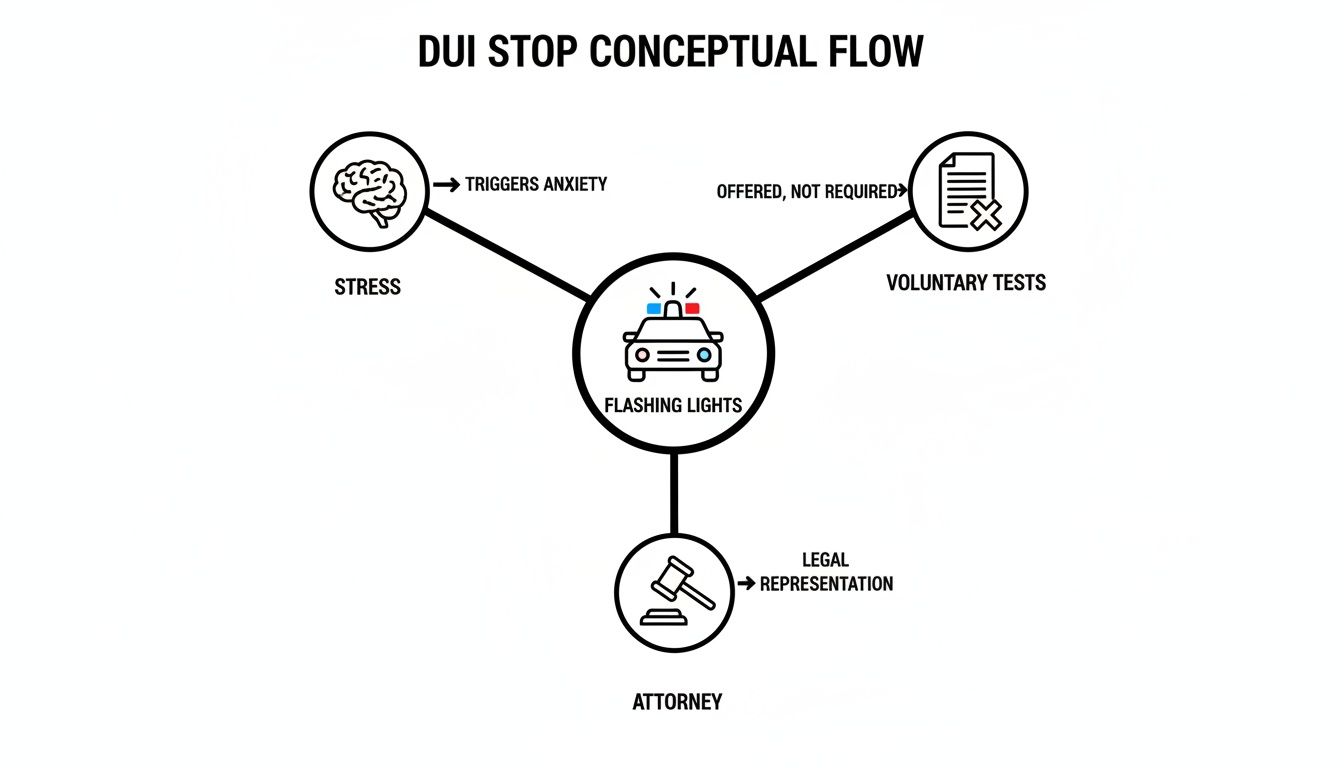
Here in Georgia, law enforcement relies on a battery of three main tests. Understanding what they are—and where they fall short—is the first step in building a strong defense.
A Breakdown of the Three Standardized Field Sobriety Tests
The NHTSA has approved three specific tests that officers across Alpharetta, Cumming, and greater Fulton County are trained to administer. Each one is designed to test a different aspect of your coordination and ability to follow instructions under pressure.
| Test Name | What the Officer Observes | Common Points of Failure |
|---|---|---|
| Horizontal Gaze Nystagmus (HGN) | The involuntary jerking of your eyes as you follow a stimulus (like a pen or finger). | Eyes not following smoothly; distinct jerking at the edge of your vision; jerking that starts before a 45-degree angle. |
| Walk-and-Turn (WAT) | Your ability to take nine heel-to-toe steps on a line, turn as instructed, and walk nine steps back. | Losing balance during instructions; starting too soon; stepping off the line; using arms for balance; not touching heel-to-toe. |
| One-Leg Stand (OLS) | Your ability to stand on one foot, with the other raised six inches, while counting aloud for approximately 30 seconds. | Swaying; hopping to maintain balance; using your arms for balance; putting your foot down before being told to stop. |
These tests are far from perfect. Let’s take a closer look at what each one really entails.
Horizontal Gaze Nystagmus (HGN)
This is almost always the first test an officer will try to perform. "Nystagmus" is just a medical term for the involuntary jerking of the eyeball. Everyone experiences it, but impairment can supposedly make this jerking more pronounced.
The officer will hold a stimulus, usually a pen or their finger, and ask you to follow it with your eyes without moving your head. They are looking for six total clues, three in each eye:
- Lack of Smooth Pursuit: Does your eye follow the object smoothly, or does it jump or jerk along the way?
- Distinct and Sustained Nystagmus at Maximum Deviation: When your eye is held all the way to the side, does it jerk noticeably and continuously?
- Onset of Nystagmus Prior to 45 Degrees: Does the jerking begin before your eye even reaches a 45-degree angle?
According to the NHTSA manual, finding four or more of these clues suggests a high probability of impairment. Of course, many other factors, from medical conditions to simple fatigue, can cause nystagmus.
Walk-and-Turn (WAT)
The Walk-and-Turn is a classic divided attention test. It has two parts: the instruction stage and the walking stage. The officer will tell you to take nine heel-to-toe steps along a line (which might be real or imaginary), turn around using a very specific series of small steps, and then take nine heel-to-toe steps back.
They're trained to look for eight specific clues:
- Can’t keep balance while listening to the instructions.
- Starts before the instructions are finished.
- Stops while walking to regain balance.
- Doesn't touch heel-to-toe on each step.
- Steps off the line.
- Uses arms for balance.
- Makes an improper turn.
- Takes the wrong number of steps.
NHTSA says that if you show just two or more of these clues, you’ve "failed" the test. It doesn’t take much to hit that number, especially on uneven ground or in poor lighting.
One-Leg Stand (OLS)
The final standardized test is another balance and concentration challenge. You’ll be told to stand with one foot about six inches off the ground and count out loud ("one thousand-one, one thousand-two…") for 30 seconds.
During this time, the officer is watching for four clues:
- Sways while balancing.
- Uses arms to balance.
- Hops to maintain balance.
- Puts the foot down.
Just like the Walk-and-Turn, exhibiting two or more of these clues is considered a failure. This test can be incredibly difficult for people with prior injuries, balance issues, or who are simply older or overweight.
These SFSTs were developed from research dating back to 1975, and a key 1998 validation study claimed 91% accuracy for the three-test battery in spotting drivers at or above a 0.08% BAC. It’s a statistic North Fulton prosecutors love to use, but one that is highly questionable when put under real-world scrutiny. You can read more about the statistical evaluation of these tests and their reported accuracy rates to see just how flimsy the science can be.
Defense Strategy: Why These Roadside Tests Are Flawed in Alpharetta
Let's get one thing straight: "failing" a field sobriety test does not automatically mean you are guilty of a DUI in Georgia. In my experience, these roadside exercises are notoriously unreliable and often feel like they're designed for you to fail from the very start.
An officer’s opinion that you “failed” is not a conviction. It’s the beginning of the fight, and for a skilled defense attorney, it's an opportunity to start dismantling the prosecution's case. Countless factors that have nothing to do with alcohol can cause someone to perform poorly on these tests. The sheer pressure of a traffic stop is enough to make anyone nervous, but the problems with these tests run much, much deeper.
Subjective Scoring and Officer Bias
Unlike a breathalyzer or blood test that gives a hard number, field sobriety tests are graded entirely on the officer's personal judgment. An officer from the Alpharetta Police Department or a Fulton County Sheriff's deputy is trained to look for tiny “clues” they believe are signs of impairment.
This whole process is completely subjective. A slight, natural sway could be marked as a point against you, even if it was caused by nothing more than an uneven patch of asphalt. If an officer already suspects you’ve been drinking, they are far more likely to see every single move you make through that lens. This is classic confirmation bias, and it’s a huge flaw when this "evidence" is presented in the Alpharetta Municipal Court or Fulton County State Court.
Uncontrolled and Unfair Testing Environments
The NHTSA created these tests in a perfect, controlled, lab-like setting. The side of a busy road in Roswell, Milton, or Sandy Springs is the exact opposite of a controlled environment.
Think about these real-world situations:
- Poor Lighting: Trying to do balance tests at night with nothing but headlights and flashing blue-and-red police lights is a challenge for anyone.
- Uneven Surfaces: Roadsides are rarely flat. They're often sloped for drainage, covered in gravel, or have cracks, making it almost impossible to walk a perfectly straight line.
- Distractions: The noise and lights from cars speeding by on GA-400 or through downtown Alpharetta create a distracting, high-anxiety environment.
- Weather: A little bit of wind, rain, or just the cold can easily throw off your balance and ability to focus.
These environmental factors are almost never noted in the officer’s report, but they are absolutely critical points to bring up in your defense.
The biggest problem is that these tests are sold as objective science, but they're performed under subjective, uncontrolled conditions. A North Fulton prosecutor might present the results as hard fact, but a good defense exposes them for what they are: one person's opinion.
Medical and Physical Conditions That Mimic Impairment
Many people have medical or physical conditions that make it impossible to pass these tests, even when they are 100% sober. While officers are supposed to ask about any relevant medical issues, that step is frequently skipped during the stress of a roadside stop.
Common conditions that can lead to a "failing" score include:
- Inner ear problems or vertigo that affect balance.
- Old leg, back, or neck injuries.
- Neurological disorders.
- Being overweight or simply being over the age of 65.
- Simple fatigue or the anxiety caused by the stop itself.
These are not excuses. They are legitimate medical and physical reasons that directly affect a person's ability to perform the kinds of divided-attention tasks these tests demand. We make sure these facts are brought to the court's attention, whether your case is in Johns Creek, Dunwoody, or Cumming.
A landmark 1991 study by Dr. Spurgeon Cole at Clemson University exposed these flaws in a stark way. Researchers filmed 21 completely sober people performing FSTs and showed the tapes to 14 trained police officers. The officers incorrectly decided that the sober individuals were too impaired to drive 43% of the time.
This study shows just how easily things unrelated to alcohol can be misinterpreted as impairment—a critical fact for residents in Fulton County to understand. You can learn more about the study's findings on FST accuracy. A poor test result isn't the end of your story; it's the beginning of your defense.
Court Process in Fulton County: Know Your Rights During an Alpharetta DUI Stop
When an officer with the Alpharetta Police Department or a Fulton County deputy pulls you over and asks you to step out of the car, your heart starts pounding. It’s easy to feel like you have to do whatever they say. You don't.
In Georgia, you have the absolute right to politely refuse to take voluntary field sobriety tests. Knowing and exercising that right is one of the most important things you can do to protect yourself during a DUI stop in Alpharetta or anywhere in North Fulton.

It's absolutely critical, however, to understand the difference between these physical roadside tests and the official chemical test an officer will ask for later. They are governed by entirely different rules and refusing them has vastly different consequences in the Fulton County court system.
The Critical Difference Between Voluntary and Required Tests
The physical coordination exercises we’ve discussed—the HGN eye test, the walk-and-turn, and the one-leg stand—are 100% voluntary. Let me be clear: they are designed for you to fail, and the officer is simply gathering subjective evidence to build a case and justify an arrest.
Refusing to perform these roadside gymnastics carries no direct penalty for your Georgia driver's license.
The official state-administered chemical test is a completely different story. This is the test required by Georgia’s Implied Consent law. The law says that by the very act of driving on a Georgia road, you have already consented to a chemical test of your blood, breath, or urine if you are lawfully arrested for DUI.
Refusing this official test—the one usually done at the police station or hospital, not on the side of the road—will trigger an automatic administrative license suspension. You can learn more about Georgia’s Implied Consent law and the consequences of a refusal on our website.
Your smartest move during a traffic stop is to politely but firmly decline all voluntary roadside tests. A simple, respectful statement is all you need: “Officer, I respectfully decline to participate in any field sobriety tests, and I would like to speak with an attorney.”
This is not admitting guilt. It's an assertion of your constitutional rights. You are never required to help an officer build a case against you.
What Should You Do During a North Fulton Traffic Stop?
If you get pulled over in Alpharetta, Milton, Roswell, or anywhere else in North Fulton, what you do in those first few minutes can dramatically change the outcome of your case. It's a high-stress situation, but keeping a cool head is your best defense.
Keep these key points in mind:
- Be Polite and Respectful: Being confrontational never helps. Provide your license and registration when asked, but don't volunteer extra information.
- You Have the Right to Remain Silent: Beyond identifying yourself, you are not obligated to answer loaded questions like, "How much have you had to drink tonight?"
- Politely Decline Field Sobriety Tests: You can and should refuse the HGN, walk-and-turn, and one-leg stand. There is no penalty to your license for doing so.
- Do Not Refuse the Portable Breath Test: The officer may have a small, handheld breathalyzer. While these results are not admissible in court to prove your specific BAC, a refusal can sometimes be mentioned by the prosecutor. This is separate from the official Intoxilyzer test at the station.
- Contact an Attorney Immediately: The second you are able to, call an experienced Alpharetta DUI lawyer. Deadlines in the Fulton County court system are unforgiving, and the sooner we can get involved, the better.
For anyone in Cumming or Dunwoody sitting there wondering what they should have done, the answer is simple: you were not required to perform those roadside exercises. A polite refusal limits the evidence the prosecution can use, strengthening your defense right from the start.
How We Challenge Field Sobriety Test Evidence in Fulton County
An arrest for DUI in Alpharetta is not a conviction. I can tell you from my experience as a former North Fulton prosecutor that the evidence from field sobriety tests is often the most subjective—and weakest—part of the State’s case. I know exactly how prosecutors use this evidence, and more importantly, how to take it apart piece by piece. Our approach is direct and strategic, focused on the facts of your case to protect your record.
Our defense work starts the moment we get our hands on the evidence from your stop, especially the officer's body camera and dashcam footage. We never just take the police report at face value. We scrutinize every second of that video, comparing what the officer wrote down to what actually happened on the side of that road in Alpharetta or Johns Creek.

Uncovering Procedural Errors in Alpharetta Police Stops
The National Highway Traffic Safety Administration (NHTSA) has strict, standardized protocols for how these tests must be administered. Any officer who deviates from these procedures can make the results unreliable and inadmissible in court. We meticulously comb through the video of the stop, looking for these common mistakes.
- Improper Instructions: Did the Alpharetta officer give you the instructions exactly as required by the training manual? Even a small change can cause confusion and completely invalidate the test.
- Failure to Inquire About Medical Issues: Officers are required to ask if you have any physical conditions that could affect your ability to perform the tests. Forgetting to ask is a critical oversight.
- Unsuitable Testing Environment: Were you asked to perform these tests on a sloped surface, in bad weather, or with blinding patrol car lights flashing in your eyes? These factors make a fair performance impossible.
When we find that an officer failed to follow these strict guidelines, we file a motion to suppress the evidence. This is a powerful legal tool that asks the judge in Alpharetta Municipal Court or Fulton County State Court to throw out the flawed FST results. You can read more about what a motion to suppress evidence entails and see how it can become the cornerstone of your defense.
A successful motion to suppress can completely gut the prosecution's case before it even reaches a jury. By removing the officer's subjective "evidence" of impairment, we often leave them with little more than a simple driving infraction.
Questioning the "Science" Behind the Tests
North Fulton prosecutors love to present FST results as if they are hard science. They are not. While NHTSA studies have long claimed high accuracy rates for these tests, independent analysis tells a much different story.
For example, you'll often hear a 91% accuracy rate cited for the three-test battery. But a 2005 peer-reviewed study found that these tests are terrible at identifying impairment in borderline cases—those drivers right around the 0.08% BAC legal limit. The tests are decent at spotting someone who is heavily intoxicated, but they fail badly in the gray area where most DUI arrests in Roswell and Fulton County actually happen. We use this kind of data, including analysis showing how the initial studies lacked modern scientific controls, to educate judges and juries on the real-world limits of these roadside exercises.
Presenting Alternative Explanations for Poor Performance in Milton
Our final angle of attack is to give the court logical, common-sense reasons why you may have struggled with the tests. These aren't excuses; they are facts that can create reasonable doubt.
We work to build a complete picture of you and the situation, highlighting factors that an officer can easily mistake for impairment:
- Documented Medical History: We can present evidence of past injuries, inner-ear problems, or neurological issues that affect balance and coordination.
- Age and Physical Condition: It’s simply not reasonable to expect someone over 65, or anyone with specific physical limitations, to perform these tests like a 25-year-old gymnast.
- Anxiety and Fatigue: The stress of a traffic stop in Cumming or Sandy Springs is immense. We explain to the court how natural human responses, like nervousness and exhaustion, can easily be misinterpreted as "clues" of impairment.
By combining a detailed video analysis with strong legal challenges and a common-sense explanation of the facts, we protect our clients. This methodical, protective approach is how we consistently fight to get charges reduced or dismissed in courtrooms all across North Fulton.
Why Choose Brian Hansford in Alpharetta
When you see those flashing lights in your rearview mirror, the moments that follow can change your life. A DUI charge in Alpharetta puts your reputation, your driver's license, and your future at risk. This is not the time for an uncertain defense; you need a strategy that is calm, experienced, and built on a deep understanding of the North Fulton legal system.
My name is Brian Hansford. Before I dedicated my practice to criminal defense, I served as a prosecutor right here in the North Fulton area. That experience wasn't just a job—it was an education in how the other side thinks.
A Former Prosecutor’s Insight on Your Side
I saw firsthand how DUI cases are built in Fulton County, how field sobriety tests are used to secure convictions, and where the most common mistakes are made. I now use that insider’s perspective to protect my clients, anticipating the prosecution’s every move and dismantling their case piece by piece.
This isn’t just an advantage; it’s the foundation of a proactive, strategic defense.
My approach is built on:
- Knowing the Playbook: Because I used to be on the other side, I know their strategies. I can anticipate the arguments they’ll make in Alpharetta Municipal Court and prepare a defense designed to counter them from the start.
- Finding the Flaws: I know what to look for in an officer's report. I spot the procedural errors, subjective judgments, and constitutional issues that many other attorneys might overlook.
- Negotiating from a Position of Strength: My reputation as a former prosecutor gives me credibility when I walk into the Alpharetta Municipal Court or Fulton County Superior Court. Prosecutors know I understand their cases as well as they do.
Focused, Protective, and Local Counsel
My firm is not a high-volume operation where you become just another case file. I deliberately limit my caseload to give my full attention to good people—professionals, parents, and community members in Alpharetta, Milton, and Roswell who've found themselves in a tough spot.
When you hire me, you get me. I will be the one answering your questions, reviewing the evidence, and standing beside you in court. The legal system in Fulton County moves fast, and you can't afford to fall behind.
Your very first court date is a critical moment. Having an experienced local attorney there from day one can completely change the direction of your case. We move immediately to protect your rights, challenge the evidence, and work to safeguard your record.
If you're facing a DUI in Alpharetta, Johns Creek, or anywhere in North Fulton, you don't have to go through this alone. You need a lawyer who gets what’s at stake and has the experience to fight for it. Call my office now for a confidential consultation to go over your case and see how I can help.
FAQ: Field Sobriety Test Questions in Alpharetta
Q: Can I refuse field sobriety tests in Alpharetta, GA?
A: Yes, you can and you should politely refuse. In Georgia, roadside field sobriety tests (HGN, Walk-and-Turn, One-Leg Stand) are entirely voluntary. Refusing them carries no direct penalty to your driver's license, unlike refusing the state-administered chemical test after an arrest. A polite refusal is a smart, protective measure in the Fulton County legal system.
Q: What happens after a DUI arrest in Alpharetta, GA?
A: After a DUI arrest by the Alpharetta Police Department, your criminal case may start in Alpharetta Municipal Court or Fulton County State Court. You will have a first court date (arraignment) very quickly. Separately, you have only 30 days to file an appeal to prevent an automatic suspension of your driver's license. It is critical to speak with an attorney immediately.
Q: What if I “failed” a field sobriety test in Milton or Johns Creek?
A: An officer's opinion that you "failed" a test does not mean you are guilty. These tests are notoriously subjective. A skilled defense attorney can challenge the results in Alpharetta Municipal Court or Fulton County State Court by demonstrating improper administration by the officer, poor testing conditions, or by highlighting your personal medical conditions that made passing impossible.
Q: Are field sobriety tests accurate evidence in Fulton County Court?
A: The accuracy is highly questionable and a common point of attack in a strong DUI defense. Factors like nervousness, fatigue, age, physical injuries, and the roadside environment can all cause a sober person to perform poorly. A good attorney can demonstrate to a judge or jury in Fulton County that these tests are not reliable scientific proof of impairment.
Q: Does the Alpharetta Police Department record FSTs?
A: Yes. Alpharetta Police and other North Fulton agencies like those in Roswell and Sandy Springs use dashcams and body cameras. This video is often the most critical piece of evidence. A defense attorney will meticulously review this footage to find errors in police procedure or to show that you did not appear impaired, often contradicting the police report.
The decisions you make in the moments after a DUI stop in Alpharetta can change your life. Don't leave your future in the hands of chance. At Brian Hansford Law, we bring our experience as former prosecutors to the table to build a powerful, strategic defense for you.
Call us immediately to protect your rights, your license, and your record.
Request a Confidential Case Review or call 770-642-4229.
Meta Title: Field Sobriety Test Guide for Alpharetta, GA (2026) | Brian Hansford
Meta Description: Pulled over in Alpharetta? Learn about GA's voluntary field sobriety tests from a former Fulton County prosecutor. Protect your rights. Call for a case review.
URL Slug: /field-sobriety-tests-alpharetta-ga/
Internal Link Suggestions:
- Link "DUI charge in Alpharetta" to the main DUI Defense page.
- Link "Georgia First Offender Act" (if mentioned) to a page about first offender options.
- Link "Fulton County court system" to a page explaining the local court process.
- Link "criminal defense attorney near me" to the homepage or contact page.
Schema Recommendations:
{
  "@context": "https://schema.org",
  "@type": "Article",
  "mainEntityOfPage": {
    "@type": "WebPage",
    "@id": "https://challengemycharge.com/field-sobriety-tests-alpharetta-ga/"
  },
  "headline": "A Guide to Field Sobriety Tests in Alpharetta, GA",
  "author": {
    "@type": "Person",
    "name": "Brian Hansford"
  },
  "publisher": {
    "@type": "Organization",
    "name": "Brian Hansford Law",
    "logo": {
      "@type": "ImageObject",
      "url": "https://challengemycharge.com/logo.png"
    }
  },
  "datePublished": "YYYY-MM-DD",
  "dateModified": "2026-MM-DD",
  "description": "A comprehensive guide to understanding field sobriety tests in Alpharetta, GA, and why you should refuse them. Learn how a former prosecutor defends against DUI charges in Fulton County.",
  "mainEntity": {
    "@type": "FAQPage",
    "mainEntity": [
      {
        "@type": "Question",
        "name": "Can I refuse field sobriety tests in Alpharetta, GA?",
        "acceptedAnswer": {
          "@type": "Answer",
          "text": "Yes, you can and you should politely refuse. In Georgia, roadside field sobriety tests (HGN, Walk-and-Turn, One-Leg Stand) are entirely voluntary. Refusing them carries no direct penalty to your driver's license, unlike refusing the state-administered chemical test after an arrest. A polite refusal is a smart, protective measure in the Fulton County legal system."
        }
      },
      {
        "@type": "Question",
        "name": "What happens after a DUI arrest in Alpharetta, GA?",
        "acceptedAnswer": {
          "@type": "Answer",
          "text": "After a DUI arrest by the Alpharetta Police Department, your criminal case may start in Alpharetta Municipal Court or Fulton County State Court. You will have a first court date (arraignment) very quickly. Separately, you have only 30 days to file an appeal to prevent an automatic suspension of your driver's license. It is critical to speak with an attorney immediately."
        }
      },
      {
        "@type": "Question",
        "name": "What if I “failed” a field sobriety test in Milton or Johns Creek?",
        "acceptedAnswer": {
          "@type": "Answer",
          "text": "An officer's opinion that you 'failed' a test does not mean you are guilty. These tests are notoriously subjective. A skilled defense attorney can challenge the results in Alpharetta Municipal Court or Fulton County State Court by demonstrating improper administration by the officer, poor testing conditions, or by highlighting your personal medical conditions that made passing impossible."
        }
      },
      {
        "@type": "Question",
        "name": "Are field sobriety tests accurate evidence in Fulton County Court?",
        "acceptedAnswer": {
          "@type": "Answer",
          "text": "The accuracy is highly questionable and a common point of attack in a strong DUI defense. Factors like nervousness, fatigue, age, physical injuries, and the roadside environment can all cause a sober person to perform poorly. A good attorney can demonstrate to a judge or jury in Fulton County that these tests are not reliable scientific proof of impairment."
        }
      },
      {
        "@type": "Question",
        "name": "Does the Alpharetta Police Department record FSTs?",
        "acceptedAnswer": {
          "@type": "Answer",
          "text": "Yes. Alpharetta Police and other North Fulton agencies like those in Roswell and Sandy Springs use dashcams and body cameras. This video is often the most critical piece of evidence. A defense attorney will meticulously review this footage to find errors in police procedure or to show that you did not appear impaired, often contradicting the police report."
        }
      }
    ]
  },
  "about": {
    "@type": "LegalService",
    "name": "DUI Defense",
    "areaServed": {
      "@type": "AdministrativeArea",
      "name": "Alpharetta"
    },
    "provider": {
      "@type": "Attorney",
      "name": "Brian Hansford"
    }
  }
}
