
An accusation of first degree murder is the most serious charge anyone can face in the state of Georgia. If you or a loved one is under investigation or has been arrested in Alpharetta, the steps you take in the next few hours and days are critical. You are facing the full power of the Fulton County prosecutor’s office. This is a fight for your future, and protecting your rights with a trusted local defense attorney must be your immediate priority.
Call Brian Hansford now for a confidential consultation. Do not speak to police without representation.
Why This Matters in Alpharetta, GA

The time immediately after an arrest in Alpharetta, Roswell, or anywhere in North Fulton can be confusing and frightening. An allegation of murder triggers an immediate and aggressive response from local law enforcement and the Fulton County prosecutor's office. You need a calm, strategic, and experienced legal advocate on your side right away.
Remember, an arrest is not a conviction. The state has the enormous burden of proving every single element of its case beyond a reasonable doubt. But the road from an accusation to a resolution is a minefield of procedural deadlines and critical decisions that will shape the final outcome. Your most urgent need is to secure legal counsel before you speak to anyone.
Your first and most important move is to exercise your right to remain silent. Calmly and politely tell any officer from the Alpharetta Police Department or any other agency that you will not answer questions without your attorney present.
A charge for murder with malice aforethought, which is Georgia's version of premeditated or first degree murder, requires the prosecutor to prove a specific state of mind. This is a very high bar for the state to clear, and it's a key area where a strong defense can be built, whether the case originates in Johns Creek, Milton, or elsewhere in the North Atlanta area.
Understanding a First Degree Murder Charge in Alpharetta

If you're facing a murder charge in Alpharetta, the first thing you need to grasp is what the Fulton County prosecutor must prove to a jury. Many people are surprised to learn that Georgia law doesn't use "degrees" for murder like on television.
Instead, what is commonly called first degree murder is officially known as “malice murder” under O.C.G.A. § 16-5-1. Understanding this distinction isn't a mere technicality—it forms the entire foundation of how your case will be built and defended in Fulton County Superior Court. At its core, a malice murder charge means the prosecutor must prove two specific elements. The entire outcome of your case will turn on whether your defense attorney can create doubt about one or both of them.
Breakdown of a Malice Murder Charge
The prosecution's case in Fulton County Superior Court stands on two pillars. If either one is weak, the entire case can fall apart.
- The Unlawful Killing of Another Person: This first part sounds straightforward. It means a death occurred, and it wasn't legally justified. Justifiable acts, such as proven self-defense, are a complete defense to the charge and a common strategy in cases arising from Alpharetta, Johns Creek, and Roswell.
- The Presence of "Malice Aforethought": This is where most legal battles are fought. "Malice" doesn't mean hatred or ill will in the way we use it colloquially. In the eyes of a Georgia court, it means the specific, conscious intent to kill. The prosecutor must convince a jury that the act wasn’t an accident, a reckless mistake, or a sudden, impulsive act in the heat of passion.
Express vs. Implied Malice in Georgia
Georgia law breaks "malice" down even further into two distinct types. A prosecutor in North Fulton will typically frame their case around one of these two theories:
- Express Malice: This is the most direct form of intent. It’s a deliberate, premeditated plan to unlawfully take a human life. Evidence could include threats made before the incident, proof of planning, or lying in wait for the victim.
- Implied Malice: This is a more complex legal concept. It applies when there is no direct evidence of a plan to kill, but the circumstances show an "abandoned and malignant heart." This legal phrase describes conduct so reckless and dangerous that it shows a complete disregard for human life. The intent to kill is inferred from the action itself.
Successfully challenging the state's evidence on malice is the cornerstone of any strong murder defense. By raising reasonable doubt about what the defendant was actually thinking, we can often argue for the charge to be reduced to something less severe, like manslaughter. For a deeper dive into this, you can review our guide which provides examples of manslaughter.
The Critical Concept of Felony Murder in Georgia
There's another way prosecutors can secure a murder conviction in Georgia, and it's one that defendants must take very seriously: the Felony Murder Rule. This rule is a major threat for anyone charged with an underlying felony in communities like Roswell, Sandy Springs, or Milton, because it dramatically lowers the prosecutor's burden of proof.
The Felony Murder Rule states that if someone dies during the commission of certain dangerous felonies—like armed robbery, burglary, or arson—all participants in that felony can be charged with murder. This holds true even if no one intended for the death to happen, or if it was a complete accident.
This means you could be facing life in prison for a death you never intended, simply because you were involved in a separate crime that went wrong. The rule effectively removes the need for the prosecutor to prove any "intent to kill," making it a powerful tool for the state.
Strategic Defense for First Degree Murder in Alpharetta
When you're facing a first degree murder charge, a passive, reactive defense is a losing one. To protect your future, we must build a proactive, intelligent, and relentless defense strategy from day one. An accusation is not proof, and the prosecution's case is rarely as airtight as it looks on the surface. Our job is to start dismantling it, piece by piece.
The heart of any murder defense in Georgia is a direct assault on the element of “malice aforethought.” If the prosecutor in Fulton County can't prove this single element beyond a reasonable doubt, their malice murder case completely falls apart. Our first goal is to systematically pick apart the evidence they claim is "proof" of that intent.
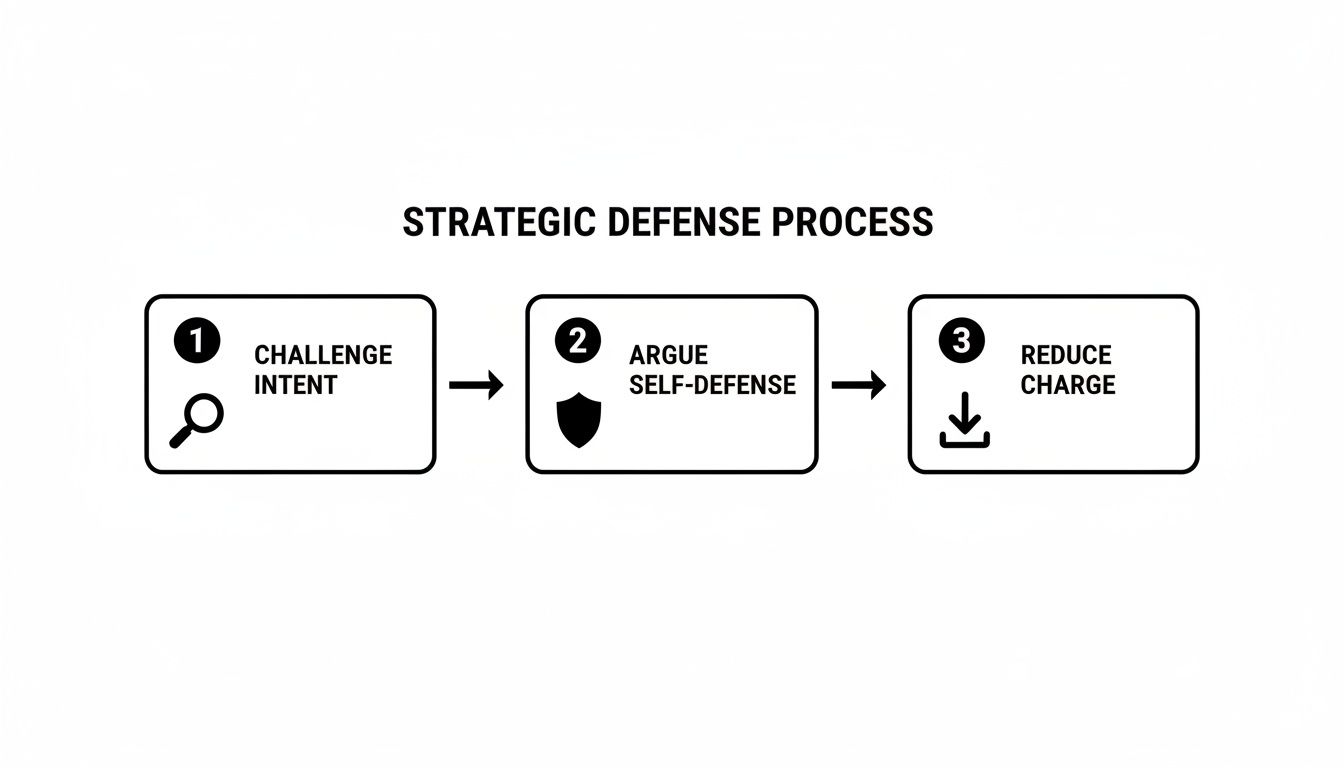
Common Defense Strategies in Fulton County
While every case is unique, several powerful defense strategies have proven effective in the Superior Courts of Fulton, Cobb, and Forsyth Counties. A winning defense often involves one or more of the following angles.
-
Challenging the Evidence: The state’s case is only as strong as its evidence. We meticulously analyze everything the Alpharetta Police Department or GBI investigators have collected. This means scrutinizing forensic reports, challenging ballistics, and questioning witness reliability. If evidence was gathered illegally, we will aggressively file a motion to have it thrown out. You can learn more about a motion to suppress evidence in our detailed guide.
-
Arguing Self-Defense: Georgia law is clear: you are allowed to use force, even deadly force, to protect yourself or others from imminent harm or death. If you had a reasonable belief your life was in danger, this can be a complete defense to a murder charge. This is an affirmative defense, meaning we present our own evidence to justify the actions taken. It's a critical and common strategy in cases from Roswell to Milton.
-
Mistaken Identity or Alibi: In some cases, the defense is simple: you were not there. An alibi defense isn't just saying you were somewhere else; it requires credible evidence to prove it. We can use digital data from your phone, credit card receipts from a store in Dunwoody, and eyewitness testimony to build a concrete timeline that makes your involvement impossible.
-
Arguing for a Lesser Charge: A key part of our strategy is often to show that while a death may have occurred, it does not meet the incredibly high legal standard for malice murder. By demonstrating there was no premeditation—for instance, showing the act was committed in the “heat of passion” right after a serious provocation—we can argue for the charge to be reduced to voluntary manslaughter.
Your future depends on the strength of your defense. Call Brian Hansford today to request a case review and start building your strategy.
The Court Process for a Murder Charge in Fulton County
The legal journey for a murder charge in Georgia is long and complex. One wrong move can change everything. Knowing what to expect can help cut through the confusion and shows why having a seasoned Alpharetta defense attorney in your corner is non-negotiable from day one.
A first-degree murder charge is not handled at the Alpharetta Municipal Court or any other local North Fulton courthouse. Because of the gravity of the accusation, the case goes directly to the Fulton County Superior Court. This is where the highest-stakes legal battles in Georgia are fought.
The Critical Stages of a Murder Case
From the moment of arrest, a clock starts ticking. A series of critical deadlines and court proceedings begins, and every stage is an opportunity for a skilled defense team to attack the state's case.
Here are the procedural steps you can expect:
- Arrest and Initial Appearance: After an arrest by the Alpharetta Police Department or another local agency, you will be brought before a magistrate judge for an initial appearance. This is where the charges are formally read and you are informed of your rights.
- The Bond Hearing: Bond for a murder charge is never automatic and is incredibly difficult to obtain. Only a Superior Court judge has the authority to grant it. An attorney must file a specific motion and make a powerful argument that you are not a flight risk or a danger to the community. This hearing is often the first real fight in the case.
- Grand Jury Indictment: Next, the Fulton County District Attorney’s office presents its evidence to a grand jury. This is a one-sided proceeding where the defense is not present. If the grand jury finds probable cause, they issue a formal indictment, which officially charges you with murder.
- Discovery Phase: Once an indictment is issued, the defense is entitled to "discovery"—all the evidence the prosecution has. This includes police reports from Johns Creek or Sandy Springs, witness statements, and forensic results. This is where our investigative work kicks into high gear.
- Pre-Trial Motions: This is a crucial phase where your lawyer files motions to define the battlefield for trial. A common example is a Motion to Suppress evidence that was obtained illegally during a search of your home or a motion to keep unreliable witness testimony out of court.
- Trial: If the case is not resolved, it moves to a jury trial in Fulton County Superior Court. The state must prove its case beyond a reasonable doubt. The defense presents its own evidence, cross-examines the state's witnesses, and makes the argument for an acquittal.
The bar for proving murder has always been incredibly high. While homicide rates in our communities like Cumming and East Cobb are low today, they are nothing like historical figures. The huge drop from medieval Europe's rate of up to 110 homicides per 100,000 people to modern statistics shows just how much the prosecutor's burden has evolved. This history actually reinforces how difficult it is for the state to prove elements like premeditation. You can learn more about these historical homicide trends and their legal implications.
Why Choose Brian Hansford for Your Defense in Alpharetta
When you are facing a first degree murder charge, the lawyer you hire is the single most important decision you will make. This is not the time for a general practice attorney or a large firm where you are just another case file. You need a deeply experienced local lawyer who understands what you're up against in the Fulton County court system.
With over two decades of focused criminal law experience, Brian Hansford brings a critical advantage. He is not just a defense attorney; he is a former prosecutor. This background gives him a powerful, real-world perspective on how the prosecution thinks. He has built the very same kinds of cases he now skillfully takes apart, giving him a unique ability to see the prosecution's strategy and find the weak spots in their case.
A Calm, Strategic, and Protective Approach
In a crisis this severe, you do not need an aggressive "billboard lawyer" who makes loud, empty promises. You need a calm, controlled, and protective advocate who thinks strategically. Brian Hansford's approach is about meticulous preparation, not courtroom theatrics. He understands the immense stress you're under and provides the clear, direct guidance you need.
This protection starts with the first phone call. Brian will immediately act to shield you, ensuring you do not speak with investigators from the Alpharetta Police Department or any other agency. His first priority is building a defense around you while methodically preparing for the pressure of a Fulton County Superior Court trial.
Deep Roots in Alpharetta and North Fulton Courts
Brian Hansford's practice is centered in Alpharetta and the North Fulton communities. He has spent his career in the same courtrooms where your case will be heard, from initial proceedings that might originate in Alpharetta Municipal Court to high-stakes trials in Fulton County Superior Court.
This local knowledge is a real tactical advantage. He knows the judges, the prosecutors, and the specific procedures of the courts in Alpharetta, Roswell, Johns Creek, and Milton. This isn't a talking point—it's a critical tool for navigating the system, whether filing pre-trial motions, negotiating with the District Attorney, or arguing a case to a local jury.
You need a lawyer who is a proven authority in our local legal community. You need Brian Hansford.
Frequently Asked Questions About Murder Charges in Alpharetta, GA
When you or a loved one is facing a murder investigation, you need clear, direct answers. Here are some of the most common questions we field from clients across Alpharetta, Cumming, and the surrounding North Fulton communities.
Q: Can I get bond for a murder charge in Fulton County?
A: Getting bond for a murder charge in Fulton County is difficult, but not impossible. Under Georgia law, only a Superior Court judge can grant bond in a murder case. An experienced Alpharetta attorney must file a specific motion and argue that you are not a flight risk or a danger to the community. This bond hearing is a critical early step.
Q: What is the difference between malice murder and felony murder in Georgia?
A: Malice murder requires the Fulton County prosecutor to prove a specific, deliberate intent to kill. Felony murder applies when a death occurs during another dangerous felony, like a burglary in Johns Creek. For felony murder, the prosecutor does not have to prove intent to kill, only intent to commit the underlying felony, making it a serious charge for defendants.
Q: Should I talk to the Alpharetta Police if they want to question me?
A: No. You must immediately and politely state: "I am exercising my right to remain silent and I want to speak with an attorney." Do not say anything else. Anything you say can be twisted and used against you, even if you believe you are helping. Your only move should be to contact a criminal defense lawyer near you immediately.
Q: How can a murder charge be reduced to manslaughter in Fulton County?
A: A key defense strategy is to challenge the element of "malice aforethought." By creating reasonable doubt about intent—for example, by showing the act occurred in the "heat of passion" after a serious provocation—an attorney can argue for a reduction to voluntary manslaughter. This can dramatically change the outcome of a case in Fulton County Superior Court.
Q: What if police illegally searched my home in Roswell?
A: If law enforcement in Roswell or any other city violated your Fourth Amendment rights with an illegal search, the evidence they found may be unusable. Your attorney can file a Motion to Suppress Evidence. If a judge grants this motion, the prosecutor is forbidden from using that illegally obtained evidence at trial, which can cripple their case.
Q: How long does a murder case take in Georgia?
A: Be prepared for a long process. Murder cases are complex and move slowly through the busy Fulton County Superior Court system. It is not unusual for a case to take a year or longer to reach trial. This timeline includes grand jury indictment, discovery, pre-trial motions, and extensive investigation, making a patient, meticulous defense team essential.
When your future and freedom are on the line, you need a proven legal strategist who knows the North Fulton courts inside and out. Brian Hansford Law has the local knowledge and trial experience to protect your rights. Call us now for a confidential review of your case at https://challengemycharge.com.
