
If you've been charged with a DUI in Georgia for the first time, you may be feeling overwhelmed. It's more serious than a simple traffic ticket, and the consequences can be confusing. It is important to understand that a DUI charge initiates two separate processes.
A DUI arrest kicks off two separate and parallel proceedings: one is administrative, which deals with your driver's license, and the other is criminal, which is handled in court.
Navigating the Two Paths of a DUI Case
A DUI charge can be thought of as a two-front process. On one front, there is the Georgia Department of Driver Services (DDS), which handles driving privileges. On the other, there is the criminal charge itself in court.
These two systems run on their own tracks and timelines. What happens in one doesn't automatically affect the other, so both require attention.
The first track is the administrative license suspension (ALS). This is all about your driver's license and starts almost immediately after an arrest. The second track is the criminal case, which moves through the court system and will determine if you're found guilty and what penalties—like fines, probation, or even jail time—might be faced.
The Administrative and Criminal Tracks
The infographic below helps visualize how a single DUI arrest splits into these two distinct proceedings.
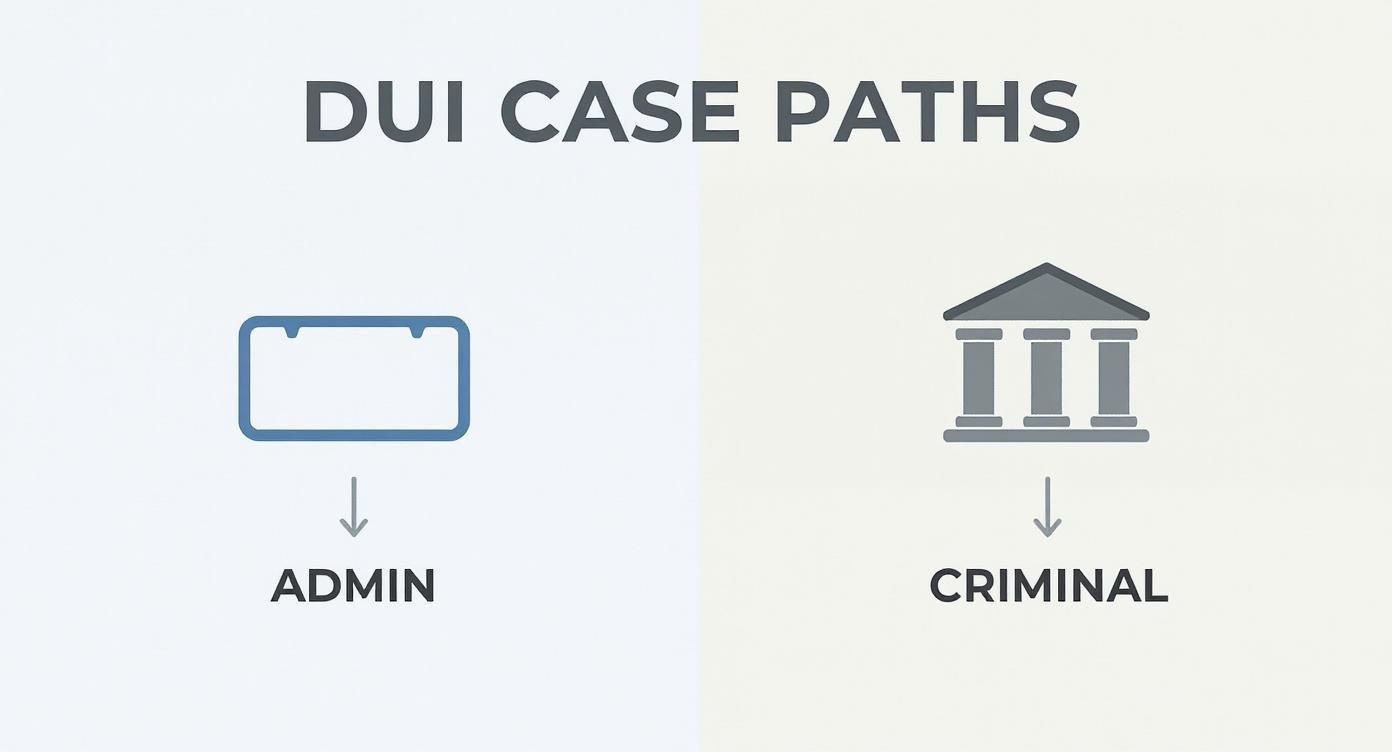
As you can see, the immediate license issues with the DDS must be addressed while also preparing for the long-term criminal proceedings in court.
One of the most critical things to remember is that the clock on the administrative side starts ticking fast. There are very strict, short deadlines to challenge an automatic license suspension, sometimes only a matter of weeks after the arrest.
Missing that window could lead to a license suspension before ever getting a day in court. For a closer look at these immediate steps, you can learn more about what to do after a DUI arrest. Meanwhile, the criminal case will follow a more traditional path of hearings and potentially a trial, where the full range of first offense DUI penalties comes into play.
The True Financial Cost of a First DUI

When people hear about DUI penalties, the first thing they usually ask about is the fine. But the court-ordered fine is just one part of the potential financial impact. It's the starting point of a financial snowball that can get bigger as the case moves forward.
It’s absolutely critical to understand that a first-offense DUI conviction in Georgia brings a mandatory minimum fine of $300, which can climb up to $1,000. But that number is deceptive. It doesn’t account for all the mandatory surcharges and fees tacked on by the state, which can easily double what is ultimately paid to the court.
Think of it this way: a $1,000 fine on paper rarely means just a check for $1,000. Once the state-mandated add-ons are applied, that number gets a lot bigger, fast.
Beyond the Initial Court Fines
The financial impact doesn't stop once the court has been paid. A conviction sets off a chain reaction of required programs and services, with the individual footing the bill for every single one. These aren't suggestions; they are non-negotiable parts of a sentence.
Here’s a look at the other costs that are almost certain to come your way:
- DUI Risk Reduction Program: Everyone calls it DUI school. It’s mandatory, and it costs a few hundred dollars just to enroll and complete the course.
- Clinical Evaluation: An individual will be required to see a state-approved professional for a substance abuse assessment. That has its own fee. And if they recommend treatment? Those costs are the individual's to cover, too.
- Probation Supervision Fees: If probation is ordered, a monthly fee will likely be paid to a private company or government agency for the "privilege" of being supervised. This goes on for the entire term of the probation.
It’s easy to see how these expenses quickly pile up, turning what seemed like a manageable fine into a serious financial strain.
A first-time DUI offense can result in substantial financial and legal repercussions across the United States. The National Highway Traffic Safety Administration (NHTSA) notes that fines and legal fees alone may exceed $10,000 for a first offense. You can get more details about national DUI trends by exploring information on risky driving from NHTSA.gov.
Long-Term Financial Consequences
The costs of a DUI conviction can follow an individual for years, long after the court case is officially closed. One of the most punishing long-term expenses is the spike in car insurance premiums.
Insurers see a DUI on a record and immediately label that person a high-risk driver. As a result, rates can easily double or even triple, and they’ll stay that high for years. This can mean thousands of extra dollars out of pocket over time.
On top of that, some drivers are required to get an ignition interlock device installed in their car. Between the installation, the monthly monitoring fees, and the eventual removal, the cost could be over $1,000 per year for that device alone. These lingering costs are a major reason people often ask, can you get a DUI off your record? They want the financial bleeding to stop.
Navigating License Suspension and Driving Privileges

For most people, the thought of losing their driver's license is the most immediate and terrifying part of a DUI arrest. An entire life—getting to work, picking up the kids, running to the grocery store—is built around being able to drive. So, understanding exactly how a license is at risk is important.
When a person is charged with a DUI in Georgia, the state launches a two-pronged attack on their driving privileges. It’s not just one process, but two separate ones running at the same time. The first is the Administrative License Suspension (ALS), handled by the Georgia Department of Driver Services (DDS). The second is a court-ordered suspension, which only happens if an individual is actually convicted of the criminal DUI charge.
These two tracks are completely independent. Someone could win their criminal case in court but still have their license suspended by the DDS, and vice-versa. The administrative side moves incredibly fast, which puts a lot of pressure on an individual right after the arrest.
The Critical 30-Day Deadline
The moment a person is arrested for a DUI, a clock starts ticking. This is probably the most important deadline: there are just 30 days to appeal the automatic administrative license suspension.
If this 30-day window is missed and an appeal is not filed, the DDS will automatically suspend the license for up to one full year. This happens no matter what the outcome of the criminal case is. Missing this deadline means a near-certain loss of the ability to legally drive.
The administrative suspension is a separate beast from the criminal case. It has its own strict rules and deadlines that must be met to protect a license.
This process is confusing, and we break it down even further in our guide on what happens with your license suspension after a DUI.
Limited Permits vs. Hard Suspensions
If a license does get suspended, can the person still drive for important things? The answer is… it depends. Georgia law makes a clear distinction between a "hard" suspension and being eligible for a limited driving permit.
- Hard Suspension: This is exactly what it sounds like. No driving is allowed, for any reason. No exceptions.
- Limited Driving Permit: If eligible, a permit might be issued that allows driving for specific, necessary trips.
A limited permit usually restricts travel to essential trips only, such as:
- Driving to and from a job
- Getting to school or college classes
- Going to necessary medical appointments
- Attending DUI School or required substance abuse treatment
Whether a permit can be obtained depends on the facts of the case, like driving history and whether a chemical test was agreed to. For many people facing first offense DUI penalties, getting a limited permit is the number one priority to keep life from grinding to a complete halt while the criminal case moves forward.
What About Jail Time, Probation, and Community Service?
Beyond the financial hit and the headache of a suspended license, a first-offense DUI conviction in Georgia can lead to jail time. It’s a reality that catches many people off guard.
Even though a first DUI is a misdemeanor, the law is unflinching: the mandatory minimum is 24 hours behind bars. That's the absolute best-case scenario. The judge has the authority to sentence an individual to up to 12 months in jail, depending on the circumstances of the case—things like a particularly high BAC, an accident, or having a child in the car.
What Does Probation Really Mean?
Most people won't serve a full year in jail on a first offense. Instead, the judge will typically "probate" or suspend the majority of the sentence. This means the rest of the 12-month sentence is served out in the community, but under the very watchful eye of a probation officer.
Probation is not a free pass. It's more like serving a sentence on a tight leash. There is a long list of rules to follow, and any slip-up can lead to being sent back to jail to finish the original sentence.
Think of probation as a test. The court trusts an individual to follow its orders to the letter. Violating that trust, even with a minor mistake, can have serious consequences, including the revocation of probation and serving the rest of the time in a jail cell.
A probation officer will likely require several things, including:
- Regular Meetings: Checking in with the officer on a set schedule.
- Random Drug & Alcohol Screens: They can test at any time to ensure compliance. A failed test is a direct violation.
- Completing Court Programs: The DUI school, any required clinical evaluation, and any recommended substance abuse treatment must be finished.
- Staying Out of Trouble: Getting arrested for any new crime while on probation is a huge problem.
Don't Forget About Community Service
Finally, every first DUI conviction in Georgia comes with mandatory community service. At least 40 hours of unpaid work for a court-approved non-profit or government agency will be required.
This isn't optional. It’s a core part of the sentence. The idea is for the individual to give back to the community that was put at risk. Whether it's working for a local charity or helping with a community project, the hours must be completed to successfully satisfy the terms of the sentence.
More Than Just Fines: Understanding Georgia's Mandatory Classes and Evaluations
The court fines and license suspension are just the beginning. A first DUI conviction in Georgia also comes with mandatory educational programs and personal evaluations. These aren't optional—they're a required part of the sentence, designed to get at the why behind the impaired driving charge.
The court sees these steps as non-negotiable. Failure to complete them means violating the terms of the sentence. That can lead to much bigger problems, like having probation revoked and being sent to jail to serve out the rest of the time.
The DUI Risk Reduction Program
Most people just call it "DUI School." The official name is the DUI Alcohol or Drug Use Risk Reduction Program, and it's a state-mandated course that every single person convicted of a DUI has to finish. The goal is pretty straightforward: to educate on the very real dangers of driving under the influence and help individuals see any problematic patterns in their own behavior.
This isn't some quick online test. It's a structured, 20-hour course broken into two parts: an initial assessment and the main classroom portion. The state sets the total cost, which usually runs a few hundred dollars, and the individual has to pay for it.
The Clinical Evaluation and Possible Treatment
Once DUI School is finished, there's still more. The next step is a clinical evaluation with a state-approved substance abuse professional. This is a one-on-one meeting where an expert assesses whether there might be an underlying substance abuse issue that needs to be addressed.
This evaluation is a huge deal because the outcome can dramatically change the rest of a sentence. The evaluator will talk with the individual, review their history, and form a professional opinion.
Based on what they find in the clinical evaluation, the professional can recommend a specific plan for substance abuse treatment. If they make a recommendation, the court will likely order its completion as a condition of the sentence.
This treatment could be anything from a few counseling sessions to a more intensive outpatient or even an inpatient program. What's recommended—along with its length and cost—is entirely based on the evaluator's professional judgment. It’s a clear signal that the state's approach to first offense DUI penalties is focused just as much on rehabilitation as it is on punishment.
How Do Georgia's Penalties Stack Up Globally?
It can be helpful to put Georgia's first offense DUI penalties into a global perspective. Every country wants to keep its roads safe, but the methods for getting there are incredibly different around the world. Seeing how other nations handle drunk driving really frames where Georgia’s laws fit in.
Some countries draw a very hard line—zero tolerance. They don’t mess around with BAC levels; any alcohol in a driver's system is illegal. It’s a straightforward approach that removes all the gray areas seen in the U.S., making it simple for police to enforce and for people to understand.
A Quick Tour of International DUI Consequences
Take Brazil, for example. They use a tiered system where even a tiny bit of alcohol can get someone in trouble. For a first-time DUI, the penalties shift depending on the BAC.
If a person is caught with a BAC between 0.01% and 0.06%, they face a hefty fine and lose their license for a full year. But if that BAC creeps over 0.06%, things get serious. It becomes a criminal offense, and jail time could be on the table. You can find more details on how U.S. penalties compare to other countries on hebetsmccallin.com.
Other places get even more creative, going way beyond the fines and license suspensions we’re used to. Their penalties often say a lot about their culture’s views on personal responsibility and public safety.
Some countries don't just punish the offender; they aim to make a very public example out of them. The goal is to create a visible deterrent that administrative or financial penalties just can't match.
Singapore is famous for its tough-on-crime approach, and DUI is no exception. A first offense there could mean:
- Massive fines, sometimes running into thousands of dollars.
- The real possibility of jail time, even if it’s a first brush with the law.
- Public caning for more serious cases or repeat offenders—a punishment you won’t find anywhere else.
Looking at these international examples shows just how wide the spectrum of first offense DUI penalties really is. While Georgia's approach—a mix of fines, mandatory classes, and potential jail—feels severe, this global context proves just how seriously this issue is taken everywhere.
Common Questions About a First DUI in Georgia
Getting hit with a DUI charge kicks up a lot of dust, and with it, a lot of questions. Knowing what to expect can bring some clarity to a confusing and stressful process. Here are some answers to the questions most often heard about a first offense DUI in Georgia.
Think of this as a starting point to help understand the basics of Georgia's DUI laws.
Can a First DUI Charge Be Reduced to a Lesser Offense
It’s the first question on everyone's mind, but the answer isn't a simple yes or no. In some cases, a first-time DUI can be negotiated down to a lesser charge, like reckless driving. This outcome is never a given, though; it depends entirely on the specific facts of a case.
Things like the recorded BAC, the driving behavior the officer noted, and the overall strength of the prosecutor's evidence all come into play. Getting a charge reduced is a complex process, and the outcome can vary dramatically from one courtroom to the next.
How Long Does a First DUI Stay on Your Record
A DUI conviction in Georgia is for life. Under current law, it stays on a person's criminal record permanently and generally cannot be expunged or sealed.
That means it will pop up on background checks for jobs, professional licenses, and even apartment applications forever. It also remains on the official driving record, where it will be used to automatically trigger harsher penalties if another DUI charge is faced down the road.
The permanence of a DUI conviction is one of its heaviest consequences. Unlike a speeding ticket that eventually fades away, a DUI is a permanent mark on a person's criminal history.
What Is the Difference Between DUI and DWI in Georgia
Here in Georgia, the law uses the term Driving Under the Influence (DUI). You've probably heard other terms like Driving While Intoxicated (DWI) or Operating While Impaired (OWI), which are used in other states.
While the letters are different, they all point to the same crime: operating a vehicle while impaired by alcohol or drugs. The critical thing to remember is that the specific laws, definitions, and penalties are unique to each state. A DUI in Georgia has its own set of rules and consequences, which are completely different from a DWI in Texas or an OWI in Michigan.
If you're facing a DUI charge in Alpharetta, Cumming, or anywhere in Forsyth County, understanding your options is the first step. For experienced guidance tailored to your specific situation, contact Brian Hansford Law today to discuss your case. Learn more at https://challengemycharge.com.
