
A forgery in the first degree charge is a serious felony in Georgia. It carries significant prison time and has the power to permanently change your future. If you or someone you care about is facing this charge in Alpharere, the stress and confusion can feel unbearable. The most important thing you can do right now is to speak with an attorney and protect your rights. Do not speak to police without representation. Your first court date matters, and deadlines in Fulton County move quickly.
Call Brian Hansford now for a confidential case review.
Why This Matters in Alpharetta

Hearing you’re being investigated or arrested for first-degree forgery in Alpharetta can make your world feel like it's falling apart. It’s a serious felony, and the thought of a conviction brings a wave of fear about your career, your family, and your future. That initial panic is completely normal, but it's also the exact moment you need a calm, strategic plan.
The first and most critical step is to secure experienced legal counsel. Do not talk to the Alpharetta Police Department or any investigator from a Fulton County agency without an attorney by your side. Anything you say can be used against you. You need a protective shield from the very beginning.
At Brian Hansford Law, we understand how heavy a forgery 1st degree charge feels in our North Fulton community. We’ve represented good people from all walks of life—professionals, parents, and college students in Alpharetta, Roswell, and Milton who suddenly found themselves in a terrifying legal battle. You don't just need a lawyer; you need a local defender who is intimately familiar with the Fulton County courts. Your first priority must be protecting your rights and your record.
Local Knowledge for a Local Problem in Alpharetta
Whether your case originates in Alpharetta, Johns Creek, or Sandy Springs, it will almost certainly land in the Fulton County Superior Court. The prosecutors there are tough, experienced, and they aggressively pursue felony convictions. You need someone in your corner who knows their playbook and understands how things really work in those specific courtrooms.
My experience as a former prosecutor gives me a unique vantage point on how the state builds these cases. I can anticipate their strategies and craft a defense specifically designed to pick apart their arguments. Forgery cases often come down to very fine details:
- Intent: Did you actually mean to defraud anyone?
- Authorization: Did you have permission to sign or change the document?
- Evidence: Was the evidence they have against you gathered legally?
The answers to these questions are the building blocks of a strong defense. If you're looking for a criminal defense attorney near you who can give you immediate and knowledgeable advice, call our office. Court deadlines in Fulton County move fast, and the work of protecting your future needs to start today.
Charge Breakdown: What Forgery in the First Degree Means in Georgia
The official legal language in Georgia’s forgery statute is dense and confusing, especially when you’re already under stress. To convict you of forgery in the first degree in a place like Fulton County, the prosecutor has to prove two very specific things beyond a reasonable doubt. Simply showing that a document was fake isn't enough. The entire case hinges on your state of mind at the time.
This charge is about active, intentional deception for a criminal purpose. The State must prove you knew what you were doing and had a clear, fraudulent goal.
The Two Pillars of a Forgery Charge
The whole case against you balances on the prosecution's ability to prove both of the following points. If a defense attorney can create reasonable doubt in either one, the State’s case often falls apart.
Possession or Creation of a False Writing: This first part is straightforward. The prosecutor must present evidence that you either made, altered, or simply possessed a written document that was falsified. This could mean creating a fake document from scratch, changing important details on a real one, or even just having a forged item you knew was fake.
Intent to Defraud: This is the critical piece of the puzzle and the harder one for the State to prove. The prosecutor has to show that you acted with a specific intent to defraud. In simple terms, your goal had to be deceiving someone to cause them a financial loss or to get some kind of unearned benefit for yourself. An accidental signature in the wrong box or a simple misunderstanding won't cut it.
A key part of defending these cases in Alpharetta and Roswell often involves attacking the "intent" element. Without proof of a fraudulent motive, the act itself may not meet the high standard for a felony forgery conviction.
Common Examples of First-Degree Forgery in North Fulton
While any false writing can technically trigger these charges, most of the forgery cases we see in Fulton County Superior Court involve documents with significant financial or legal weight. A forgery 1st degree charge isn't about minor fibs; it’s about high-stakes deception. You can learn more about how these types of offenses are categorized by reading our guide to what is considered a white-collar crime.
The table below gives you some concrete examples of what this looks like in the real world and could lead to an arrest in Alpharetta, Milton, or Johns Creek.
Examples of First-Degree Forgery in Georgia
This table illustrates the documents and fraudulent intent that can lead to a first-degree forgery charge under Georgia law.
| Document Type | Fraudulent Action | Potential Scenario in North Fulton |
|---|---|---|
| Personal Checks | Signing someone else's name or altering the amount on a stolen check. | Cashing a check belonging to a family member or roommate without their permission at a bank in Sandy Springs. |
| Property Deeds | Forging a signature on a deed to unlawfully transfer property ownership. | Falsifying a parent's signature on a property deed to take ownership of a home in Cumming or Dunwoody. |
| Government ID | Creating or possessing a fake driver's license or state ID with the intent to use it for fraud. | Using a fake ID to open a bank account or apply for a loan, not just to buy alcohol (which is a different offense). |
| Professional Licenses | Altering or creating a fake professional license to secure employment. | A person in East Cobb presenting a falsified nursing or contracting license to get a high-paying job. |
As you can see, the common thread is a deliberate act of deception aimed at gaining something of value, whether it's money, property, or a job you aren't qualified for.
The High Stakes of a Forgery Conviction in Fulton County

It is absolutely crucial to understand what you're up against with a first-degree forgery charge. In Georgia, forgery in the first degree isn't a minor issue—it's a serious felony. A conviction carries a potential prison sentence of one to fifteen years.
For people living in Alpharetta and the surrounding communities of Johns Creek and Cumming, the penalties go far beyond prison walls. A felony conviction means a permanent criminal record that follows you for life, creating obstacles you might not even be able to imagine right now. The fallout can be devastating, especially for professionals. If you’re a nurse, real estate agent, financial advisor, or hold any other professional license in Georgia, a forgery conviction could trigger a suspension or even permanent revocation.
Beyond Prison: The Lifelong Consequences
Even after you've served your sentence, the stigma of a felony conviction sticks with you. It can create major hurdles in almost every part of your life.
- Employment Difficulties: Most employers in competitive areas like Roswell and Sandy Springs run background checks. A felony forgery conviction is often an automatic disqualifier.
- Housing Challenges: Landlords almost always run background checks. A felony on your record makes finding a safe, desirable place to live a real struggle.
- Immigration Status: For anyone who isn't a U.S. citizen, a forgery conviction is a "crime involving moral turpitude." This can lead directly to deportation or prevent you from becoming a citizen.
- Loss of Civil Rights: A felony conviction strips you of certain fundamental rights, including the right to vote (until the sentence is complete) and the right to own a firearm.
Why North Fulton Prosecutors Pursue These Cases Aggressively
Prosecutors in Fulton County take white-collar crimes like forgery very seriously. They don’t see these as simple mistakes. They view them as deliberate acts of deception that undermine the trust our financial and legal systems are built on. The global explosion of document fraud has put law enforcement on high alert, pushing prosecutors to come down hard on these cases to send a clear message.
Given the severe penalties and the aggressive stance of local prosecutors, facing a forgery 1st degree charge without a skilled legal defense is a risk you cannot afford to take. The right attorney can mean the difference between a life-altering conviction and a protected future. To get a clearer picture of what a felony charge involves, take a look at our guide on what happens when you are charged with a felony.
Defense Strategy: Building a Defense for Your Alpharetta Forgery Case
Just because you’ve been accused of forgery 1st degree does not mean you will be convicted. The State carries the entire burden of proof, and a defense attorney who knows the system can expose the holes in their case. Crafting a solid defense in Alpharetta isn't about generic arguments; it’s about a targeted strategy that anticipates the Fulton County prosecutor's approach and attacks the specific weaknesses in their evidence.
Facing a felony charge is overwhelming, but you have rights and strong defenses available. As a former prosecutor, I know exactly how these cases are put together, which gives my clients a real edge. We challenge the State's case from day one.
Challenging The "Intent To Defraud" Element
This is often where the case is won or lost. The prosecutor must prove, beyond a reasonable doubt, that you specifically intended to deceive someone for a financial benefit. We dig into the full context of what happened and challenge the prosecutor's story:
- Was this an honest mistake or a simple misunderstanding?
- Did you genuinely believe you had permission to sign or alter the document?
- Is there any actual evidence of a fraudulent motive, or is the prosecutor just guessing?
In many cases we handle in courts serving Milton and Johns Creek, the "intent" element is the prosecution's weakest link. We know how to find that weakness and exploit it.
Arguing Lack Of Knowledge
You cannot be guilty of forgery if you had no idea a document was fake. For example, if someone hands you a fraudulent check to cash and you have no reason to suspect it's bad, you haven't committed forgery. This defense is especially important in cases where you might have been an unknowing participant in someone else's scheme.
Proving You Had Authorization
A simple but powerful defense is showing you had the authority to do what you did. If you had permission, it isn't forgery. For instance, if you held a power of attorney or had clear verbal consent to sign for someone, no crime was committed. We pull together all the proof—emails, texts, witness statements, and legal papers—to establish you had every right to sign or alter the document.
Filing Motions To Suppress Illegally Obtained Evidence
Police must follow strict constitutional rules during an investigation. If officers in Alpharetta or Fulton County conducted an illegal search of your house, car, or computer, any evidence they found can be suppressed. A successful Motion to Suppress can destroy the prosecutor's case before trial. You can learn more about this process in our guide explaining what a motion to suppress evidence is.
This is where having a lawyer who knows the procedures for the Alpharetta Municipal Court and Fulton County Superior Court is critical. We examine every police report to find violations of your Fourth Amendment rights.
Court Process: Navigating the System in Fulton County
If you’ve been arrested for forgery 1st degree in Alpharetta, Roswell, or another North Fulton city, your case is just beginning a journey through the court system. Understanding the path ahead is the first step toward regaining control. Make no mistake, every deadline and court appearance is critical. The prosecutors in North Fulton are known for taking a hard line on felony charges.
From Initial Arrest to the First Appearance
The clock starts the moment you're arrested. Whether you were detained by the Alpharetta Police Department or another local agency, you will likely be transported to the Fulton County Jail for booking.
Within 48 to 72 hours, you must be brought before a magistrate judge for a bond hearing. This hearing is your first opportunity to secure your release from jail while the case proceeds. For a serious felony like first-degree forgery, having an experienced attorney argue for a reasonable bond on your behalf is absolutely crucial.
After the bond hearing, your case gets officially assigned to the Fulton County Superior Court, which handles all felony matters. Your first formal court date there is the arraignment, where you will enter a plea of not guilty.
The Discovery and Motions Phase in Fulton County
After arraignment, your case moves into the discovery phase. This is where your attorney formally requests and receives all the evidence the State has against you, including police reports, witness statements, and the documents you allegedly forged.
This is a critical stage where we meticulously comb through the evidence, looking for inconsistencies, procedural mistakes by law enforcement, or violations of your constitutional rights. This detailed analysis leads directly into the pretrial motions phase, where we can formally challenge the prosecution’s case by filing motions to:
- Suppress Evidence: Argue that evidence was obtained through an illegal search or seizure.
- Challenge Witness Testimony: Question the credibility or reliability of the State’s key witnesses.
- Dismiss The Case: Ask the judge to dismiss the charges if the evidence is legally insufficient.
This infographic shows some of the core defense angles we explore to dismantle the prosecution's case.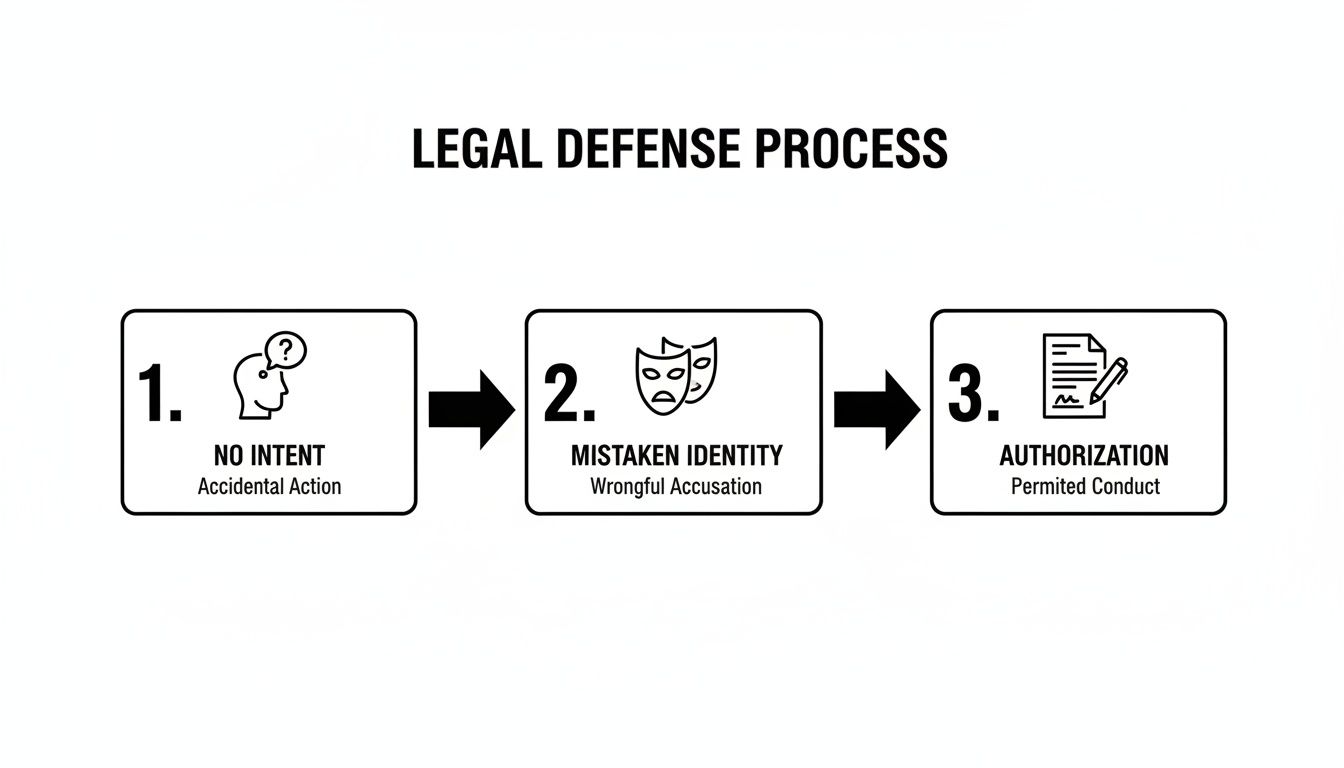
Each of these defenses is designed to attack an essential element that the prosecutor is required to prove.
Potential Resolutions for Your Forgery Case in Alpharetta
Many cases are resolved through strategic negotiations with the Fulton County District Attorney's office. This could mean getting the charge reduced to a less serious offense or securing a sentence that avoids prison.
For some individuals, especially first-time offenders, options like pretrial diversion programs or sentencing under the Georgia First Offender Act can be a lifeline. These programs offer a path to keep a felony conviction off your permanent record. Of course, if the prosecution is unwilling to offer a fair deal, we are always prepared to take your case to a jury trial.
Prosecutors have become especially vigilant due to high-profile document fraud schemes. For a broader look at national crime trends, you can explore the full data on identity theft and cybercrime.
Why Choose Brian Hansford for Your Alpharetta Defense
When you’re staring down a forgery 1st degree charge, the lawyer standing next to you in that Fulton County courtroom is the single most important decision you'll make. It's about finding a local defender who truly knows the system, the people, and exactly what’s on the line.
At my firm, your case isn't passed off to a junior associate. I handle it personally, from our first conversation to the final resolution. It's a level of personal commitment you won't find at a big, impersonal law firm.
A Former Prosecutor’s Insight
I spent critical time as a prosecutor, and that experience gives my clients a massive advantage today. I don’t have to guess what the North Fulton prosecutors are thinking or how they'll build their case. I already know their playbook. This insight allows me to get ahead of their strategy and build a defense specifically designed to dismantle their arguments, whether your case started in Alpharetta, Roswell, or Cumming.
When your freedom is on the line, you need an attorney who sees the case from both sides of the courtroom. This dual perspective is a powerful tool in protecting your rights.
Deep Roots in the North Fulton Legal Community
I've spent decades practicing in the courts where your case will be heard, from the Alpharetta Municipal Court all the way up to Fulton County Superior Court. I know the judges, prosecutors, and court staff. These professional relationships, built on years of mutual respect, are critical for direct, effective communication that can lead to favorable resolutions—options an outside attorney might never know exist.
While global data shows forgery is a widespread problem, it's the local impact that matters to you. Forgery and identity fraud are serious issues in our state, and for residents in Johns Creek, Milton, or Dunwoody, a felony conviction is devastating. My firm uses its deep local experience to pick apart the evidence and exploit weaknesses in the prosecution's case. You can read more research on document forgery patterns here.
Your future is at stake. Call my office today for a confidential consultation.
FAQ: Common Questions About Forgery Charges in Alpharetta
If you're facing a serious felony charge like forgery in the first degree, you need clear answers. Here are answers to the questions we hear most often from clients in Alpharetta and across North Fulton.
Q: What happens after a Forgery 1st Degree arrest in Alpharetta, GA?
A: After an arrest for forgery in Alpharetta, you will likely be processed at the North Fulton Annex Jail before being moved to the main Fulton County Jail. Because forgery 1st degree is a felony, your case will be heard in Fulton County Superior Court. A bond hearing is typically scheduled within 48-72 hours, and having an attorney present is critical.
Q: Can a forgery charge be reduced in Fulton County?
A: Yes, getting a charge reduced is often a primary goal. A skilled attorney can negotiate with the North Fulton District Attorney's office to potentially get a forgery 1st degree charge reduced to a misdemeanor or a less severe felony. Success hinges on the evidence, your criminal history, and exposing weaknesses in the prosecutor's case, such as lack of intent.
Q: Is the Georgia First Offender Act an option for forgery in Alpharetta?
A: It can be. The Georgia First Offender Act is a sentencing option for certain first-time felony offenders. If you qualify and successfully finish your sentence, the conviction is sealed from your public record. An attorney familiar with the Fulton County courts can assess your eligibility and make a persuasive case to the judge and prosecutor for this outcome.
Q: Do I need a lawyer for a forgery charge in Alpharetta?
A: Absolutely. A forgery 1st degree charge carries a prison sentence of up to 15 years in Georgia. You should never handle this on your own. Fulton County prosecutors are tough. You need an experienced criminal defense lawyer near you from day one to defend your rights, analyze the evidence, and guide you through the complex court process to achieve the best possible result.
Q: Can I go to jail for a first-time forgery offense?
A: Yes, jail time is a possibility even for a first offense. The law sets the sentencing range for forgery in the first degree at one to fifteen years in prison. An effective defense aims to avoid prison by fighting for alternatives like probation, fines, or entry into a program like the First Offender Act. Your lawyer's quality directly impacts this outcome.
The stakes are far too high to face a forgery charge without an expert in your corner. You need a calm, strategic advocate fighting for you immediately. At Brian Hansford Law, we have the local experience and prosecutorial background to protect your rights and your future. Call us now for a confidential review of your case.
