
A DUI arrest in Forsyth County usually starts the same way. Blue lights. A short walk to the shoulder. Questions that feel simple until you realize every answer matters. Then a ride to jail, bond paperwork, and a drive home where deep fear sets in.
By the next morning, many in this situation aren't thinking about legal theory. They're thinking about work, their license, their family, and whether one arrest is about to follow them for years. If you're in Cumming, Alpharetta, Roswell, Johns Creek, Milton, Marietta, or nearby North Atlanta, that reaction is normal.
What matters now is this. A DUI arrest in Georgia creates two separate problems at once. One is the criminal case in court. The other is the threat to your driver's license through the administrative process. Those tracks move on different timelines, and the first month is where people either protect themselves or lose advantage they can't easily get back.
The Critical Moments After a DUI Arrest in Forsyth County
At 2 a.m., the arrest feels finished once bond is posted and you get home. In Forsyth County, that is usually the point where the case starts to get more dangerous. The officer has already created the first version of the facts. The State will build on that version quickly. At the same time, the license side of the case may already be on a shorter clock than the court date on your citation.
That is why the first decisions matter so much. A DUI arrest creates one set of facts, but those facts are used in two places. One is the criminal case. The other is the administrative fight over your driving privileges. If those responses are handled separately, people miss evidence, miss deadlines, or make statements that hurt them in both forums.

As a former prosecutor, I look at the first few days differently than many people do after an arrest. I want to know what can still be preserved, what deadline expires first, and whether the stop, detention, arrest, chemical test request, or booking process created issues we can use. Bodycam footage may exist. Dashcam footage may exist. The implied consent notice may have been handled correctly, or it may not have been. A weak point on the criminal side can also matter in the license case, which is why the first 30 days need one coordinated plan.
What to do right away
- Stop talking about the case: Do not explain, apologize, or speculate in texts, calls, or social media posts.
- Save every document: Keep the citation, bond papers, tow receipt, DDS paperwork, and any temporary permit together.
- Write down the details while they are fresh: Note the route, the reason given for the stop, what was said before field tests, whether you were read implied consent, and whether anyone saw the stop or your driving beforehand.
- Act before evidence gets harder to find: Video requests, witness contact, and timeline review are stronger in the first days than they are weeks later.
- Get legal guidance early: Early strategy affects both the prosecution in court and the separate threat to your license.
A practical starting point is to review what to do after a DUI arrest in Georgia and then match those steps to the dates and paperwork in your own case.
Practical rule: Treat the arrest as one event that created two legal fights, and respond to both from day one.
Why this window changes the case
In Georgia, a DUI charge under O.C.G.A. § 40-6-391 can expose a driver to jail time, fines, license consequences, and required classes or treatment depending on the charge and the person’s record. Those penalties are set out in the statute itself, and the license consequences can begin on a different track from the criminal court process.
That split is where many avoidable mistakes happen. A person focuses on the court date and assumes the license issue can wait. Another person says too much to family, work, or insurance before counsel has reviewed the reports. Someone else loses the chance to gather favorable evidence because they treated the case like a single hearing instead of an immediate, two-track problem.
Early defense work is practical. Get the papers organized. Preserve what can be preserved. Build one plan for the court case and the license case before the first 30 days close.
The First 30 Days Your Critical Georgia DUI Timeline
You get out of jail in Forsyth County, look at the citation, and focus on the court date. Meanwhile, a separate 30 day deadline is already running against your license. That is the mistake that causes preventable damage in Georgia DUI cases.
The first month is not two separate problems you can handle one at a time. It is one case with two tracks that have to be managed together from the start. The facts, paperwork, and timing on the license side often shape what can be done later in the criminal case.
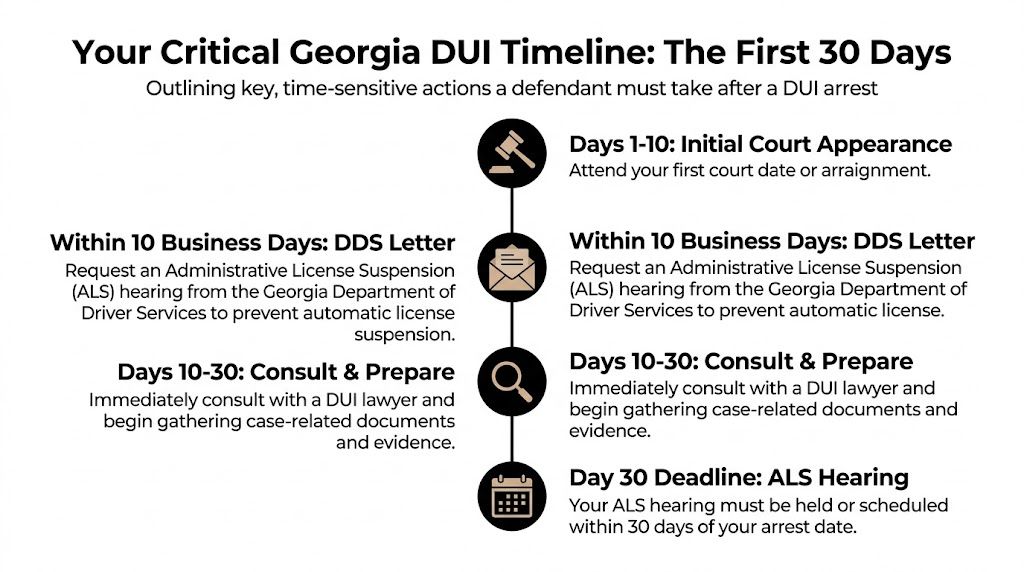
Days 1 through 3. Secure the papers and protect the timeline
Start with the documents. Keep the citation, bond paperwork, DDS notice, temporary permit, tow paperwork, and any medical or testing paperwork together. Small details matter in DUI cases. The date of arrest, the exact charge, the officer's stated grounds for the stop, and the wording of the implied consent notice can all matter later.
Write out your own timeline while your memory is still fresh. Include where you were coming from, why you were stopped, what the officer said, whether field sobriety tests were requested, and whether you gave a breath or blood sample. Do not guess. Do not clean it up. Accuracy matters more than sounding good.
Days 1 through 10. Evaluate both tracks together
The criminal case will deal with motions, negotiations, trial settings, and any plea discussions. The license case can affect whether you are allowed to keep driving while the court case is still in its early stages.
That is why early review has to be coordinated. A lawyer should be looking at the stop, the arrest decision, chemical testing issues, and the DDS paperwork as one file, not as unrelated tasks. A bad stop can matter in court and in the administrative case. A problem with implied consent can matter in both places too.
Days 1 through 30. Decide what to do about the ALS hearing
Georgia gives you a short window to act on the administrative suspension issue. If that deadline passes, the state can suspend your license before the criminal case is resolved. For many people in Cumming and the North Atlanta area, that is the first real crisis. Work, school pickups, probation compliance, and medical appointments all become harder at once.
A clear explanation of the Georgia administrative license suspension hearing process helps, but the larger point is strategic. The hearing is not just about transportation. It is also an early chance to examine the state's version of events, pin down positions, and avoid giving up ground before the prosecutor has even produced full discovery.
A practical first-month plan
Collect every document in one file
Missing paperwork creates avoidable problems. Keep digital copies and paper copies.Create a clean timeline of the stop and arrest
Include times, locations, witnesses, and anything said about testing or consent.Get the case reviewed before the 30 day mark
The review should cover the stop, arrest, field tests, chemical testing, DDS consequences, and court dates together.Make a decision on the ALS hearing quickly
Waiting closes options. Early action preserves them.Stay quiet about the facts of the case
Do not try to explain the arrest to your employer, insurance company, or anyone else in a way that locks you into a version of events before counsel reviews the reports.
The first 30 days set the tone of the case. If you act early, you preserve arguments, protect your ability to drive, and give your lawyer more room to work.
What helps the defense in this window
Early preparation changes cases. As a former prosecutor, I can say that files are evaluated differently when the defense is already tracking deadlines, preserving facts, and testing whether the officer followed procedure. That does not guarantee a dismissal. It does improve your position.
Waiting for arraignment usually hurts. By then, memories are weaker, deadlines may be gone, and the state has had more time to frame the case before the defense has done its own work.
The real trade-off
Some drivers focus only on staying out of court trouble and ignore the license issue. Others focus only on keeping a permit and assume the criminal case can be sorted out later. Both approaches are incomplete.
The better approach is a unified plan from day one. Protect the license. Prepare the court defense. Use the same facts and the same early investigation to support both.
Understanding DUI Charges and Penalties in Georgia
A DUI charge in Georgia can put two different risks on the table at once. One is the criminal case. The other is what happens to your ability to drive. By the time clients reach this part of the process, they usually want one straight answer: what am I facing?
The short answer is exposure. Jail is one part of it. Fines, probation terms, treatment requirements, community service, license consequences, and a lasting record can matter just as much. That is why the first 30 days matter so much. The same early work that helps at an ALS hearing can also shape how the criminal case is charged, negotiated, or tried.
Georgia does not require the state to prove a case with only one piece of evidence. Prosecutors may rely on driving conduct, officer observations, statements, field sobriety testing, and chemical test results. In some cases, they proceed on an alcohol concentration theory. In others, they proceed on a less-safe-driver theory. That distinction affects how the case is defended and how risk is evaluated.
Georgia DUI penalties at a glance
The baseline penalty ranges come from Georgia's DUI statute, O.C.G.A. § 40-6-391, along with related sentencing provisions courts apply in standard DUI cases.
| Penalty | 1st Offense | 2nd Offense within 10 years | 3rd Offense within 10 years |
|---|---|---|---|
| Jail | Minimum 24 hours, up to 12 months | Minimum 72 hours, up to 12 months | Minimum 15 days, up to 12 months |
| Fine | $300 to $1,000, plus surcharges | $600 to $1,000, plus surcharges | $1,000 to $5,000, plus surcharges |
| License consequences | License suspension or limited driving consequences may apply depending on the facts and prior history | Longer suspension exposure and stricter reinstatement requirements | Much harsher reinstatement and driving restrictions |
| Other consequences | DUI Alcohol or Drug Use Risk Reduction Program, probation, community service, possible treatment conditions | More community service, publication and clinical evaluation issues may apply | Habitual violator concerns and other repeat-offender consequences may apply |
Those ranges are the starting point, not the final result in every file. The actual outcome depends on the facts, prior record, test evidence, and whether the state can prove each required part of the charge.
The charge level matters, and prior history matters more than many drivers realize
A first DUI and a repeat DUI are defended differently. In a first-offense case, the fight is often about the stop, the investigation, the testing, and how the arrest is framed from the beginning. In a repeat-offense case, those issues still matter, but the prior convictions become part of the battle too.
Georgia uses a 10-year lookback period for sentencing on many DUI repeat-offense questions. The Georgia Department of Driver Services explains repeat DUI treatment and licensing consequences in its Driver Services DUI information. If an older conviction falls outside the applicable window, or if the state cannot properly prove the prior, the sentencing exposure can change in a meaningful way. I have seen cases where that issue made the difference between being sentenced as a repeat offender and being treated as a first offender for penalty purposes.
That is one reason generic advice misses the mark. The defense is not just about whether someone blew over the limit. It is also about whether the state can prove the right charge, the right prior history, and the right penalty range.
Exposure should guide decisions early
Clients sometimes focus on the arrest itself and underestimate the sentencing side. That is a mistake. A DUI case can affect employment, professional licensing, commercial driving, insurance costs, and family logistics within weeks. A parent who cannot drive, a nurse with a board-reporting issue, and a CDL holder do not face the same practical problems, even if the charge on paper looks similar.
That is why early case planning matters. A lawyer should be looking at the police reports, the stop, the chemical test issues, the prior history, and the license timeline together. If you want a clearer sense of how defense strategy is built from those facts, this guide on how to beat DUI charges gives a useful overview.
The goal at this stage is simple. Measure the actual risk correctly, then make decisions that protect both your court case and your ability to drive.
Proven Defenses Used to Fight a DUI in North Atlanta
A DUI case is often won in the details collected during the first 30 days. The same facts that support the criminal defense can also shape the license strategy, witness interviews, video requests, and decisions about whether to challenge the stop, the arrest, or the chemical test. Treating those issues as one plan, not separate fights, usually puts the defense in a stronger position.

The stop is often the first pressure point
Every DUI prosecution starts with a simple question. Did the officer have a lawful reason to stop the car?
If the answer is weak, the rest of the case can weaken with it. A report may claim weaving, speeding, failure to maintain lane, or some other traffic violation. The defense should compare that claim against dashcam footage, bodycam, dispatch timing, roadway conditions, and the officer's exact description of what happened. I have seen reports sound stronger than the video.
That review matters early because prosecutors often begin with the report. Their assessment can change once the footage shows ordinary driving, a brief lane touch, or a stop that lasted longer than the facts justified.
Roadside tests are often overstated
Drivers put too much weight on field sobriety tests. Those exercises are affected by lighting, slope, traffic noise, footwear, age, medical issues, anxiety, and whether the officer gave the instructions correctly. A person can look unsteady on the shoulder of GA 400 and still give the state poor proof of impairment.
The same is true for video. Jurors tend to trust what they can see, but video does not always show what the report claims. One of the best questions in any DUI file is a simple one.
Does the video match the report?
If you want a broader look at how lawyers build these arguments, see these practical DUI defense strategies in Georgia.
Chemical test evidence has to be tested too
A breath or blood result does not end the case. The defense needs to examine timing, observation periods, machine records, sample handling, implied consent issues, and whether the state can reliably connect the test result back to the time of driving. In some cases, the issue is the machine. In others, it is the officer's process.
That work also affects the first-30-days license plan. Test refusal cases, test-result cases, and DUI-drug cases do not create the same risks, and they should not be defended the same way.
Common defenses in real Forsyth County cases
Several defense themes show up again and again:
- Improper stop: The officer claims unsafe driving, but the video shows normal travel or too little conduct to justify the stop.
- Weak arrest decision: The officer moves to arrest based on odor, admission to drinking, and shaky roadside tests without solid indicators of impaired driving.
- Field sobriety problems: Instructions were unclear, the surface was uneven, the footwear was poor, or a medical issue affected performance.
- Breath or blood challenges: The defense questions testing procedures, timing, maintenance records, or chain-of-custody issues.
- Causation problems: The state has a number, but weak proof that the person was impaired while driving.
A strong defense does not depend on one dramatic issue. It usually comes from stacking several factual problems until the prosecutor has to reassess the case.
Good defenses also improve negotiation posture
Some cases should be set for motions. Some should be prepared for trial. Some should be negotiated from a position of strength after the weak points are documented.
Former prosecutor experience matters here because not every flaw changes the value of a case. Some problems are minor. Others affect probable cause, admissibility, or trial proof in a way that forces serious review by the state. The lawyer's job is to know the difference quickly, then use it.
Some DUI cases require a narrower, more technical defense
Alcohol cases get most of the attention, but many North Atlanta DUI cases involve other complications. Experienced lawyers should also look closely at whether the driver has a CDL, was taking prescription medication, or faces related charges such as fleeing, as discussed in George Creal's Forsyth County DUI content.
That can change the defense strategy fast. A CDL holder may be making decisions under work pressure from day one. A prescription-drug case may call for pharmacy records, medical context, and a very different approach to impairment proof. A case with related charges may require the defense to challenge the stop and the officer's timeline even more aggressively.
For readers interested in law firm visibility and client education online, Mastering SEO for Service Based Businesses offers a marketing perspective, but the legal priority in a DUI case remains the same. Get the video, protect the license, and build one defense plan that covers both the criminal case and the ALS timeline.
How to Choose the Right Forsyth County DUI Attorney
A good hiring decision in a DUI case usually happens in the first call. You need to know whether the lawyer sees your case as one problem with two tracks, the criminal prosecution and the 30-day license deadline, or treats them as separate issues that can be handled later. In Forsyth County, that distinction matters early.
A forsyth county dui lawyer should be able to explain what gets done first, what can wait, and what facts could change the plan. If the answer is generic, keep asking questions.
What to look for beyond general experience
Former prosecutor experience matters because it affects judgment. A former prosecutor knows which facts tend to drive charging decisions, which officer mistakes are minor, and which problems can change negotiations, motions, or trial posture. That helps a client get a realistic case assessment instead of a sales pitch.
Local practice matters too. A lawyer handling DUI and related misdemeanor work in North Atlanta should be comfortable with the courts, prosecutors, and procedures that affect clients from Forsyth County and nearby areas such as Alpharetta, Roswell, Johns Creek, Milton, Marietta, East Cobb, and Cobb County.
The right lawyer should also connect the license issue to the defense strategy from day one. A rushed ALS hearing request, a missed deadline, or an early statement made without a plan can affect the criminal case later. That is why the first 30 days should be handled as one coordinated response.
Questions worth asking in a consultation
Ask direct questions and listen for direct answers.
- Who is handling my case? Find out whether the lawyer you speak with will appear in court and manage the ALS side, or whether the case will be handed off.
- What happens in the first 30 days? A good answer should cover the license deadline, evidence preservation, court scheduling, and early defense review in one timeline.
- What facts would change your approach? The lawyer should ask about a refusal, breath test, blood draw, accident, prior DUI, CDL status, prescription medication, or any related charge.
- Do you evaluate motions early? DUI cases should be reviewed for stop, arrest, statement, and testing issues before the discussion turns only to plea options.
- How do you talk about possible outcomes? Careful lawyers do not promise dismissals. They explain the range of outcomes and what facts affect each one.
Brian Hansford Law is one example of a North Atlanta criminal defense firm that handles DUI and related charges from a former prosecutor's perspective. That background can matter when a case includes a license suspension issue, a reduction discussion, or misdemeanor charges tied to the stop.
Red flags people miss
One red flag is a lawyer who talks about court but glosses over the ALS hearing deadline. Another is a consultation that focuses on fees before the lawyer has pinned down the arrest date, the form of test requested, and whether the officer took your license.
General criminal practice is not always enough. Some DUI cases need a narrower approach. Cases involving CDL holders, prescription medication, or related charges can shift strategy quickly, as discussed in George Creal's Forsyth County DUI content. Those facts affect evidence, timing, and the practical advice a client needs right away.
A third red flag is vagueness about who appears in court. Clients often assume the lawyer they meet will handle every hearing. That assumption should be confirmed, not guessed.
Client-side test: If the consultation leaves you unclear about the 30-day deadline, the license risk, or who is responsible for your case, keep looking.
A note on online research
People often compare lawyers online before they call. That is reasonable. A useful law firm website should explain deadlines, process, service area, and the kinds of cases the firm handles.
If you are curious why some firms explain services more clearly than others, Mastering SEO for Service Based Businesses offers a marketing view of how service businesses organize educational content.
In a DUI case, clear communication is more than marketing. It usually reflects whether the lawyer has a concrete plan for the first month, when your license, your court posture, and your future are all on the line.
Navigating the DUI Court Process From Arraignment to Resolution
A Forsyth County DUI case usually feels simple for about 24 hours. Then the deadlines start stacking up. Your first court date, the prosecutor's evidence, the officer's video, and the license consequences all start affecting each other. That is why I treat the court case and the license problem as one strategy from day one, especially in the first 30 days.
Arraignment and the first court appearance
Arraignment is usually the first formal criminal court setting. The judge calls the charge, addresses procedure, and a plea is entered. In many DUI cases, the smart opening position is a not guilty plea so the defense can get the evidence, examine the stop and arrest, and avoid giving up arguments too early.
Clients get into trouble here by talking. Open court is not the place to explain what happened, apologize, or try to sound cooperative. A casual statement can lock in facts that later matter in negotiation, motions, or trial.
The first appearance also helps set the tone of the case. A prepared defense shows the court and the prosecutor that the case will be examined closely, not processed on autopilot.
Investigation and discovery
After arraignment, intensive work begins. That means getting the police report, body camera and dash camera footage, dispatch records, implied consent notice issues, breath or blood testing records, and any witness information.
I do not review those items as separate pieces. I compare them against each other. Does the video match the officer's report. Was the reason for the stop clear. Do the roadside exercises look as poor as the report claims. Was the arrest made before enough evidence existed. In blood or breath cases, were the testing steps followed the way the state will later say they were.
That review shapes the case early. It also shapes how the license side should be handled, because the same facts often matter in both places.
Motions and negotiation
Strong negotiation usually comes after the defense identifies a real proof problem. Prosecutors do not reduce charges because someone asks nicely. They listen when the stop is questionable, the field sobriety work is weak, the video undercuts the report, the implied consent warning was mishandled, or the chemical test has reliability issues.
That is why motions matter. A motion to suppress can challenge the stop, statements, arrest, or test evidence. Even when a motion is not fully argued to the finish, filing and preparing it can change the conversation because it shows the state where the risk is.
Some cases do resolve without trial, sometimes through a reduction such as reckless driving. That result depends on the facts, the court, the prosecutor, and how much pressure the defense can put on the state's evidence. It is earned through preparation.
Trial if the case does not resolve
If the state will not offer a fair resolution, the case may need to be tried. By that point, trial preparation should already be well underway. Jury trial is where the earlier work gets tested. The stop, the officer's credibility, the field sobriety exercises, the chemical evidence, and your statements all have to hold up under scrutiny.
For clients, this is usually the point where the case starts to look different than it did on the night of arrest. It is no longer just a police accusation. It is a prosecution that has to prove its case with admissible evidence, in the right order, under courtroom rules.
That shift matters. Good DUI defense is built in the first month, but it pays off all the way through resolution.
Frequently Asked Questions About DUI Cases in Georgia
How much does a DUI lawyer cost in North Atlanta
Fees vary by court, facts, and how aggressively the case needs to be litigated. A straightforward first-offense case is different from a DUI with a crash, blood testing, a CDL issue, or related drug possession or fleeing charges. The right question isn't just price. It's what work the lawyer is doing for that fee, including license issues, evidence review, motions, negotiation, and trial preparation if needed.
Should I refuse a breath or blood test
There isn't a one-size-fits-all answer after the fact. In real cases, refusal can remove one kind of evidence while creating a license problem and a different set of arguments. Taking the test can create a number the state wants to use, but that result may still be challenged depending on procedure and reliability. The better question now is how the choice affects your current defense.
Can a DUI be reduced to reckless driving
Yes, that can happen in some cases. It's not automatic, and it doesn't happen because a person asks politely. It usually happens when the defense shows the prosecution a real weakness in the proof, such as a questionable stop, unreliable roadside testing, or a problem with the chemical evidence.
Am I going to jail for a first DUI
Georgia law allows jail exposure on a first offense, and the stakes are serious. Whether jail is likely depends on the facts, the court, your history, aggravating details, and the quality of the defense. People make mistakes when they assume "first offense" means "no risk." It doesn't. But first-offense cases are also often the files where early, disciplined defense work makes the biggest difference.
Can I still drive after the arrest
Maybe, but don't assume you can. The answer depends on what paperwork you received, what deadlines apply, and what action is taken quickly after the arrest. This is one of the first things a lawyer should review with you.
Do I need a lawyer if I plan to plead guilty
Yes, at least before making that decision. Pleading guilty without evaluating the stop, testing process, and license consequences can create avoidable damage. Even when the evidence looks strong, the defense may still improve the outcome through negotiation, charge reduction, or a more protective approach to sentencing and license issues.
Your Next Step to Protect Your License and Your Future
If you're facing a DUI in Forsyth County, the first month matters more than commonly understood. The case isn't just about a future court date. It's also about the immediate threat to your license, the evidence that needs to be examined, and the strategy decisions that shape what happens later.
A DUI arrest is serious. It is not a conviction.
The right response is fast, calm, and organized. Protect the deadline tied to your driving privileges. Preserve documents. Stop discussing the facts casually. Get the case evaluated by someone who understands both sides of the process, the criminal case in court and the separate administrative track affecting your ability to drive in Cumming, Johns Creek, Milton, Alpharetta, Roswell, Marietta, Forsyth County, and Cobb County.
If you need immediate help after a DUI arrest, contact Brian Hansford Law for a free consultation. Get clear answers about the first 30 days, your license risk, your court process, and the defense options available in Forsyth County and across North Atlanta.
