
When you're facing a charge for a fraudulent check in Georgia, the penalties aren't one-size-fits-all. The consequences hinge almost entirely on the dollar amount written on the check. Cases range from misdemeanors with fines and possible jail time to serious felonies that carry up to ten years in prison for checks over $1,500.
Simply put, the higher the check amount, the more serious the potential penalty.
Understanding The Fraudulent Checks Penalty In Georgia
If you've been accused of passing a bad check in Georgia, the first thing on your mind is probably, "What am I up against?" It's a fair question, but the answer isn't straightforward. Georgia law, specifically O.C.G.A. § 16-9-20, sets up a tiered penalty system that is almost entirely based on the value of the check involved.
Think of it as a sliding scale. A small amount might land you on one end with a lesser charge, while a large amount pushes you to the other end, where the consequences can be life-altering. This dividing line is what separates a misdemeanor from a felony—two very different worlds with vastly different outcomes. You can learn more about the critical differences between felony and misdemeanor charges to see just how much is at stake.
The Misdemeanor Versus Felony Threshold
In Georgia, the magic number that separates a misdemeanor from a felony bad check charge is $1,500.
If the fraudulent check (or a series of them) totals less than $1,500, it's typically prosecuted as a misdemeanor. While still a serious charge, a misdemeanor conviction comes with penalties that are less severe than a felony:
- Up to 12 months in county jail
- Fines reaching up to $1,000
- Court-ordered restitution to repay the victim
But the moment that check value crosses the $1,500 line, everything changes. The charge is elevated to a felony, and the potential penalties get much tougher.
The Escalation To A Felony Charge
Once a bad check case becomes a felony, the potential punishment reflects the significant financial harm the law presumes was caused. For a single check valued at $1,500 or more, you could be facing anywhere from one to ten years in state prison.
Georgia's penalties are tiered and can become incredibly harsh. While a small bad check is a misdemeanor, the charge jumps quickly to a felony with significant prison time. For very large amounts, fines can even scale up to $100,000. Repeat offenders or those involved in more complex schemes, like forgery, often face even steeper sentences.
To give you a clearer picture, here’s a quick breakdown of how the penalties stack up.
Georgia Fraudulent Check Penalties At A Glance
| Check Amount Or Offense Type | Classification | Potential Jail Or Prison Time | Potential Fines |
|---|---|---|---|
| Under $1,500 | Misdemeanor | Up to 12 months in jail | Up to $1,000 |
| $1,500 or more | Felony | 1 to 10 years in prison | Up to $100,000 |
| Repeat Offenses / Forgery | Felony | Can be significantly enhanced | Substantial, court-determined |
This table shows how quickly the stakes can rise based on the check's value and your criminal history.
The core principle is straightforward: the greater the alleged financial loss, the more seriously the offense is viewed. A conviction for a felony offense not only carries the risk of significant time behind bars but also creates a permanent criminal record that can affect future opportunities long after a sentence is served.
Common Types Of Check Fraud Offenses
When people hear "check fraud," they usually think of one thing: writing a bad check. But in reality, Georgia law covers a whole range of deceptive acts under that umbrella. Some are obvious, while others are more complex, and a person can get tangled up in them without seeing the full picture.
The penalties for fraudulent checks depend heavily on what, exactly, happened. Think of it less like a single crime and more like a family of related offenses. They all share the same DNA—deceit for financial gain—but each has its own unique features. Let's break down the most common ones we see.
Forgery: Signing Someone Else’s Name
Forgery is the classic form of check fraud. It’s simple: you sign someone else's name to a check without their permission. This can be as straightforward as stealing a checkbook or as elaborate as creating fake business checks.
Imagine someone finds a wallet in a parking lot in Alpharetta. It has a checkbook inside. If they write a check to themselves and forge the owner's signature, that’s forgery. The intent to defraud is crystal clear because they're pretending to be someone else to get money that isn't theirs.
In a business setting, an employee with access to the company's financials might write a check to a fake company they set up, then forge their boss's signature. This is a serious breach of trust and a textbook forgery case that brings stiff penalties.
Check Alteration: Changing The Details
This happens when someone takes a perfectly good, legitimate check and changes the important details on it. Usually, they alter the payee's name or, more often, the dollar amount. With modern chemicals, fraudsters can "wash" a check to erase the original ink and write in a new, higher value.
Here’s a real-world scenario. A small business owner in Roswell gets a check from a client for $100. The check gets stolen from their mailbox, and the thief uses chemicals to erase the amount, rewriting it for $1,000. When the bank tries to process the altered check, it gets flagged. Suddenly, the business owner, the actual victim, is caught up in a fraud investigation.
The heart of alteration is taking a valid document and manipulating it. The check started out as real, but its terms were illegally changed to create a fraudulent instrument.
This is how innocent people get dragged into these situations. A shop owner in Marietta deposits what looks like a normal payment, only to find out later it was altered. Now they have to answer questions from bank investigators and law enforcement.
Check Kiting: The Floating Funds Scheme
Check kiting is a more sophisticated fraud that plays on the "float"—the few days between when a check is deposited and when the money actually moves between banks. It involves using at least two bank accounts to create the illusion of having money that isn't really there.
Think of it like juggling with two empty buckets, representing two bank accounts. You "pour" water from Bucket A into Bucket B by writing a check. Before Bucket A’s bank realizes it’s empty, you write a bigger check from Bucket B to refill Bucket A. This constant back-and-forth makes it look like you have money when you're really just floating debt.
The scheme gets complicated fast:
- The Setup: A person opens an account at Bank 1 in Cumming and another at Bank 2 in Johns Creek.
- The Kite: They write a $2,000 check from Bank 1 (which has no funds) and deposit it into Bank 2. For a couple of days, Bank 2 shows a $2,000 balance before the check has a chance to bounce.
- The Cycle: Before the first check is rejected, they write a $3,000 check from Bank 2 and deposit it into Bank 1. This covers the first check and makes Bank 1's balance look healthy for a moment.
This cycle is repeated, often with larger and larger amounts, until the whole thing collapses—and it always does. When the dust settles, the person running the scheme, and sometimes the unsuspecting people who accepted the bad checks, are left facing the consequences.
How A Check Fraud Case Moves Through The System
When a business or individual in Georgia gets hit with a bad check, it kicks off a surprisingly formal process. The journey from a bounced or forged check to a courtroom isn't instant; it's a step-by-step progression that begins long before any official charges are filed.
It all starts with a complaint, usually from the person or business left holding the worthless check. Once that report is made, law enforcement and the banks start digging in to figure out exactly what happened.
The Initial Investigation
The investigation is the foundation for everything that follows. Banks are the first stop, and they play a huge role by providing key documents like transaction records, deposit slips, and, of course, copies of the bad check itself. They can trace its path, showing where and when it was deposited or cashed.
From there, law enforcement officers take that financial trail and start building a case. Their goal is to gather enough evidence to pinpoint who's responsible. This often involves:
- Surveillance Footage: Getting video from the bank or store where the check was passed is often the strongest piece of evidence.
- Witness Statements: Officers will interview bank tellers, store clerks, or anyone else who was there during the transaction.
- Transaction Data: They’ll look for records that link the check to a specific person or account, which helps build a clear timeline.
This is a methodical process. The police are trying to build a solid, airtight case they can hand over to a prosecutor. If the evidence points squarely at someone, an arrest is the next step.
The infographic below shows the three most common types of check fraud investigators are looking for: forgery, alteration, and kiting.
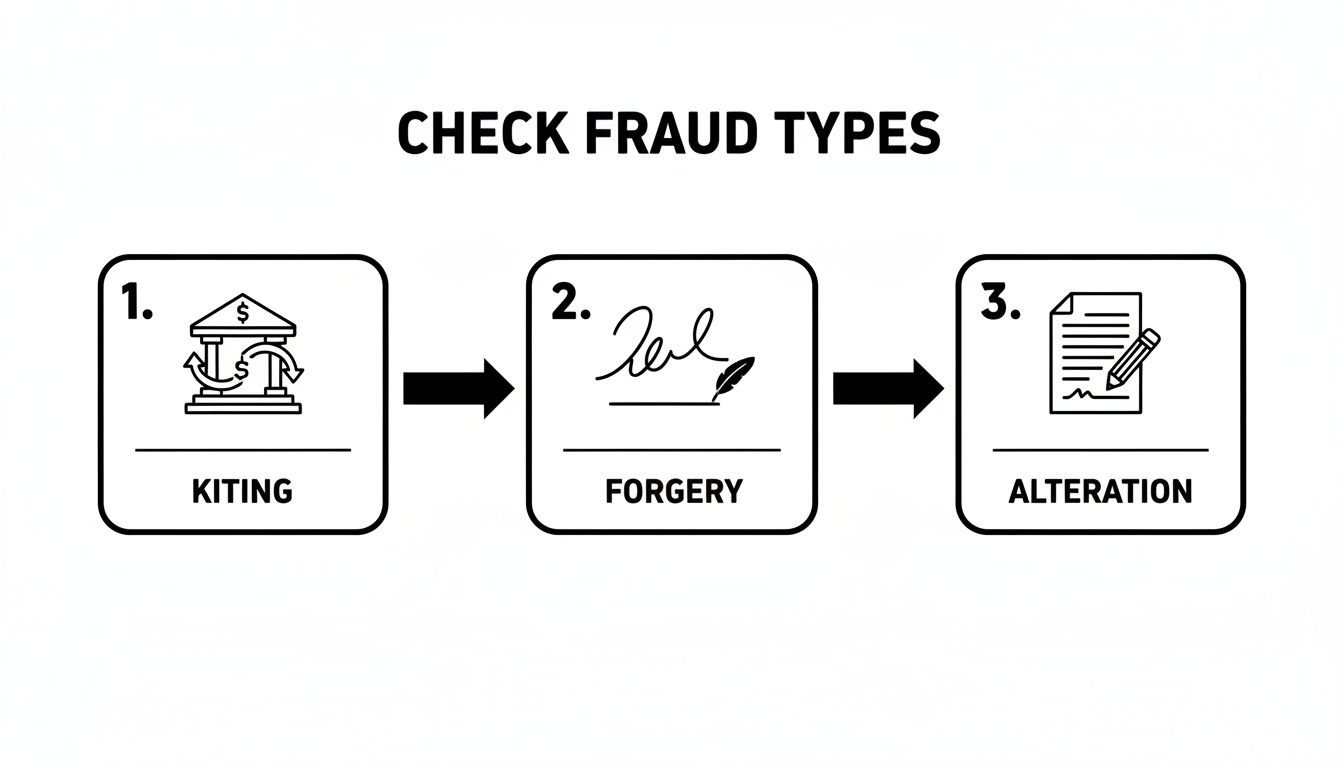
As you can see, actions that seem minor—like changing a dollar amount or signing someone else's name—are exactly what can trigger a formal investigation.
Navigating The Formal Process
Once an arrest is made, the case officially enters the criminal justice system. The person accused will be taken into custody and booked. From that point on, the case follows a structured path. For anyone new to this world, understanding the steps in the criminal justice process can make a confusing time feel a bit more manageable.
The first time you see a judge is at the arraignment. This is where the charges against you are formally read, and you're asked to enter a plea—usually "guilty," "not guilty," or "no contest." This hearing really sets the stage for everything else.
After the arraignment, the case moves into what’s called the discovery phase. This is a critical time where the defense gets to see and analyze all the evidence the prosecution has, including police reports, witness statements, and bank records.
This is where a good defense attorney earns their keep. They meticulously comb through the state's case, looking for holes, procedural mistakes, or weak evidence. It’s their first real chance to see exactly what they're up against.
Following discovery, there are often plea negotiations. This is where your attorney and the prosecutor discuss whether the case can be resolved without going to trial. Depending on the strength of the evidence and your history, this might mean negotiating for lesser charges or a lighter sentence in exchange for a guilty plea. A lot of cases, especially in busy courts like those in Forsyth and Cobb County, get resolved right here.
If no agreement can be reached, the case moves toward trial. At that point, both sides will present their arguments to a judge or jury. The entire process, from that initial complaint all the way to a potential trial, can take several months or even longer, depending on how complex the case is and how backed up the court's calendar is.
Exploring Common Defenses in Check Fraud Cases
Being accused of check fraud can make you feel like your fate is already sealed. But an accusation is just that—the start of a process, not the end. Under Georgia law, the prosecution has the burden of proving every single element of the crime. There are several powerful ways to challenge their version of events.
It's important to understand that not every bounced check or flagged transaction is a crime. The real story often reveals an honest mistake, a case of mistaken identity, or simply no criminal intent whatsoever.
The Core Issue: Lack of Intent
In nearly every check fraud case, the central battleground is the defendant's state of mind. To get a conviction, a prosecutor must prove you intentionally and knowingly committed a fraudulent act. That is a very high bar to clear.
An honest mistake is not a crime. Let's say you wrote a check fully believing you had enough money in your account. But then, an automatic bill payment you forgot about hit first, or a deposit you were expecting was delayed. If the check bounces, your actions almost certainly lack the criminal intent required for a fraud conviction.
The heart of this defense is showing the difference between a simple financial miscalculation and a deliberate plan to deceive someone. A strong case can be built by showing you acted in good faith—maybe you tried to fix the debt right away or have a long history of responsible banking.
Life gets messy, and so do finances. A simple accounting error or a miscommunication with your spouse over a joint account can easily lead to an overdraft. These situations are a world away from a calculated scheme to defraud a person or business.
Mistaken Identity and Stolen Information
Another major defense centers on mistaken identity. We live in an age where mail theft and identity fraud are all too common, meaning innocent people get wrongly accused more often than you'd think. It's entirely possible for someone to steal your checkbook, forge your signature, and pass bad checks all over town without you even knowing it happened.
The rise of check fraud is a huge problem. In fact, the 2025 AFP Payments Fraud and Control Survey revealed that checks were the payment method most frequently targeted by fraudsters in 2024, with a staggering 63% of organizations reporting incidents. For people living in communities like Johns Creek or Milton, this isn't just a statistic—it's a local reality. Thieves routinely target mailboxes to get their hands on checks, leading to thousands of fraud cases. You can discover more insights about these trends and learn how check fraud remains a top threat.
Here are just a few scenarios where mistaken identity becomes a very real defense:
- Stolen Checks: Your checkbook is lifted from your car or home, and a thief starts forging your name.
- Mail Theft: A check you mailed gets intercepted, "washed" with chemicals to change the payee or amount, and cashed by a criminal.
- Identity Theft: Someone uses your personal information to open a new bank account and starts writing bad checks in your name.
In these situations, you're the victim, not the criminal. A solid defense would involve showing you weren't the person who wrote or passed the check. Evidence like alibis, handwriting analysis, or even police reports from the initial theft could be used to prove your innocence.
Other Potential Defense Angles
Beyond intent and identity, other arguments can form the foundation of a strong defense. The details of every case matter, and a deep dive into the evidence can often uncover procedural mistakes or other mitigating factors.
One such angle is authorization. If you had a legitimate reason to believe you were authorized to sign or use a check, that can completely negate the element of fraud. This issue sometimes comes up in complex business partnerships or family financial situations where the lines of permission are blurry.
Finally, bank error can be a factor. It’s less common, but banks absolutely make mistakes. An erroneous hold on your account or a deposit credited to the wrong person could be the real reason a check bounced. Proving a bank error shifts the blame away from you, showing that the situation was entirely out of your control and not the result of any deceptive act on your part.
The Hidden Consequences Of A Conviction

The official penalties for writing a bad check—fines, probation, maybe even jail time—are really just the tip of the iceberg. The real damage, the kind that follows you for years, often starts long after your case is closed. A conviction, particularly a felony, puts a permanent stain on your record that’s hard to ignore.
This criminal history becomes a massive roadblock in almost every area of your life. It’s a weight that makes moving forward and rebuilding feel next to impossible.
Your Future Employment And Professional Life
One of the first and most painful hits you'll take is to your career. Many employers, especially in fields like finance, healthcare, or anything involving trust, run mandatory background checks. An offense involving theft or deceit on your record is often an automatic deal-breaker.
Even for jobs without a formal background check, that one little box on the application—"Have you ever been convicted of a crime?"—can sink your chances. Answering "yes" often gets your application tossed aside, no matter how qualified you are or how long ago it happened. Finding good, stable work becomes a constant struggle.
For licensed professionals like nurses, real estate agents, or contractors, the stakes are even higher. A fraudulent check conviction can trigger a review by your state licensing board, which could lead to:
- Suspension of your license, putting your career on hold.
- Revocation of your license, effectively ending your profession.
- Denial of a new license, slamming the door on a field you've trained for.
At the end of the day, it all comes down to trust. For licensing boards and employers, a conviction for a crime of dishonesty like check fraud shatters that trust, and they're often unwilling to take a chance.
The Lasting Financial Burden
Beyond the court fines, a conviction brings a whole new set of financial headaches. A big one is court-ordered restitution. This isn't a fine; it's a direct order to pay back every single dollar the victim lost because of the bad check. You have to pay it back in full, on top of everything else.
The scale of this problem is huge, which is why the penalties are so harsh. Globally, check fraud has ballooned into a $26.6 billion problem, with a staggering 80% of those losses happening right here in the Americas. This isn't some distant statistic; it hits home for people in Alpharetta, Cumming, and Roswell, as Georgia prosecutors are cracking down hard. If you're charged in Forsyth County, you could be looking at a felony theft by deception charge, which carries 1-20 years in prison. You can read more about how these check fraud statistics highlight the severity of the issue.
So, you're struggling to find a job while also facing a mountain of debt from fines and restitution. This combination can make it incredibly difficult to get back on your feet. It also wrecks your credit score, making it tough to get a loan, a mortgage, or even rent an apartment in places like Marietta or East Cobb. A conviction creates a vicious cycle of financial hardship that's hard to escape.
The Role Of An Experienced Defense Attorney
When you're facing something as serious as a check fraud charge in Georgia, the system can feel like a maze. It’s a world filled with confusing procedures and rules that most people have never encountered. This is precisely where a skilled defense attorney steps in—not just as representation, but as your guide through a very tough situation.
An attorney's first job is to get a magnifying glass and go over every single piece of evidence the prosecution has. We're talking about digging into surveillance videos, combing through bank records, and picking apart witness statements. The mission is to find the weak spots, the inconsistencies, or any procedural missteps that can be used to challenge the state's narrative.
The Advantage of a Former Prosecutor's Perspective
There’s a unique edge that comes with hiring a defense attorney who used to be a prosecutor. It’s like having someone on your team who has the other side’s playbook. An attorney who has built cases for the prosecution knows their strategies, understands what they prioritize in evidence, and can often see their next move coming.
This insight allows for a much more proactive defense. Instead of just playing defense and reacting to the prosecutor’s arguments, a lawyer with this background can build a counter-strategy designed to take the state’s case apart from the inside. They know where the pressure points are and can use that knowledge in negotiations or in the courtroom.
Being able to see a case from both sides of the aisle—defense and prosecution—is a game-changer. It allows for a complete strategy that not only defends against the current charge but also anticipates and cuts off the prosecution's tactics before they even get started.
This dual perspective is incredibly valuable in the courts across Forsyth County, Cobb County, and the surrounding North Fulton cities like Alpharetta and Roswell, where we practice every day.
Building A Solid Defense Strategy
A good defense attorney does a lot more than just speak for you in court; they build a comprehensive defense specifically for you and your situation. This usually involves a few key actions:
- Negotiating with Prosecutors: A surprising number of check fraud cases are resolved without ever going to trial. An experienced lawyer knows how to talk to prosecutors to get charges reduced or, in some cases, dismissed entirely, depending on the facts.
- Protecting Your Rights: From the moment you're charged, your attorney is there to make sure your constitutional rights are protected. This means watching for things like illegal searches or improper questioning.
- Preparing for Trial: If a fair deal can't be reached, your attorney will get ready for a fight. They'll prepare a strong, well-argued defense to present to a judge or jury.
Choosing the right lawyer is one of the most important decisions you'll make. For anyone unsure of how to start, this guide on how to find a qualified criminal lawyer is a great resource. In the end, the right attorney is more than just representation; they are your dedicated advocate, committed to protecting your rights and fighting for the best outcome possible for your future.
Frequently Asked Questions About Check Fraud Charges
When you're accused of check fraud, a flood of questions and worries is completely normal. The system can feel confusing, and you’re probably wondering what’s going to happen next. Here are some straightforward answers to the questions we hear most often.
Can I Face Charges For An Honest Mistake?
This is a big one. Many people worry that a simple error, like miscalculating a bank balance, could land them in criminal trouble. The key difference between a financial mistake and a crime always comes down to intent.
For a prosecutor to build a criminal case, they have to prove you knew the check wouldn't be honored and wrote it anyway with the intent to deceive. An accidental overdraft or a check that bounces because a deposit was delayed usually doesn't meet that standard. You'll still owe the money and might get hit with bank fees or a civil collection, but that's a world away from a deliberate scheme to defraud someone. The entire case often hinges on whether the prosecution can show you knew the funds weren't there when you wrote the check.
What Should I Do If A Detective Calls About A Check?
Getting a call from a detective about a bad check is a serious development. It means a formal complaint has likely been filed, and a criminal investigation is officially underway. This is often the first sign that things are escalating.
How you handle this call is critical. It signals that the issue has moved beyond a simple dispute with a business and is now being treated as a potential crime. What you say—or don't say—can shape the direction of the investigation from this point forward.
It's essential to understand that an investigation is a formal process designed to gather evidence. Any information you share can, and likely will, become part of the official record used by the prosecution.
Can A Check Fraud Charge Be Removed From My Record?
A criminal record can follow you for years, so it's natural to ask if a check fraud charge can be wiped clean. In Georgia, the process for sealing a criminal record is called record restriction (what some people used to call expungement). Whether a check fraud charge is eligible depends entirely on how the case turns out.
If your charges were dismissed, never formally prosecuted, or you were found "not guilty" at trial, you often have a good chance of getting the record restricted. Convictions are a different story. The rules are much stricter and depend on whether it was a misdemeanor or felony, the date you were sentenced, and your criminal history. Figuring out if you're eligible requires a close look at the specific details of your case and Georgia's complex statutes.
If you or someone you care about is facing a check fraud accusation in Alpharetta, Cumming, Johns Creek, or the surrounding areas, the uncertainty can be the hardest part. At Brian Hansford Law, we believe everyone deserves a strong, dedicated defense. Contact us to understand your options and protect your future by visiting challengemycharge.com.
