
When you're facing a criminal charge in Georgia, it’s easy to feel lost. The state's legal system can seem like a confusing maze, but understanding the basic layout is the first real step toward finding your way through it.
How Georgia's Criminal Law System Works
Think of the criminal justice system here in Georgia like a network of roads. Some offenses are like quiet side streets—less serious, with lighter consequences. Others are like major interstate highways, where the stakes are much higher and the outcomes far more significant. Knowing which road a case is on is critical.
The journey almost always starts with an arrest. Once that happens, a case is officially in the system, and it will follow a structured process. This path involves several key players: prosecutors fighting for the state, defense attorneys advocating for the accused, and judges making sure the rules are followed.
The Typical Path of a Case
While every situation has its own unique twists and turns, most criminal cases in Georgia follow a predictable sequence. This process is built to move a case from one stage to the next in a methodical way, starting from that first interaction with law enforcement all the way to a final resolution.
This chart gives you a bird's-eye view of how a case generally moves through the system.
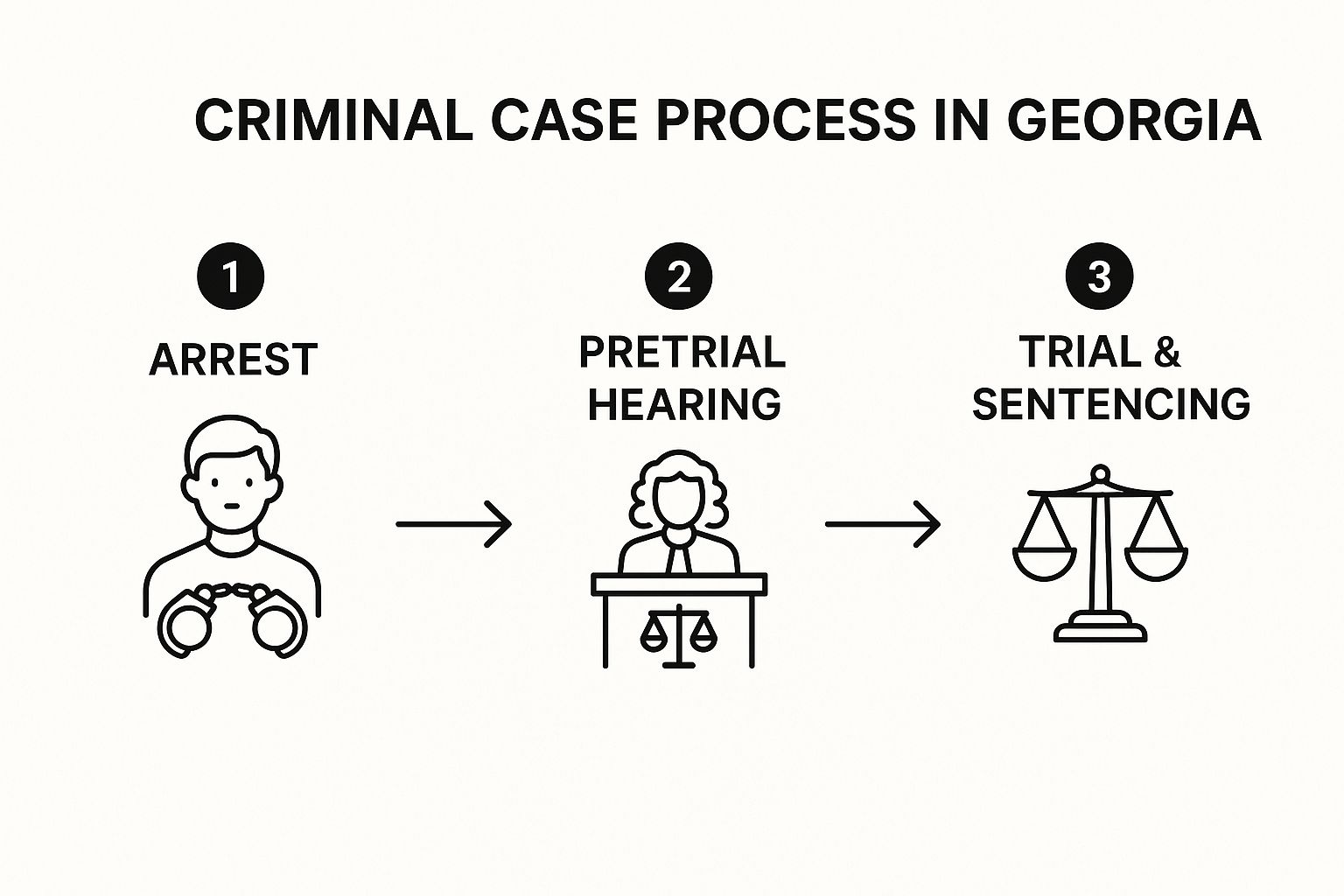
As you can see, a case goes from the arrest to pretrial hearings long before a trial might ever happen. The arrest itself is what kicks everything off, triggering a cascade of required legal procedures. To get a better handle on that crucial first step, you can learn more about what happens when someone is arrested in our detailed breakdown.
To give you a clearer idea of the timeline, here’s a simplified look at the key stages.
Key Stages in a Georgia Criminal Case
| Stage | What Happens | Purpose |
|---|---|---|
| Arrest & Booking | An individual is taken into custody, photographed, and fingerprinted. | To officially record the arrest and process the individual into the system. |
| First Appearance | The accused appears before a judge, who informs them of the charges and sets bail. | To ensure the accused knows their rights and to address release from custody. |
| Preliminary Hearing | The prosecutor presents evidence to show there is probable cause for the charges. | A checkpoint to see if the state has enough evidence to move forward. |
| Arraignment | The accused is formally charged and enters a plea (guilty, not guilty, or no contest). | To officially begin the court case and state a position. |
| Pre-Trial Motions | An attorney files motions to challenge evidence or other aspects of the case. | To shape the trial by excluding improper evidence or resolving legal issues. |
| Trial | Both sides present evidence and arguments to a judge or jury. | To determine guilt or innocence based on the evidence presented. |
| Sentencing | If found guilty, the judge determines the appropriate punishment. | To impose a penalty that fits the crime and the circumstances. |
This table maps out the general path, but the specifics can change depending on the unique situation.
From Misdemeanors to Felonies
One of the first things people hear about is whether a charge is a misdemeanor or a felony. This distinction is fundamental in Georgia law and shapes everything that follows, from the potential penalties to the specific court that will hear the case.
- Misdemeanors: These are the less serious offenses, like those local roads we talked about. Penalties usually involve fines, probation, or jail time of up to 12 months.
- Felonies: These are the most serious crimes, treated like a major crash on the highway. A felony conviction can lead to a state prison sentence of one year or more and will dramatically change a person's life.
The core difference lies in the severity of the potential punishment. This classification is a critical factor that shapes the entire legal strategy and process from the very beginning.
Ultimately, this overview is meant to give a clear, high-level picture of how the system is put together. When the basic roadmap is understood—from arrest and court dates to the different types of charges—it is easier to navigate what’s ahead.
Understanding Common Charges in Georgia

When someone is facing a criminal charge, the legal language can feel overwhelming and confusing. To get a real handle on what's going on, it helps to break down some of the most common charges filed here in Georgia. These aren't just minor infractions; they come with serious consequences and are built on specific elements the prosecution has to prove.
From a traffic stop in Cobb County to an incident in Forsyth, certain cases pop up far more frequently than others. Getting to know the basics of these charges gives a clearer picture of how the state’s criminal code works in the real world. This information is purely to explain the legal framework, not to provide guidance on any specific case.
Decoding DUI Allegations
Driving Under the Influence (DUI) is probably one of the most recognized charges in Georgia, but it's much more layered than people think. It's not a single, one-size-fits-all accusation. The state actually pursues it under two different legal theories, and knowing the difference is critical.
Think of a DUI charge as a two-sided coin.
On one side, there is the "per se" DUI. This is all about the numbers. If a driver’s blood alcohol concentration (BAC) is 0.08% or higher—or 0.02% for drivers under 21—the law says they are impaired. It doesn't matter how perfectly they were driving. The number itself is the violation.
Flip the coin, and there is the "less safe" DUI. This charge has nothing to do with a specific number. Instead, the focus is on the driver's actions. Did alcohol or drugs make them a less safe driver? The evidence here is observational—things like swerving, failing a field sobriety test, or other visible signs of impairment.
There’s another twist: refusing a chemical test like a breathalyzer or blood test. In Georgia, that refusal can trigger an automatic driver's license suspension. The prosecution can also use the fact that a test was refused as evidence in a "less safe" DUI case.
Drug Offenses: Possession and Intent
In Georgia, drug charges hinge on two key factors: the type of substance and what the police believe the person was going to do with it. The law draws a very sharp line between having drugs for personal use and having them with the intent to sell or distribute.
- Simple Possession: This charge is for possessing a controlled substance for personal use. It's still a serious offense, but the penalties are typically less harsh than for distribution.
- Possession with Intent to Distribute: This is a much heavier felony charge. Here, law enforcement and prosecutors look for clues that the drugs were meant for more than just personal consumption.
So, what separates these two charges? It's often all about the surrounding evidence. Things that can push a simple possession charge into "intent to distribute" territory include:
- A quantity of the drug that's more than someone would typically have for personal use.
- The presence of scales, individual baggies, or other packaging materials.
- Large amounts of cash found near the drugs.
- Text messages or other communications that hint at drug sales.
It's also crucial to remember that the type of drug matters immensely. Charges involving Schedule I or II drugs, like heroin or methamphetamine, come with far more severe potential penalties than those involving marijuana.
Theft Crimes: Value and Intent
Theft charges in Georgia are defined by two things: the value of what was taken and the person's intent. The law covers everything from a minor shoplifting incident at a store in Alpharetta to a sophisticated felony scheme.
At its core, any theft charge requires the prosecution to prove that someone intentionally took property belonging to someone else without permission. But it's the value of that property that usually dictates how serious the charge is.
- Misdemeanor Theft: If the stolen property is valued at $1,500 or less, the charge is generally a misdemeanor. This can include shoplifting a few items from a department store.
- Felony Theft: Once the value climbs above $1,500, the charge escalates to a felony. This could be anything from stealing expensive electronics to a "theft by taking" charge involving a car or another high-value asset.
It's pretty straightforward: taking a candy bar is handled very differently than taking a diamond ring. While both are theft, Georgia law scales the consequences based on the financial loss to the victim. Intent is always the foundation, but value is the yardstick the justice system uses.
A Look at White-Collar Crime Statutes

While many criminal charges are about physical actions, another entire category of offenses lives in the world of finance, business, and data. These are known as white-collar crimes, and in Georgia, they are investigated with incredible scrutiny. These cases aren't about what happened on the street; they’re about what happened on the balance sheet.
Unlike a straightforward theft charge, white-collar crimes are built on deception, manipulation, and broken trust. They are complex by their very nature, almost always forcing investigators to follow a winding digital or paper trail just to piece the puzzle together.
Fraud, Embezzlement, and Identity Theft
Some of the most common white-collar offenses in Georgia are fraud, embezzlement, and identity theft. While they all boil down to illegal financial gain, they operate in very different ways. Knowing these distinctions is the first step in understanding how prosecutors build a case.
- Fraud: This is a catch-all term for intentionally deceiving someone to profit from it. It can be as simple as faking information on a loan application or as complex as an elaborate insurance scam.
- Embezzlement: This is essentially theft from the inside. It’s when a trusted person with access to funds—like a company accountant or treasurer—secretly pockets money they were supposed to be managing for the business.
- Identity Theft: This crime involves illegally taking and using someone’s personal information, like a Social Security number or bank account details, to commit fraud or other offenses.
The core element in these cases is always the intent to deceive. Prosecutors have to prove not just that money was lost, but that there was a deliberate plan to mislead for personal enrichment.
Investigators in Georgia use specialized methods to build these cases. They’ll conduct deep financial audits, tracing every single transaction to find irregularities. They might also bring in digital forensics experts to recover deleted emails or analyze computer hard drives for evidence of the scheme.
The Power of the Georgia RICO Act
When fraudulent acts become organized and widespread, Georgia prosecutors have an incredibly powerful tool: the Racketeer Influenced and Corrupt Organizations (RICO) Act. It was originally designed to take down organized crime, but its use has expanded dramatically over the years.
The Georgia RICO Act is actually even broader than its famous federal counterpart. It gives prosecutors the power to connect a series of seemingly separate criminal acts into one massive conspiracy. To get a conviction, they must prove a "pattern of racketeering activity," which means showing at least two related predicate offenses.
For instance, a group of people working together on a coordinated mortgage fraud scheme could all face RICO charges. Each fraudulent loan application is a separate act, but under RICO, they can all be linked together as part of a single criminal enterprise.
This approach completely changes the game. A RICO conviction carries devastating penalties, including long prison sentences and massive financial forfeitures. It's a big reason why white-collar investigations are pursued so aggressively by the state. The complexities involved underscore the need for a detailed understanding of these specific statutes. If you are exploring this topic further, our firm provides more information on the defense of white-collar crimes in Georgia.
At the end of the day, these financial crimes are treated with immense seriousness because they can erode trust in our entire economic system. Whether it's an individual committing identity theft or an organized group running a widespread fraud, Georgia has a tough legal framework in place to unravel these intricate offenses. The focus is always on following the paper trail and proving the deceptive intent behind the numbers.
Fundamental Rights as a Defendant

When someone is accused of a crime in Georgia, the system isn't just focused on the charges against them. It’s also built on a foundation of fundamental, constitutionally protected rights designed to keep the process fair for everyone involved. Think of these rights as a critical counterbalance, making sure the scales of justice stay even.
Understanding these protections is absolutely essential. They aren't just abstract legal theories; they're practical rules that dictate how law enforcement can gather evidence and how prosecutors must build their case.
The Right to Remain Silent
This is probably the most famous protection of all, thanks to TV and movies. Rooted in the Fifth Amendment, the right to remain silent means a person is never obligated to answer questions or provide information that could be used against them. It's a cornerstone of American justice.
Asserting this right is not an admission of guilt. It's simply an exercise of a constitutional protection. It allows an individual to control what they say while they and their attorney assess the situation.
Protection Against Unreasonable Searches
The Fourth Amendment acts as a powerful shield against unreasonable searches and seizures. Picture this right as a lock on a home, car, and even a phone. To get past that lock, law enforcement typically needs a key—a valid search warrant.
A warrant can't just be a fishing expedition. It must be based on probable cause and specifically describe the place to be searched and the items they are looking for. If evidence is obtained in violation of this right, it can often be suppressed, meaning the prosecution can't use it in court. This is a crucial check on government power.
This constitutional safeguard isn’t just about physical property; it extends to digital life as well. The rules governing searches of cell phones and computers are a key battleground in modern criminal law in Georgia and across the country.
The Right to an Attorney
Another fundamental right is having an attorney. This ensures an accused person has someone with deep legal knowledge to guide them through the maze of the criminal justice system. This right kicks in at critical stages of the process, often as soon as a person is taken into custody.
If someone cannot afford an attorney, the court is required to appoint one. This makes sure that everyone, regardless of their financial situation, has access to legal representation when facing criminal charges.
Accessing the Prosecution's Evidence
The legal process in Georgia isn't a game of hide-and-seek. A defendant has a right to see the evidence the prosecution has gathered. This is done through a formal process called discovery. It's a vital step that allows the defense to prepare a strong case.
The discovery process involves reviewing key pieces of information, which almost always includes:
- Police Reports: The detailed play-by-play of the investigation and arrest.
- Witness Statements: Any recorded interviews with people who have information about the case.
- Physical Evidence: The chance to review any items the prosecution plans to use at trial, from lab results to physical objects.
- Exculpatory Evidence: Any information that might suggest the accused is not guilty. The prosecution is legally required to turn this over.
This level of transparency is designed to prevent a "trial by ambush." It allows an attorney to analyze the strengths and weaknesses of the state's case, spot procedural mistakes, and build a defense based on all the facts. Ultimately, these rights work together to uphold the core principle of a fair trial.
The Role of a Criminal Defense Attorney
Trying to get through the Georgia criminal justice system alone is like trying to navigate a dense, unfamiliar forest in total darkness. A criminal defense attorney acts as a guide. They function as an advocate, strategist, and advisor from the moment a person is charged until the very end of the case.
An attorney’s real work isn't just what is seen in the courtroom. Most of it happens behind the scenes, involving careful preparation and strategic planning. Their job is to protect a client's constitutional rights and make sure every part of the process is fair, including holding law enforcement accountable to legal boundaries.
Building a Strategic Defense
The first thing a defense attorney does is take a hard look at the prosecutor's case. This means going through every piece of evidence—police reports, witness statements, lab results, digital data—with a fine-tooth comb. It's a bit like a mechanic taking an engine apart piece by piece, searching for any flaw or weakness.
This process often turns up crucial procedural mistakes or even constitutional violations that can completely change the direction of a case. The attorney's goal is to challenge the state's story and frame the facts in a way that builds the defense.
This strategic work involves a few key actions:
- Filing Pre-Trial Motions: These are formal requests made to the court. A common one is a motion to suppress evidence that was collected illegally.
- Interviewing Witnesses: A good attorney talks to potential witnesses to gather more information and find inconsistencies in the prosecution's version of events.
- Negotiating with Prosecutors: Many cases are resolved before trial. An attorney will negotiate with the state to potentially get charges reduced or reach a more favorable outcome.
An attorney's role is a blend of legal knowledge and investigative skill. They work to ensure their client's side of the story is heard and their rights are protected at every single stage of the process.
An Advocate and Advisor in Court
If a case moves toward trial, the attorney's role shifts to being the strongest voice for the client in the courtroom. They present the case to the judge or jury, cross-examine the prosecution's witnesses, and make persuasive legal arguments. At every turn, they explain the options clearly so the client can make informed decisions about their own future.
Choosing the right person for this job is one of the most important decisions anyone can make in this situation. A person needs someone with real experience and a deep understanding of the local courts here in Georgia. For help with that, you can learn more about how to find a good criminal lawyer in our guide.
Ultimately, a defense attorney is there to level the playing field. The state has enormous resources, and an experienced lawyer makes sure the accused is not at a disadvantage. They translate confusing legal jargon into plain English, explain what could happen with each choice, and fight to get the best possible result for the specific situation.
Answering Common Questions About Georgia Law
If you're exploring the criminal justice system in Georgia, you're bound to have questions. The whole process can feel overwhelming, packed with strange terminology and uncertain outcomes, especially for a first-timer. The goal here is to clear up some of the most common points of confusion.
While this information is for educational purposes and is not a substitute for guidance on a specific situation, understanding these key concepts can provide a much clearer picture of what’s happening.
What Is the Difference Between a Misdemeanor and a Felony in Georgia?
This is one of the first questions almost everyone asks. In Georgia, the line between a misdemeanor and a felony is all about the seriousness of the potential punishment. Think of it like the difference between a parking ticket and a multi-car pile-up on the interstate—the consequences just aren't in the same ballpark.
A misdemeanor is a less serious crime. The maximum penalty for a standard misdemeanor in Georgia is 12 months in jail and a fine of up to $1,000. We're usually talking about offenses like simple battery, shoplifting something of low value, or a first DUI.
A felony, on the other hand, is a whole different level of serious. A felony conviction means a person is facing a year or more in a state prison. These charges cover everything from aggravated assault and drug trafficking to white-collar crimes like embezzlement. The long-term fallout from a felony conviction is also much heavier, affecting a person's rights and future for years to come.
Can a Criminal Charge in Georgia Be Expunged From a Record?
People often ask if they can wipe a past charge off their record. Here in Georgia, the term "expungement" is not technically used. The process is called record restriction and sealing, but the goal is the same: to limit who can see the records of a past arrest or charge.
Getting a record restricted isn't automatic, though. Eligibility depends on a few key things:
- How the Case Ended: Charges that were dismissed, never prosecuted, or ended with a "not guilty" verdict are often prime candidates for restriction.
- The Type of Charge: Some crimes, especially serious felonies like violent or sexual offenses, are typically ineligible for restriction, even if there wasn't a conviction.
- Completing The Sentence: For certain misdemeanor convictions, it might be possible to get the record restricted after the sentence has been successfully finished and a person has stayed out of trouble for a set period.
The laws around record restriction in Georgia are incredibly specific and have been updated over the years. Eligibility is determined by the exact statute and the unique facts of a case.
What Should Someone Do If Arrested in Georgia?
Getting arrested is a confusing and stressful experience for anyone. The most important thing to remember in that moment is the existence of certain rights. The U.S. Constitution provides two critical protections that kick in immediately.
First is the right to remain silent. A person does not have to answer law enforcement's questions about what happened. Politely stating a wish to remain silent is not an admission of guilt—it’s an exercise of a fundamental right.
Second is the right to an attorney. A person can tell the officers that they want to speak with a lawyer before any questioning. Once that request is made, they are legally required to stop the interrogation.
Of course, basic information like name and address will be required. But beyond that, standing on these constitutional rights is a crucial step.
How Does Bail or Bond Work in Georgia?
After an arrest in Georgia, one of the first hurdles is bail, which is often called bond. The purpose of a bond is simple: it’s a financial guarantee to the court that an individual will show up for all future court dates once released from jail.
A judge can set a bond in a few different ways:
- Own Recognizance (OR) Bond: The judge releases a person on their own promise to return to court. No money is required.
- Cash Bond: The individual or their family must pay the full bail amount in cash. As long as all court appearances are made, that money is returned when the case is over.
- Surety Bond: This is the most common route. A bail bonding company is paid a fee, usually 10-15% of the total bond amount. The company then posts the full amount. This fee is non-refundable—it's payment for their service.
When setting a bond amount, a judge looks at several factors, including how serious the alleged crime is, a person's criminal history, and whether they might be a risk to flee or a danger to the community. In some very serious cases, a judge can deny bond entirely.
Navigating the complexities of the criminal justice system in Forsyth County, Cobb County, or anywhere in the surrounding Georgia area requires an attorney who knows the local courts inside and out. At Brian Hansford Law, we are committed to protecting our clients' rights and fighting for the best possible outcome. For a detailed evaluation of your case, visit us at https://challengemycharge.com.
