
A criminal record can feel like a life sentence, closing doors to jobs, housing, and other opportunities long after a person has paid their debt to society. In Georgia, there's a process to help people move forward, but it goes by a different name: record restriction.
It's a powerful tool designed to limit public access to a past arrest or charge, offering a real chance at a clean slate. Understanding exactly how this works is the first step toward reclaiming one's future.
Your Path to a Clean Slate in Georgia

The idea of clearing a record can seem daunting, almost like an uphill battle. But it’s really more of a journey with a clear map and specific milestones. A past charge shouldn't have to be a permanent barrier, and Georgia law provides relief for those who qualify. The key is knowing the specific language the courts use.
Many people inquire about an "expungement," but that term was officially replaced in Georgia back in 2013. Today, the process is called record restriction.
The end goal is the same. It prevents the general public—think potential employers in Alpharetta or landlords in Marietta—from seeing a particular arrest on a background check. The record isn't physically destroyed, though. It remains accessible to law enforcement and for certain high-level government security clearances.
Understanding Key Terminology
Getting the language right is half the battle. People often wonder about the difference between expunged and sealed records, and while the terms are often used interchangeably, they have distinct meanings that can vary from state to state. Knowing these definitions helps clarify what's actually possible in Forsyth County or Cobb County.
A common misconception is that a restricted record is completely erased. In reality, it is sealed from public view, offering a functional clean slate for most practical purposes, like job applications and housing searches.
To get started, it's helpful to understand the core concepts encountered when navigating this process. Think of it as a quick cheat sheet for Georgia's system.
Georgia Record Restriction Key Concepts
Here’s a breakdown of the most important terms you'll hear when discussing clearing a record in Georgia.
| Term | What It Means in Georgia | Typical Application |
|---|---|---|
| Record Restriction | The official term for sealing an arrest record from public view. This is Georgia's version of expungement. | Applied to eligible arrests that did not result in a conviction or specific convictions under certain statutes. |
| Sealing | Generally synonymous with record restriction. It means the record is not publicly accessible but still exists for official use. | Used to describe the outcome of a successful record restriction petition, often for cases in Roswell or Johns Creek. |
| First Offender Act | A sentencing option that allows a charge to be discharged without a conviction upon successful completion of the sentence. | Individuals who complete their sentence under this act can have their record restricted and sealed from public view. |
| Conditional Discharge | A sentencing alternative for certain first-time drug offenses, leading to a dismissal of charges after probation. | Successfully completing this program makes the original arrest eligible for record restriction across Georgia. |
Grasping these distinctions is crucial. For instance, knowing if an individual was sentenced under the First Offender Act can make the restriction process much more straightforward.
Determining Your Eligibility for Record Restriction
Before starting any paperwork, the first and most critical question is: is the record eligible for restriction under Georgia law? This isn't always a simple yes or no. The answer is buried in the details of the specific case—the type of charge, and, most importantly, how it was resolved. Eligibility is the gatekeeper to the entire process.
Georgia’s laws are pretty straightforward for certain situations. For many people, a good starting point is an arrest that never led to a conviction.
Cases Without a Conviction
If a case wrapped up without a formal conviction, the situation is favorable. Think of a shoplifting charge in Forsyth County that was dismissed for lack of evidence, or a not guilty verdict after a misdemeanor trial in a Roswell courtroom.
These types of outcomes often qualify for restriction because the justice system never found the person guilty. The law acknowledges that just the arrest itself can hang over someone's head, even when they are cleared in the end.
Other common scenarios include:
- Charges Dropped by the Prosecutor: Sometimes the D.A.'s office in places like Marietta or East Cobb decides not to pursue the case. This is formally known as nolle prosequi.
- Completion of Pre-Trial Diversion: Many counties offer programs where, if the required steps are completed, the charges get dismissed.
- Statute of Limitations Expired: In some rare cases, if the state waits too long to prosecute, the arrest becomes eligible for restriction.
Special Programs and Sentencing Options
Even if there was a finding of guilt, Georgia law has carved out specific pathways for restriction. These exceptions are a lifeline for many, especially first-time offenders.
Two of the biggest ones are the First Offender Act and Conditional Discharge.
If someone was sentenced under the First Offender Act and they successfully completed everything—probation, fines, all of it—they were not technically “convicted.” This is a powerful tool designed to keep one mistake from ruining a person's future, making their record eligible for restriction. It's the same story for a Conditional Discharge, which is often used for first-time drug possession charges; finish the program, and the case is dismissed and eligible.
Understanding these specific sentences is vital. Successfully finishing a First Offender sentence in Cobb County, for example, opens the door to restriction in a way a standard conviction simply does not.
What About Actual Convictions?
This is where things get trickier. For a long time in Georgia, getting a conviction restricted was next to impossible. But recent changes in the law have cracked the door open for certain misdemeanor and pardoned felony convictions.
For example, it may be possible to restrict up to two misdemeanor convictions, but only if an individual has stayed out of trouble for at least four years after their sentence was completed. There are a lot of exceptions to this, though—DUI, sex crimes, and family violence offenses are typically excluded. Getting a handle on what applies is a critical step, and more details can be found in our guide on how to seal criminal records.
This push for second chances isn't just happening in Georgia. It’s a nationwide trend. There's a growing understanding that a past mistake shouldn't be a life sentence of closed doors. In the years leading up to 2022, state legislatures passed more than 250 laws aimed at clearing records and restoring rights. It’s all part of a movement to help people get back on their feet. You can see how this trend is playing out across the country in a national survey from the Collateral Consequences Resource Center. Georgia's evolving laws are part of this bigger picture, moving slowly but surely toward rehabilitation.
Navigating the Paperwork and Filing Process
Once eligibility is confirmed, the next step is diving into the paperwork. This isn't just about filling out a single form; it’s a specific, structured process that involves multiple agencies. Many cases get derailed by a simple mistake here—a missing signature or an incomplete section can send an applicant right back to square one.
The whole thing kicks off with the Request to Restrict Arrest Record form, which comes from the Georgia Crime Information Center (GCIC). This is the official document that starts the process, but it doesn't travel alone. Certified copies of the final disposition of the case must be obtained to go along with it.
This chart gives a simplified look at the initial check that should be done before anyone touches the paperwork.
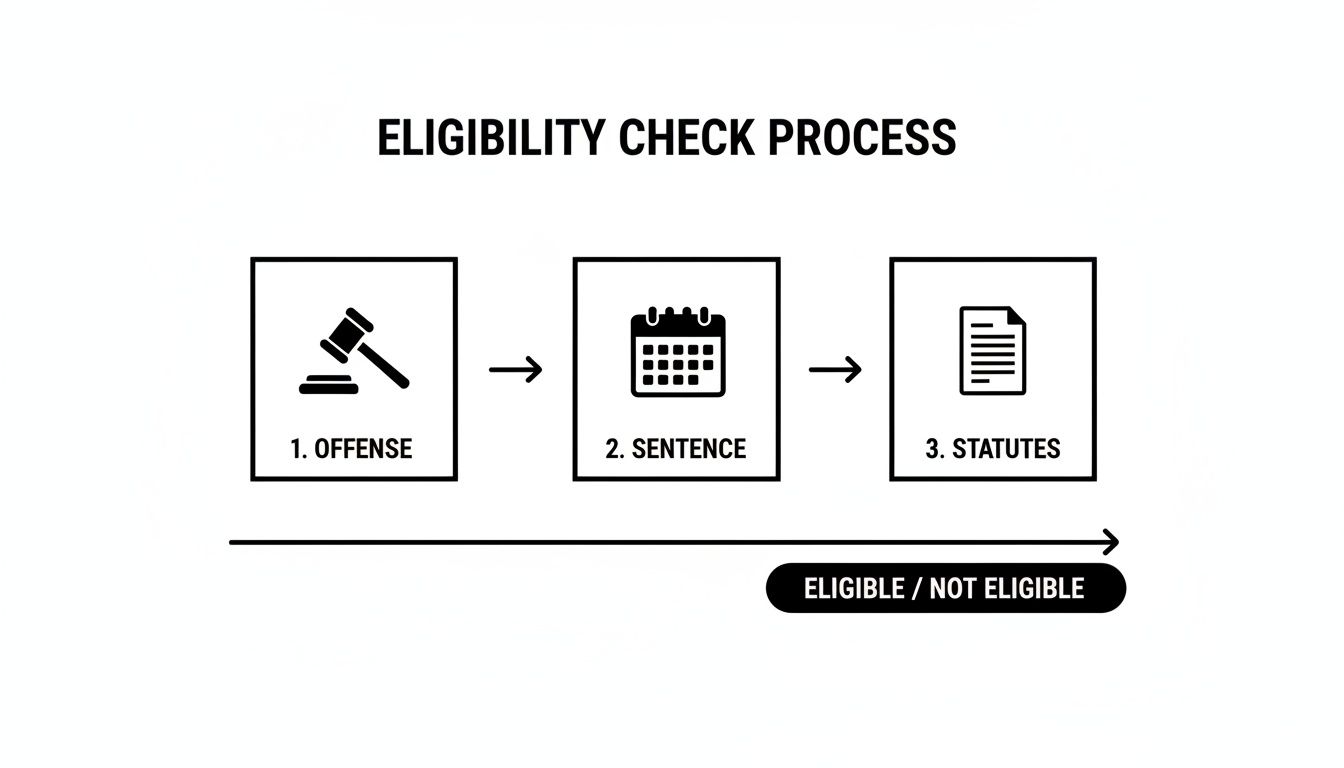
As you can see, the original offense, the sentence received, and Georgia’s specific laws all have to line up perfectly before moving forward.
Gathering Your Essential Documents
Before filing anything, it's necessary to pull together documents. Think of it as building a case file. The most important piece is a certified disposition from the clerk of court in the county where the case was handled—whether that’s in Cumming, Alpharetta, Marietta, or somewhere else.
A "certified" copy is non-negotiable. It means the document has an official stamp or seal from the court, proving it’s a true and accurate copy from their records.
A checklist would look something like this:
- The GCIC Request Form: Filled out completely and accurately. No blank spaces.
- Certified Final Disposition: This is the court document showing exactly how the case concluded (e.g., dismissal, acquittal, or successful completion of a program).
- Your Criminal History Report: It’s always a good idea to pull a GCIC criminal history. This way, the information being submitted can be matched perfectly to what the state already has on file.
A common mistake is people assuming a printout from an online court portal will work. It won’t. Courts in Forsyth County and Cobb County require a physical, certified copy, which often means going in person or mailing a request to prove its authenticity.
The Correct Filing Sequence
This isn't a one-stop-shop process. Paperwork has to be submitted to different agencies in the right order. The sequence makes sense when you think about it: it starts with the agency that made the arrest, moves to the prosecutor, and finishes with the court that handled the case.
1. The Arresting Law Enforcement Agency
The first stop is the police department or sheriff’s office that made the arrest. They’ll review Part 1 of the request form along with the case disposition to confirm the basic facts. If they agree the record is eligible, they’ll forward the entire packet to the prosecutor.
2. The Prosecutor's Office
Next, the prosecutor who handled the case—like the District Attorney or Solicitor-General—gets the packet. They examine the legal reasons for the restriction, which are detailed in Part 2 of the form. If they sign off on it, the paperwork is ready for the final step.
3. The Clerk of Court
Once both the arresting agency and the prosecutor have given their approval, the applicant files the application with the clerk of court. The clerk then presents it to a judge for a final signature on a court order. That order is what makes the restriction official.
Avoiding Common Filing Pitfalls
So many people get tripped up by simple procedural errors that cause major delays. Missing just one piece of information can get an application kicked back, forcing the process to start all over.
To keep things on track, double-check these common problem areas:
- Incomplete Forms: Every single field on the GCIC form needs an answer. Blank spaces are a huge red flag for clerks and will almost certainly cause a rejection.
- Incorrect Case Information: Make sure the case numbers, dates, and charges on the form are an exact match to what’s on the certified disposition. Any discrepancy is a problem.
- Filing in the Wrong Order: Do not submit the paperwork directly to the court before getting signatures from the arresting agency and prosecutor. It’s an automatic rejection, every time.
Think of it like putting together furniture—if a step is skipped or the wrong screw is used, the whole thing falls apart. The same logic applies here. The sequence and accuracy of the paperwork are everything, and paying close attention to these details is the best way to get through the process without any headaches.
Understanding the Costs and Timelines

Let's talk about two of the biggest questions people have: "How much will this cost?" and "How long is this going to take?" It's crucial to set realistic expectations from the start. Getting a record restricted isn't free, and it definitely isn't fast. Knowing what to expect financially and time-wise helps in preparing for the road ahead without any unwelcome surprises.
The total cost isn't one single payment. Instead, think of it as a series of smaller fees that pop up at different stages of the process. When these are budgeted for, the whole thing feels a lot more manageable.
A Breakdown of Potential Expenses
Every case is unique, but the types of fees faced are pretty standard across the board. The exact dollar amounts can vary depending on where the filing takes place—what's paid in Cobb County might be a little different from Forsyth County, for example.
Here’s a look at the typical costs one can expect to run into:
- Court Filing Fees: This is paid to the clerk of court just to get a petition officially filed. It usually runs anywhere from $50 to over $200, depending on the county.
- Cost of Certified Records: Official, certified copies of the final disposition of the case are needed. These documents usually have a small fee, often around $10 to $25 each.
- Fingerprinting Fees: At certain points, a person might be required to get fingerprinted, which comes with a small administrative charge.
- Mailing and Notary Costs: These are minor expenses, but the cost of certified mail and getting documents notarized can add up, especially if anything has to be resubmitted.
How Long Does Record Restriction Really Take?
Patience is more than a virtue in this process; it's a necessity. This isn't something that gets resolved in a few weeks. A realistic timeline is several months, and if a case has any complexities, it could easily stretch out longer.
The timeline is completely at the mercy of multiple government agencies, and each one has its own backlog and internal procedures. A simple dismissed charge in a smaller jurisdiction like Milton or Johns Creek will likely move faster than a more involved case in a busy court system.
A key thing to remember is that every agency involved—from the arresting police department to the prosecutor's office and the GCIC—is on its own clock. A delay at any one of those steps will slow down the entire process.
To give a clearer picture, here’s what a hypothetical timeline for a straightforward case might look like:
- Arresting Agency Review: The police or sheriff's department can take 30-60 days to process their part.
- Prosecutor Review: From there, it goes to the solicitor or district attorney, which can add another 30-90 days.
- Court Processing: Once the petition is filed, it could take the court 60-120 days to get a judge to sign the final order.
- GCIC Update: After the judge signs off, the Georgia Crime Information Center can take another 30-60 days to officially update its system and restrict the record.
All told, the process can take a typical range of 4 to 10 months for a case that doesn't hit any snags.
The investment of time and money, however, can pay off in a big way. Research has consistently shown the powerful economic benefits of clearing a criminal record. One major study found that people who successfully got their records expunged saw their wages jump by an average of over 22% in just one year. It's a direct path to better opportunities and financial stability. You can learn more about these findings in the Harvard Law Review.
Common Hurdles and When to Call for Backup
On paper, the steps to get a record restricted can look pretty straightforward. In reality, the process is often peppered with unexpected roadblocks. Many people start out feeling confident, only to get bogged down by a procedural snag or a sudden objection from the other side.
Knowing these common hurdles from the get-go can help in deciding if this is a path that can be walked alone or if an experienced guide is needed to see it through.
Navigating an Objection from the Prosecutor
One of the most common—and frankly, discouraging—obstacles is an objection from the prosecutor’s office. Even if a person is sure they meet every single eligibility requirement for a record restriction, the solicitor or district attorney in counties like Cobb or Forsyth still has the right to review the case and object.
Their objection doesn't automatically mean it's over, but it does mean a court hearing is likely needed to argue the case before a judge. Prosecutors might object for a number of reasons:
- They feel the original charge was just too serious.
- They believe restricting the record isn’t in the public's best interest.
- There's a disagreement over whether all sentencing requirements have been truly completed.
When this happens, what started as an administrative task instantly becomes a formal court hearing. A compelling, legally sound argument will need to be presented explaining why the benefits of restricting the record outweigh any of the prosecutor's concerns. This is often where the journey gets tough.
The Frustration of Old or Missing Records
Another frequent headache pops up with older cases, especially those from a decade or more ago. Court records in places like Roswell or Marietta weren't always digitized. Physical files get misplaced, archived incorrectly, or are just plain incomplete. It happens more than you'd think.
You can't move forward without a certified disposition—the official paper showing exactly how a case was resolved. This can turn into a frustrating scavenger hunt, trying to prove a case was dismissed when the documentation has vanished. Reconstructing a case file takes time, persistence, and a solid understanding of how the local court system archives its records.
A missing file isn't the end of the road, but it complicates things significantly. It often means filing a motion with the court to get a judge to officially acknowledge the case's outcome based on other available evidence—a legal process in and of itself.
The Higher Bar for Restricting Convictions
As we've touched on, getting an actual conviction restricted in Georgia is a whole different ballgame. It's much, much harder than sealing a non-conviction. The laws that allow for restricting certain misdemeanors or pardoned felonies are fairly new and come with a long list of exceptions and mandatory waiting periods.
For example, to restrict a misdemeanor conviction, it must be proven that a person has had a clean record for the last four years and that the original offense isn't on the list of excluded crimes. This requires a meticulous review of the entire criminal history and a precise interpretation of the law. It’s a high-stakes process where one small mistake can result in a denial.
Knowing When Professional Assistance May Be Needed
A simple restriction for a recently dismissed charge can be handled by an individual. But certain red flags might indicate it’s time to bring in a professional. Getting a record expunged is all about the details, and the more complex the situation, the more valuable an experienced attorney can be.
Consider getting help if any of these situations arise:
- The prosecutor objects to the petition. This immediately turns the case into an adversarial legal battle.
- The case involves old records that are hard to find. An attorney who works in the local courts knows who to call and how to track down those archived documents.
- The goal is to restrict a conviction. The legal standard is much higher, and the process is far more intricate.
- There are charges in multiple jurisdictions. With cases in both Forsyth and Cobb County, for instance, there are two different sets of court staff, procedures, and prosecutors to deal with.
- A sentence was given under a special statute like the First Offender Act. While this program makes a person eligible, the paperwork needs to correctly reflect that status to avoid any hang-ups.
Deciding to hire an attorney is a big step. It’s about more than just paperwork; it’s about finding someone who understands the local court systems in places like Cumming and Alpharetta and knows the legal arguments that work with local judges and prosecutors. For more on this, our guide on how to choose a criminal lawyer offers valuable insight.
Ultimately, investing in professional help can be the difference between a fresh start and a frustrating dead end.
Common Questions About Getting a Record Restricted in Georgia
The whole process of getting a record restricted—what many people still call "expunged"—can be confusing. Many questions arise from folks all over North Georgia, from Cumming and Alpharetta to Marietta. Let's clear up some of the most common ones.
Is Record Restriction the Same as Expungement?
Pretty much, yes. In Georgia, the legal term was officially switched from "expungement" to "record restriction" back in 2013. While the old term is still thrown around, they both point to the same goal: sealing a past criminal charge from public view.
The main difference is what actually happens to the file. Expungement sometimes sounds like the record is physically destroyed, which isn't the case here. Record restriction just limits who can see it. It won't pop up on a standard background check for an apartment or a job, but law enforcement and certain government agencies can still access it for sensitive screenings.
Can You Restrict a Felony Conviction in Georgia?
This is a tough one. The short answer is that it's very difficult and uncommon. The vast majority of felony convictions simply don't qualify for restriction in Georgia.
There are, however, a couple of narrow paths. The most well-known route is for people who were sentenced under the First Offender Act. If a person completes every single term of their sentence perfectly, their conviction can be sealed.
A law passed in 2021 opened another small window, allowing certain non-violent felonies to be restricted, but there's a huge catch: a pardon must be obtained first. Even after a pardon, there is still a specific waiting period. It's a complicated, multi-step process with very strict rules.
How Long Does This Whole Process Take?
It really depends. The timeline for getting a record restricted can be all over the place, based on the specific case and the county involved. A simple case, like a dismissed charge in Forsyth County where everyone is on board, might take anywhere from three to six months.
What really slows things down is the backlog at each government office. The arresting police department, the prosecutor's office, and the Clerk of Court all have their own piles of paperwork, and a delay at any one of those stops can add weeks or months to the wait.
If things get complicated—say, the prosecutor objects or a full court hearing is needed to make the case—it could easily drag on for a year or even longer.
Will I Have to Go to Court?
Not always. For a lot of cases involving charges that didn't lead to a conviction (like dismissals or acquittals), it's mostly an administrative process. If both the arresting agency and the prosecutor agree to the restriction, the paperwork is filed, they sign off, and a judge makes it official without the need to step into a courtroom.
However, a person will almost definitely need to show up for a hearing if:
- The prosecutor objects to the request.
- The request is to ask the court to restrict an eligible conviction under one of the few exceptions in the law.
- The old court records are missing or unclear, and a judge is needed to issue an order to clean things up before proceeding.
In those situations, a hearing is where evidence is presented and legal arguments are made to convince the judge that restricting the record is the right move under Georgia law.
Will a Restricted Record Show Up on a Background Check?
For the most part, no. Once a record is restricted, it will not appear on the kind of background checks run by private companies for jobs, housing, or school admissions. That's the whole point—to remove that barrier from a person's life.
But it’s important to remember the record isn’t vaporized. It's still there, and it remains fully visible to law enforcement agencies and for certain high-level security clearances. When applying for a job as a police officer, with the military, or for a government position that requires a deep background investigation, they will see it. For everyday civilian life, though, a clean slate is achieved.
Navigating the maze of record restriction can feel like a full-time job, especially if a snag is hit. If a case isn't straightforward or an individual just wants the peace of mind that comes with knowing it’s done right, having an experienced lawyer in their corner can be invaluable. For help with a specific situation in Forsyth County, Cobb County, or anywhere nearby, reach out to Brian Hansford Law at https://challengemycharge.com.
