
When people in Georgia talk about "getting records expunged," they're usually referring to a process officially called record restriction. It's a crucial distinction. While a criminal record isn't completely destroyed, its access is so severely limited that it's hidden from public view for things like job or housing applications.
Understanding this difference is the first step toward exploring a fresh start.
What Record Restriction Really Means in Georgia
The idea of expungement often brings to mind a record being totally wiped clean, as if it never happened. Some states do it that way, but Georgia has its own specific approach. Here, the correct term is record restriction.
Instead of destroying the file, record restriction acts more like sealing it. The information is removed from public databases. This means a standard background check run by a potential employer, landlord, or university will almost always come back clean. For most people, that’s the entire goal.
However, the record itself isn't gone forever. It remains accessible to certain parties under specific circumstances.
Who Can Still See a Restricted Record?
Even after a record is restricted, it stays visible to law enforcement and other criminal justice agencies. It can also be accessed during screening for certain sensitive jobs, like those involving work with children, the elderly, or in law enforcement fields.
Think of it this way: a restricted record gets moved from a public library shelf into a secure, private archive. The general public can no longer check it out, but authorized personnel with the right clearance can still pull the file if they have a legitimate reason.
Knowing this sets realistic expectations for the process. If you want to dive deeper into the nuances, we've outlined the difference between expunged and sealed records in another guide. The outcome can be powerful, unlocking opportunities that were previously closed off.
A criminal record can feel like a permanent roadblock, but record restriction offers a pathway to move forward. It's about ensuring past mistakes don't perpetually define your future access to employment, housing, and personal growth.
The Real-World Impact of Record Restriction
The benefits of successfully restricting a record can be life-changing. It directly tackles the hurdles many people face when trying to get back on their feet.
For instance, a restricted record can lead to:
- Improved Job Prospects: Many employers automatically filter out candidates with a criminal record. Restriction removes that immediate barrier.
- Better Housing Opportunities: Landlords almost always run background checks. A clean report can be the deciding factor in getting a lease.
- Access to Education: Some college programs and financial aid applications ask about criminal history, and restriction can help clear the way.
- Personal Peace of Mind: Just knowing that a past mistake won't constantly reappear is an immense relief that allows you to finally focus on the future.
This isn't a niche issue. With an estimated 74 million Americans carrying a criminal record, the need for effective second-chance laws is obvious. In response, more than two-thirds of U.S. states have passed laws to expand eligibility for clearing records, including some felony convictions. Understanding Georgia's specific approach is your first step on this important journey.
Could You Be Eligible for Record Restriction?
Figuring out if you can get your record restricted is the very first, and most important, step in this whole process. In Georgia, it's called "record restriction," and it's definitely not a simple rubber-stamp approval. Your eligibility boils down to the specific facts of your case and, most critically, how it all ended.
The good news? If your case ended without a conviction, you're in a very strong position. The law is designed to help people who got tangled up in the justice system but were never actually found guilty of a crime. That single distinction opens the door for a lot of folks who just want to move on.
Cases That Often Qualify for Restriction
If your brush with the law didn't end with a guilty plea or a guilty verdict, your path to a clean slate is usually pretty clear. These are some of the most common scenarios that are eligible for restriction.
A few examples include:
- Arrests Where Charges Were Never Filed: It happens. You get arrested, but the prosecutor looks at the file and decides not to formally press charges. The arrest record is still there, but since there's no case, it can almost always be restricted.
- Charges Dismissed by the Prosecutor: This is a big one. The prosecutor might drop the charges for any number of reasons and file what's called a "nolle prosequi"—a formal notice that they're walking away from the case.
- You Were Found "Not Guilty": If your case went all the way to a trial and a judge or jury acquitted you, the records tied to that arrest are eligible for restriction.
- You Finished a Diversion Program: Many counties, including Forsyth and Cobb, have pretrial diversion programs. You complete the requirements—maybe some classes or community service—and in exchange, the prosecutor dismisses your charges.
Think about a college student in Alpharetta arrested for misdemeanor shoplifting. If they get into a diversion program, finish their classes, and pay back the store, the prosecutor dismisses the case. That arrest and the dismissed charge can then be restricted, keeping it off background checks for jobs and apartments.
The single most important factor is the final outcome of your case. A dismissal or an acquittal is fundamentally different from a conviction, and Georgia law creates a clear path for restriction in those situations.
What if the Case Was Dismissed?
A dismissal is a fantastic outcome, but why it was dismissed can matter. If the charges were dropped because a key witness didn't show up or crucial evidence was thrown out, your path to restriction is usually wide open. It means the prosecution simply couldn't make its case against you.
And here’s another piece of good news: for most of these non-conviction scenarios, there's no waiting period. You can start the process to restrict the record as soon as the case is officially closed.
The Role of Georgia's "Second Chance Act"
Things really changed when Georgia's "Second Chance Act" (SB 288) became law in 2021. Before this, you could pretty much only restrict records for cases that didn't end in a conviction. Now, the law has expanded to include certain misdemeanor convictions after a waiting period.
This was a massive shift, giving a fresh start to people held back by a minor mistake from their past. Under the new law, you might be able to get a misdemeanor conviction restricted if you meet these three conditions:
- It's been at least four years since you completed your entire sentence (that includes finishing any probation).
- You haven't had any new convictions during that four-year window.
- You don't have any criminal charges pending against you right now.
This law helps people who have clearly turned their lives around finally put an old conviction behind them. If you want to dive deeper into the specifics, you can find more detail on how to expunge a misdemeanor in Georgia. Just keep in mind that not every misdemeanor is eligible—serious traffic offenses like DUI, for example, are specifically excluded from this law.
To help you see where you might stand, here’s a quick summary of common situations.
Common Scenarios for Record Restriction Eligibility in Georgia
This table breaks down some typical outcomes and whether they generally qualify for restriction. Remember, this is for informational purposes only—every case is unique.
| Scenario | General Eligibility Guideline (Informational Only) | Common Outcome |
|---|---|---|
| Arrested, No Charges Filed | Generally eligible right away. | Record of the arrest can be restricted. |
| Case Dismissed ("Nolle Prossequi") | Generally eligible right away. | Record of the arrest and dismissed charge can be restricted. |
| Acquitted at Trial (Not Guilty) | Generally eligible right away. | The entire record of the case can be restricted. |
| Completed a Diversion Program | Eligible once all program requirements are met and the case is dismissed. | Record of the arrest and dismissed charge can be restricted. |
| Eligible Misdemeanor Conviction | Must wait 4 years after sentence completion with no new arrests or pending charges. | The conviction record can be restricted from public view. |
| Ineligible Misdemeanor (e.g., DUI) | Not eligible for restriction under current law. | The conviction remains on your public criminal history. |
Navigating these rules is the foundation of the whole process. By taking a hard look at how your case was resolved and understanding which laws apply, you can get a clear picture of whether record restriction is a realistic option for you.
How the Record Restriction Process Unfolds
So, you think your situation qualifies for record restriction. What happens next? Getting a record sealed isn't just a single action; it's a sequence of steps that involves several different agencies, each with a specific job to do. Think of it as a procedural journey that demands real attention to detail from the very beginning to the final signature.
Surprisingly, the whole process kicks off not at the courthouse, but with the very law enforcement agency that arrested you in the first place. This is where the official paperwork trail starts.
This visual guide breaks down the common paths to getting your record restricted, showing how cases that end in a dismissal, a completed diversion program, or an acquittal are often eligible.
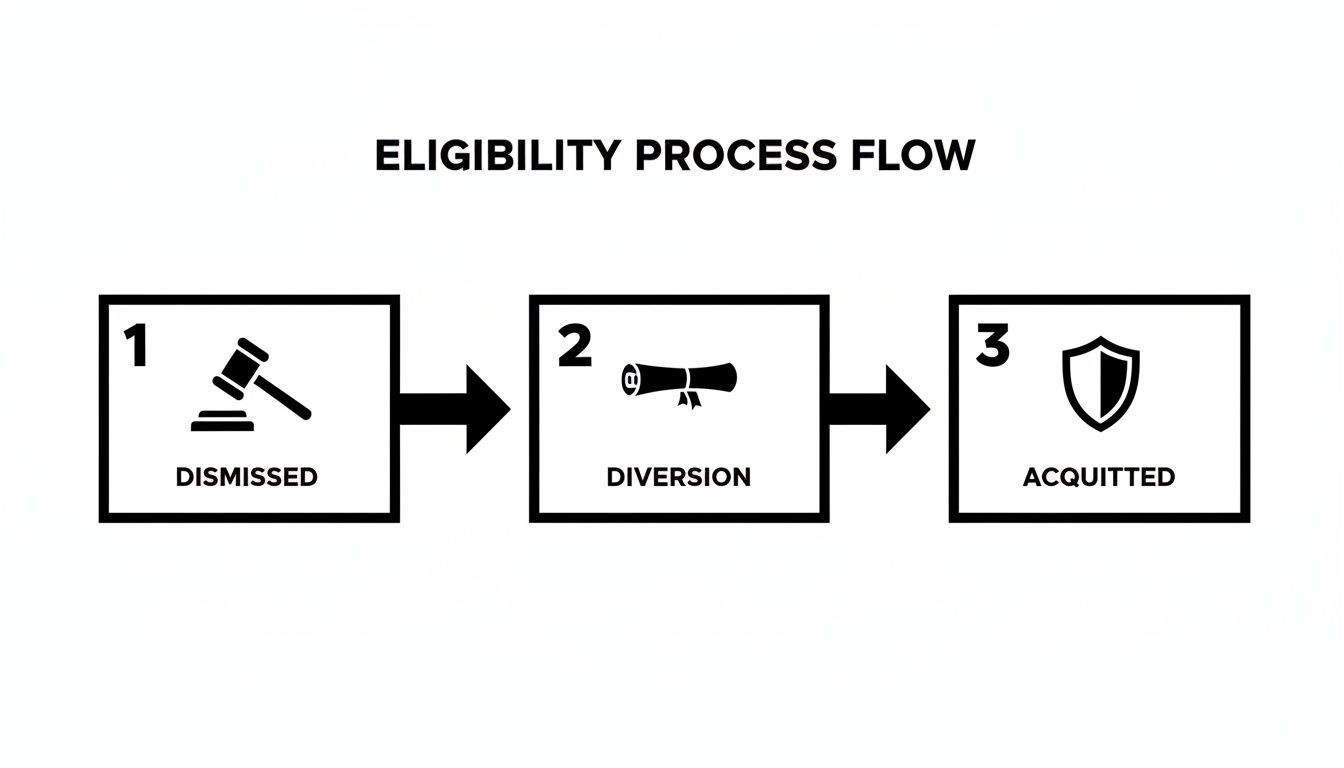
As the chart shows, the most direct routes to restriction are for cases that never led to a conviction.
Initiating the Request with Law Enforcement
Your first move is to get in touch with the arresting agency. This could be the Roswell Police Department, the Cobb County Sheriff's Office, or another local department. You'll need to fill out a "Request to Restrict Arrest Record" form—this document is what officially gets the ball rolling.
On this form, you’ll provide your personal details and information about the specific arrest you want restricted. The agency will then pull its own records to confirm the details. Their job is to complete their portion of the form, verifying the arrest data and the final outcome of the charges. Once they’re done, they forward your application to the prosecutor's office that handled your case.
The Prosecutor's Crucial Review
The prosecutor's office is a critical checkpoint. It's their responsibility to review the case file and the information sent over by the arresting agency to confirm that your charges are, in fact, eligible for restriction under Georgia law.
They are looking to verify outcomes like:
- The case was dismissed (nolle prosequi).
- You successfully finished a pretrial diversion program.
- Charges were never formally filed after your arrest.
- You were found not guilty (acquitted) at trial.
If the prosecutor agrees that your record qualifies based on the case's final disposition, they will approve and sign their section of the form. This approval is absolutely essential. Without it, the process pretty much stops in its tracks. Their signature is the green light that confirms the basis for your request and allows it to move forward.
Finalizing the Process with the Court
With the prosecutor’s signature in hand, the completed application is usually filed with the Clerk of Court in the county where the charges were originally brought—places like Forsyth County Superior Court or Johns Creek Municipal Court. This is the last stop, where a judge gives the final, official approval.
The judge reviews the application, makes sure all the procedural steps were followed correctly, and confirms the prosecutor has verified your eligibility. If everything is in order, the judge will sign a court order to restrict your record. This signed order is the ultimate goal.
A common point of confusion is thinking the process is finished once the prosecutor agrees. The court order is the binding document that officially restricts your record; it's the final and most important piece of the puzzle.
Once the order is signed, the Clerk of Court sends it to the Georgia Crime Information Center (GCIC). The GCIC is the state's central hub for criminal history information. When they receive the court order, they update their database to restrict your record from public view, which effectively completes the process. You can learn more about what this means by exploring how to get your arrest record expunged.
While this is the standard process here in Georgia, it's worth noting that technology is starting to change how expungement is handled across the country. Pennsylvania’s "Clean Slate" law in 2018 was a pioneer, introducing automation to the process. This reform has inspired other states like Utah and Michigan to follow suit. The trend is accelerating, with new AI-powered tools now able to scan complex criminal records, flag eligible charges, and make sense of it all in seconds. For more on this national trend, research from Prisonology offers some great insights.
A Local Look at North Georgia Procedures
While Georgia law creates a single set of rules for record restriction, how that process plays out on the ground can feel wildly different from one county to the next. The journey to clear a record in a busy metro courthouse like Marietta's often involves different people and procedures than in a suburban city like Milton.
Each county, and even each city, has its own way of doing things. The big-picture requirements are the same everywhere, but the day-to-day administrative details—who you talk to, which specific form you use, and how long it takes—are all local. Getting a handle on these variations is the key to avoiding unnecessary delays.
Navigating County-Specific Processes
From Forsyth County to Cobb County, the core eligibility for getting a record restricted doesn't change. What does change is the practical side of it. One Clerk of Court might have everything online, while another still wants you to walk in with paper copies.
For instance, the person you need to speak with at the Alpharetta Police Department to start the process might be in a completely different division than their counterpart at the Forsyth County Sheriff's Office. These aren't huge roadblocks, but they are practical hurdles that will trip you up if you aren't prepared.
Here’s what some sources say about some key North Georgia areas:
- Forsyth County (Cumming): For felony and most state-level misdemeanor cases, everything runs through the Forsyth County Clerk of Superior Court. You have to know their specific filing rules, including any local forms they require or fee schedules they follow.
- Cobb County (Marietta, East Cobb): Cobb is a big county, so its court system is more specialized. You'll likely deal with the Solicitor General's Office for misdemeanors and the District Attorney's Office for felonies. Each office has its own internal review process and timeline.
- North Fulton County (Alpharetta, Johns Creek, Milton, Roswell): These cities have their own municipal courts, but only for things like traffic tickets and city ordinance violations. If the charge was a more serious state misdemeanor or a felony, your case is handled at the Fulton County level. This means you could be dealing with multiple jurisdictions for a single arrest.
A common mistake people encounter is getting stuck because they don't know which government office handles which step. For example, if you were arrested by the Roswell Police Department for a state drug charge, your case file is with the Fulton County prosecutor and courts, not the City of Roswell's municipal system.
Who to Contact and Where to Go
Knowing the right door to knock on can save weeks of frustration. While every case is unique, here are the three main players you'll interact with in almost any county:
- The Arresting Law Enforcement Agency: Your first stop is always the agency that made the arrest. Whether it was the Cumming Police Department or the Cobb County Sheriff's Office, you'll need their records division to kick off the "Request to Restrict Arrest Record" process.
- The Prosecutor's Office: This is the gatekeeper. For misdemeanors, it's usually the Solicitor General; for felonies, it's the District Attorney. They have to review your history, confirm your eligibility, and sign off on your request before a judge will even look at it.
- The Clerk of Court: Once the prosecutor approves, you file the completed application with the Clerk of Court. They are the official record-keepers for the court system. After a judge signs the final order, the Clerk is responsible for sending it to the Georgia Crime Information Center (GCIC) to have your record officially restricted.
Each of these offices in Marietta, Alpharetta, or Cumming has its own staff and internal procedures. Before you drive over there, it’s always a good idea to check their official website or just call ahead. Confirm their hours, ask exactly which forms you need, and verify any filing fees. A five-minute phone call can save you from making a wasted trip and keep your case moving forward.
Getting Clear on Costs and Sidestepping Common Pitfalls

Before you even start, it’s smart to get a handle on the potential costs and the common tripwires that can slow this whole process down. Yes, getting a record restricted is a huge win, but there are some financial and procedural hoops you have to jump through first. Knowing what they are ahead of time makes everything a lot less stressful.
When it comes to the money side of things, it’s not just one big fee. Think of it as a series of smaller costs that add up along the way. These can swing quite a bit depending on which county you're in and how messy your case is, but knowing the basics will help you budget realistically.
A Breakdown of the Fees You Can Expect
As you get the ball rolling, plan on facing a few different kinds of fees. Some are pretty small, but others can be more significant.
- Court Filing Fees: Pretty much every court, whether you're in Forsyth County or Cobb County, is going to charge you to file the petition for record restriction. This is just an administrative fee to get your case opened and into their system.
- Background Check Costs: The prosecutor and the court need to see your full criminal history before they sign off on anything. This means you’ll likely have to pay for an official background check from the Georgia Crime Information Center (GCIC) or a similar approved source.
- Administrative Charges: It's also common for law enforcement agencies to charge a small fee just to process your initial "Request to Restrict Arrest Record" form.
It’s important to remember these aren't fines—they're standard fees that cover the paperwork and legwork required by the government offices handling your request.
Based on reports, one of the biggest frustrations people face is an unexpected delay. More often than not, these delays come from simple, avoidable errors on the paperwork or a missed deadline. Being obsessive about the details from day one is your best defense against getting your case stuck in bureaucratic limbo.
Common Mistakes That Can Derail Your Case
The process is definitely manageable, but some otherwise solid requests get knocked off track by a few common missteps. Knowing what these are is half the battle.
Submitting incomplete or just plain wrong forms is probably the number one mistake people make. A single missing date of birth, a typo in a case number, or a forgotten signature can be enough for the clerk's office to reject your entire application. When that happens, you’re back to square one. This is especially true in busy courts like those in Marietta or Alpharetta, where clerks have zero time for sloppy paperwork.
Another classic error is failing to follow up. Once you file your documents, they get passed from one office to another—from the arresting agency to the prosecutor’s office and finally to the court. You have to be your own advocate. It’s crucial to track where your application is and to check in if you haven't heard anything back in a reasonable amount of time.
Finally, a critical mistake is not understanding the specific local rules. As we’ve talked about, the way things are done in Roswell's municipal court can be completely different from the superior court in Forsyth County. If you don't know those local quirks, you could end up filing in the wrong place or missing a county-specific form, which just leads to more delays and frustration. Keeping these issues on your radar will put you in a much better position for a successful outcome.
Your Top Questions About Record Restriction
When you're looking to put a past mistake behind you, navigating Georgia's record restriction process can feel a little overwhelming. It's a system with its own language and rules, so it's only natural to have a lot of questions.
Let's cut through the confusion and get straight to the answers you're looking for.
What’s the Difference Between Record Restriction and Expungement in Georgia?
This is easily one of the most common points of confusion. In Georgia, we don’t use the term “expungement” anymore; the correct term is record restriction.
While other states might use "expungement" to mean a record is physically destroyed, Georgia’s process is more like sealing it. Think of it this way: your record isn't deleted, but it is hidden from the public's view, which includes most employers, landlords, and anyone running a standard background check.
How Long Does the Record Restriction Process Take?
There’s no single, simple answer here—the timeline really depends on the county you're dealing with, how complex your case is, and any backlogs the court or prosecutor's office might have. Timelines can vary widely.
Generally, you should prepare for a process that takes several months from the day you file the paperwork to the moment you have a final court order in your hand. If the prosecutor needs extra time for review or if a court hearing is required, that can definitely extend the wait. Patience is key.
The goal of a restricted record isn’t to pretend something never happened. It's about removing real-world barriers so you can secure a good job, find safe housing, and move forward with your life without a past mistake holding you back.
Does a Restricted Record Disappear Completely?
No, it doesn't vanish into thin air. While the record becomes invisible to the general public, it still exists and can be accessed by law enforcement and certain government agencies for specific purposes.
For example, it might be visible during background checks for jobs requiring a high-level security clearance or for certain professional licenses. But for the vast majority of everyday situations, it’s out of sight, out of mind.
Can I File for Record Restriction Myself?
Yes, you absolutely can handle the process on your own. There’s no requirement to hire a third-party service.
However, the paperwork can be tricky, and the specific procedures can change from one county to the next. From Cobb County to Forsyth County, each courthouse has its own way of doing things. Making sure you're truly eligible, filling out every form perfectly, and hitting every deadline is crucial. One small mistake can get your entire petition thrown out.
If you're dealing with the justice system in Alpharetta, Cumming, Marietta, or anywhere in the surrounding counties, you don't have to figure it all out alone. The team at Brian Hansford Law has seen it all and knows how to navigate the system. Contact us for a consultation and we can talk through your specific options.
