
It all starts with a simple, split-second decision: to stay or to go. A hit and run charge isn't about who caused the crash—it’s about what happened immediately after. The choice to leave the scene of an accident without stopping to exchange information or help someone who's hurt is where the trouble begins. That single act can have serious consequences, from a misdemeanor all the way up to a felony, depending on what happened in the crash.
What Happens When a Driver Leaves the Scene
You hear the crunch of metal, the screech of tires. Before you can even get your bearings, the other car is just a set of taillights fading into the distance. That's the textbook definition of a hit and run in Georgia. It’s a jarring and frustrating experience, but the law is crystal clear about a driver’s duties in that moment.
Under Georgia law, every driver involved in a collision has a strict set of responsibilities. In those first critical seconds, the law isn't focused on fault. Its only goal is to ensure everyone is safe, accountable, and gets medical help if they need it. Following these rules isn’t optional; it’s mandatory.
A Driver’s Core Obligations
The duties after an accident are straightforward and designed to keep a bad situation from getting much, much worse. They’re what stand between a minor fender-bender and a serious criminal charge.
Here’s the breakdown of what the law requires:
- Immediately Stop: A driver has to stop their vehicle as close to the scene as they safely can, without blocking more traffic than necessary.
- Render Aid: Drivers are required to provide reasonable help to anyone who is injured. That could mean calling 911 or, if it's necessary and safe, helping get them to a doctor.
- Exchange Information: A driver must give their name, address, and vehicle registration number to the other driver, anyone who was injured, or the police on the scene.
This flowchart lays out exactly what is involved to stay on the right side of the law.
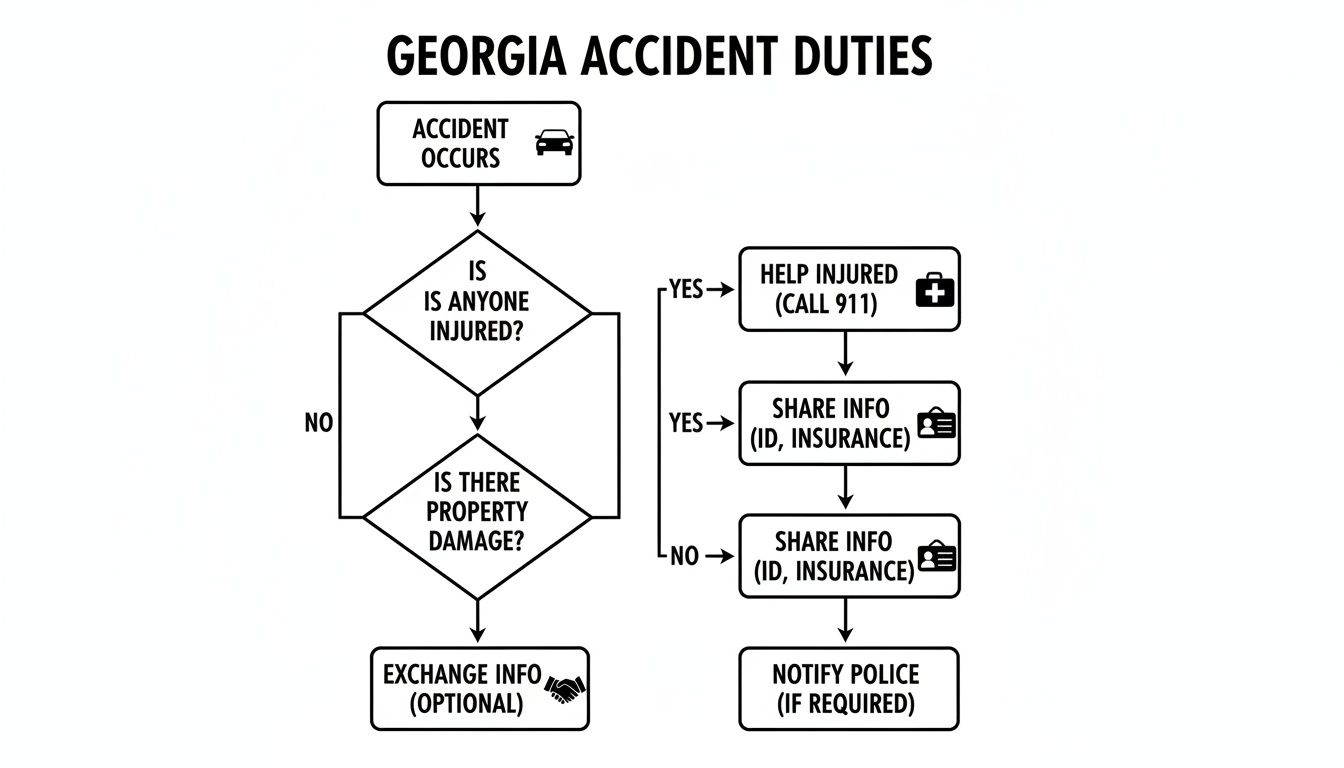
As you can see, the path changes slightly depending on whether someone was hurt or if there was only property damage. But no matter what, the core duties to stop and share information never change.
The law sets out clear, non-negotiable duties for any driver involved in a collision. Fulfilling these obligations is the key to avoiding a hit and run charge. The table below simplifies these core responsibilities.
Key Responsibilities After an Accident in Georgia
| Required Action | What This Involves | Why It's Legally Required |
|---|---|---|
| Stop Immediately | Pulling over as close to the scene as safely possible without unnecessarily blocking traffic. | To assess the situation, prevent further accidents, and begin fulfilling other duties. |
| Render Aid | Providing reasonable assistance to anyone injured, which often means calling 911 for an ambulance. | Georgia law prioritizes human safety and requires drivers to help those who may be in medical distress. |
| Exchange Information | Giving your name, address, and vehicle registration to the other party or the police. | This ensures accountability and allows all parties to handle insurance claims and other matters. |
| Notify Police | Calling law enforcement if there is an injury, death, or apparent property damage of $500 or more. | Creates an official record of the accident and ensures proper procedures are followed. |
Ignoring these steps is what elevates a simple car accident into a criminal offense.
The Consequences of Failing to Act
When a driver makes the choice to flee, they’ve committed a hit and run. How serious the hit and run charges will be depends entirely on the outcome of that accident.
A crash that only damages an empty, parked car is a world away from one that leaves someone with a serious injury. The first is usually a misdemeanor, but the second can quickly become a felony with life-changing penalties.
This distinction is critical. The law scales the punishment to match the level of harm, which is why the duty to stay and help is so heavily enforced. Understanding these fundamental obligations is the first step to understanding the full weight of Georgia’s hit and run laws.
Understanding Georgia's Hit and Run Laws
To really get a handle on the seriousness of a hit and run charge, you have to look at the laws that spell out exactly what a driver must do after a crash. Georgia's statutes aren't just a random list of rules; they're a framework built to keep people safe and hold drivers accountable. These specific duties are laid out in the Official Code of Georgia Annotated (O.C.G.A.).
The idea behind these laws is straightforward: if you're in a collision, you can't just drive away. There is an immediate responsibility to stop, check on everyone involved, and exchange information. The whole point is to keep a traffic accident from turning into a tragedy because someone was left without help.
A Driver's Duty: What the Law Demands
Georgia law sets up a clear hierarchy of responsibilities that changes based on how bad the accident is. Think of it like a ladder—the more serious the potential harm, the more the law demands. A minor fender-bender with an empty, parked car is on a much lower rung than a crash that leaves someone with a serious injury.
This distinction is the single most important part of Georgia’s hit and run laws. The entire framework pivots on one question: Was anyone hurt? The answer determines whether a person faces a misdemeanor or a felony that could change their life forever.
This tiered system ensures the response fits the crime. The law’s main goal is to make sure drivers give immediate help to anyone who needs it, which is why crashes involving injuries are treated so seriously.
Property Damage vs. Personal Injury: A Critical Distinction
The law draws a very sharp line between accidents that only damage property and those that injure or kill someone. This isn't just a technicality; it’s based on the fundamental priority of protecting human life.
- Hitting Unattended Property: If you hit an empty vehicle or something like a fence or mailbox, O.C.G.A. § 40-6-271 says the driver has to find the owner or leave a note with their name, address, and vehicle registration number.
- Hitting Attended Property (No Injuries): If you hit another car with people in it but nobody is hurt, O.C.G.A. § 40-6-270 requires the driver to stop and exchange information with the other driver.
- Accidents Involving Injury or Death: This is the most serious category. Under the same law, if anyone is injured or killed, the driver must stop, provide "reasonable assistance" (like calling 911), and report the crash immediately by the "quickest means of communication."
This structure creates an obvious escalation. A driver who bumps a parked car and leaves a note has done their duty. But a driver who speeds off after causing an injury has ignored their most critical obligation.
The law is designed to create a safety net. Its purpose is to ensure that no injured person is ever left abandoned at an accident scene, waiting for help that might not arrive because the other driver chose to flee.
Ignoring these statutes is what leads to a hit and run charge. The severity of that charge is tied directly to which of these duties were brushed aside and what happened as a result of the collision.
Hit and run cases have become a major focus for law enforcement nationwide. In the United States, these incidents are a significant cause of traffic injuries and deaths. In fact, some studies show that hit and run crashes account for roughly 14% of all collisions that result in injuries or fatalities, making enforcement a top priority. You can dig into the latest NHTSA data to see the national trends for yourself. This context shows exactly why Georgia’s laws are written to demand accountability from every single driver.
Not every hit and run is treated the same under Georgia law. The courts draw a very clear line between an accident that only involves property damage and one where a person gets hurt. This single fact is what separates a misdemeanor charge from a much more serious felony, and the consequences couldn't be more different.
It’s crucial to understand this distinction. Think of it this way: scraping a parked car and driving off is one thing, but leaving the scene after someone has been injured is abandoning them when they critically need help. The law views these situations with completely different levels of severity, and the penalties reflect that.
When a Hit and Run is a Misdemeanor
A hit and run is charged as a misdemeanor when the only outcome is property damage. This covers any accident where no one was physically injured.
Let's imagine a common scenario. A driver in an Alpharetta parking garage misjudges a turn and scrapes the side of an empty SUV. They panic and leave without leaving a note. Because only a vehicle was damaged, this would be considered a misdemeanor hit and run.
The same goes for someone in Roswell who clips a mailbox or backs into a residential fence and fails to find the owner. As long as no person is hurt, the charges will almost certainly be at the misdemeanor level.
The heart of a misdemeanor charge is failing to take responsibility for damaging someone else's property. It's still a serious offense, but the law treats it far differently than an act that puts a person's life or health at risk.
The Line That Elevates Charges to a Felony
Things change dramatically the instant someone is injured. A hit and run becomes a felony in Georgia if the driver flees an accident that caused "serious physical injury" or death. These are the most severe hit and run cases, and the penalties are designed to match.
Consider this situation: a driver is speeding down a main road in Forsyth County and causes a chain-reaction collision. The driver in the car they hit suffers a broken arm and a concussion. If the at-fault driver takes off without stopping to help or call 911, they’ve just crossed the line into felony territory.
Georgia law is structured to force drivers to stop and render aid. Leaving an injured person behind is seen as a profound disregard for human life. That’s why felony hit and run charges are among the most serious traffic offenses a person can face. The focus shifts from financial responsibility for property to the immediate, critical need to help an injured person.
To make the differences crystal clear, here’s a side-by-side comparison of how these charges break down.
Comparing Misdemeanor and Felony Hit and Run in Georgia
The table below breaks down the key differences between misdemeanor and felony hit and run charges in Georgia. As you can see, the triggering event—property damage versus physical injury—radically alters the potential consequences.
| Factor | Misdemeanor (Property Damage Only) | Felony (Injury or Death) |
|---|---|---|
| Triggering Event | Leaving the scene of an accident that caused damage to property (attended or unattended). | Fleeing an accident that resulted in serious physical injury or death to another person. |
| Typical Fines | Up to $1,000. | Up to $10,000 or more, depending on the specifics of the case. |
| Potential Jail Time | Up to 12 months in county jail. | A mandatory minimum of 1 year and up to 15 years in state prison, per incident. |
| License Impact | Points on your license and a potential suspension. | Long-term license revocation, often for several years. |
| Criminal Record | A permanent misdemeanor conviction. | A permanent felony conviction, impacting rights like voting and firearm ownership. |
This table makes it plain how quickly the stakes are raised. A split-second decision to leave a scene where someone is hurt can lead to consequences that follow a person for a lifetime, impacting their freedom, finances, and future.
The Investigation and Prosecution Process
So, what happens after someone calls 911 to report a hit and run? That initial call is just the first step in a complex process where law enforcement tries to piece together exactly what happened and who was behind the wheel. An act that feels anonymous in the moment can quickly unravel into a full-blown investigation.
The process kicks off the second officers arrive on the scene. They aren’t just there to take a report; they're starting a forensic puzzle. Every detail, no matter how small it seems, becomes a potential clue pointing back to a specific vehicle and driver.

Building a Case from the Ground Up
Investigators in places like Cobb County or Johns Creek have a methodical way of tracking down a driver who has fled. It all boils down to a combination of old-fashioned detective work and modern technology, blending physical evidence with witness testimony.
First, they have to secure every piece of physical evidence they can find. This often includes:
- Paint Chips: It's amazing what a tiny flake of paint can reveal. Modern forensic labs can often match it back to the exact make, model, and year of a car.
- Vehicle Debris: A shattered piece of a headlight, a broken mirror, or a fragment from the grille acts like a vehicle's fingerprint, offering direct clues.
- Tire Tracks: The tread patterns left behind can tell a story about the type of tires and, sometimes, the vehicle that was wearing them.
Of course, physical evidence is only part of the story. Eyewitnesses are often invaluable. A bystander who jotted down a partial license plate or can give a good description of the driver might provide the breakthrough police need.
The Role of Modern Technology
Technology has completely changed the game for solving hit and run cases. Investigators lean heavily on digital breadcrumbs to fill in the missing pieces.
Surveillance footage is often the key that unlocks the entire case. A single clear image from a traffic camera or a storefront security system can identify the vehicle, the license plate, and sometimes even the driver.
Police will canvas the area, asking for footage from gas stations, retail stores, and even residential doorbell cameras. This digital dragnet helps them track a vehicle's path before and after the collision, building a timeline and zeroing in on suspects. This is especially true in busier areas like Marietta and Roswell, where cameras are almost everywhere.
Once a suspect vehicle is identified, the investigation moves forward. Officers will run the tag, find the registered owner, and then pay them a visit to inspect the vehicle for damage that matches the accident scene.
From Investigation to Prosecution
When law enforcement feels they have enough evidence to confidently identify the driver, they turn the case over to the prosecutor's office. At this point, the focus shifts from finding a suspect to building a formal case against them.
The prosecutor will meticulously review everything the police gathered—witness statements, photos, forensic reports, and video footage. It's their job to decide if there's enough evidence to formally file hit and run charges and prove their case beyond a reasonable doubt.
If they decide to press charges, the case enters the court system. This kicks off a series of proceedings, starting with an arraignment where the charges are officially presented. Learning more about what happens at different stages of the process can provide a better handle on how it fits into the criminal justice system.
Ultimately, the strength of the prosecutor's case is a direct reflection of the quality of the police investigation. A case built on a blurry video and a vague witness description is a world away from one backed by DNA evidence, crystal-clear footage, and a perfect paint analysis. This entire sequence shows how a split-second decision on the road can escalate into a serious criminal matter.
Common Defenses and Mitigating Factors
Facing a hit and run charge can feel like the walls are closing in, but it's important to remember that these incidents are rarely black and white. A whole range of factors and legitimate arguments can—and should—play a huge role in how the case unfolds.
The entire foundation of a hit and run charge rests on the driver’s state of mind. For the prosecution to make its case stick, they generally have to prove the driver knew, or at least should have reasonably known, they were just in an accident. If the driver didn't know, it’s tough to argue they intentionally fled the scene.
Arguments Centered on Awareness and Intent
It might sound like a convenient excuse, but drivers can genuinely be unaware that a collision even happened. This is a legitimate defense in many real-world scenarios.
- Large Vehicle Scenarios: If someone is driving a big commercial truck or even a heavy-duty pickup, they might clip a much smaller car and honestly not feel a thing over the rumble of their own engine.
- Minor Contact: Think about a packed parking lot in Cumming or Alpharetta. A tiny scrape or bump can easily get lost in the noise and chaos, going completely unnoticed.
- Inclement Weather: Driving in heavy rain or dense fog? Visibility is shot, and senses are dulled. It's entirely plausible a driver wouldn't be aware of minor contact.
In situations like these, the argument is simple: a person can't be guilty of intentionally fleeing a scene they never knew existed.
The heart of a hit and run charge is the conscious choice to leave. If a driver was genuinely unaware an impact occurred, that fact challenges the very basis of the accusation.
Issues of Identification and Justification
Beyond a simple lack of awareness, other defenses can dismantle a hit and run case. Mistaken identity is a surprisingly common problem. The only evidence might be a grainy security video or a partial license plate number scribbled down by a witness in a panic.
There are also times when leaving the scene is actually justifiable. For instance, what if someone had to rush themselves or a passenger to the hospital for a medical emergency? Or maybe the accident happened in an unlit, unsafe area, and the driver drove to a nearby well-lit gas station to call the police. These aren’t acts of evasion; they’re reasonable responses to urgent circumstances. Understanding how a case might be dismissed often involves showing that a person's actions were driven by necessity, not a desire to escape.
The Role of Mitigating Factors
Mitigating factors aren't a "get out of jail free" card, but they provide critical context that can significantly influence the outcome, potentially leading to reduced charges or penalties. They help paint a fuller picture of an individual.
Common mitigating factors include:
- A Clean Driving Record: A long history as a safe, responsible driver shows the incident was an out-of-character mistake, not a pattern of behavior.
- Prompt Self-Reporting: If a person panicked and left but quickly had a change of heart and called the police to report what happened, it shows they’re trying to take responsibility.
- Full Cooperation: Being honest and cooperative with law enforcement from the start can also work in a person's favor.
Long-Term Consequences of a Conviction
A hit-and-run conviction isn't something you just pay a fine for and move on. It's the kind of charge that creates a ripple effect, touching almost every part of a person's life for years, long after the ink on the court order is dry. The penalties handed down by a judge are really just the opening act.
The immediate problem is the criminal record. A conviction, especially if it’s a felony, puts a permanent mark on a person's background that follows them everywhere. This isn't just a technicality—it has real-world consequences that can slam doors shut on future opportunities.

Financial and Professional Setbacks
One of the first and most painful hits is to the wallet. Car insurance premiums are likely to skyrocket. Insurers see a hit-and-run conviction and immediately label a person a high-risk driver, which means they’ll be paying thousands more over the next several years.
Beyond that, a person's career can take a serious blow. A lot of jobs are simply off-limits if there is a hit-and-run on the record, especially anything that involves driving a company vehicle, operating machinery, or holding a position of trust. It can stop a career dead in its tracks or even force someone to find a whole new line of work.
A conviction acts like a shadow, following you into every job interview and background check. A split-second bad decision on the road can end up defining your professional life for a decade or more.
The issue of hit and run charges is a serious component of road safety statistics. The National Safety Council reports tens of thousands of motor vehicle deaths each year in the U.S., with a significant number involving drivers who flee the scene. These incidents make it harder to ensure traffic safety and assist victims, particularly pedestrians and cyclists who are most vulnerable. Understanding these trends and statistics is important.
Everyday Life and Personal Freedom
The fallout doesn't stop with a bank account or a job. A criminal record can make it tough to find a place to live, since most landlords run background checks. It can also stand in the way of getting certain professional licenses or even being accepted into a college or graduate program.
For felony convictions, the stakes are even higher. A person could lose some of their most basic civil rights, like the right to vote or own a firearm. When all these limitations are added up, the effect can be incredibly isolating and frustrating.
Here’s a quick rundown of what a person could be facing:
- Employment Barriers: Disqualification from any job that requires a clean driving record or a clean background check is possible.
- Insurance Costs: Expect auto insurance rates to jump dramatically and stay high for years.
- Housing Difficulties: Landlords might deny a rental application because of a criminal record.
- Civil Liberties: A felony conviction could mean losing the right to vote or own a firearm.
While some convictions last a lifetime, Georgia law does offer ways to get certain records sealed or restricted. It is possible to look into how to expunge a misdemeanor, as that process can sometimes help ease these long-term burdens for offenses that qualify. Understanding just how long-lasting these impacts can be shows the true cost of leaving the scene of an accident.
Frequently Asked Questions About Hit and Run Charges
When dealing with the stress of a hit and run charge, it's natural to have questions. Let's clear up some of the most common ones.
What Should I Do If I Hit a Parked Car?
It happens to many people—a tight spot in a Milton or Marietta parking lot, and someone accidentally scrapes a parked car. The key is what happens next. Georgia law is very clear: you can't just drive away.
First, a person has to make a real effort to find the owner. If the owner can't be tracked down, a note must be left on the car in a place they can't miss, like under the windshield wiper. That note needs to have the person's name, address, and vehicle registration number. On top of that, there is a requirement to call the local police and report what happened right away.
How Long Do Authorities Have to File Charges?
The clock starts ticking for the prosecution the moment an incident occurs, but how long they have depends on the severity. This is called the statute of limitations.
- For a misdemeanor hit and run (usually just property damage), the state generally has two years to file charges.
- When it comes to a felony involving serious injury or death, the timeline is much longer—typically four years or more. This gives investigators the time they need to build a solid case.
Can I Be Charged If the Accident Wasn't My Fault?
Absolutely, and this is a point that trips up a lot of people. The duty to stop, help anyone who is injured, and exchange information applies to every single driver involved in an accident. It doesn’t matter who caused it.
The hit and run charge isn't about who was at fault for the crash; it's about the act of leaving. Even if the other driver was 100% to blame, there is still an obligation to stay at the scene.
Is Leaving the Scene the Same as a Hit and Run?
Yes, in Georgia, they're two sides of the same coin. "Leaving the scene of an accident" and "hit and run" are used interchangeably to describe the same offense: a driver failing to stop and do what the law requires after a collision.
The official Georgia code doesn’t use the term "hit and run." Instead, it lays out a driver's duties after an accident. If those duties are not followed to the letter, that person has committed what everyone commonly calls a hit and run. At its core, the crime is about failing to remain and take responsibility.
So, while the legal statutes use more formal phrasing, the practical meaning and the serious consequences are exactly the same.
Facing the criminal justice system alone can be overwhelming. For a case in Alpharetta, Roswell, or anywhere in the surrounding counties, you can contact Brian Hansford Law for a consultation at https://challengemycharge.com.
