
At its core, serving a subpoena is the official way of telling someone they need to show up in court or hand over specific documents for a legal case. Think of it less as a request and more as a legally binding command. This formal process keeps things fair and orderly, ensuring everyone involved knows what's expected of them.
Understanding the Fundamentals of Serving a Subpoena
Before getting into the nuts and bolts of how a subpoena is served, it’s helpful to understand why this formal process exists in the first place. It’s all part of something called "service of process," which is a foundation of fairness in the legal system. It's designed to make sure no one is surprised by a legal demand they never knew existed.
The whole point is to give official notice. This gives the person on the receiving end a real chance to respond, gather what’s needed, or even challenge the subpoena if they have grounds to do so. This is a key part of "due process" and prevents legal actions from happening in the shadows.
The Purpose of Formal Service
So, why all the formality? It really boils down to a few critical reasons:
- It creates an official record. When a subpoena is served correctly, it generates a formal document—usually called a "Proof of Service" or "Affidavit of Service"—that confirms exactly when, where, and how the recipient was notified.
- It upholds due process. This formal step guarantees that people have a fair opportunity to be heard or to prepare for what’s being asked of them, protecting their fundamental rights.
- It makes the subpoena enforceable. If a subpoena isn't served by the book, a court can throw it out and deem it invalid. Proper service is what gives the document its legal teeth.
This structured system is essential, especially given how many legal demands fly around every year. Subpoenas are a routine part of both criminal and civil cases. For example, large corporations often have entire systems just to handle these requests. In just the first half of one recent year, AT&T reported getting a staggering 93,864 subpoenas for customer data. When you add in other legal demands, that number shot up to 138,347. That's a massive volume, and it shows just how common this process is.
Key Terms in the Subpoena Process
To get a handle on this topic, it helps to know the lingo. Below is a quick cheat sheet with the most common terms you might encounter. Understanding these will make the rest of this guide easier to follow.
Key Terms in the Subpoena Process
| Term | Simple Explanation |
|---|---|
| Issuing Party | This is the attorney or court clerk who officially creates and signs the subpoena. |
| Process Server | The person who physically delivers the legal documents. It could be a sheriff's deputy or a private process server. |
| Recipient | The person or organization named in the subpoena who has to comply with the demand. |
| Proof of Service | A sworn statement signed by the process server that details when, where, and how the subpoena was delivered. |
For a deeper dive into the specific rules that apply in Georgia, be sure to check out our complete guide on Georgia's legal landscape. Having this background knowledge is a helpful first step to understanding the process.
Decoding the Methods of Subpoena Delivery
So, how does a subpoena actually get from the courthouse to the person it's intended for? This is a critical question, and there isn't just one answer. The right method depends on the situation, who is being served, and the specific rules of the court. The main goal is always the same, though: to deliver the notice in a way that can be proven in court later.
The system has specific, approved methods to make sure the delivery is official and undeniable, rather than just tossing an important legal document on a doorstep and hoping for the best.
This infographic breaks down the typical path a subpoena takes, from the moment it's created to the final step of compliance.
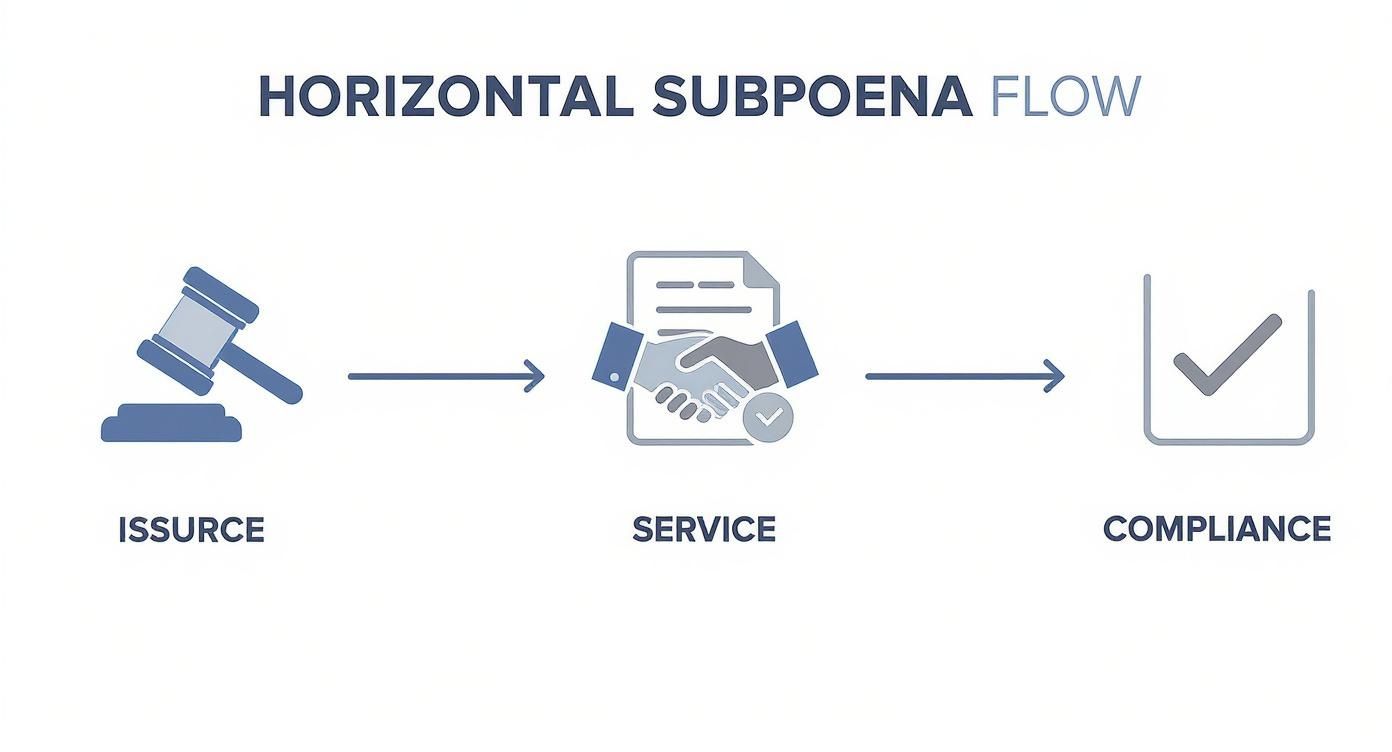
As you can see, that service step is the crucial link. It connects the court's order with the person who has a legal duty to respond.
Personal Service: The Gold Standard
The most reliable and universally accepted method is personal service. This is exactly what it sounds like—a sheriff's deputy or a private process server physically hands the subpoena directly to the recipient. It's considered the "gold standard" because it makes it almost impossible for someone to later claim they never got the document.
For instance, if a key witness in a personal injury case needs to testify, a process server might find them at home or work and place the papers right in their hand. That face-to-face handoff is powerful evidence.
Because it provides a clear, verifiable moment of delivery, personal service is the strongest and most preferred method. It effectively eliminates any debate over whether the recipient was properly notified.
Once this happens, the server completes a formal document called a "Proof of Service" or "Affidavit of Service." In it, they swear under oath to the date, time, and location of the delivery. That form gets filed with the court and becomes an official part of the case record.
Substituted Service: A Practical Alternative
But what if the person isn't home or seems to be dodging the server? This is where substituted service comes into play. This method allows the server to leave the subpoena with another responsible adult at the person's usual residence or, in some cases, their workplace.
There are strict rules for this method. The documents cannot be handed to any random person who answers the door. The individual must be of a certain age (usually 18 or older) and live at the address. For example, leaving the documents with a spouse, a roommate, or another family member living in the home would generally be valid.
Other Delivery Methods
While personal and substituted service are the heavy hitters, a few other methods can be used in specific circumstances.
- Service by Mail: In some situations, a subpoena can be sent via certified mail with a return receipt requested. The signed green card that is returned in the mail serves as proof that someone at that address received and signed for the delivery.
- Electronic Service: As we get more digital, some courts are starting to allow service by email. However, this isn't the norm and usually requires the recipient to have already agreed in writing to accept legal documents electronically.
- Service by Publication: This is an absolute last resort. If a person truly cannot be located after extensive, documented efforts, a judge might grant permission to publish the notice in a local newspaper. It's rare because it's so indirect, and a party has to prove to the court that every other reasonable method failed.
The type of information obtainable with a subpoena is also specific. For instance, federal law allows a company like Verizon to provide six specific categories of customer information with just a subpoena—name, address, phone records, and so on—but not the content of any calls or messages. For a deeper look at what major companies turn over, you can review Verizon’s transparency reports to learn more about their data release policies.
Who Can Legally Deliver a Subpoena
When it comes to serving a subpoena, not just anyone can walk up and hand over the document. Georgia law is very specific about who is authorized to handle this critical step, and the rules are there for a good reason: to ensure fairness and avoid any conflicts of interest.
The most important rule is that the person serving the subpoena cannot be a party to the case. This means the plaintiff, the defendant, or anyone directly involved in the lawsuit is disqualified. This simple but crucial requirement maintains impartiality and prevents a potentially biased or heated interaction from compromising the legal process. The job must fall to a neutral, third-party individual.
Authorized Individuals for Service
So, if the people involved in the case cannot serve the subpoena, who can? Georgia law outlines a few categories of individuals who are legally permitted to serve subpoenas.
- Sheriff's Deputies or Marshals: Using a law enforcement officer is a common and reliable method. Their official status lends an immediate sense of authority to the delivery, making it clear that the document is serious and legally binding.
- Professional Process Servers: These are specialists—individuals or companies whose entire business is delivering legal documents. Hiring a professional is often done, especially when anticipating the recipient might be hard to find or may try to avoid being served.
- Any Disinterested Adult: In Georgia, pretty much any adult who is at least 18 years old and not involved in the lawsuit can legally serve a subpoena. This could be a friend or a colleague, but they must have zero stake in the outcome of the case.
The bedrock principle here is neutrality. The person delivering the subpoena must be a disinterested party. This ensures the entire process is fair and that the Proof of Service filed with the court is credible and legally sound.
Why Use a Professional Process Server
While it's true that any non-party adult can legally serve the papers, there are compelling reasons why lawyers and individuals often choose to hire a professional process server. It is like bringing in an expert for a critical task.
Professionals are deeply familiar with the rules of civil procedure that govern how, when, and where a subpoena must be served. They know how to handle someone who is actively dodging them, how to properly document every attempt, and how to make sure their service will hold up under court scrutiny. Their expertise can help sidestep common mistakes—like improper delivery or a poorly filled-out Affidavit of Service—that could get a subpoena thrown out.
How International Subpoena Service Works
Serving a subpoena in the United States has its own rules, but when the person to be served is in another country, the complexity skyrockets. You cannot just hire a local process server to hop across a border; there is a formal system built on international treaties and respect for national sovereignty. Every country has its own ideas about privacy and legal procedure, which makes serving documents overseas a delicate and often time-consuming affair.
This whole intricate process exists for one simple reason: a court in one country has no automatic authority over a person or company in another. Trying to sidestep these established channels can create diplomatic friction and make a subpoena completely worthless.
Understanding Treaties and Conventions
To get around this problem, countries have set up formal agreements to help each other with legal matters. The two main frameworks one might encounter are Mutual Legal Assistance Treaties (MLATs) and the Hague Service Convention.
-
Mutual Legal Assistance Treaties (MLATs): These are direct agreements between two or more countries to cooperate in legal proceedings, like gathering evidence or serving documents. When using an MLAT, the request travels through diplomatic channels. It typically goes from the U.S. Department of Justice to its counterpart in the foreign country. This process is notoriously slow. It's not uncommon for it to take many months, or even over a year, to complete.
-
The Hague Service Convention: This is a major international agreement designed to create a more streamlined, standardized way to serve legal documents between member nations. It sets up a "Central Authority" in each country to handle requests, which can be faster than going the MLAT route. The catch is that not every country has signed on, and the convention's rules must be followed to the letter.
The core principle behind all these international systems is mutual respect for sovereignty. A foreign court can't compel someone to act on U.S. soil without going through the proper channels, and the U.S. extends the same courtesy to other nations.
The demand for these structured, privacy-focused processes has grown significantly. Globally, the market for privacy-compliant subpoena processing is projected to surge from $2.14 billion to $6.20 billion by 2033, largely because of complex regulations like Europe’s GDPR.
This is exactly why when a foreign government asks a company like AT&T for U.S. customer data, the company points them straight to the formal MLAT process. That process involves extra layers of review and, as one might guess, significant delays. You can read more about this trend in this report on the privacy-compliant data subpoena market.
Ultimately, serving a subpoena internationally demands patience, expertise, and a solid understanding of global legal frameworks. It’s a deliberate, methodical process where following international law is always more important than speed.
Common Hurdles in the Service Process

Knowing the black-and-white rules for serving a subpoena is one thing. Actually getting it into the right hands in the real world can be a whole different ballgame. The process isn't always a simple handoff, and plenty of things can turn a routine task into a complex challenge that demands skill and patience.
From individuals who actively dodge service to the bureaucratic mazes of large companies, the path to successful service is often full of obstacles. This is exactly why professional process servers are so valuable—they've seen it all before and have the experience to get the job done right.
Dealing with an Evasive Recipient
One of the most classic headaches is the evasive recipient. This is someone who knows a subpoena is coming and may do anything to avoid it. They might stop answering the door, suddenly change their daily routine, or even disappear to a relative's house for a while.
When this happens, serving the subpoena becomes a strategic game of cat-and-mouse. A process server can’t just leave the documents in the mailbox; Georgia law requires more than that. Instead, they have to rely on more advanced (and time-consuming) techniques.
- Stakeouts: This is exactly what it sounds like. A server might have to discreetly monitor a person's home or workplace, sometimes for hours, just waiting for the right moment to approach them.
- Skip Tracing: If the person has seemingly vanished, a server can use specialized databases and public records to perform a "skip trace" to track down a current, verifiable address.
These methods take a significant amount of time and resources, but they're often the only way to meet the legal requirements for personal service when someone is determined to hide.
Keep in mind, when someone intentionally dodges service, they aren't just delaying things. Their actions could be interpreted as obstructing a legal process. That said, it's absolutely critical that all attempts to serve them remain within legal bounds to avoid putting the entire case at risk.
Navigating Large Corporations
Serving a big corporation presents a totally different kind of challenge. One cannot just walk into the lobby and hand a subpoena to the first employee they see. Big companies have specific protocols, usually involving a designated legal department or a "registered agent" who is the only person authorized to accept legal documents on the company's behalf.
Trying to pinpoint the right person in a massive organization with thousands of employees can be a logistical nightmare. This is especially true if the company's legal team is in a different state from its main headquarters. If the wrong person is served, a judge could rule the service invalid, and the process would have to start over.
For anyone who feels a legal process was mishandled, understanding the concept of abuse of process can shed light on how courts view these kinds of procedural errors. Following the rules to the letter isn't just about formality—it's about ensuring the corporation is officially and legally notified.
Answering Your Top Questions About Subpoenas
Even with a good grasp of the basics, subpoenas can bring up a lot of specific questions. The procedural rules are strict, and it's natural to wonder about certain "what if" scenarios. Let's clear up some of the most common points of confusion.
This can serve as a quick reference guide for the practical side of serving subpoenas in Georgia.
What Happens If a Subpoena Isn't Served Correctly
This is one of the biggest questions people have: what happens when service goes wrong? If a subpoena isn't delivered according to the letter of the law, it’s considered "improper service." This isn't just a minor mistake; it can have major consequences for the case.
Simply put, improper service can render a subpoena completely unenforceable. A judge has the power to "quash" it, which is the legal term for nullifying the document. Once quashed, the recipient has no legal obligation to comply. This is a crucial protection that upholds the principle of fair notice—a person cannot be held accountable for a legal document they never officially received.
For the party who issued it, this means starting the entire service process from scratch, which often leads to costly and frustrating delays.
Can You Leave a Subpoena in a Mailbox
It's a common myth that a subpoena can just be stuck in a mailbox or taped to someone's front door. In almost every situation, this is not valid service. There are a couple of very important reasons why.
First, U.S. mailboxes are exclusively for mail delivered by the Postal Service, and putting anything else in there is technically a federal offense. But more importantly, methods like these offer zero proof that the intended recipient actually got the document.
The entire point of the service rules is to ensure delivery can be verified. Leaving a subpoena on a doorstep or in a mailbox creates far too much uncertainty. It could be blown away by the wind, taken by a neighbor, or just ignored. That's why the law requires methods like personal or substituted service.
These stricter rules make sure that the exact moment of notification is clear, official, and documented.
What Is a Proof of Service Form
After a subpoena is successfully delivered, there’s one last, critical step. The person who served the document has to fill out a form called a Proof of Service, sometimes called an Affidavit of Service.
This is a sworn legal statement that creates an official record of the delivery. It documents all the key details, including:
- The name of the individual who was served.
- The exact date and time the service occurred.
- The address where the delivery took place.
- The method used (e.g., personal or substituted service).
- The signature of the process server, made under penalty of perjury.
This form is then filed with the court and becomes a permanent part of the case file. It stands as the official evidence that the recipient was properly notified, which is essential if a dispute ever arises about whether service was done correctly. Understanding this final step is just as vital as knowing what happens at an arraignment hearing is to the early stages of any criminal case.
If you or a loved one are dealing with a criminal charge in Cumming, Alpharetta, or the surrounding Forsyth County area, navigating the legal system can be overwhelming. Brian Hansford Law has over 25 years of experience, including time as a former prosecutor, providing a strong and knowledgeable defense. For a dedicated advocate who will fight to protect your rights, visit https://challengemycharge.com to schedule a consultation.
