
A lot of people search how can i get my criminal record expunged after the same moment. A job application stalls. A landlord stops returning calls. A background check brings up a case you thought was behind you.
In Georgia, the answer is often more complicated than most websites make it sound. If you live in Alpharetta, Roswell, Johns Creek, Milton, Cumming, Marietta, or anywhere in North Atlanta, you need Georgia-specific advice, not a generic article written for some other state. The difference matters, because filing the wrong thing, in the wrong court, with the wrong expectation can cost you time and hurt your chances later.
The Clean Slate You Need Understanding Georgia Record Restriction
A client from Marietta once sat in my office with a dismissed case that was still showing up on background checks years later. He had done what many people do. He searched for "expungement," found advice written for other states, and assumed Georgia offered the same fix. It does not.
In Georgia, the term that usually matters is record restriction under O.C.G.A. § 35-3-37. That wording changes the whole analysis. It affects which cases qualify, which agency has to act, and what a background screening company is likely to see afterward. If you live in Alpharetta, Cumming, Roswell, or Cobb County, that distinction is not academic. It determines whether you are asking for relief Georgia law recognizes.
Why the word matters in Georgia
Georgia does not follow the broad, generic "wipe it clean" model people read about online. In many cases, the actual question is whether a record can be restricted from ordinary public access, not erased from every system everywhere.
That starts with the case outcome.
A dismissal is different from a conviction. A nolle prosequi is different from a dead-docketed case. A First Offender discharge is different from a straight guilty plea. I spent years reviewing files from the prosecutor's side, and small differences in the final disposition often controlled whether relief was even worth pursuing. The same issue comes up now when I review records from Forsyth County, Cobb County, Fulton County, and surrounding courts. Clients often remember the arrest clearly but not the legal ending. The paperwork matters more than memory.
Here is the practical framework:
- Non-conviction records often present the strongest basis for restriction, especially where charges were dismissed or the accused was acquitted.
- Conviction records usually involve much tighter limits under Georgia law.
- DUI cases require careful review because people often assume any old DUI can be cleared, and that is usually wrong if the case ended in a conviction.
What restriction actually does
Record restriction usually means the case is blocked from ordinary public disclosure through the Georgia Crime Information Center system and related public-facing searches. It does not mean the event never happened. Law enforcement, prosecutors, and certain government agencies may still be able to see the record.
That difference matters, but it still has real value.
For many people, a restricted record no longer appears in the routine background checks used by private employers, apartment complexes, and schools. In practice, that can mean the difference between getting an interview and being filtered out before anyone hears your explanation. In North Atlanta counties, where employers and property managers often rely on fast commercial screening, that practical result is usually the reason people start this process in the first place.
The better question is simple: Can this Georgia record be restricted, and who will still be able to see it afterward?
If you want a plain-English comparison of the terminology, this guide on the difference between expunged and sealed is a useful starting point.
Court records are only part of the problem. If the arrest led to a mugshot site, a local news item, or old social posts, you may also need a separate plan for how to manage your online presence. A successful record restriction helps, but it does not automatically clean up the internet.
Determining Your Eligibility for a Second Chance
A common call to my office starts like this. Someone in Alpharetta, Cumming, or Marietta was told years ago that the case was “dropped,” but a job application or apartment screening still pulls up the arrest. The first question is not whether you deserve relief. The first question is whether the record is legally eligible for restriction under Georgia law.
That is where Georgia trips people up. Other states talk about expungement in broad terms. Georgia uses a narrower record restriction system, and eligibility turns on the exact case result, the charge, and how the clerk and GCIC coded the disposition.

Start with the case outcome, not your memory of it
People often tell me, “It was thrown out,” or “I completed everything, so it should be off my record.” Sometimes that is true. Sometimes the file shows a plea to one count, a dismissal on another, or a first offender sentence that was never properly discharged.
Eligibility usually begins with one of these categories:
Dismissed charges
If the prosecutor dismissed the case, restriction may be available. The dismissal has to be clear in the court record.Acquittals
A not guilty verdict puts the case in a very different posture from a plea or conviction.Other non-conviction outcomes
Some arrests that never ended in a conviction may qualify, but the details matter. The accusation, indictment history, and final disposition all need to line up.
In Forsyth and Cobb County cases, I regularly see confusion caused by shorthand. A person says the case “went away.” The paperwork says something else. The paperwork controls.
First offender cases deserve a close review
Some discharged first offender cases can be restricted even though a standard conviction cannot. This is one of the areas where Georgia law gives people a real second-chance option, but only if the record supports it.
I do not treat first offender cases casually. I want to see the sentencing order, the discharge, and the final entry in the court system. If one of those pieces is missing, a qualifying case can look ineligible until the record is corrected.
That happens more often than people expect.
If you are comparing Georgia terms and trying to sort out whether your case involves restriction, sealing, or another form of relief, this guide on how to seal criminal records in Georgia can help frame the issue.
Some records face real legal barriers
Georgia does not offer broad relief for every case. Certain records are poor candidates from the start, and clients are better served by hearing that early.
| Record type | General reality in Georgia |
|---|---|
| DUI conviction | Usually not eligible for record restriction |
| Serious felony conviction | Often blocked or heavily limited |
| Sex offense conviction | Commonly restricted by statute or excluded |
| Pending charge | Usually prevents relief until the case is resolved |
| Incomplete disposition records | Often stops the process until the file is fixed |
One point causes a lot of confusion. A dismissed DUI case is very different from a DUI conviction. Those are not interchangeable labels, and bad advice often starts with mixing them together.
Local court practice matters more than people realize
This is not just a statewide legal question. It is also a file-review question.
A missing disposition in Fulton County can create problems even if the underlying case should qualify. A clerk entry in Cobb can be coded in a way that does not match what the sentencing order says. In Forsyth, an old accusation case may require pulling records from more than one source before anyone can give you a reliable answer.
That is why I screen eligibility before talking about filing strategy. The hard part is often identifying what the case ultimately became in the system.
A practical eligibility screen
Before spending time and money on a petition, answer these questions with documents in hand:
- Outcome: Was the case dismissed, acquitted, or resolved without a conviction?
- Status: Are any charges still pending anywhere?
- Disposition: Do you have the final court paperwork showing how the case ended?
- County: Where were the arrest and final case handled?
- Sentence type: Were you sentenced under first offender?
- Charge category: Does the case involve a DUI, a serious felony, or another offense that commonly limits relief?
If you cannot answer those questions from the actual record, you are not ready to file. You are ready to investigate eligibility. In Georgia, that distinction matters.
The Official Process for Filing for Record Restriction in Georgia
Once a case appears to qualify, the work shifts from legal theory to file control. That is the stage where good cases get delayed in Forsyth, Cobb, and Fulton because the paperwork does not match across agencies, the filing goes to the wrong court, or the prosecutor is not served correctly.
Georgia also uses terms that confuse people. Many clients ask about "expungement," but in Georgia the relief is usually record restriction. The label matters because the process, the forms, and the court handling the request are Georgia-specific.
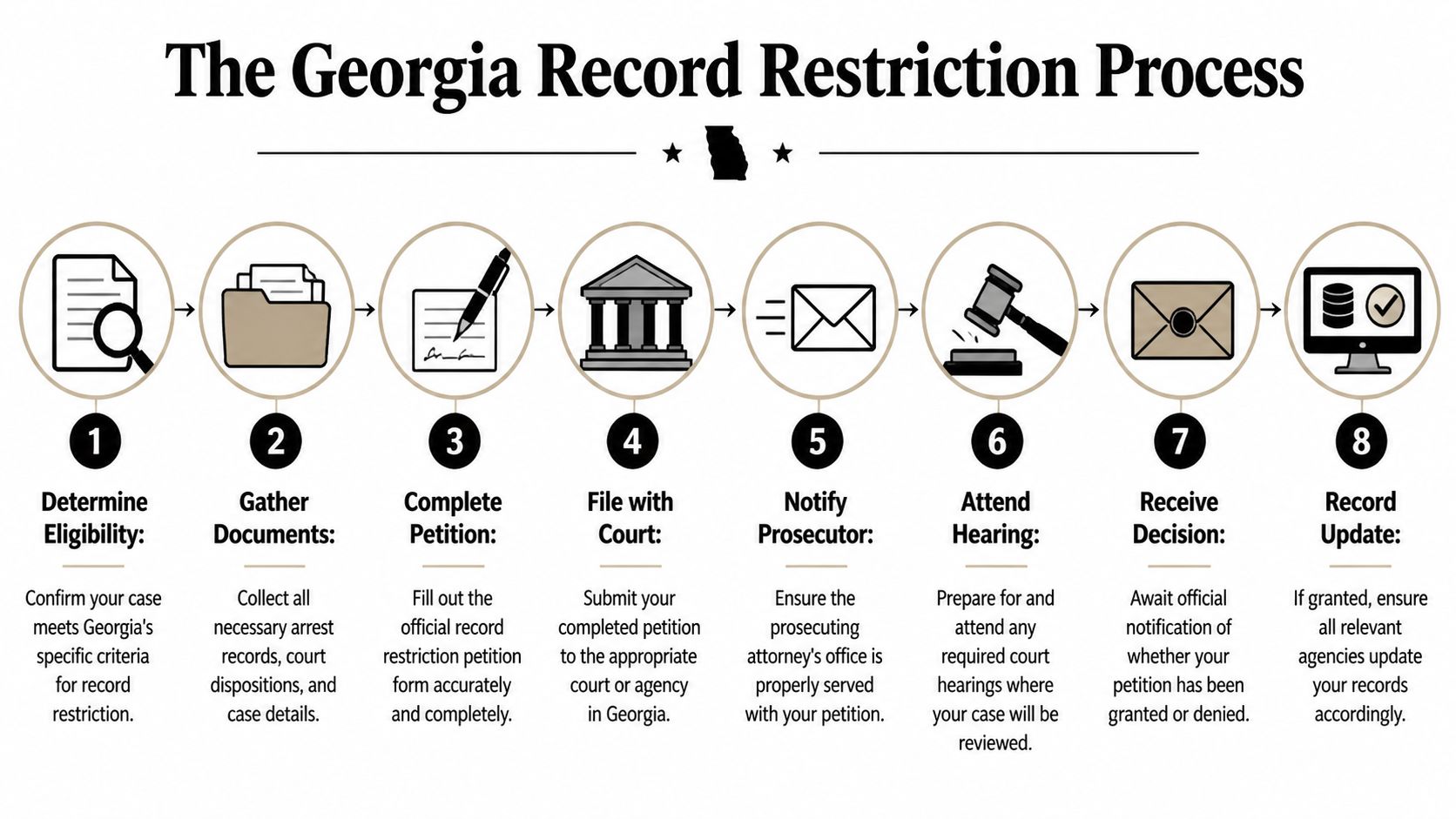
Start with the official record, not memory
Before drafting anything, pull the records that control the case. In practice, that usually means your Georgia criminal history, the final court disposition, and any order showing dismissal, discharge, acquittal, or sentence completion.
Memory is not enough. Old jail paperwork is not enough. A private background check is not enough.
In North Atlanta cases, I often see one version of the outcome in the clerk's system and a different version in the arrest record. A Marietta case may show closed online but still lack a usable disposition for filing. A Forsyth file may require records from the clerk, the arresting agency, and the statewide history before the packet is ready.
Gather these first:
- Your official criminal history record
- Court disposition paperwork
- Arrest records, if available
- Any sentencing, discharge, or dismissal orders tied to the case
If the record is incomplete, fix that problem first. Filing with gaps usually creates delay, objections, or an outright denial.
File in the correct court with the required state paperwork
A common point of confusion is location. The proper filing county is tied to the case and the controlling court records, not where you live now. Someone may live in Alpharetta and work in Roswell, but if the arrest and prosecution were handled elsewhere, the filing has to follow the case.
Use the state-required petition forms and filing procedure that apply to Georgia record restriction. Check the current court and agency requirements before filing because clerks and local practices can differ. That is especially true if the case is older or if the arrest happened in one county and the prosecution paperwork ended up in another.
If you are trying to sort out the difference between restriction and sealing, this guide on how to seal criminal records gives helpful background. Georgia's process still turns on the exact statute, the exact disposition, and the exact court file.
Service on the prosecutor has to be done correctly
Service is part of the case. Courts expect proof that the prosecuting office received the petition the way the rules require.
People handling this on their own often focus on drafting the petition and treat service like a mailing task. That mistake can stall an otherwise valid request. If the prosecutor is not served properly, the court may never reach the merits.
The better approach is simple. Confirm every supporting document first, identify the correct prosecuting office, serve the petition the way the rules require, and keep proof of each step in the file.
Expect review, and sometimes opposition
Some petitions move through with little resistance. Others draw a response from the prosecutor, especially if the case history is messy, the record coding is inconsistent, or the underlying facts raise concerns.
That is one reason local practice matters. One office may focus on whether the paperwork is complete. Another may spend more time on the arrest narrative, prior contacts with law enforcement, or whether the requested relief fits the statute. A former prosecutor can usually spot those concerns before the state puts them in writing.
If the court sets a hearing, the petition has to do more than recite the statute. It has to show, clearly and with supporting records, why this case qualifies under Georgia law and why the court record supports the relief requested.
The filing package has to make sense on its face
Judges and clerks should not have to guess what happened in the underlying case. If one count was dismissed and another was pled, the petition needs to separate those outcomes cleanly. If the arrest record is missing a final disposition, attach the order that resolves it or get the court record corrected before filing.
These are the problems I see most often:
- Missing final disposition
- Filing in the wrong county
- Serving the wrong prosecutor's office
- Blending eligible and ineligible counts together
- Ignoring another pending case that affects the request
None of those problems are glamorous. All of them matter.
A signed order is not the last step
After a grant, confirm that the record was updated by the agencies that maintain and report criminal history information. Do not assume every database changes immediately or all at once.
I tell clients to follow through until the paper result becomes a practical result. If a background check still shows the case months later, the next step is not frustration. The next step is finding out which agency or reporting source did not update and correcting it with the order in hand.
The process in plain English
For most Georgia record restriction cases, the sequence looks like this:
- Confirm the case qualifies under Georgia law.
- Obtain the official criminal history and court records.
- Identify and correct missing or inconsistent dispositions.
- Prepare the state-required petition and supporting documents.
- File in the correct court.
- Pay the required filing costs.
- Serve the prosecutor properly and keep proof of service.
- Respond to any objection and prepare for a hearing if needed.
- After a grant, confirm the relevant records were updated.
On paper, that list looks manageable. In real cases from Cumming, Marietta, Alpharetta, and the surrounding courts, the difficulty usually comes from old records, mixed case outcomes, and clerical errors that no one noticed until a job application or housing screening brought the case back to life.
Maximizing Your Chance of Success What Judges and Prosecutors Look For
A petition can be legally eligible and still lose momentum because the file raises doubts. In Forsyth or Cobb, the people reviewing it usually start with two questions. Is this person actually eligible under Georgia law, and does the paperwork support the request without forcing the court or prosecutor to fill in the gaps?
That practical reality matters more than people expect.

The judge is looking for a file that is easy to trust
Georgia record restriction cases are not won by emotion alone. Judges want a petition that is organized, accurate, and supported by records that line up with the court file and criminal history. If dates do not match, if a disposition is missing, or if the petition overstates what the law allows, credibility drops fast.
In close cases, that is often the difference between a clean hearing and a hard one.
A strong filing usually does three things well. It identifies the correct legal basis for restriction, it documents the case history clearly, and it gives the court a concrete reason to grant relief now. For a client in Alpharetta, Cumming, or Marietta, that often means showing that the old case is still blocking work, housing, or licensing, while also showing a stable record since the arrest.
Proof of stability carries more weight than promises
Judges and prosecutors have both seen hurried filings put together after a job offer falls through. What helps more is proof that shows a pattern over time.
Useful supporting documents often include:
Employment records
Recent pay stubs, a letter from an employer, or a work history can show consistency and responsibility.Education or training records
Diplomas, certificates, trade programs, and licensing documents help show forward progress.Treatment or counseling records, when relevant
In the right case, documented treatment can address the concern that led to the charge.Character letters with specifics
The strongest letters come from people who know the applicant well and can describe conduct, reliability, and change with detail.A short personal statement
A useful statement is honest, measured, and focused on facts. It should explain the impact of the record without sounding evasive or argumentative.
I tell clients the same thing I used to look for as a prosecutor. Show the court a stable present, not just regret about the past.
What prosecutors usually focus on first
Prosecutors tend to read these petitions defensively. Their job is not to complete the file for the applicant. Their job is to test it.
These are the problems that draw attention quickly:
| What prosecutors notice | Why it hurts |
|---|---|
| Inconsistent dates or charges | It creates a credibility problem and invites closer scrutiny |
| Missing final dispositions | It suggests the petition was filed before the record was fully verified |
| A statement that minimizes the underlying facts | It can make the applicant look less candid |
| Recent arrests, probation issues, or pending cases | It weakens the argument that the record should be restricted now |
| Generic letters of support | They add little if they do not address conduct with real detail |
The legal issue is rarely just whether someone wants a second chance. The file has to show that Georgia law allows relief and that granting it makes sense on the actual record in front of the court.
Timing and presentation both matter
Some petitions should be filed immediately. Others are better filed after a little more groundwork. That is a judgment call, and local court experience matters. A person with an old case and several years of steady work presents differently from someone with the same case but a recent pending charge or unresolved clerical problems.
Presentation matters too. Judges appreciate a packet that is easy to follow. Prosecutors are less likely to assume the worst when the documents are complete, labeled clearly, and consistent with the official history. Sloppy filings create avoidable problems.
One option available to Georgia residents seeking record restriction help is Brian Hansford Law, which handles criminal defense and record restriction matters in North Atlanta.
A practical self-check before filing
Before anything is submitted, ask four hard questions:
- Is the legal basis for Georgia record restriction stated clearly and correctly?
- Does every document match the official case record?
- If a prosecutor objects, is there paper in the file that answers the objection?
- Does the packet show present stability with records, not just claims?
If those answers are uncertain, the filing usually needs more work. In record restriction cases, careful preparation is often what makes the request look reasonable from the bench instead of risky.
After the Decision What Happens When a Petition is Granted or Denied
A judge signs the order, and many people assume the problem is over. In Georgia record restriction cases, that is only partly true. The practical result depends on what the order says, which agency has to act on it, and whether the record updates as it should in the systems employers and landlords rely on.

If the petition is granted
A granted petition usually means the eligible record is restricted from ordinary public access. In Georgia, that does not mean the case vanished or that every database changes overnight. It means the official channels now have to carry out the court’s order, and that takes time.
In Forsyth County, Cobb County, and other North Atlanta courts, I tell clients to treat the signed order as the start of the cleanup phase, not the finish line. Clerical delays happen. Data entry mistakes happen. Private background companies may continue reporting old information until their files refresh.
Take a few practical steps right away:
- Get a certified or signed copy of the order
- Confirm which agency must process the restriction
- Calendar a follow-up date to check the record status
- Save every notice, email, and stamped filing
- Keep the order available in case a school, employer, or licensing board asks questions
A granted order often improves hiring and housing prospects. It can also reduce the chance that an old arrest from Alpharetta, Cumming, or Marietta keeps surfacing in routine screening. But do not assume every problem disappears on its own. Verify the result.
If the petition is denied
A denial creates a different problem. The court has now said no, and the reason matters.
Sometimes the denial rests on legal ineligibility. Sometimes the court agrees with a prosecutor’s objection. Sometimes the filing had a defect that could have been fixed before submission. From a former prosecutor’s perspective, a weak petition can make the next attempt harder because the objections are already framed and the court has already seen the bad version of the case.
That is why the file should be reviewed carefully before anyone rushes to refile. People looking for guidance on choosing a good criminal defense lawyer for a record restriction case should focus on someone who handles these petitions in the local courts where the case was filed, not someone giving generic expungement advice from another state.
What a denial can mean outside the courthouse
The legal ruling is only part of the damage. A denied petition can leave you explaining the attempt itself to an employer, licensing board, or landlord if the issue comes up later. In practice, that means more scrutiny, more paperwork, and less room for error.
That risk is higher for people applying for work involving children, money, health care, driving, firearms, or professional licensing. Those decision-makers often ask follow-up questions that a standard private employer may never ask.
Denied does not always mean the case is over
Some denials can be addressed. Others cannot.
The first job is to identify why the court said no:
- Legal ineligibility usually means record restriction is not available on the current facts
- Procedural defects may be corrected with the right filings and supporting records
- Insufficient evidence or poor presentation may call for a stronger packet and a better explanation of why relief fits Georgia law
In North Atlanta courts, the difference between a dead end and a fixable denial often comes down to the order itself, the prosecutor’s written objection, and the underlying disposition. Read those documents closely before taking the next step. Refiling without changing the problem usually leads to the same result.
Navigate Georgia's Complex Laws with an Alpharetta Defense Attorney
Georgia record restriction law is narrow, technical, and local in practice. The statute matters, but so do the courthouse, the prosecutor’s office, the disposition codes, and the quality of the petition. That is why generic internet advice often fails people in Alpharetta, Roswell, Johns Creek, Milton, Cumming, Marietta, and the surrounding counties.
If you are dealing with the fallout from an old arrest, a dismissed charge, a first offender matter, or the collateral damage from a criminal case, this is not paperwork you should guess your way through. The same is true if your larger concern started with a DUI arrest, a reckless driving charge, a drug case, a misdemeanor, a felony accusation, or a traffic-related offense that triggered broader record concerns. The original case and the cleanup process are often tied together.
Local knowledge changes the quality of the filing
A lawyer who regularly works in Fulton County, Forsyth County, Cobb County, Gwinnett County, or Cherokee County knows where petitions tend to stall. That includes service issues, incomplete dispositions, objection practice, and the practical difference between a petition that looks prepared and one that looks improvised.
A former prosecutor’s perspective also helps because the state’s likely objections are easier to anticipate before they are filed. That can shape how the petition is drafted, what exhibits are attached, and whether the timing is right.
Hiring counsel is not about convenience
For many people, this is not a simple administrative errand. It is about protecting a future job, a professional license, a housing application, or a family’s stability. If your case involves more than one count, more than one county, or any uncertainty about the final disposition, legal help becomes even more important.
If you are comparing lawyers, use practical criteria. Look for someone who handles criminal defense regularly, understands record restriction specifically, and can explain the risks without sugarcoating them. This guide on how to find a good criminal lawyer gives a useful framework for that decision.
The right next step is usually a case-specific review of your charges, dispositions, and options. That is true whether you need a DUI attorney in Alpharetta, a reckless driving lawyer in Roswell, a traffic ticket attorney near me, a license suspension lawyer in Cumming, or a criminal defense lawyer in Marietta who can evaluate the long-term record consequences of the underlying case.
If you want a clear answer about whether your record can be restricted in Georgia, contact Brian Hansford Law for a free, confidential consultation. The firm represents clients across Alpharetta, Roswell, Johns Creek, Milton, Cumming, Marietta, and North Atlanta, and can review your case history, explain what relief may be available, and help you avoid mistakes that can cost you later.
