
Probation can feel like a sentence that keeps following you after court is over. You report. You ask permission before you travel. You worry that one missed payment, one scheduling mistake, or one bad stop for a traffic ticket in Alpharetta, Roswell, Cumming, or Marietta could turn into a much bigger problem. Even when you're doing everything right, probation can block job opportunities, interfere with family plans, and keep your life in a holding pattern.
That’s usually when people start asking the right question: how do i get off probation early?
In Georgia, early termination can be possible, but it isn’t automatic and it isn’t based on good intentions alone. Courts want proof. Probation officers want consistency. Prosecutors want to know whether supervision still serves a purpose. Judges in North Atlanta courts often look at the request less like a favor and more like a risk decision. If your file shows discipline, completion, and a practical reason to end supervision, you may have a real path forward. If your record is incomplete or your timing is wrong, the motion can fail fast.
A former prosecutor’s perspective matters here. The written law is only part of the picture. The other part is understanding what persuades a judge in Fulton County, Forsyth County, Cobb County, Cherokee County, or Gwinnett County when the issue is whether supervision should end early.
Your Life on Probation and the Path to End It Sooner
A lot of people on probation are doing what the court asked, but they still feel stuck. They’ve paid fines. They’ve completed classes. They’ve stayed out of trouble. Yet they still have to plan work travel around reporting rules, explain restrictions to employers, and live with the concern that a simple mistake could put them back in front of a judge.
That frustration is real. It’s also why early termination matters.
In Georgia practice, the strongest requests usually come from people who stopped treating probation like something to endure and started treating it like something to finish well. They keep records. They communicate clearly with the probation officer. They avoid new legal trouble, including the kind of traffic stop that can spiral into a reckless driving charge, DUI investigation, license suspension issue, or misdemeanor case. They build a record that says supervision has done its job.
What judges usually want to see
Early termination is rarely about one dramatic fact. It’s usually about a pattern.
A judge wants to know whether you followed rules when nobody was chasing you. A probation officer wants to know whether you became easier to supervise because you became more stable. A prosecutor wants to know whether the original concerns from sentencing still exist.
Judges don’t end probation early because someone is tired of probation. They do it when the file shows that continued supervision isn’t serving much purpose.
That’s where local knowledge matters. In North Atlanta courts, presentation counts. A clean record on paper often matters more than a heartfelt explanation without backup. If you’re asking a court in Alpharetta, Johns Creek, Milton, Sandy Springs, Duluth, or surrounding counties to cut supervision short, the request has to be organized and credible from the start.
Understanding Your Eligibility for Early Probation Termination
The legal power to terminate probation early exists. Under California Penal Code 1203.3, courts have statutory authority to modify or terminate probation during the term, and the same source notes that courts often begin entertaining early termination motions after approximately 50% or more of the probationary term is complete, with judges typically preferring at least 12 to 18 months before considering a request in practice. That same source also states that courts grant early termination when two things are present: full completion of probation terms and a justifiable reason for ending supervision as explained in this early termination overview.

That gives you the broad rule. Georgia practice adds another layer. Local courts don't just ask whether you're technically eligible. They ask whether your case file justifies ending supervision now.
Start with the sentencing order
Before anything else, read the sentencing paperwork. Not your memory of what happened in court. The actual written order.
That order usually controls the issues that matter most:
- Length of probation and when it began
- Special conditions such as DUI school, counseling, treatment, or community service
- Financial obligations like fines, fees, and restitution
- Restrictions involving travel, alcohol, weapons, driving, or contact with certain people
People get denied because they think they finished everything when one condition is still open on paper. That happens in DUI cases, drug possession cases, reckless driving cases, and general misdemeanor defense matters alike.
The two-part test courts care about
Most judges are looking at two practical questions.
Have you completed what the court ordered
This sounds simple, but it’s where many motions collapse. Completion means more than “I’ve been trying.” It means you can show you finished what was required.
That can include:
- Payments made and current under the court’s order
- Classes completed with certificates in hand
- Community service documented
- No new arrests or violations
- No unresolved reporting issues
If your probation involved a DUI conviction or a traffic-related offense, judges often look closely at whether your driving record stayed clean during supervision. A new speeding ticket in Roswell or a reckless driving stop in Cumming can undercut the argument that probation is no longer needed.
Do you have a real reason for early termination
A solid motion usually includes a concrete reason, not just a general request for relief. Courts respond better when the reason connects to real life and can be verified.
Examples include:
- Employment barriers because a job requires travel or a cleaner supervision status
- Family responsibilities that probation scheduling makes harder
- Financial hardship tied to continued reporting or compliance demands
- Professional licensing issues where supervision interferes with advancement
Practical rule: “I’ve done enough time” is weak. “I completed every condition and probation is now blocking a verified job opportunity” is much stronger.
Timing matters more than most people think
Many people ask too early. Others wait too long and lose momentum. Both are mistakes.
The strongest filing window usually opens only after enough time has passed for the judge to see a stable pattern. If you’re early in the sentence, your lawyer may advise you to spend the next stretch building a cleaner record rather than filing a motion that isn’t ready.
Case type affects how the motion is viewed
Not every probation case feels the same to a judge. A first-time offender on a nonviolent charge often starts in a better position than someone with a longer criminal history. The source cited above also notes that first-time offenders generally have better chances than people with extensive criminal records.
That doesn’t mean a felony probationer can’t win. It means the burden is more practical. The court needs to believe you’ve changed the risk picture since sentencing.
Some examples from North Atlanta practice:
- A person on probation for a first DUI may need to show not just class completion, but stable conduct and no alcohol-related issues afterward.
- A person with a drug possession case may need to show treatment completion, negative supervision history, and steady work.
- A person with a traffic ticket or reckless driving case who stayed entirely clean may have a more straightforward story, but still needs records and timing.
A quick self-check before you call a lawyer
If you’re wondering whether your case is ready, ask yourself:
- Have I completed the major conditions in my sentence?
- Am I current on money obligations required by the order?
- Have I stayed free from new arrests, citations, and probation violations?
- Can I explain why ending probation now makes sense?
- Can I prove all of that on paper?
If you can answer yes to most of those, you may be in a position to move forward. If not, the better strategy may be to clean up the weak spots first.
Building Your Case with a Flawless Documentation Package
Most early termination motions are won or lost before anyone walks into the courtroom. The court file has to tell a complete story. If the paperwork is thin, inconsistent, or missing a key item, your motion may never get real traction.
One point matters more than people expect. Judges often want written proof from the probation officer confirming zero violations before considering the motion, and 92% of denied early termination motions fail because the documentation package is incomplete rather than because of judicial discretion as discussed in this probation termination video summary. The same source says drug cases, theft, and robbery show 60-70% approval rates when properly documented.
The document that often controls the whole process
A probation officer status letter or written confirmation of compliance can act like a gatekeeper. Without it, your lawyer may be asking the judge to trust your summary of events. With it, the motion starts with independent confirmation from the person supervising you.
That doesn’t mean the officer decides the case. The judge does. But the officer’s written position can shape how everyone else sees the request.
Early Termination Documentation Checklist
| Document | Purpose | Where to Obtain |
|---|---|---|
| Probation officer status letter | Confirms compliance history and whether there were violations | Your probation officer or supervising department |
| Payment ledger or receipts | Shows fines, fees, and restitution are paid or current | Clerk’s office, probation office, or your own records |
| Class completion certificates | Proves special conditions were finished | Program provider, school, counselor, or treatment program |
| Community service log | Verifies required hours were completed | Service organization or supervising agency |
| Employment verification letter | Supports hardship or advancement argument | Employer or HR department |
| Housing records if relevant | Shows stability and structure | Lease, landlord, or utility records |
| Character letters if helpful | Adds context about reform and responsibility | Employers, mentors, clergy, or community leaders |
| Sentencing order | Confirms what had to be completed in the first place | Clerk, attorney file, or your own records |
What a clean package looks like
A strong packet is organized and chronological. It lets a judge or prosecutor understand your progress without hunting for missing pieces.
Use this working approach:
- Match every condition to proof. If the sentence required DUI school, attach the certificate. If it required community service, attach the signed log.
- Show money clearly. Don’t hand over random screenshots or partial receipts. Use a ledger, statement, or complete payment history.
- Include employment support when relevant. If your reason for ending probation is job-related, get a letter that explains the issue in plain language.
- Keep dates consistent. Conflicting completion dates or payment records create unnecessary doubt.
- Label everything. Judges appreciate order. So do prosecutors.
If you’re trying to manage records from multiple providers, a practical article on streamlining legal document workflows can help you think about file naming, version control, and keeping one clean set of records for your lawyer.
Judges want proof, not promises
People often say, “My probation officer knows I finished that,” or “The clerk should have that on file.” Maybe. But if the document isn’t attached, the court may treat the condition as unresolved.
That is especially true in cases where the original sentence included treatment, alcohol education, counseling, or behavior-based conditions. In those situations, the court often wants the exact piece of paper showing completion.
A motion with weak attachments tells the judge one of two things. Either the person isn’t ready, or the person isn’t organized enough to prove readiness.
Use mitigation the right way
Some people focus only on compliance. That’s necessary, but it isn’t always enough. A strong motion also explains why termination makes sense now. That’s where mitigation matters.
Useful mitigation may include employment progress, family obligations, treatment success, military service, education, or documented stability. If you want a plain-language explanation of what counts and how lawyers frame it, this overview of mitigating factors in criminal cases is a useful starting point.
Common documentation mistakes
These are the errors that repeatedly hurt people in probation termination matters:
- Waiting until the last minute to request certificates or letters
- Assuming payments are posted correctly without checking the ledger
- Filing before getting the probation officer’s written status
- Submitting incomplete records from treatment or counseling
- Using generic hardship claims with no supporting documents
Some law offices help clients build and review these packets before filing. For example, Brian Hansford Law handles criminal defense matters in North Atlanta and can review whether the motion package matches what the local court is likely to expect. That kind of review matters because a denial can set the case back even when the person would otherwise have had a decent chance.
Navigating the Motion to Terminate Probation Process
Once your case is ready, the process becomes procedural. That’s where many people get frustrated. They assume filing the motion is the hard part. In reality, filing is only the start. The hearing posture, the prosecutor’s response, the probation officer’s input, and the court’s calendar all matter.
Strategic timing matters too. In federal cases, there is a strict one-year minimum before an early termination motion can be filed. In Georgia state probation, the available guidance referenced here says courts often require completion of at least one-third of the period, and attorneys should begin preparing 90-120 days before eligibility. The same source notes that federal prosecutors oppose approximately 40% of these motions in certain cases as outlined in this probation FAQ and timing guidance.
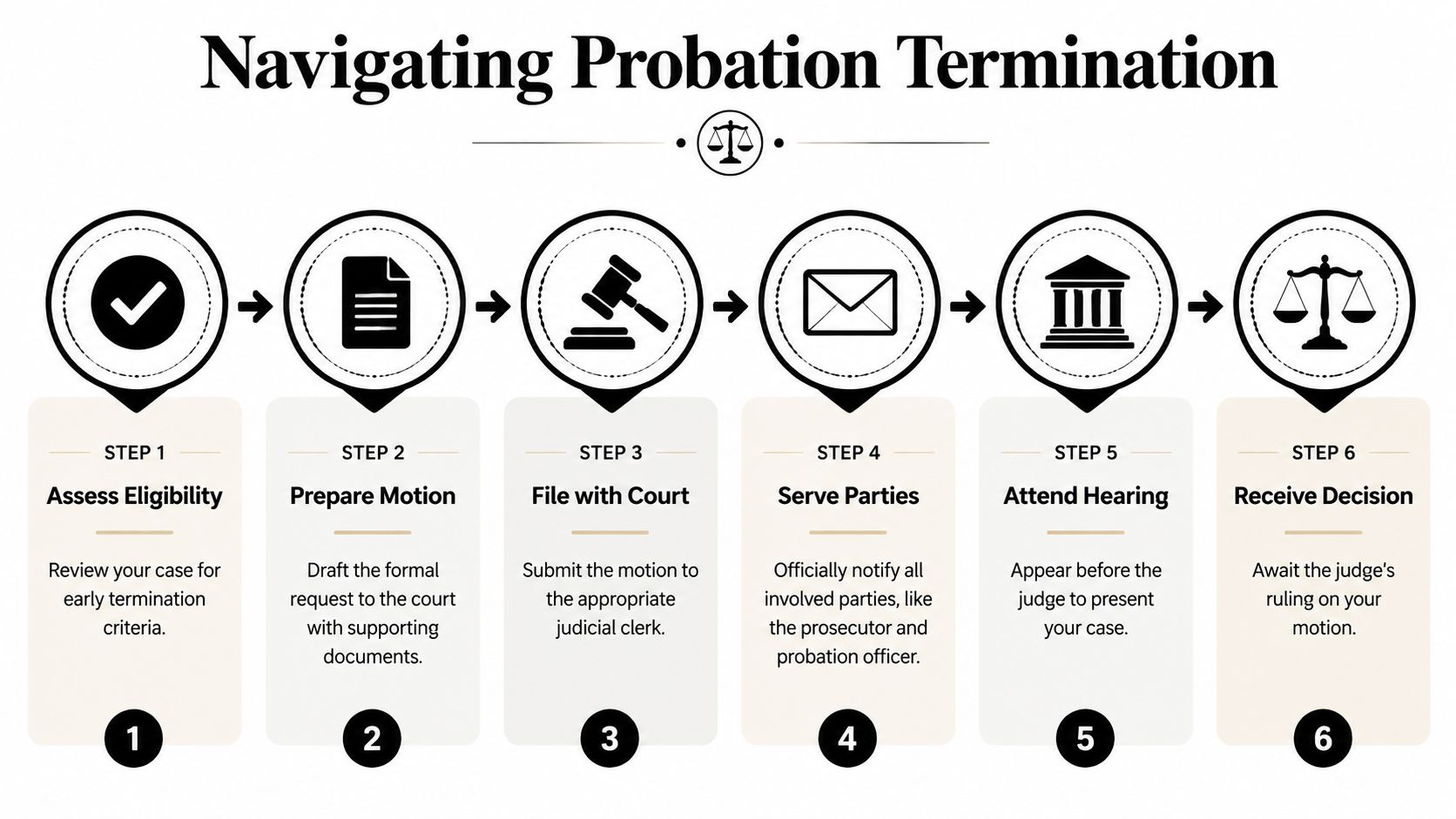
Step one is deciding where you actually stand
The first question isn’t whether you want off probation. It’s whether your file is mature enough to survive scrutiny.
Your lawyer should review:
- the sentencing order
- compliance history
- the probation officer’s likely position
- any open payments or conditions
- whether the reason for termination is persuasive
That review often determines whether to file now or wait and strengthen the record.
Filing the motion and serving the parties
The formal request is usually a Motion to Terminate Probation. It gets filed with the court that sentenced you. In North Atlanta area practice, that may involve state or superior courts handling cases from Alpharetta, Roswell, Johns Creek, Cumming, Marietta, or surrounding jurisdictions.
The motion usually includes the core facts, the legal basis for the request, and supporting attachments. After filing, the relevant parties have to be notified. That typically includes the prosecutor and often the probation department.
What the motion should accomplish
A good motion does more than ask for relief. It frames the case.
It should show:
- Eligibility
- Completion of conditions
- No violations
- A practical reason for early termination
- Why continued supervision no longer serves the court’s purpose
That framing matters because prosecutors often read these motions quickly. If the point isn’t clear on the first pass, opposition becomes more likely.
What happens after filing
After the motion is on file, several things may happen depending on the court and case:
- The probation office may be asked for a status report
- The prosecutor may consent, object, or ask for more time
- The court may set a hearing
- The judge may want updated records before hearing the motion
In some counties, the process moves smoothly if the file is complete and the probation officer is supportive. In others, a hearing is more likely even on a solid request.
Courtroom reality: A complete, well-served motion reduces delay. A sloppy motion creates extra work for the court, and judges rarely reward that.
The hearing itself
If the court sets a hearing, the focus is usually narrower than people expect. The judge often wants to know whether the sentence conditions were completed, whether there were violations, and why ending probation now is appropriate.
Your lawyer may present the packet, answer the judge’s questions, and address any objection from the State. If the prosecutor raises a concern, it’s often about timing, missing conditions, or public-safety issues tied to the underlying charge.
For many clients, the most helpful preparation is practical, not dramatic. Dress appropriately. Be on time. Don’t interrupt. Know your dates. If you want a straightforward guide to that part of the process, review these tips on how to prepare for a court hearing.
Local nuance matters
A motion filed in a North Atlanta court isn’t just paperwork. It lands in front of a specific judge with a specific calendar and a specific tolerance for incomplete records. Some judges want concise filings. Some want a full record. Some prosecutors are more willing to resolve the matter without a fight if the package is strong. Others will insist on a hearing.
That’s why the process isn’t just legal. It’s strategic.
Success Strategies and Common Pitfalls to Avoid
Early termination is one of those areas where doing the basics well matters more than making a clever argument. The people who put themselves in the best position are usually disciplined, boring, and consistent. They don’t create side problems. They don’t assume the court will fill gaps for them. They don’t confuse internet advice from another state with the rules that govern their case.
One mistake deserves special attention. Confusing state and federal probation rules can wreck the timing and strategy of the entire motion, and many online articles focus on state rules while federal supervision operates under different eligibility standards, including a one-year supervision benchmark in federal cases as noted in this discussion of federal and state probation differences.

What works in real cases
The strongest cases usually share the same traits.
The probation officer doesn’t have surprises
If your officer learns about missed paperwork, a new citation, or unpaid obligations for the first time when the motion is filed, that’s a problem. Officers are often more receptive when the file has been clean for a while and the request doesn’t feel rushed.
The request is tied to something concrete
Judges respond better when probation is interfering with a verifiable next step. Employment is common. Travel for work can matter. Family caretaking responsibilities can matter. Schooling or licensing can matter.
The person has stayed out of fresh trouble
This sounds obvious, but it’s where people sabotage themselves. A new DUI arrest, drug possession accusation, reckless driving citation, or probation violation can change the whole picture. Even a traffic matter that seems minor can become a credibility issue, especially if the underlying case involved driving, alcohol, or judgment.
If you're currently dealing with any alleged breach of supervision, read this breakdown of what happens when you violate probation before you make assumptions about your options.
What does not work
Some themes almost always hurt.
- Filing based on frustration alone. Being tired of probation isn’t a legal reason.
- Relying on verbal assurances. If a program says they can “send something later,” wait until you have it.
- Downplaying new issues. Judges care about judgment during probation. A new charge for speeding, a license suspension problem, or a failure to appear can matter.
- Treating all courts the same. The tone and expectations in one county may not match another.
Don’t give the judge an easy reason to say no.
If treatment or sobriety is part of your history
In DUI and drug-related cases, courts often care about whether your stability is durable. If treatment, sobriety support, or a clean living environment has been part of your progress, document it carefully. In some situations, a structured recovery environment can support the broader picture that supervision is no longer the tool keeping you compliant because you’ve built outside accountability and routine.
That kind of evidence works best when it is specific. Generic statements about “doing better” don’t carry much weight. Dates, attendance records, and provider letters do.
The unwritten rules people miss
From a former prosecutor’s perspective, these practical points come up again and again:
- Credibility compounds. If your file has been clean for months, each additional month of quiet compliance helps more than one emotional explanation at a hearing.
- Judges notice unfinished details. A small unpaid balance, an unfiled certificate, or an unresolved administrative issue can overshadow larger positives.
- A new case changes everything. If you pick up a fresh misdemeanor, DUI, or felony issue while trying to terminate probation, the focus shifts from early release to damage control.
For people in Alpharetta, Johns Creek, Milton, Roswell, Sandy Springs, Duluth, Marietta, and throughout North Atlanta, that means one practical thing. If anything new happens while you’re on probation, address it immediately with a criminal defense attorney, DUI lawyer, traffic ticket attorney, or license suspension lawyer who understands how the new matter will affect the old one.
Take Control of Your Future and End Probation Early
If you’re serious about getting off probation early, the path is straightforward but not easy. You need the right timing, complete compliance, a well-built record, and a motion that fits the court in front of you. People lose these motions when they guess at eligibility, file too soon, ignore documentation, or assume the judge will connect dots that were never put on paper.
People win them when they approach the process like a case, not a wish.
The right way to think about the decision
Ask a simple question. If a judge looked at your file today without hearing you speak, would the paperwork show discipline, completion, and stability?
If the answer is yes, you may be close. If the answer is no, the smartest move may be to spend a little more time cleaning up the record before filing. That can mean gathering missing records, finishing a program, resolving a money issue, or making sure there are no unresolved traffic or criminal problems hanging over the case.
Why local counsel matters
A motion to terminate probation is filed in a real court with real personalities and local practices. A lawyer who handles North Atlanta criminal cases can assess not only whether the motion is legally supportable, but whether it is practically ready.
That matters in courts serving Alpharetta, Cumming, Roswell, Johns Creek, Milton, Marietta, Forsyth County, Fulton County, and Cobb County. The same legal request can land very differently depending on how it is framed, what the prosecutor sees in the packet, and whether the judge believes the person in front of the court has moved past the reasons probation was imposed.
Getting your life stable helps the legal strategy
Courts tend to respond well when the legal request lines up with broader personal stability. If counseling, mental health support, family repair, or stress management are part of that picture, use credible providers and document the work. For people looking outside Georgia for support resources for family or relocation reasons, directories like find Grande Prairie therapists can be an example of how to locate structured counseling options in a specific community.
That kind of support won’t replace legal preparation. It can strengthen the actual story behind the motion.
One final point
Probation doesn’t end because enough time passed. It ends early only when the court decides your conduct, your record, and your supporting proof justify it. That is why details matter. It is also why the way the motion is prepared matters.
If you're dealing with probation after a DUI, reckless driving case, drug charge, traffic offense, misdemeanor, or felony in North Atlanta, don't assume the process will take care of itself. Build the record. Get the file reviewed. Make the request at the right time.
If you want a practical review of whether your case is ready for an early termination motion, contact Brian Hansford Law. The firm handles criminal defense matters in North Atlanta and offers a free consultation to discuss probation strategy, documentation issues, court timing, and how any new DUI, traffic, license, drug, misdemeanor, or felony issue may affect your ability to get off probation early.
