
If you’re trying to clear a misdemeanor in Georgia, the first thing to know is that the term "expungement" isn't officially used anymore. The official legal term is record restriction. It's a subtle but important difference. This process seals your criminal record from the public, offering a fresh start when it comes to things like job applications and housing.
Understanding Misdemeanor Record Restriction in Georgia

So, what does "record restriction" really mean? Unlike a true expungement, which might imply the total destruction of a file, record restriction locks it away from public eyes. Think of it like putting a sensitive document in a safe that only law enforcement can open.
For most practical purposes—like a background check for a new job, an apartment, or college—that restricted misdemeanor simply won't show up. It provides a powerful way to move on from a past mistake without it following you around forever.
The Real-World Impact of a Restricted Record
The difference between a public criminal record and a restricted one is night and day. When a potential employer runs a standard background check, a restricted record is invisible. A minor offense from the past no longer acts as an automatic roadblock to a job you are perfectly qualified for.
This benefit extends to other critical areas of life, too:
- Housing Applications: Landlords won't see the restricted offense, which can significantly boost the chances of getting that lease.
- Educational Opportunities: Colleges and universities are far less likely to see a restricted record during the admissions process.
- Professional Licensing: Many state licensing boards won't have access to restricted records, clearing a major hurdle to a chosen career.
Essentially, record restriction allows a person to truthfully say on most applications that they haven't been convicted of that specific offense. That one change can reopen doors that a past mistake had slammed shut.
By restricting a misdemeanor, a person is effectively taking back control of their narrative. It allows their qualifications, skills, and character to define them, not a single past event that no longer reflects who they are today.
Key Concepts to Know from the Start
Before getting into the step-by-step process, it’s important to understand that record restriction isn't an automatic pardon. It's a formal procedure with specific rules and eligibility requirements that must be met. Knowing the basics provides a solid foundation as you figure out how to get a criminal record expunged.
The system is designed to give a second chance to people who have served their sentences and are moving forward in a positive direction. For many misdemeanors, especially cases that were dismissed or handled through programs like pre-trial diversion, the path to restriction is fairly straightforward.
But even for certain convictions, Georgia law offers a way forward. The trick is to identify which path applies to a specific case, because the procedure changes depending on the arrest date and how the case was resolved. This guide is here to demystify all of that, giving you the information needed to understand the options and take that next step.
Who Can Get Their Record Restricted?
Before thinking about filling out paperwork to get a misdemeanor expunged, it's necessary to answer the most important question: is the record even eligible under Georgia law? This is the first and most critical step. The state has very specific rules that depend almost entirely on how a criminal case ended. Figuring out where a situation stands is essential.
This isn't a one-size-fits-all process. Eligibility is tied directly to the final outcome of an arrest and any charges that followed. As a general rule, Georgia law is much more forgiving for cases that did not end in a conviction.
For example, let’s say someone was arrested for shoplifting in Alpharetta, but the prosecutor eventually decided to dismiss the charges. In that scenario, they are almost certainly a strong candidate for record restriction. The same goes for cases where a pre-trial diversion program was completed, which results in the charges being dropped once all the requirements are met.
How Your Case Outcome Affects Everything
The single most important factor is how the case was resolved. Certain outcomes create a much clearer path to restriction than others.
Here are a few common situations where the eligibility requirements will likely be met:
- Arrested but Never Formally Charged: The police made an arrest, but the prosecutor's office never filed official charges.
- Charges Were Dismissed: The prosecutor dropped the case (this is officially called a nolle prosequi).
- Acquitted at Trial: The case went to trial and a judge or jury found the person "not guilty."
- Completed a Diversion Program: The person successfully finished a pre-trial diversion program, and as a result, the charges were dismissed.
In these instances, the justice system ultimately did not find the person guilty, which makes clearing their record a logical and attainable next step.
To make it easier to see where a situation might stand, here’s a quick breakdown of common scenarios.
Common Eligibility Scenarios for Georgia Record Restriction
This table gives a snapshot of different case outcomes and whether they generally qualify for misdemeanor record restriction in Georgia.
| Case Outcome | Is It Typically Eligible? | Key Considerations |
|---|---|---|
| Arrested, No Charges Filed | Yes | Usually straightforward. An application can be submitted as soon as the statute of limitations for the crime expires. |
| Charges Dismissed | Yes | Eligible. The process can often be started right away. |
| Found "Not Guilty" (Acquitted) | Yes | Eligible immediately following the acquittal. |
| Completed Diversion Program | Yes | Eligible once there is proof of successful completion and the case is officially dismissed. |
| Misdemeanor Conviction (First or Second) | Yes, with conditions | The entire sentence must be completed, all fines paid, and there is a four-year crime-free waiting period. |
| DUI Conviction | No | DUI convictions are specifically excluded and cannot be restricted in Georgia. |
| Family Violence Conviction | No | Offenses related to family violence are generally not eligible for restriction. |
| Multiple Misdemeanor Convictions (3+) | No | The "Second Chance Law" only allows for the restriction of up to two misdemeanor convictions. |
This isn't exhaustive information, but it should give a good idea of whether restriction is a realistic option for a situation.
What If You Were Actually Convicted?
Okay, but what happens if there was a conviction for the misdemeanor? The rules get much tighter here. To even begin the process of restricting a misdemeanor conviction, the entire sentence must have been completed. This means more than just getting out of jail.
Every single requirement must be finished, including:
- Completing any and all probation or parole.
- Paying all fines, court costs, and restitution in full.
- Finishing any court-mandated classes or community service hours.
After the sentence is 100% complete, the clock starts. Under Georgia's "Second Chance Law," a person can petition the court to restrict up to two misdemeanor convictions, but only after remaining completely crime-free for four years.
This four-year waiting period is non-negotiable. The court sees it as proof that the person has put the past behind them and is ready for a clean slate.
It’s worth noting that Georgia’s approach is part of a larger movement. Across the country, states are rethinking how they handle old criminal records, especially for minor offenses. Many are passing laws to broaden access to expungement, recognizing how a past mistake can create huge barriers to jobs and housing. You can learn more about the national survey of expungement laws to see how Georgia compares to other states.
Some Offenses Can Never Be Restricted
While many misdemeanors are eligible, Georgia law draws a hard line on certain crimes. Convictions for some offenses can never be restricted, no matter how much time has passed.
A big one is DUI. Even a first-offense DUI conviction is not eligible for record restriction in Georgia. This is a critical exception that trips a lot of people up. Similarly, offenses related to family violence and most sex crimes are permanently excluded.
Knowing these limitations from the start will save a ton of time and frustration. The law is designed to give people a second chance for minor, non-violent mistakes after they've demonstrated they've turned their lives around. That's why the very first step is always understanding the specific charge on the record.
The Process for Requesting Record Restriction
Once you've figured out that a record is likely eligible, the next step is diving into the actual process of requesting a record restriction. This isn't a single action but a series of precise steps that demand full attention. Knowing what to expect ahead of time can make the whole journey smoother and help sidestep common mistakes that can delay or completely derail a request.
First things first, an official criminal history is needed. A copy must be obtained from a local law enforcement agency. This document is absolutely crucial because it lists the specific arrest dates, charges, and dispositions—all details needed to fill out the forms correctly.
Identifying the Correct Agencies
To file properly, two key players must be pinpointed: the arresting agency (the police department that made the arrest) and the prosecuting agency (the office that handled the case, like a Solicitor-General or District Attorney). The process almost always starts by submitting the request to the arresting agency first.
For example, let's say someone was arrested by the Alpharetta Police Department and the case was handled in Fulton County State Court. The process would begin by taking the paperwork to the Alpharetta PD. They review their files before sending the request over to the prosecutor for their review and approval.
This initial step is foundational. Many people make the simple mistake of submitting their request to the wrong agency, and it just leads to unnecessary delays.
The infographic below gives a basic idea of the flow after a sentence is completed and the required time has passed.
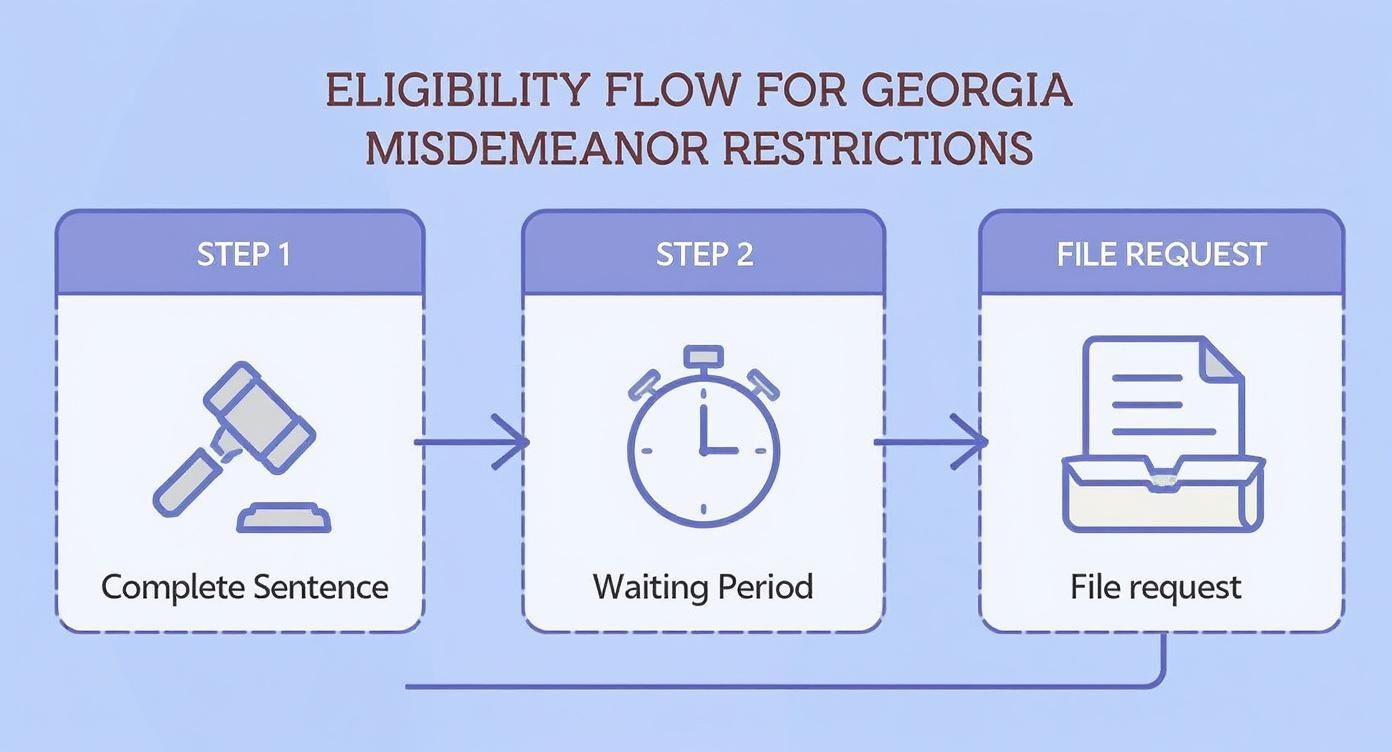
As you can see, the process only kicks off after all sentencing and waiting period requirements are met. It highlights just how important patience and diligence are before even thinking about filing.
Filling Out and Submitting the Paperwork
The heart of the request is the official Request to Restrict Arrest Record form. This document is broken down into sections. Section One must be completed with personal information and the details of the arrest to be restricted. Be meticulous here—any inaccuracies could get the application kicked back.
Once that part is done, the form is submitted to the arresting agency. They will fill out their section and then forward it to the correct prosecutor's office. The prosecutor then reviews everything to confirm eligibility under Georgia law.
It's really important to understand that the prosecutor's office has a lot of discretion here. They will double-check that the sentence is complete, the waiting period has passed, and that the offense actually qualifies for restriction. Their approval is a critical gatekeeping step.
If the prosecutor signs off on it, the request goes to the Georgia Crime Information Center (GCIC) to update the official state records. For certain convictions that require a judge's order, the process will involve filing a formal petition with the court after the prosecutor has had a chance to weigh in. Navigating the steps to erase a criminal record means following these procedural rules to the letter.
Understanding Pre-2013 vs. Post-2013 Offenses
The law that governs how you expunge a misdemeanor changed in a big way on July 1, 2013. The path to take depends entirely on whether an arrest happened before or after this date.
- Arrests After July 1, 2013: For many cases that didn't result in a conviction (like dismissals), the process is often automatic or at least streamlined. The prosecutor can approve the restriction without needing a court order.
- Arrests Before July 1, 2013: Older cases usually require a judge's approval. This means after getting the prosecutor's consent, a motion will have to be filed with the court that originally heard the case, and a hearing is likely.
This distinction is vital. Many people trying to restrict older records are surprised to learn they have to go through the extra step of getting a court order.
Even with the clear benefits of clearing a record, a shocking number of eligible people never finish the process. Procedural hurdles, not knowing where to start, and filing costs create what's known as an "uptake gap." A study in Michigan found that only about 6.5% of eligible individuals successfully get an expungement within five years—a statistic that really shows the challenges people face. This gap prevents thousands from getting better jobs and housing, which is why simplifying these procedures is so critical.
Navigating Local Procedures in Alpharetta and Metro Atlanta
While Georgia’s record restriction law applies across the state, the actual process isn't a one-size-fits-all deal. How paperwork is filed, how long it takes, and even what it costs can change dramatically from one county courthouse to the next. For anyone in Alpharetta or the surrounding Metro Atlanta area, this is a critical point to understand.
Filing in Fulton County can feel completely different than in Cobb, Gwinnett, or DeKalb. Each Clerk of Court and Solicitor-General's office has its own way of doing things. This is where a lot of people get tripped up—facing frustrating delays simply because they weren't ready for a specific county’s unique rules.
Understanding County-Specific Nuances
Think of the statewide law as the main highway. Each county has its own local roads and traffic rules to follow to get where you're going. For instance, the filing fees for a record restriction petition are not uniform. One county might have a standard fee, while another tacks on extra administrative costs.
You'll also run into differences in how the paperwork itself needs to be submitted. Some courthouses are more modern and offer online portals for digital filing. Others are still old-school, requiring everything to be filed in person with a precise number of copies for each department.
Here are a few variations to expect to see around the Metro Atlanta area:
- Different Filing Fees: The cost to file is not consistent. The best bet is to call the Clerk of Court’s office in the county where the case was handled to confirm their current fee schedule.
- Unique Clerk's Office Requirements: Little details matter. One clerk might require notarized signatures on every form, while another doesn’t. A single missing signature or an incorrect form is enough to get an entire packet rejected, forcing a restart.
- Specific Forms: The state provides a standard "Request to Restrict Arrest Record" form, but don't be surprised if a county requires its own supplemental documents as well.
Timelines and Prosecutor Review Periods
One of the biggest variables from county to county is the timeline. The time it takes for a prosecutor to review and sign off on a request can vary widely. In a high-volume jurisdiction like Fulton County, the caseload is massive. It could take several months before a prosecutor even looks at the paperwork.
In contrast, a smaller or less busy county might process the same request in a fraction of that time. It has nothing to do with the importance of a case—it's just a matter of administrative bandwidth. For example, the review period might be 90 days in one county but stretch to 180 days or more in another.
Knowing the typical processing time for a specific county helps set realistic expectations. It saves the anxiety of wondering if a request got lost when, in reality, it's just moving through a much longer queue.
Practical Tips for Metro Atlanta Counties
To get through the process successfully in Alpharetta, Fulton, Cobb, Gwinnett, or DeKalb, it helps to be proactive. Never assume that the procedure read about for one county applies to another.
Actionable Steps for Local Success:
- Visit the County Website: Before doing anything else, find the official website for the Clerk of Court and the Solicitor-General (for misdemeanors) in the county of the arrest. They often post their specific instructions, forms, and fee information right on the site.
- Make a Phone Call: A quick call to the clerk’s office can clear up any confusion. Ask them directly about their process for record restriction filings, what forms they require, and what the current fees are. This five-minute call can save a completely wasted trip to the courthouse.
- Check for Local Resources: Some jurisdictions have self-help desks or clinics. While this guide gives the big picture, these local resources can provide tips tailored specifically to that courthouse's procedures.
By taking a little extra time to understand these local differences, a person is in a much better position. When the potential hurdles in a specific county are known, a correct and complete application can be assembled from the start, minimizing setbacks and moving closer to putting this chapter behind.
What Happens After Your Record Is Restricted

You’ve gone through the entire process, filed the paperwork, and a judge has finally granted the request to restrict a misdemeanor record. It's a huge win. So, what happens now? The changes are real, tangible, and can immediately start clearing away the obstacles that have held you back.
The single biggest benefit hits during background checks. When a potential employer, landlord, or even a college admissions officer pulls a record, the restricted offense is basically invisible to them. This is a game-changer. You can finally pursue opportunities without that constant fear of an old mistake sabotaging your future.
The Impact on Employment and Housing
For most people, this is all about getting a better job. With a restricted record, you can honestly check "no" on most job applications that ask if you've been convicted of a crime (related to that specific charge, of course). That simple answer stops an application from getting automatically tossed in the trash by an automated HR system.
It works the same way for housing. Landlords run background checks on almost everyone these days. A restricted record means that minor offense from years ago won't be a red flag, dramatically improving the odds of getting the keys to the apartment or house you really want.
By restricting a record, you regain control over your personal narrative. It ensures that your skills, experience, and character are the first things people see, not a single event that no longer defines who you are.
Limitations You Should Understand
While record restriction is incredibly powerful, it’s not a magic wand that makes the charge disappear forever. It’s crucial to understand what it doesn’t do. The record isn't destroyed or erased; it's just sealed from public view.
This means certain agencies and entities can still see it. Who has access?
- Law Enforcement Agencies: Police and prosecutors will still be able to view restricted records if they are conducting a criminal investigation.
- Government Security Clearances: If you’re applying for a job that needs a high-level security clearance, you can bet the restricted offense will pop up during their deep-dive background check.
- Certain Professional Licensing Boards: Some sensitive fields, like healthcare or childcare, may have statutory access to sealed records when you apply for a professional license.
For the vast majority of day-to-day civilian life, though, the record is effectively cleared. Knowing these nuances helps set realistic expectations and handle specific situations that might come up down the road. You can get more clarity by learning about the finer points of how to seal criminal records.
A Powerful Tool for a True Second Chance
Georgia's laws on record restriction are built on a simple, powerful idea: rehabilitation. They exist because our communities are stronger when people who have paid their debt can get back on their feet and become productive citizens. This isn't about hiding from the past—it's about proving you've moved on from it.
The data backs this up. A major study out of Michigan, for instance, found that people with expunged records have incredibly low rates of reoffending. In fact, within five years of clearing their record, only 7.1% were rearrested for any new offense. Their reoffense rates were actually lower than the general population’s, which should put to rest any fears that clearing records poses a public safety risk. For a deeper look, check out this analysis from the Cato Institute on the benefits of a clean slate.
At the end of the day, a restricted record frees a person to chase their goals without being anchored to a past mistake. It opens doors to better jobs, stable housing, and higher education, giving them the power to build the future they and their family deserve.
Common Questions About Georgia Record Restriction
As you start looking into the process of restricting a record, a lot of practical questions are bound to come up. Even with a good guide, the specific details of the forms and procedures can get confusing. Here are some quick answers to the questions that come up most often.
Knowing these details upfront helps set the right expectations and gives more confidence as you move forward.
How Long Does the Record Restriction Process Take?
This is probably the number one question people ask, and the honest answer is: it varies. The timeline really depends on the county, the prosecutor's office, and the specifics of a case. There's no single, guaranteed schedule.
Generally, once everything is filed correctly, the entire process can be expected to take anywhere from three to six months. That’s from the moment the forms are submitted to when a final decision is received from the Georgia Crime Information Center (GCIC). In busier metro Atlanta jurisdictions, it can sometimes take even longer.
Patience is a must. However, if nothing has been heard after several months, it's reasonable to follow up with the clerk's office to check on the status.
Is a Legal Professional Needed for This Process?
A person is allowed to handle the record restriction process themself—this is called proceeding pro se. But the paperwork can be a real headache. The forms demand very specific information, and one small mistake can get an application kicked back, forcing a restart of the entire process.
Working with an experienced professional can help ensure forms are filled out correctly and that the complex eligibility rules are met. A legal professional can also appear in court if a hearing is required, which is often the case for offenses that happened before 2013.
This guide provides a solid overview of the general process, but it's not a substitute for guidance tailored to a specific situation. A professional can analyze a case and map out the best strategy.
What Is the Difference Between Restriction and Sealing?
In Georgia, people often use the terms "record restriction" and "sealing" interchangeably, but they are two very different legal actions. For almost all adult arrests, the process to follow is record restriction.
- Record Restriction: This is what most people think of as "expungement" in Georgia. It limits who can see a criminal history, making it invisible on most background checks conducted by private employers.
- Sealing: This is a separate, less common procedure. It’s typically reserved for juvenile records or very specific adult cases, like those involving victims of human trafficking.
For the vast majority of people trying to clear a misdemeanor arrest that didn't lead to a conviction—or one of the two convictions now eligible under the "Second Chance Law"—record restriction is the correct path. It's the legal tool designed to help people get that clean slate.
Navigating the complexities of record restriction can feel overwhelming, but you don't have to go through it alone. At Brian Hansford Law, we have years of experience helping clients in Alpharetta, Cumming, and throughout Forsyth and Cobb Counties clear their records. If you have questions about your eligibility or need help with the process, contact us for a consultation.
